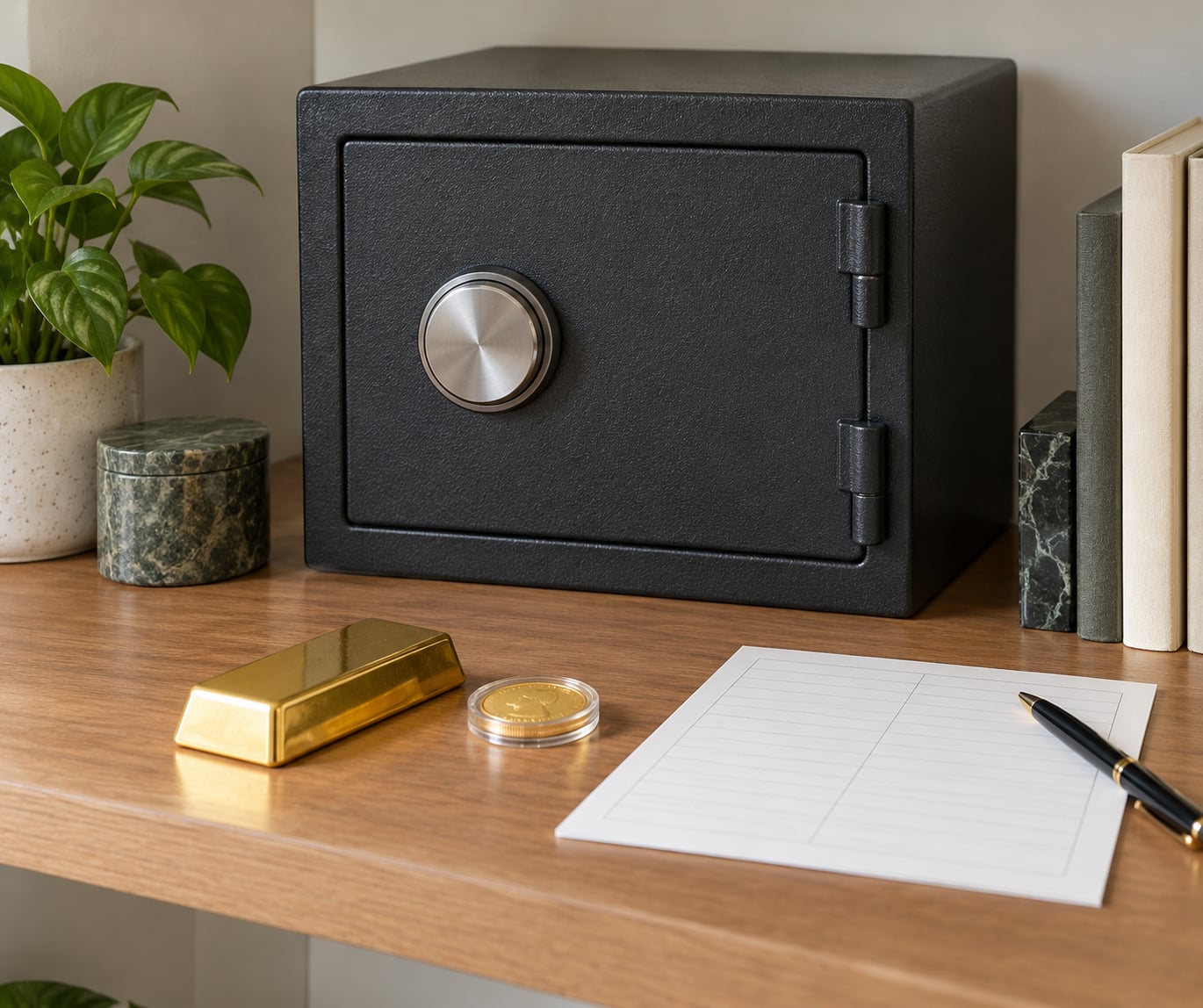
The safest way to store gold at home is a fireproof, burglary-rated safe bolted to a concrete floor or structural wall, with its location kept confidential. That one setup answers the two risks that actually cost people money: a burglar who cannot walk out carrying it, and a fire that does not reduce your holdings to scrap.
Everything after that is maintenance rather than hardware. Right capsules, a dry environment, a written inventory, and an insurance policy you have actually read. An afternoon of setup gets you most of the way.
One thing to know before you buy anything heavier: in the United States there is no limit on how much gold you may keep in your own house. The limit that bites is financial, not legal. Standard homeowners policies commonly cap precious metals coverage at a few hundred dollars, so an uninsured gap is what turns a break-in into a total loss.
Table of Contents
- What You Need
- Step-by-Step: How to Store Gold at Home Safely
- Step 1: Decide What You Are Storing
- Step 2: Choose a Storage Location
- Step 3: Select the Right Safe for Storing Gold at Home Safely
- Step 4: Organize and Inspect the Gold
- Step 5: Create an Inventory and Purchase Records
- Step 6: Test Access and Make a Contingency Plan
- Step 7: Review Insurance and Security Periodically
- Common Mistakes
- Frequently Asked Questions
- What is the safest way to store gold at home?
- Should I store gold coins or bars at home?
- What type of safe is best for storing gold?
- Does homeowners insurance cover gold stored at home?
- How should I record my gold holdings?
- Is it safer to store gold at home or in a bank vault?
- Conclusion
What You Need
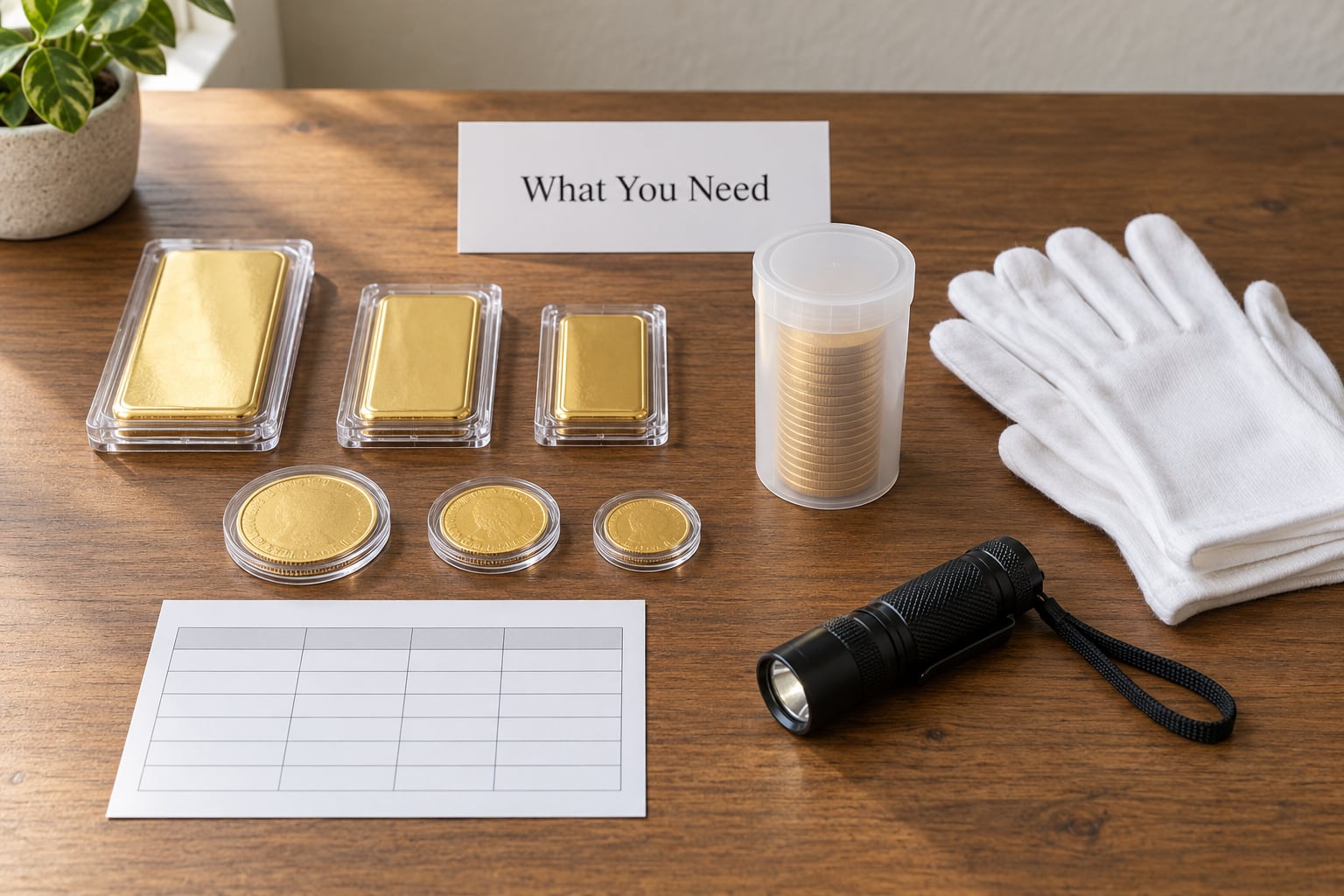
Start by separating what you already own from what you need to buy. Some of this list costs almost nothing.
- Acceptable bullion. Mint-packaged bars in their original assay packaging, coins in hard plastic capsules, and coins still in their mint tubes. Loose unmarked rounds are the hardest to value later and the easiest to pass off as fakes, so treat them separately.
- A rated safe. Look for two independent ratings: a fire rating from a lab such as UL, and a burglary resistance class. The TL-15 designation means the safe resisted fifteen minutes of professional tool attack, which is the bar most bullion owners treat as the bare minimum.
- Anchor hardware. Concrete anchors and a drill if the safe is not supplied with a bolt kit. An unbolted safe is furniture with a lock on it.
- Inventory supplies. A spreadsheet or a dedicated notebook, a phone camera, a small flashlight, inert capsules, silica gel packets, and labels.
- Your insurance declarations page. The first page of your homeowners or renters policy, so you can read the precious metals limit before you talk to an agent.
- A fireproof document pouch for receipts, appraisals, and a copy of your inventory.
One glove note. Nitrile gloves are the better choice for handling coins and bars in storage, because knits and cotton loopers catch loose grit and drag it across a surface. Handle every piece by its edges, or wear nitrile.
Step-by-Step: How to Store Gold at Home Safely
Seven steps, in the order that avoids rework. The order matters: deciding what you own before you choose a container saves you from buying a safe sized for last year’s stack.
Step 1: Decide What You Are Storing
Bullion bars, bullion coins, numismatic collectibles, and jewelry are four different problems wearing the same name.
Bars and bullion coins are priced by weight and fineness, so they need only dry, tamper-evident, discreet storage. Collectible and proof coins carry a premium tied to grade and provenance, and capsule damage or PVC contact can cost real money, so those want inert holders, stable temperature, and a condition check twice a year. Jewelry is usually insured and replaced under a homeowners policy rather than held as an investment.
You will know this step worked when every piece in the house is in one list with a number attached to it, and that number does not change when you move the gold.
Step 2: Choose a Storage Location
There are four realistic options, and the honest answer is that none of them is best at everything.
- A home safe in a private room. Full control and same-day access, which matters for emergency money. This is where the record-keeping burden sits on you.
- A bank safe deposit box. Strong physical security and no possibility of a house fire touching it. Contents are not federally insured, bank access can change or be restricted during a financial crisis, and access is limited to branch hours. Banks have also stopped renting boxes in some markets, so availability is worth confirming first.
- A private bullion vault. Segregated storage, often underwritten by a Lloyd’s of London syndicate and audited by a third party. Costs are typically a percentage of the holding’s value, usually well under one percent a year, and you take on counterparty risk instead of burglary risk.
- Split storage. A small working reserve at home, bulk holdings elsewhere. This is the strategy most regulars on bullion forums describe, because it caps the loss from any single incident.
Skip the obvious hiding places. Mattresses, sock drawers, hollow drywall cavities, freezers and unmarked floor boards are all found, and movers and installers talk. If you want a second layer behind the safe, put the gold in a sealed, non-metallic container that does not look like a bullion box, and put that inside the safe.
Step 3: Select the Right Safe for Storing Gold at Home Safely
A safe for gold needs to defeat two different threats, and most cheap safes are built for only one of them.
For fire, the number that matters is the fire rating in hours at a stated interior temperature, and a UL listing is the mark of a rating that was independently tested. Fireproof document boxes are not safes and are not rated for this job. For burglary, a TL rating describes tool resistance, and TL-15 is the practical entry point for precious metals; TL-30 exists and costs considerably more.
Then the details that owners regret skipping: anchor the safe to a concrete floor or a structural wall rather than drywall, place it somewhere a person cannot reach it without standing fully inside the room, and keep the door swing clear so the door can open wide. If the room already has a monitored alarm, the safe sits inside that perimeter. Cheap combination lockboxes sold for documents are theft-deterrent at best.
You will know the safe is right when you can answer two questions: what happens if someone lifts it, and what happens if the building burns for an hour.
Step 4: Organize and Inspect the Gold
Organize so that a single event does not turn a clean collection into an unsorted pile.
Keep each bar in its original packaging; the assay card and the serial number are your proof of authenticity to an appraiser, an insurer, or a buyer. Put coins in inert capsules or flips, never PVC tubes, and keep mint tubes sealed with the label facing up so you can read contents without opening them. Add a silica gel packet to any non-airtight container, and keep it from touching the metal directly. Do not use airtight plastic for long-term coin storage, because trapped moisture does more damage than any dust.
Inspect twice a year, in a well-lit spot, wearing nitrile gloves. You are checking for a broken seal, a scuffed or discolored surface, capsule discoloration, or a weight that does not match the mark. Tamper evidence matters more than appearance: a bar in a resealed package is a problem, a bar with a scuff is not.
Environmental stability matters more than any single gadget. Keep the gold away from bathrooms, laundry rooms, basements that flood, garages, and exterior walls that get damp. A basement or an attached garage is the single most common place people lose metal to water, and both are cheap to avoid by relocating the safe before it is full.
Step 5: Create an Inventory and Purchase Records
This is the step that pays you back. Without it, an insurance claim becomes a memory exercise, and an heir’s job becomes an argument.
For every item record: item type, quantity, exact weight in troy ounces, purity or fineness, serial number, mint and year for coins, purchase date, purchase price and dealer, and your current valuation basis. Photograph each item next to a ruler or scale with the serial number legible, and store those photos on a drive that is not the only copy. Keep original receipts and assay cards, and put a copy of everything in the fireproof document pouch.
Then handle the part most guides skip. Tell exactly one person outside your household where the inventory and gold are, or write a coded note in your will that points to the records rather than naming the location outright. An estate that does not know the safe exists cannot claim on it.
On the legal side, holding bullion at home is not a reportable event and no agency limits how much you may keep. Reporting questions come up on the way out, not the way in: when a dealer buys bullion from you, that transaction can generate paperwork, and selling collectible coins is generally treated as a capital transaction with records and reporting obligations. Rules differ by country and state, so ask a tax professional about your own situation rather than taking a stranger’s word for it.
Step 6: Test Access and Make a Contingency Plan
Storage that nobody can open under pressure is a problem, not a precaution.
Sit down once a year with a second authorized person, if you have one, and open the safe from scratch using only what is documented. If you use a key, keep the duplicate in a sealed pouch at a different address rather than on the same keyring. If you use a code, store it in a password manager with emergency access rather than on a sticky note taped inside the drawer.
Then plan for the ordinary disruptions. What happens to the gold during a move, a remodel, or a flood? Who holds the safe key if the house is being sold? If a container is water-damaged or the safe mechanism fails, who do you call? Write those answers down. A five-page plan you can hand to a family member beats a perfect setup that nobody understands.
Step 7: Review Insurance and Security Periodically
Review it once a year and immediately after any major change to the house or the holding.
Read the precious metals section of your homeowners or renters policy and find the actual number, not the assumption. Many policies limit unscheduled precious metals to a small fraction of the dwelling coverage, and some require the items to be stored in a locked safe or vault before coverage applies at all. A scheduled personal property endorsement or a rider is the usual route to full value; ask your agent for the incremental premium and the documentation it requires, such as an appraisal or receipts.
Bank safe deposit box contents are not federally insured, and vault insurance comes from a private underwriter with its own conditions, so you are checking which contract pays whom, under what proof requirements, and whether it is theft-only or all-risk. Update valuations as holdings grow, and re-read access rules annually, since the things most likely to have changed are your policy’s exclusions and who can reach the box.
One question worth asking every year: at what holding size does home storage stop being the sensible choice? If the answer keeps moving up as the stack grows, a split arrangement with the bulk in a vault is the natural next step.
Common Mistakes
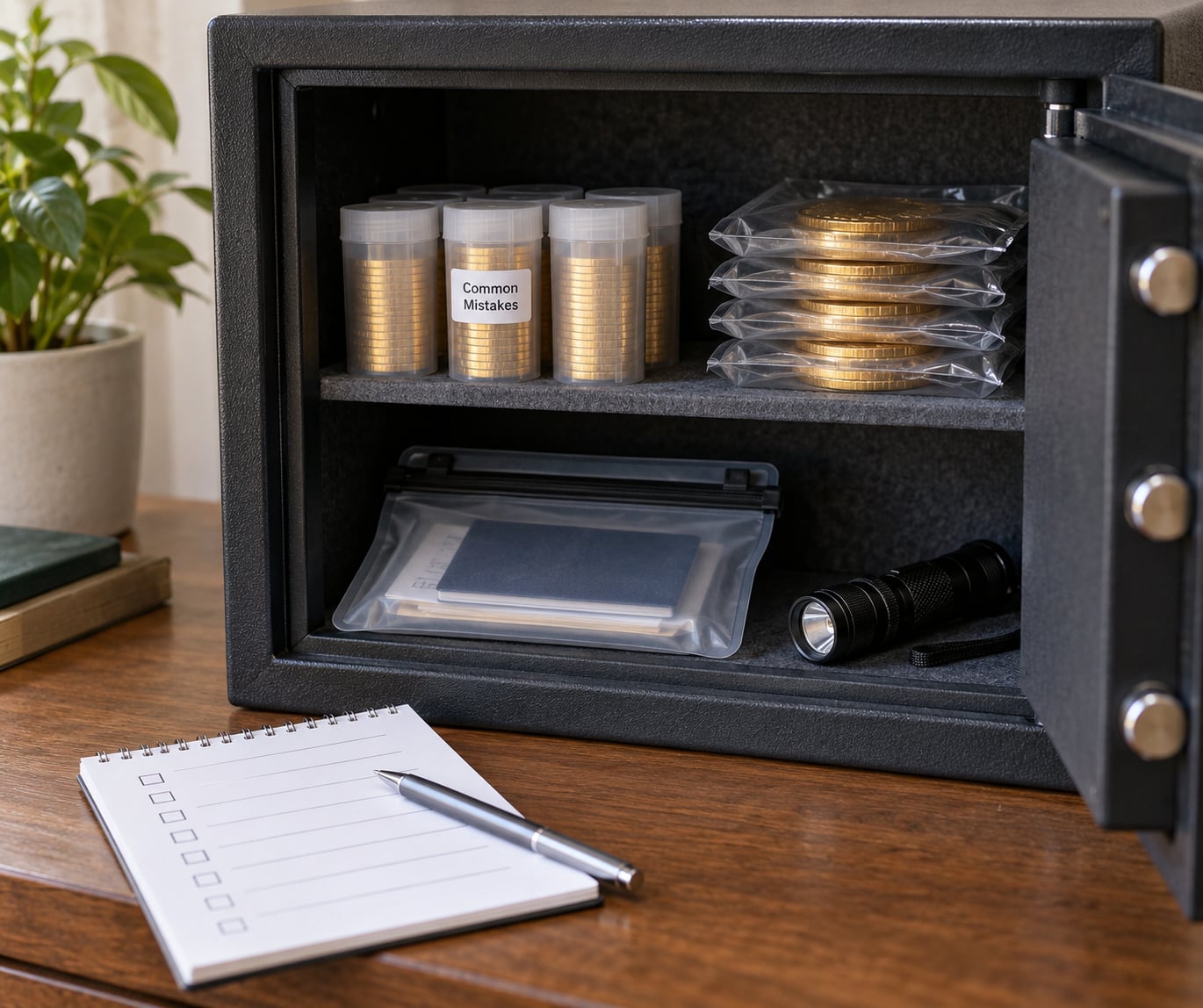
These are the errors that cost the most, in rough order of how often they happen.
- Hiding gold somewhere obvious. A mattress, a freezer, a hollow wall. Fix: rated safe, anchored, in a private room. Concealment is a second layer, never the first.
- Treating a fireproof document box as a safe. It protects paper from heat for a short window and does nothing against tools. Fix: a UL fire-rated safe with a TL burglary rating.
- Leaving the safe unbolted. A thief who cannot open it will take it with them, and floor safes weigh enough to need two people and a truck. Fix: concrete anchors, or place it where removal means breaking a wall.
- Skipping the inventory. No serials, no photos, no receipts means a denied claim and a lost estate. Fix: one spreadsheet, updated the day each piece arrives.
- Handling coins with cotton or knit gloves. They collect grit and drag it across every surface they touch. Fix: nitrile gloves, or clean dry hands and bare fingers on the edges.
- Assuming insurance covers it. The default precious metals limit on a lot of policies is a few hundred dollars, and a theft claim without a police report and proof of ownership rarely goes well. Fix: read the number, then add a rider if it is short.
- Telling people where the gold is. Casual mentions leak, and a home security vendor, an appraiser, or a relative is exactly who you did not want to ask. Fix: privacy is a control, not rudeness.
- Believing there is a legal limit on holding gold at home. There is not. The legal questions appear when you sell, not when you store.
- Storing everything in one place. Fire, flood, or one burglary and it is all gone. Fix: split the holding so no single event can take all of it.
A 60-second check before you lock the door: is the safe bolted, is the location known to exactly one trusted person or a coded note, does every piece appear in the inventory with a serial number, is the policy limit higher than the value in the box, and did you open the safe from written instructions alone.
Frequently Asked Questions
What is the safest way to store gold at home?
The safest setup is a fireproof safe with a UL fire rating and a TL-15 or higher burglary rating, bolted to a concrete floor or structural wall, located in a private room and kept secret. Inside it, keep bars in original packaging and coins in inert capsules with a silica gel packet. Add a written inventory with serial numbers, photographs, and a policy rider that covers the actual value.
Should I store gold coins or bars at home?
Either works, and the storage logic is nearly identical because both are priced by weight and fineness. Bars need only their original packaging and a tamper-evident container, while coins benefit from inert capsules or sealed mint tubes so they do not scratch each other. If you hold numismatic or proof coins, the premium depends on grade, so those are best kept in a dry, stable environment and inspected twice a year.
What type of safe is best for storing gold?
Look for two separate ratings. A fire rating from a lab such as UL tells you how long contents survive at a stated temperature, and a TL burglary rating tells you tool resistance, with TL-15 as the practical minimum for precious metals. Anchor it to concrete or a structural wall, place it away from exterior walls and plumbing, and keep the door swing clear. A cheap lockbox is a deterrent, not a safe.
Does homeowners insurance cover gold stored at home?
Usually only in part. Many homeowners and renters policies limit unscheduled precious metals to a small dollar amount or a fraction of the dwelling coverage, and some require the gold to be in a locked safe before the limit even applies. Ask your agent for a scheduled personal property endorsement or rider, and ask what documentation the claim will require, such as receipts, serial numbers, an appraisal, and a police report.
How should I record my gold holdings?
For each piece record the type, quantity, weight in troy ounces, purity, serial number, mint and year, purchase date, dealer, and price paid, plus your valuation basis. Photograph every item with its serial number legible and keep a second copy of those files. Store the paperwork in a fireproof document pouch, and make sure one trusted person or a coded note in your will points to where the records are.
Is it safer to store gold at home or in a bank vault?
It depends on what you are optimizing for. Home storage gives you daily access, full control, and no ongoing fee, but the security, the records, and the insurance gap all sit with you. A bank box has strong physical security but contents are not federally insured and access is limited to branch hours. Private vaults offer segregated, audited, insured storage for a percentage of value, and shift the risk from burglary to counterparty trust.
Conclusion
Start with four actions this week. List every piece you own with weights and serial numbers, then photograph them. Read the precious metals limit on your homeowners policy and decide whether a rider closes the gap. Choose a UL fire-rated, TL-rated safe, bolt it to concrete in a private room, and tell exactly one person where the inventory lives.
After that, inspect twice a year, keep one small reserve at home, and move the bulk to a vault once the value inside the house stops being an amount you would be happy to lose in a single afternoon. Home storage is a perfectly reasonable choice for a sensible share of a metals holding. It is a poor choice for all of it.