You can invest in cocoa prices in five practical ways: cocoa futures on the Intercontinental Exchange, a listed exchange-traded commodity note such as the ETFS Cocoa ETC, a broad commodity fund, shares in cocoa farming and trading companies, and shares in chocolate makers whose margins track bean costs. Most retail readers should start with the unlevered options and treat futures as a different, riskier activity rather than an investment.
This guide explains how to invest in cocoa prices in plain terms: what each route actually owns, what it costs, and what can go wrong. Nothing here is personalised investment advice, and the rules, taxes and tax rates around commodity trading differ by country, so check your own position with a qualified adviser before committing money.
Updated for 2026.
Table of Contents
- What You Need
- Step-by-Step: How to Invest in Cocoa Prices
- Step 1: Define your objective and risk limit
- Step 2: Research cocoa supply and demand
- Step 3: Choose how to invest in cocoa prices
- Step 4: Check the contract and total costs
- Step 5: Enter the position and manage the risk
- Step 6: Monitor the thesis and decide when to exit
- Common Mistakes
- Frequently Asked Questions
- Is it worth investing in cocoa?
- Is there an ETF for cocoa?
- How do I invest in cocoa futures?
- How much money do I need to invest in cocoa?
- Can I buy cocoa without a futures account?
- What happens if cocoa prices crash?
- Conclusion
What You Need

Before you open anything, you need four things: access to the route you have chosen, the specification of what you are buying, a source for crop fundamentals, and a written limit on how much you are willing to lose.
For futures, that access means a regulated broker with a commodity permission, a futures account approved for the exchange, and enough in the account to post initial margin. Most retail brokers will ask for a futures suitability assessment before approving you, and that is a normal step rather than a sign of trouble.
For the exchange-traded route, you need a brokerage account in a jurisdiction where the note is listed. The widely referenced cocoa product, the ETFS Cocoa ETC, trades in London and on European venues, so access depends on your broker and your country. Industry reporting has long noted that there is still no cocoa ETF or ETN listed in the United States, which is why US-based investors often find nothing obvious when they search a broker’s fund list. That gap is a recurring question on retail investing forums too.
You also need the contract specification in front of you, not from memory. For ICE cocoa futures the standard contract covers 10 metric tonnes, the price is quoted in US dollars per tonne, and contracts are listed for March, May, July, September and December delivery. Confirm the current figures on the exchange’s own specification page before you rely on anything written here, because contract terms are changed by the exchange from time to time.
Finally, you need a crop calendar. Most of the world’s cocoa comes from West Africa, with Côte d’Ivoire and Ghana dominant, and the main crop is harvested roughly from October to March while the crop year runs to September. That timing matters because it tells you when physical supply is arriving and when a bad harvest shows up in the numbers.
Step-by-Step: How to Invest in Cocoa Prices
Step 1: Define your objective and risk limit
Decide first whether you are trading or allocating. A trade has an entry, a target, a stop and an end date. An allocation is a small, long-held share of a portfolio meant to move differently from stocks and bonds. Mixing the two is how people end up holding a leveraged position through a three-year decline and calling it an investment.
Then write down two numbers. The first is the maximum total loss you accept, expressed as both a percentage of your portfolio and a cash figure. The second is the position size that loss figure implies.
Cocoa is a high-volatility, mean-reverting soft commodity. Prices can move several percent in a session on a weather forecast, and they can give back a large rally over months. A position you cannot afford to watch for a full year is too large, whatever the thesis sounds like.
Step 2: Research cocoa supply and demand
Cocoa prices are set by a small number of observable things, and each one is checkable rather than guessable.
- Weather in West Africa. Rainfall timing, a dry harmattan, or heat during flowering affects the crop months later. This is the driver most often cited for cocoa price spikes.
- Crop disease and ageing trees. Cocoa trees are vulnerable to fungal disease, and plantations that have not been replanted for decades produce less. This is a slow structural squeeze, not a news event.
- Stocks and inventory. Reported exchange and warehouse stocks in importing regions tell you how much cover buyers have before the next harvest.
- Grindings data. Grindings show how much cocoa is actually being processed into butter and powder, which is the cleanest demand number available. They come from bodies such as the International Cocoa Organization and from national agencies such as the US Department of Agriculture.
- Currency. Most cocoa is produced in West Africa and traded in dollars. A weaker local currency there reduces the local-currency price farmers accept, which tends to cap the dollar price.
Then separate a spike from a trend. A single weather week produces a spike that usually fades. A trend needs three things at once: a physical shortfall, depleted stocks, and demand that has not slowed. One drought headline is a trade setup, not a thesis.
This matters because cocoa prices moved from under 3,000 US dollars per tonne in March 2023 to above 10,000 US dollars per tonne, a move retail forums attributed to poor harvests, disease, climate risk and speculative buying together. Prices that have already tripled are not automatically mispriced, and they are not automatically cheap either. Check where the forward curve sits: a market in steep backwardation signals tight nearby supply, while contango signals the opposite.
Step 3: Choose how to invest in cocoa prices
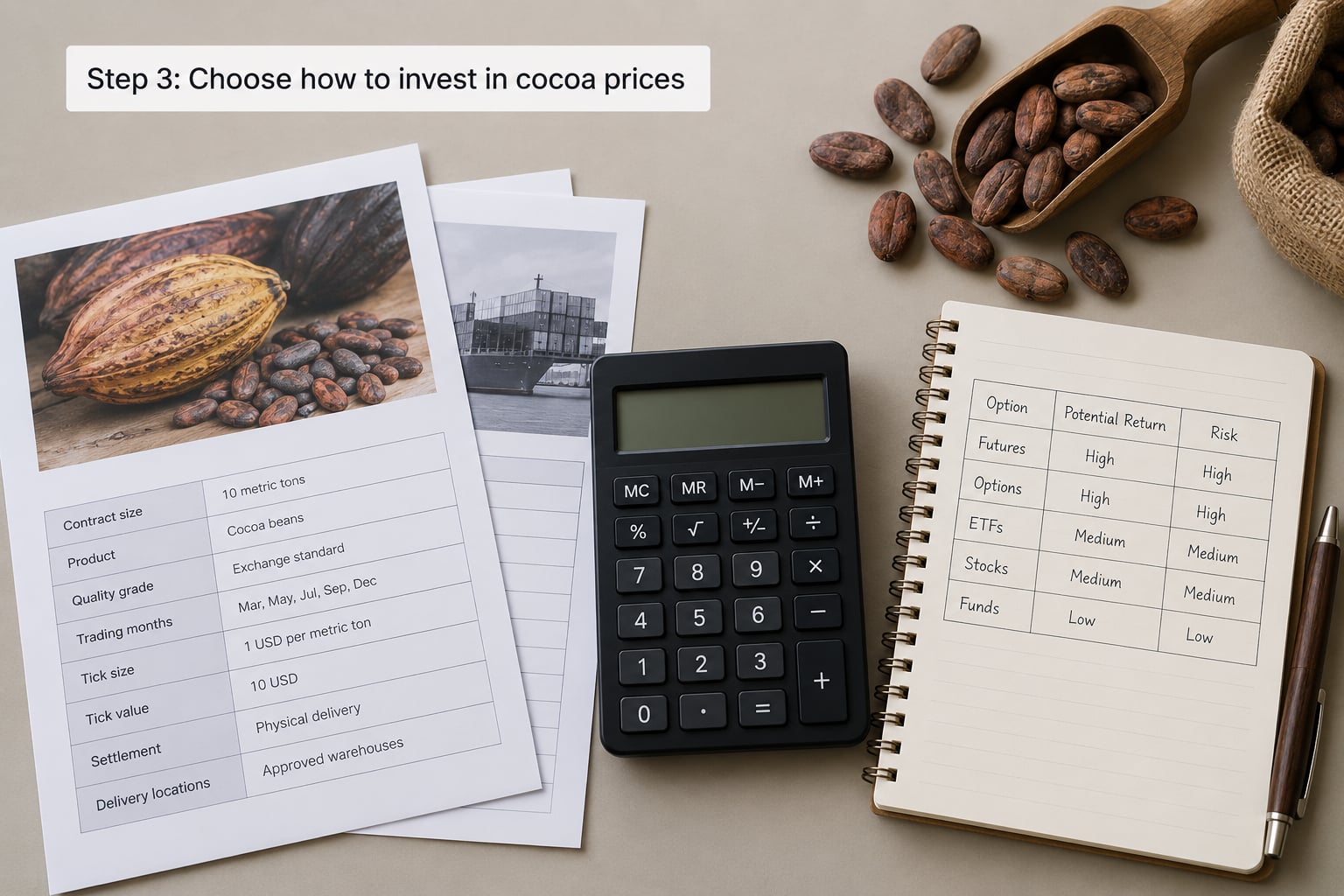
There are five routes, and they differ enormously in how much money and attention each one needs from you.
| Route | What you actually own | Capital needed | Borrowed exposure | Time commitment |
|---|---|---|---|---|
| ICE cocoa futures (ticker CC) | A fixed-price contract for delivery of 10 tonnes in a future month | Margin only, set by the broker and often a few thousand US dollars | Very high | Daily, active |
| Exchange-traded commodity note, such as the ETFS Cocoa ETC | A portfolio of cocoa futures held by an issuer, plus collateral | Purchase price of the note | None at investor level | Occasional |
| Broad commodity fund or ETF | A basket of many commodities | Purchase price of the fund | None at investor level | Occasional |
| Cocoa farming and trading shares | Equity in a company that grows, buys or sells cocoa | Purchase price of the shares | None | Occasional |
| Chocolate maker shares | Equity in a manufacturer, an indirect and imperfect cocoa proxy | Purchase price of the shares | None | Occasional |
A note of caution on the exchange-traded route. A physically backed commodity note is not a fund. It is an issuer’s unsecured promise, so you carry counterparty risk on top of the commodity risk, and you will usually receive a K-1-style tax statement rather a standard 1099 in the United States. Many of these notes also issue a notice and then amend the terms, and the collateral yield that supports them can fall when interest rates fall, which quietly adds to your tracking difference.
Physical ownership, including farm or plantation syndicates, deserves a separate word. Some brokerages and platforms will arrange delivery or participation in warehouse schemes. The economics are poor for small investors: storage, insurance, grading and certification fees run into a double-digit percentage of a small holding, and you cannot sell without arranging a sale yourself.
Step 4: Check the contract and total costs
For futures, the numbers that matter are contract size, tick value, initial margin and the cost of rolling. With a 10-tonne contract, a move of one US dollar per tonne is 10 US dollars of profit or loss per contract. If the quoted price moves 200 dollars in a day, that is 2,000 dollars against your margin, and most retail cocoa positions carry margin in the low-to-mid thousands. That arithmetic is the whole risk story in one line: a small percentage move in the price is a large percentage move in your account.
Rolling is the quiet cost. Cocoa futures are not in permanent contango the way many commodity futures were for years, and when the curve is in contango a long position that rolls forward pays a small, repeated penalty. When it is in backwardation the roll can earn you a small amount. Either way, assume it costs until the curve proves otherwise.
Then check everything that is not the price: bid and ask spread, the broker’s per-contract fee, overnight financing if you hold beyond the session, and the tax treatment. In the United States, regulated futures and options on most commodity exchanges fall under Section 1256, where 60 percent of gains are taxed at long-term capital gains rates and 40 percent as short-term regardless of holding period. Exchange-traded notes usually do not. Rules outside the United States differ, and so do UK and EU arrangements, so take your own accountant’s view before trading.
Do the same cost check for the unlevered routes. Compare the note’s total expense figure with the commodity index it tracks, and read the fee for what it is. A fund that appears cheap on a headline number can carry a high securities lending or administration charge underneath.
Step 5: Enter the position and manage the risk
Enter in stages rather than at once. Three equal tranches entering over separate weeks cost you nothing if the market proves you wrong and reduces the damage if it turns on you between orders.
Size from your written loss limit, not from conviction. Work backwards: if the maximum acceptable loss is 1 percent of the portfolio, and you want the trade to stay within that, then the position size is the distance to your exit level multiplied by contract value, expressed against the portfolio total. If the arithmetic gives you a position that feels too big, the exit level is wrong, not the position.
Decide the exit before you enter, and write it down. A stop-loss is one option, a time-based review is another, and a fundamental condition such as a confirmed record West African crop is a third. Whichever you pick, decide which prices would prove the thesis wrong and place a real order there rather than relying on intention.
Keep the position small relative to everything else you own. Cocoa is a satellite allocation, not a core holding, and it should sit alongside other commodities rather than being the only one, since cocoa, coffee, sugar and cotton often respond to the same weather and currency forces in the same direction.
Step 6: Monitor the thesis and decide when to exit
Watch the specific things your thesis depends on. If your argument is a West African harvest shortfall, then the relevant checks are crop-condition reporting, arrivals at port, exchange stocks and the grindings releases. If your argument is a demand story, watch processing volumes and the forward curve instead.
Set a review rhythm. Weekly for positions that matter to you, monthly for a small allocation, and always immediately before a scheduled report. Write down what would change your mind at the time you build the position, because re-reading your own notes six months later is the only reliable defence against a story you have become attached to.
Reacting to every headline is how losses turn permanent. Cocoa headlines arrive daily and most of them reverse. Move on the change in the facts, not the volume of news.
Common Mistakes
Treating futures as a savings product. Leveraged contracts are trading instruments with daily settlement, and losses can exceed your margin quickly if you are wrong and slow to act. Fix: decide the trade or the allocation before you choose the vehicle, and never put money you need within five years into a futures position.
Confusing cocoa with chocolate demand. Bean prices are set by the crop, not by how much chocolate people buy. Grindings follow bean prices with a lag, so strong retail sales do not rescue a failing harvest. Fix: check grindings and stocks, not sales figures.
Buying the wrong kind of contract. Contracts that have delivered and are nearly at delivery limit can be illiquid, and some retail platforms have turned out thinly traded cocoa contracts into losses for clients who could not get out. Fix: trade the most active delivery months and check the open interest before you trade.
Ignoring roll and currency costs. A position that tracks the price can still underperform it once the roll and any fees are counted. Fix: subtract expected roll cost and fees from the return you expect, not just from the price move you hope for.
Overconcentrating. Putting a large share of a portfolio into a single soft commodity is a concentrated bet on one region’s weather. Fix: cap the commodity sleeve at a set share of the portfolio and rebalance on a schedule rather than on feelings.
Trading without a written plan. Entering in the moment a headline arrives means your entry price is the worst price of the day, which is the most common way retail traders give money back. Fix: write the plan, then place orders away from headlines.
Trusting a microcap cocoa story. Small companies linked to cocoa farming or trading trade on thin volume, publish little, and can be highly illiquid, which is exactly the profile investors ask about when they search for a cocoa share. Fix: check filings and volume before buying, and understand that some cocoa-linked operations are exposed to the same crop risk without any of the diversification of a broad fund.
Frequently Asked Questions
Is it worth investing in cocoa?
It depends entirely on which route you take and what you already own. Cocoa has been one of the strongest-performing soft commodities recently, rising from under 3,000 US dollars per tonne in March 2023 to above 10,000, but that history tells you nothing reliable about the next year. The commodity is volatile, mean-reverting and dominated by West African weather. As a small diversifier in a diversified portfolio it can make sense; as a large concentrated bet it rarely does.
Is there an ETF for cocoa?
Not in the United States. There is still no cocoa ETF or ETN listed on a US exchange, which is why US investors searching a brokerage fund list often find nothing. The main listed product is the ETFS Cocoa ETC, which trades on European venues under tickers such as COCO and COCO.L and holds cocoa futures plus collateral. It is an issuer debt note rather than a fund, so it carries counterparty risk and usually produces a K-1 style tax statement.
How do I invest in cocoa futures?
Open an account with a regulated futures broker, get approved for commodity trading, and choose a delivery month with healthy open interest. The standard ICE cocoa contract covers 10 metric tonnes quoted in US dollars per tonne, so one dollar per tonne is ten dollars per contract. Post the initial margin your broker requires, place a stop and a target before you enter, size the position so a normal adverse move stays inside your loss limit, and remember that gains and losses settle daily.
How much money do I need to invest in cocoa?
For futures, the minimum is your broker’s initial margin, which for cocoa is typically in the low-to-mid thousands of US dollars per contract, and you must be able to absorb a several-thousand-dollar move without being forced out. For the exchange-traded note or a broad commodity fund, you need only enough to buy the units, so a few hundred dollars works. Neither figure should exceed a small share of your total portfolio.
Can I buy cocoa without a futures account?
Yes, through the exchange-traded cocoa note, a broad commodity fund, or shares in companies that farm, trade or use cocoa. These routes avoid margin calls and daily settlement because no borrowed exposure is involved. The trade-offs are different: the note is an issuer promise rather than a fund, broad funds dilute cocoa so heavily that a cocoa rally barely moves them, and company shares depend on management, debt and the cocoa price at the same time. Physical ownership through warehouse schemes exists but is usually uneconomic at small sizes.
What happens if cocoa prices crash?
A futures position loses money quickly, often faster than most retail traders expect, and a margin call can force a close at the worst moment in the tape. An exchange-traded note falls roughly in line with the futures it holds, minus fees, roll cost and any change in collateral yield. Broad commodity funds fall only a fraction of the cocoa move. Shares in farming companies can fall further than cocoa itself because their costs and balance sheets are geared to it, and chocolate makers can rise or fall independently of the bean price.
Conclusion
The safest first step is to pick the vehicle that matches your objective, not the one that sounds most exciting. Choose a small, unlevered route such as the listed cocoa note or a broad commodity fund if you want cocoa exposure in the background, and only use cocoa futures if you genuinely intend to trade and can absorb losses several times larger than your margin.
Before you buy anything, read the contract or fund specification in full, work out the total annual cost, set a maximum position size in writing, and make sure the amount fits the rest of your financial plan. Cocoa can earn money for a patient, disciplined position and can also reverse hard against one that ignores the crop cycle, the forward curve and its own downside limit.