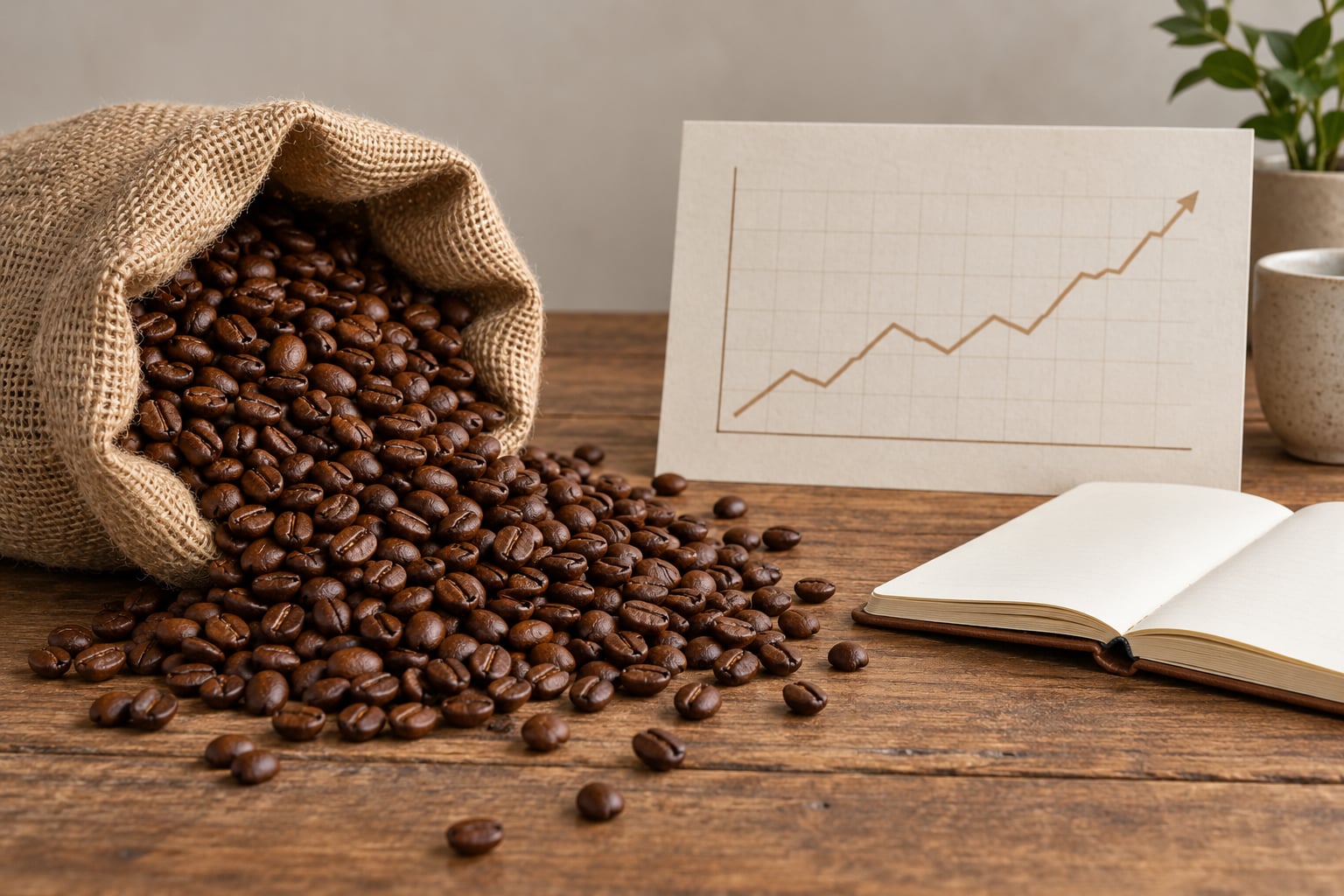
Coffee is investable the same way most commodities are: through exchange-traded futures on the ICE US Coffee C contract, through funds that hold those futures for you, or through shares in the companies that grow and roast beans. Futures give you direct, leveraged price exposure. Funds suit accounts that want exposure without the contract-size decisions. Producer shares track company profits, not the bean price.
This guide covers how to invest in coffee as a commodity in plain English: what one contract actually costs you in risk, where the expenses hide, what moves the price, and the mistakes that catch beginners. It is educational information about markets and mechanics, not personal investment advice, and rules and costs vary by country and provider.
Table of Contents
- What You Need to Invest in Coffee as a Commodity
- Step-by-Step: How to Invest in Coffee as a Commodity
- 1. Set a Goal and Investment Limit
- 2. Learn How Coffee Futures Work
- 3. Compare Routes: How to Invest in Coffee as a Commodity
- 4. Check Prices, Costs, and Market Conditions
- 5. Choose a Position Size and Place the Trade
- Common Coffee Investing Mistakes
- Frequently Asked Questions
- Can individual investors buy physical coffee as a commodity?
- What are the main factors that affect coffee prices?
- Are coffee futures suitable for beginners?
- How do coffee futures differ from coffee investment funds?
- What should I check before investing in coffee?
- Conclusion
What You Need to Invest in Coffee as a Commodity
You need one of three things, and the third is the one people forget: a broker or fund platform that gives you access, cash that you can genuinely leave alone for years, and a written risk limit before the first trade.
For the direct futures route, you need a futures-commission-merchant account with access to ICE coffee contracts, which means an application, an approval process and a margin agreement. For funds and exchange-traded notes, an ordinary stock brokerage account is usually enough. Producer and roaster shares need nothing special at all.
Here is the honest comparison of the routes most people consider:
| Route | Access | Exposure | Borrowed exposure | Minimum practical capital | Main risk |
|---|---|---|---|---|---|
| ICE US Coffee C futures (KC) | Futures account | One arabica price, chosen delivery month | Yes, contract-sized | Margin for one contract, often several thousand, plus room to absorb a move | Margin call and leveraged losses |
| Coffee futures options | Futures account with options approval | A defined-risk view on arabica | Premium paid up front | Premium per contract, loss capped there | Time decay and thin open interest in some strikes |
| Coffee exchange-traded note or fund | Stock brokerage account | Basket of coffee futures | No | Small | Roll cost in contango and tracking difference |
| Daily-reset amplified or inverse coffee fund | Stock brokerage account | A multiple of the daily move | Resets each day | Small | Decay over multi-day holds |
| Broad soft-commodity or real-asset fund | Fund platform | Coffee as a small slice of a basket | No | Small | Coffee diluted to a rounding error |
| Producer and roaster shares | Stock account | Company profits and margins | No | Small | Single-company and currency risk |
| Physical green coffee | Importer and warehouse route | Actual beans | No | High, once grading and storage are paid for | Logistics, storage cost and quality drift |
Two more things belong on that list before you start. First, a research habit: crop reports, weather and a place to watch the quote. Second, a rule about money you cannot replace. Coffee positions can move several cents in a session, and a leveraged position that goes the wrong way does not wait politely for you to decide what to do.
Step-by-Step: How to Invest in Coffee as a Commodity
1. Set a Goal and Investment Limit
Write down which of three jobs the position is doing, because each one justifies a different amount of money. Diversification needs a small, permanent slice. Commodity exposure can be a standing allocation inside a real-asset portfolio. A directional bet on coffee demand is a trade with an end date, not an investment.
Then write the limit as a number, not a feeling. A common starting point is one to five percent of investable assets for a commodity sleeve, with no single commodity taking up the whole sleeve.
You know this step worked when two documents exist: a one-paragraph note saying what the position is for, and a number that says the maximum you will ever have in coffee exposure. If you cannot write the number, you are not ready to size anything.
2. Learn How Coffee Futures Work
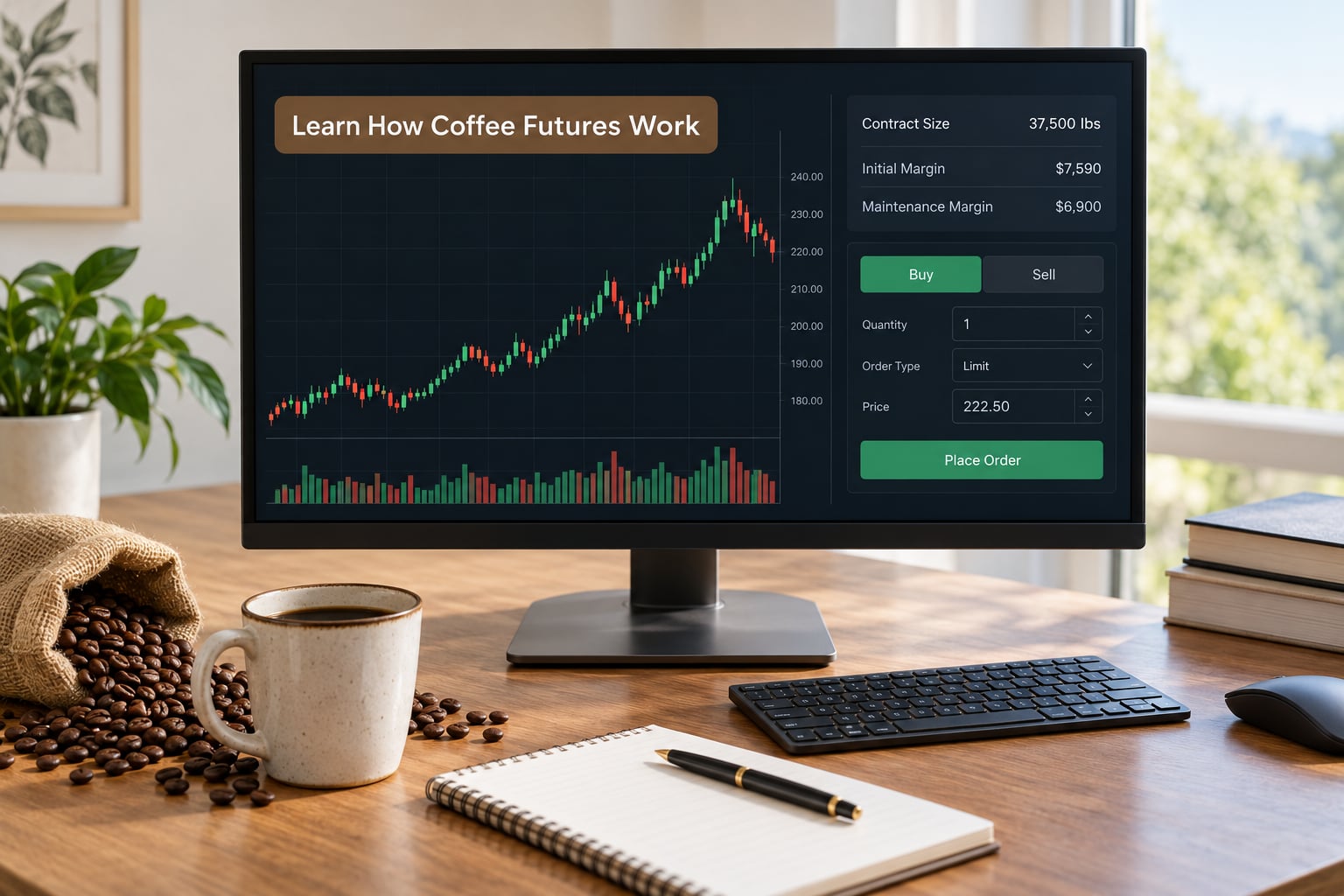
A futures contract is an agreement to buy or sell a fixed quantity of a commodity at a price fixed today, for a delivery month later. You do not need to own beans or take delivery. What you do need to post is margin: a deposit the broker holds so the position cannot go deeply negative.
The standard arabica contract on ICE, symbol KC, is sized far larger than most retail accounts. A one-cent move on it is worth more than most people expect, which is why sizing comes before enthusiasm.
| Specification | ICE US Coffee C (KC) |
|---|---|
| Contract unit | 37,500 pounds, about 17.01 metric tonnes |
| Quoted in | US cents per pound |
| Minimum price fluctuation | 5/100 of one cent per pound |
| Value of that minimum tick | About 18.75 in trading currency |
| Value of a one-cent move | About 375 in trading currency |
| Listed delivery months | Cycle through March, May, July, September and December |
| Settlement | Cash settlement against the exchange settlement price; physical delivery is not the retail path |
Three mechanics follow from that table. Margin is a deposit, not the total risk: real exposure is the whole contract value, so a 20-cent adverse move on one contract is about 7,500 in trading currency before fees. Contracts expire, so a position held to delivery rolls into a later month at whatever price that month trades at. And because borrowed exposure is built in, the same contract magnifies gains and losses by the same multiple.
3. Compare Routes: How to Invest in Coffee as a Commodity
Each route tracks something different, which is the part that confuses people comparing their balances. A futures position tracks the price of one delivery month. A coffee fund tracks a basket of futures, adjusted daily for roll and fees. A producer share tracks one company’s revenue, costs and currency exposure, and a good harvest in Brazil can actually hurt a company that sells into a falling market.
In practice, short-term traders who follow weather and crop reports usually choose futures, because they need to choose a month and a size. Longer-term investors usually choose funds, because they want exposure that survives without attention. Producer shares fit people who want a business they can analyse rather than a commodity they can only price.
One more difference matters: hours of attention. A leveraged futures position needs a plan before it is opened, because a margin call can arrive while you sleep. A fund position needs a quarterly glance. Anyone who says they have no time for research should not be holding futures.
4. Check Prices, Costs, and Market Conditions
Before any position, check the things that decide whether the price you see is real value or just noise. Here is the working list I would run through:
- The live quote and spread. Look at the front month and the next month, and note the bid-ask spread, because a wide spread quietly raises your entry cost.
- Your all-in cost per contract. Compare the broker’s round-turn commission and exchange fees for one contract against the expense ratio of any fund you are considering.
- Fund holdings and index method. Confirm whether a coffee note tracks futures directly or a subindex, and read how it handles roll and collateral.
- Crop and acreage reports. Government and exchange crop estimates tell you whether the market is expecting a big supply or a small one.
- Certified inventories. Compare stored beans against expected use, because inventories are the buffer that absorbs a shock.
- Weather and harvest timing. In Brazil the main harvest lands in the middle of the year; frost or drought during the crop cycle moves prices long before anyone sees the beans.
- The Brazilian real and the Vietnamese dong. Producers sell in dollars but earn in local currency, so a weaker real makes their beans cheaper for everyone else.
- Roaster demand. Demand shifts with the retail cycle and with what happens in competing drinks, which is the pull against the supply side.
A credible setup after this check should have three things: a stated reason for the trade, a number for what you lose if wrong, and a named date or price for leaving. If you cannot fill in those three, you are guessing.
5. Choose a Position Size and Place the Trade
Size first, then place the order. The arithmetic is simple enough to do on paper, and it is the step that saves accounts.
Use this conservative formula: contracts = (your risk budget) divided by (the cents of movement you are willing to lose, multiplied by 375). A 50-cent stop on one contract risks about 18,750 in trading currency. A 25-cent stop risks about 9,375.
Now run the honest version. If your risk budget is 1,000 in trading currency and you want a 50-cent stop, the formula returns zero contracts, and zero is the correct answer. That is the single most useful fact about coffee futures: with a small account, one contract is usually too large to hold through a normal move, which is why the fund route exists and why widening a stop to force a trade is a bad idea.
When you do trade, two sides matter. Long means you profit when the price rises. Short means you profit when it falls. Short positions carry unlimited theoretical loss in a rising market, so they need a smaller size and a hard stop.
Reduce execution mistakes with three habits. Use limit orders so you choose the price instead of accepting whatever appears when you press the button. Keep the position small enough that a full contract’s move cannot change your life. Write the exit before the entry: price, stop or date, whichever comes first, and hold to it even when the weather forecast is arguing with you.
You know this step worked if, after the order fills, you can point to the line in your plan that says how much you are risking and the line that says when you leave.
Common Coffee Investing Mistakes
Most coffee losses I hear about come from one of seven repeating mistakes, and every one of them has a straightforward fix.
- Buying several contracts because the margin looked small. Margin is a deposit, not a risk limit. Fix: size from the stop distance, never from the deposit.
- Treating a leveraged futures position as a savings account. A contract held for years can bleed through rolls and margin calls. Fix: hold futures on a deliberate trade horizon, and use a fund for long holding periods.
- Ignoring roll cost. When near months trade below later months, a fund sells the cheap contract and buys the dear one, and that drag can cancel out a rising spot price. Fix: read the fund’s index method and note the cost each year.
- Expecting the fund to match the headline coffee price. Funds also carry expense ratios, tracking difference and roll effects. Fix: compare the fund with the futures curve, not with a news headline.
- Putting everything into one producer. A single company’s results depend on its own costs, its hedges and its currency. Fix: if you want company exposure, spread it, and remember it is not a coffee price substitute.
- Trading on a headline. Frost reports and harvest estimates arrive, get priced, and are revised. Fix: wait for confirmation from inventories and a second crop estimate before acting.
- Using amplified and inverse funds as long-term holdings. Daily reset means the return over weeks or months can differ sharply from the multiple in the name. Fix: treat them as short-horizon instruments and check the daily index.
A few habits cover most of the rest. Keep an emergency fund that has nothing to do with trading. Set one review date per quarter instead of watching the screen. Note every trade and its reason in a short journal, because the second year of trading is where most beginners finally learn what the first year was doing.
Frequently Asked Questions
Can individual investors buy physical coffee as a commodity?
Technically yes, through coffee importers and certified warehouse receipt schemes, but it is rarely practical for individuals. You would need to fund grading, storage, insurance, transport and eventual sale, and storage costs and quality risk eat into any gain. Most people who want the commodity itself buy futures or a fund instead, which gives price exposure without handling beans.
What are the main factors that affect coffee prices?
Supply dominates. Brazil is the largest arabica producer, Vietnam the largest robusta producer, so harvest size, frost, drought and El Nino or La Nina patterns in those countries move prices quickly. The Brazilian real matters because producers earn in local currency while selling in dollars. Certified inventories, crop estimates from agencies such as the USDA, and roaster demand on the buying side complete the picture.
Are coffee futures suitable for beginners?
Usually not, and the reason is size rather than complexity. One ICE US Coffee C contract covers 37,500 pounds, and a one-cent move is worth about 375 in trading currency, so a normal move can exceed a small account. Beginners often do better with a coffee fund, which removes contract sizing and margin decisions. Futures suit people who can size a position mathematically and accept leveraged risk.
How do coffee futures differ from coffee investment funds?
A futures position is a single contract on one delivery month, sized by margin and by your own stop. A fund holds many coffee futures, usually resets exposure daily, deducts an expense ratio and pays a roll cost when the market is in contango. That is why a fund can lose money over a period when the coffee price rises, and why the two are not interchangeable.
What should I check before investing in coffee?
Check the live quote and the bid-ask spread, the all-in cost per contract or the fund expense ratio, how the fund or note handles roll and tracking, current certified inventories, crop and acreage estimates, the harvest calendar, and the local currencies of Brazil and Vietnam. Write your maximum loss and exit point before you trade. Learn how to invest in coffee as a commodity with those numbers in hand, not after.
Conclusion
Pick the route first: futures if you can size a position mathematically, a coffee fund if you want exposure without contract decisions, producer shares if you want a business rather than a commodity. Then set a small written risk limit, learn the contract or read the fund’s index method, and check every fee before the order goes in.
No route removes risk. Coffee is volatile, leveraged positions can turn a good month into a forced sale, and funds pay costs that futures do not. Returns are not guaranteed, and none of this is individual investment or tax advice. Take the time to work out how to invest in coffee as a commodity before the size of the position decides it for you.