Learning how to invest in palladium comes down to four routes: exchange-traded funds and commodities, physical bullion, shares in mining companies, and futures contracts. Each one mixes cost, liquidity and risk differently, and for most beginners the cheapest and least painful entry point is a small position in a fund rather than a bar in a safe deposit box. It takes an afternoon to research and set up, and you can start with a small amount.
Palladium is unusual among precious metals because its price is driven by industry rather than by fear. Roughly 80% of its consumption goes into catalytic converters in gasoline vehicles, so what happens to car production, to hybrid sales and to electric vehicle adoption matters more than what happens to central banks. That also means the metal can move by more than half in a calendar year, in either direction, and anyone who bought near the top of the spike that ended the last boom learned that the hard way.
Table of Contents
- What You Need
- Step-by-Step
- Step 1: Define Your Goal and Time Horizon
- Step 2: Understand Palladium’s Market Drivers
- Step 3: Compare Ways to Invest in Palladium
- Step 4: Check Costs, Liquidity and Risk
- Step 5: Make a Measured Purchase
- Step 6: Monitor and Review the Position
- Common Mistakes
- Frequently Asked Questions
- How do I actually buy palladium as a beginner?
- Is palladium still a good investment?
- How much should I invest in palladium?
- What happens to palladium if electric cars take over?
- Is physical palladium better than a palladium fund?
- Are palladium ETFs taxed differently for US investors?
- How to Start with Palladium Safely
What You Need
Before you buy anything, you need five things sorted. Skipping them is how people end up holding a position they cannot explain.
- A stated goal. Are you adding a diversifier to a portfolio, making a commodity bet, or trading a supply disruption? Each answer points to a different vehicle.
- Emergency savings in place. Money you may need within a year should sit in cash or short-term deposits, not in a volatile industrial metal.
- An honest read on risk tolerance. Palladium has moved more than 50% in both directions in recent years. Decide what you can sit on through a drawdown of that size.
- The right account access. A general brokerage account for funds, mining shares and futures; a reputable dealer relationship for physical metal; for US readers, a self-directed IRA if you want the metal inside a retirement account.
- Two or three sources you actually read. A fund factsheet, an exchange or official price benchmark, and a dated dealer quote. Prices and premiums quoted without a date are decoration.
Step-by-Step
Step 1: Define Your Goal and Time Horizon
Write down, in one sentence, why you want palladium and when you expect to sell. A 15-year accumulation plan looks nothing like a two-year trade, and the vehicle you pick should match the sentence you wrote.
For most people the honest framing is a small diversifier. Retail precious-metals forums describe palladium consistently as a satellite position rather than a core holding, and that framing survives contact with real markets. If your aim is income, palladium pays none. If your aim is capital appreciation, accept that you are underwriting an industrial commodity, not a savings product.
Set two numbers before you look at prices: the maximum percentage of your portfolio you will allow, and the point where you would sell or trim. Those two numbers do more to protect you than any chart you can find.
Step 2: Understand Palladium’s Market Drivers
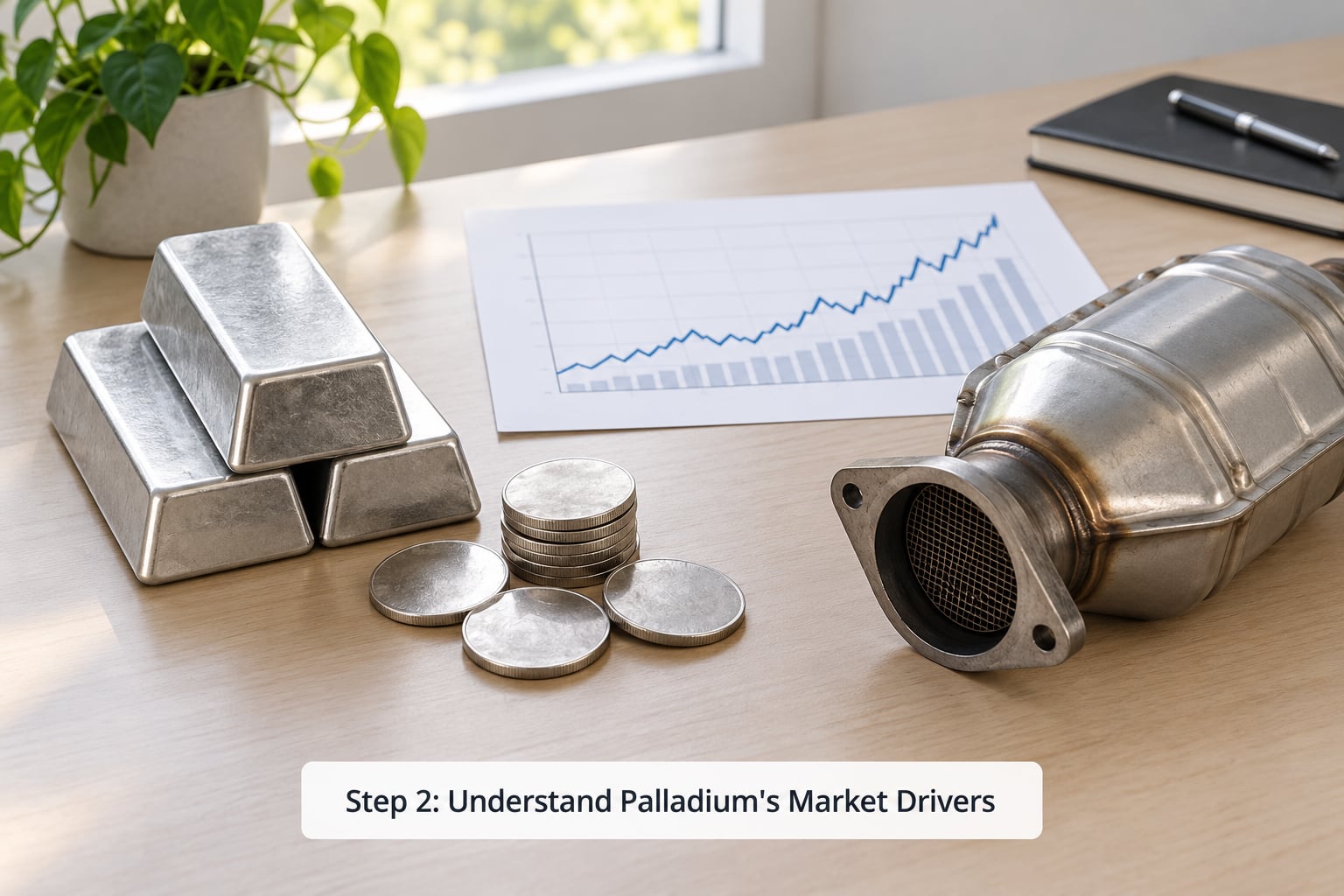
Palladium is a platinum group metal, one of six elements in that family, and it is mined mostly as a by-product of nickel, copper and platinum operations rather than on its own. That detail drives most of the supply side: producers cannot simply turn up output when the price is attractive.
Mine supply is concentrated. South Africa and Russia are the two largest producers, which means power interruptions, labour disputes, refining constraints or export policy in either country can tighten physical availability fast. Recycling from scrapped catalytic converters adds a partial buffer, but it moves with car scrappage rates rather than with price signals.
On the demand side, substitution cuts both ways. Rhodium and platinum can partly replace palladium in catalyst formulations, and each switch pushes in the opposite direction from a price spike. Vehicle production forecasts, hybrid sales and the pace of battery-electric adoption are the inputs worth following, along with industrial activity data and inventory levels at exchanges.
Two more drivers catch newcomers out. The dollar matters, because these metals are priced in dollars for everyone. And palladium behaves like an industrial metal in a risk-off market, which is the opposite of what many people assume about something carrying the precious metals label.
Step 3: Compare Ways to Invest in Palladium
Four routes cover almost everyone: physical metal, funds and commodities, mining shares, and futures. Each carries a different bill.
- Physical bullion. Bars and coins bought from a dealer and held by you or in an insured vault. No issuer risk and no counterparty risk beyond the dealer, but you pay a premium over spot on the way in, storage and insurance, and a wider spread on the way out. Exit liquidity is the weak point, because palladium has no deep retail coin market the way gold and silver do.
- Physical-backed funds. An exchange-traded fund or commodity security that holds allocated metal in an institutional vault and issues you fractional claims. On the LSE, SPPP is a widely used example. Clean entry and exit at the market price, storage handled for you, no dealer premium.
- Futures-based and mining funds. Products that replicate price using futures, or funds holding mining equities rather than metal. Watch the roll cost: a futures-based fund in contango bleeds value every month as contracts are rolled. Mining funds behave like equities, not like metal. GLTR is a multi-commodity basket rather than a pure palladium play.
- Mining shares. Individual platinum group metals producers, most of which earn most of their revenue from other metals. You are buying company execution, costs and country risk on top of the metal price. Few of these companies exist as pure palladium plays, so the exposure is diluted in both directions.
- Futures and contracts for difference. NYMEX palladium futures trade on margin with leverage. This is a trading tool, not an investment, and a beginner has no business starting here.
| Route | Access | Ongoing cost | Main drawback |
|---|---|---|---|
| Physical bullion | Dealer or vault | Premium on entry, bid-ask spread on exit, storage and insurance | Thin resale market and wide buyback spread |
| Physical-backed fund | Brokerage, exchange traded | Expense ratio plus bid-ask spread | Issuer and custodian exposure; no interest paid |
| Futures-based fund | Brokerage, exchange traded | Expense ratio plus roll cost in contango | Tracking difference can widen in a steep market |
| Mining shares | Brokerage | Commission, plus dividends or no dividends | Company, cost and country risk swamp metal exposure |
| Futures and CFDs | Futures desk or broker platform | Commission per contract, margin financing | Leverage; losses can exceed the margin |
PALL is the North American exchange-traded name most retail investors meet first, while SPPP sits on the LSE. Compare structures before comparing tickers: physically backed means a vault and a custodian, futures-based means a rolling book of contracts and a permanent roll cost. A physical-backed fund also keeps you away from an ETC, which is a debt claim on an issuer and carries issuer risk a fund does not.
Step 4: Check Costs, Liquidity and Risk
Costs decide the outcome more often than the metal does. In physical palladium, dealer premiums observed in published dealer comparisons have ranged roughly from 8% to 35% over spot, and the spread you get back when you sell is usually much wider than the spread that got you in. That round trip alone can consume most of a modest gain, which is why forum users regularly recommend funds over coins purely on exit mechanics.
For funds, read the factsheet rather than the marketing page. Note the expense ratio, whether the fund holds physical metal or futures, the custodian, and whether the fund has traded at a premium or discount to its net asset value. A tracking difference that stays inside the expense ratio is fine; one that widens is a signal to look elsewhere.
For mining shares, the costs sit inside the company: energy, labour, refining and sustaining capital. When palladium moves, a miner with rising unit costs converts a price gain into a much smaller profit gain.
Then check liquidity honestly. How many contracts trade on a typical day, how wide is the spread at the moment you want to trade, and how far does the price gap when everyone wants out at once? A position you cannot exit in a stressed market is not really an investment.
Step 5: Make a Measured Purchase
Size the first position so that a 50% decline leaves you comfortable rather than panicked. A small satellite weight, held alongside a diversified core of equities and bonds, is a defensible answer for most self-directed beginners. Anything larger deserves a written argument.
Spread entry across time rather than committing everything on one day. Use limit orders in thin markets so you set the price you will accept instead of crossing a wide spread. Write down the reason, the intended holding period and the conditions that would make you sell, and put the date in your calendar.
Do not buy a sharp move. Palladium has produced sudden spikes and then given back more than half within a couple of years. You are not obliged to own it today at any price.
Step 6: Monitor and Review the Position
A quarterly review is enough for most people. Look at vehicle production and catalyst demand data, at supply disruptions in South Africa and Russia, and at whether your fund’s tracking difference and premium to net asset value are still normal.
If you hold mining shares, add company results, unit costs and capital spending. Re-check your total metals weight against the maximum you set in Step 1, since a rising price silently inflates it.
Ask the one question that matters: is the reason I bought still true? If the answer takes more than a sentence, the position has drifted from the plan and deserves a decision.
Common Mistakes
Treating palladium as a guaranteed hedge. It is an industrial metal with a thin investment market, not a savings substitute. The fix is to size it as a satellite and never as the part of a portfolio that must be there in five years.
Buying physical metal without checking the spread. A 20% dealer premium plus a wide buyback spread can wipe out years of gains. The fix is to ask what the dealer pays on the day you sell, before you buy, and to compare that with what a fund charges.
Concentrating in one mining company. Those companies are leveraged plays on several metals, not on palladium. The fix is to use a fund, or to spread a mining allocation across several producers.
Confusing volatility with value. A 50% fall does not make something cheap, and a doubled price does not make it safe. The fix is to keep position sizing proportional to the damage a further fall would do.
Ignoring tax treatment. Physical purchases can carry VAT in many jurisdictions, and a physically backed fund can be classified as a PFIC for US holders, with reporting obligations attached. The fix is to check your own country’s rules before buying, since rates and classifications change.
Using borrowed money. Leverage on a commodity that has already halved once is a fast route to losing the deposit. The fix is to use cash you can afford to see fall, or margin you could cover without selling.
Not checking storage and issuer risk. For physical metal, ask where it is stored, whether it is insured and segregated, and who has title. For a commodity security, read whether it is a secured claim on a trust or an unsecured debt claim on a company.
Frequently Asked Questions
How do I actually buy palladium as a beginner?
Most beginners start with a physically backed fund, because a brokerage account gives you fractional exposure, tight spreads and a clean exit without storage or dealer premiums. Open an account, confirm it allows exchange-traded commodities, fund it, search the ticker, and place a limit order during liquid hours. Physical metal is the slower route: choose a reputable dealer, ask for the premium over spot and the buyback price in writing, and arrange insured storage before you buy.
Is palladium still a good investment?
It can be a useful small diversifier and a way to take a view on the automotive catalyst cycle. It is not a dependable store of value, because roughly 80% of its demand is industrial and the price has moved by more than 50% in both directions in recent years. Treat any holding as a measured satellite position, not as a core asset or a hedge you are relying on.
How much should I invest in palladium?
There is no single right number, but a small satellite weight keeps a bad year from damaging your plan. Decide the maximum percentage of your portfolio you will allow and stick to it, rebalancing if a price move pushes you over. Never use money earmarked for the next year, and if the position would keep you up at night at a 50% decline, it is already too large.
What happens to palladium if electric cars take over?
Demand for catalytic converters falls as battery-electric vehicles take share, which is the central bear case for the metal. The transition is gradual rather than a cliff, because hybrids still use catalysts and the global vehicle fleet turns over slowly. Substitution toward platinum and rhodium also plays out, and recycling supply adjusts with scrappage rates. The honest answer is that a fast transition is bad for palladium demand and a slow one is merely disappointing.
Is physical palladium better than a palladium fund?
Physical metal removes issuer and counterparty risk and gives you something tangible, which is its real appeal. Against that, you pay a dealer premium of roughly 8% to 35% over spot on entry and a wider spread on exit, plus storage and insurance, and exit liquidity is thin because there is no deep retail coin market. A physically backed fund keeps the metal exposure while removing most of that friction.
Are palladium ETFs taxed differently for US investors?
Yes, and it catches people out. A physically backed commodity fund can be classified as a passive foreign investment company, which triggers PFIC reporting and can cost more in tax than the gain itself. Funds holding mining shares or futures generally follow ordinary equity or commodity tax rules instead. Rules vary by country and change, so confirm the treatment with a tax professional before you buy.
How to Start with Palladium Safely
Start by choosing one route and one fund, not five tickers. Read the factsheet, check the premium or tracking difference, and confirm what it will cost you to enter and exit.
Then allocate a small amount you could lose entirely without changing your plans, set a review date on your calendar, and write down the reason you bought. If that reason stops being true, the decision gets much easier.
This is general information about how palladium exposure works and how it is bought, not personal financial advice. Tax treatment and fund classifications vary by country and change over time, so check the current rules for where you live before you buy.