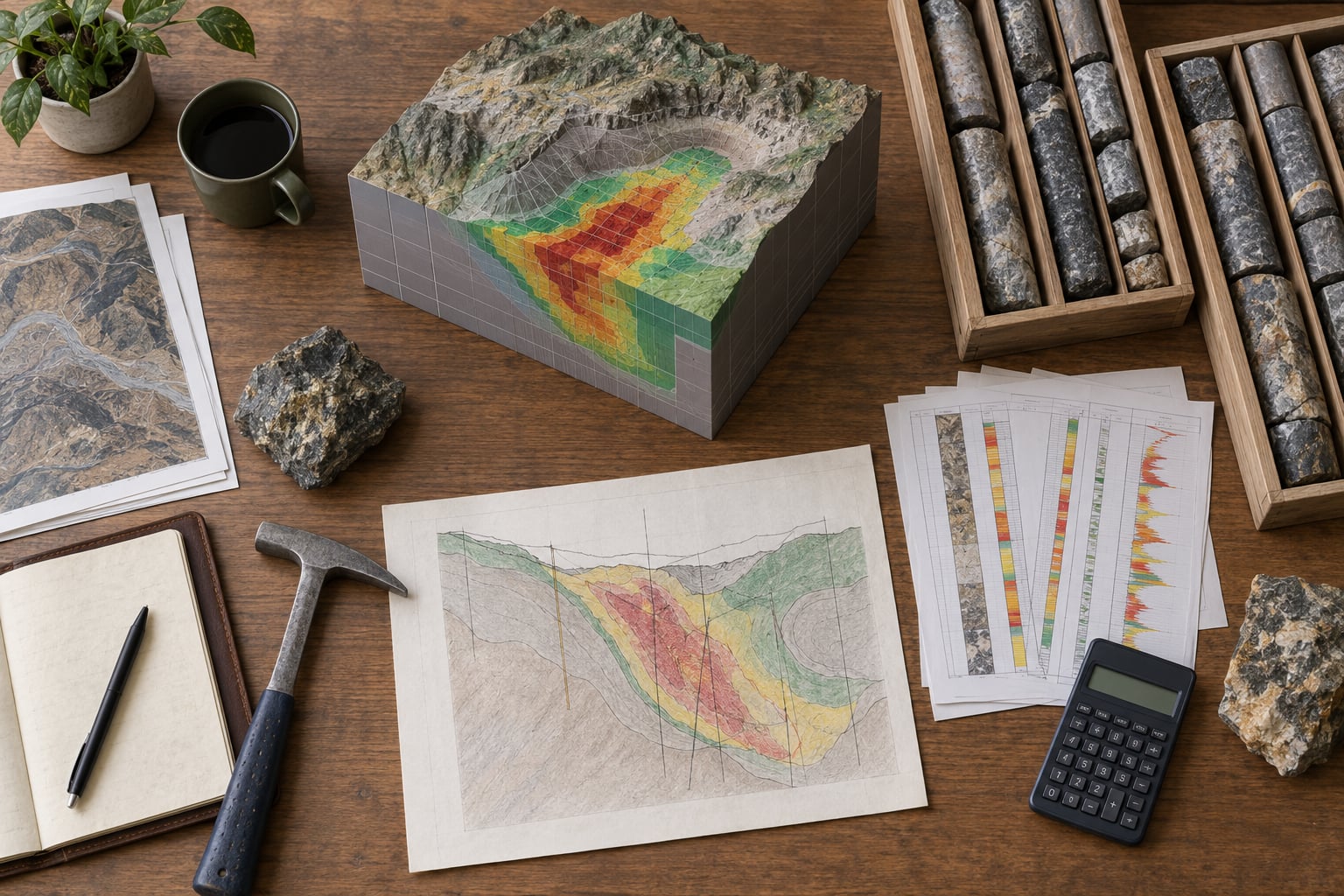
A resource estimate in mining is a qualified geologist’s quantified statement of how much mineral is known or reasonably inferred to exist in a deposit, at what grade, and with what degree of geological confidence. It is normally reported as measured, indicated and inferred tonnage at a stated cut-off grade and metal price, signed off by a named professional under a reporting code such as JORC or NI 43-101.
That is the technical version. The practical version is simpler: a resource estimate is the only quantified, signed measure of what a mining company actually owns underground, and almost every number a junior mining company publishes is built on top of one.
Because that single document carries so much weight, it is worth knowing what sits inside it, which parts are hard geology and which parts are judgement calls, and where the number can quietly be made to look better. A press release headline gives you tonnage. An investor needs the grade, the cut-off grade and the category mix behind it.
Table of Contents
- Key Takeaways
- What Is a Resource Estimate in Mining?
- What Is the Difference Between a Mineral Resource and a Reserve?
- What Measurements Make Up a Resource Estimate?
- A worked example: from tonnes to contained ounces
- How Are Mineral Resources Classified?
- What Is a Resource Estimate in Mining: How Is One Made?
- What Is a Cut-Off Grade and Why Does It Matter?
- What Should Investors Check Before Trusting an Estimate?
- The reporting codes behind the numbers
- Glossary of the acronyms
- Frequently Asked Questions
- What is a resource in mining?
- What is the difference between a resource and a reserve?
- What is a maiden resource estimate?
- What does indicated and inferred mean in mining?
- What is the difference between measured, indicated, proven and probable?
- What are the National Instrument 43-101 standards of disclosure for mineral projects?
- Start by Reading the Assumptions
Key Takeaways
- A resource estimate quantifies how much mineral exists, at what grade, and with what level of confidence. It is not the same thing as a reserve, which must also pass an economic test.
- Resources come in three confidence tiers: measured, indicated and inferred. A reserve comes in two: proven and probable.
- Cut-off grade is the single biggest lever on reported tonnage. A lower cut-off grade always produces more tonnes and usually a lower average grade.
- Somewhere between one and seven of every ten resource ounces never become reserves once mine plans, dilution, metallurgy, costs and permits are applied.
- Maiden, updated and upgraded are lifecycle words. A category upgrade is a stronger signal than a bigger tonnage headline.
What Is a Resource Estimate in Mining?
A resource estimate is a statement about geology plus a statement about confidence. A geologist drills a grid of holes, samples the core, sends it to a laboratory for assay, and then interpolates the assay results across the volume between holes. The output is a tonnage of material at a range of grades.
Three terms get tangled constantly, so it is worth separating them cleanly.
Ore is rock that can actually be mined and processed at a profit today. A deposit can hold a very large mineral resource and still contain almost no ore. A mineral resource is mineral material that has enough geological confidence to be counted, and under most modern codes it must have reasonable prospects of eventual economic extraction. A mineral reserve is the part of the resource that survives the full mining, processing, cost and permitting exercise.
Why does any of this matter outside the industry? Because resource estimates drive almost everything a mining equity is valued on. They justify capital raises, set the bar for acquisition prices, decide whether a feasibility study is worth funding, and tell you how much metal a company has added or lost since the last update. When two juniors are compared on market capitalisation per ounce of resource, the quality of the estimate decides whether the comparison means anything at all.
The honest caveat is that a compliant, code-signed estimate still is not a statement about profitability. A report prepared under JORC, NI 43-101 or SAMREC can be entirely valid and still describe a project that will never be mined.
What Is the Difference Between a Mineral Resource and a Reserve?
The difference is the economic test. A resource is a geological statement; a reserve is a geological statement that has also survived mining engineering, metallurgy, capital and operating costs, commodity price assumptions, permitting and legal title.
| Question | Mineral resource | Mineral reserve |
|---|---|---|
| What it measures | How much mineral is in the ground, and with what confidence | How much mineral can be extracted and processed at a profit |
| Economic test applied | Reasonable prospects of economic extraction, stated but not fully demonstrated | Fully demonstrated, with modifying factors and a mine plan applied |
| Confidence categories | Measured, indicated, inferred | Proven, probable |
| Typical supporting study | None required, often a maiden estimate or scoping study | At least a pre-feasibility study, usually a feasibility study |
| Share of resources that qualify | 100% of the resource base by definition | Roughly 30% to 70% in most projects, sometimes far less |
Here is the conversion funnel in plain text, which is how I read every newswire that crosses my desk:
Drill results → Exploration target → Inferred + Indicated + Measured resources → Probable + Proven reserves → Production
Each arrow removes material. What gets removed is everything the geologist cannot demonstrate, everything the mine plan cannot reach, everything the plant cannot recover, and everything the balance sheet cannot fund. A project that reports 10 million ounces of measured and indicated resources and then declares 3 million ounces of reserves has not lost 7 million ounces of rock. Those 7 million ounces never had a mine, a mill, a permit and a cost estimate attached to them.
What Measurements Make Up a Resource Estimate?
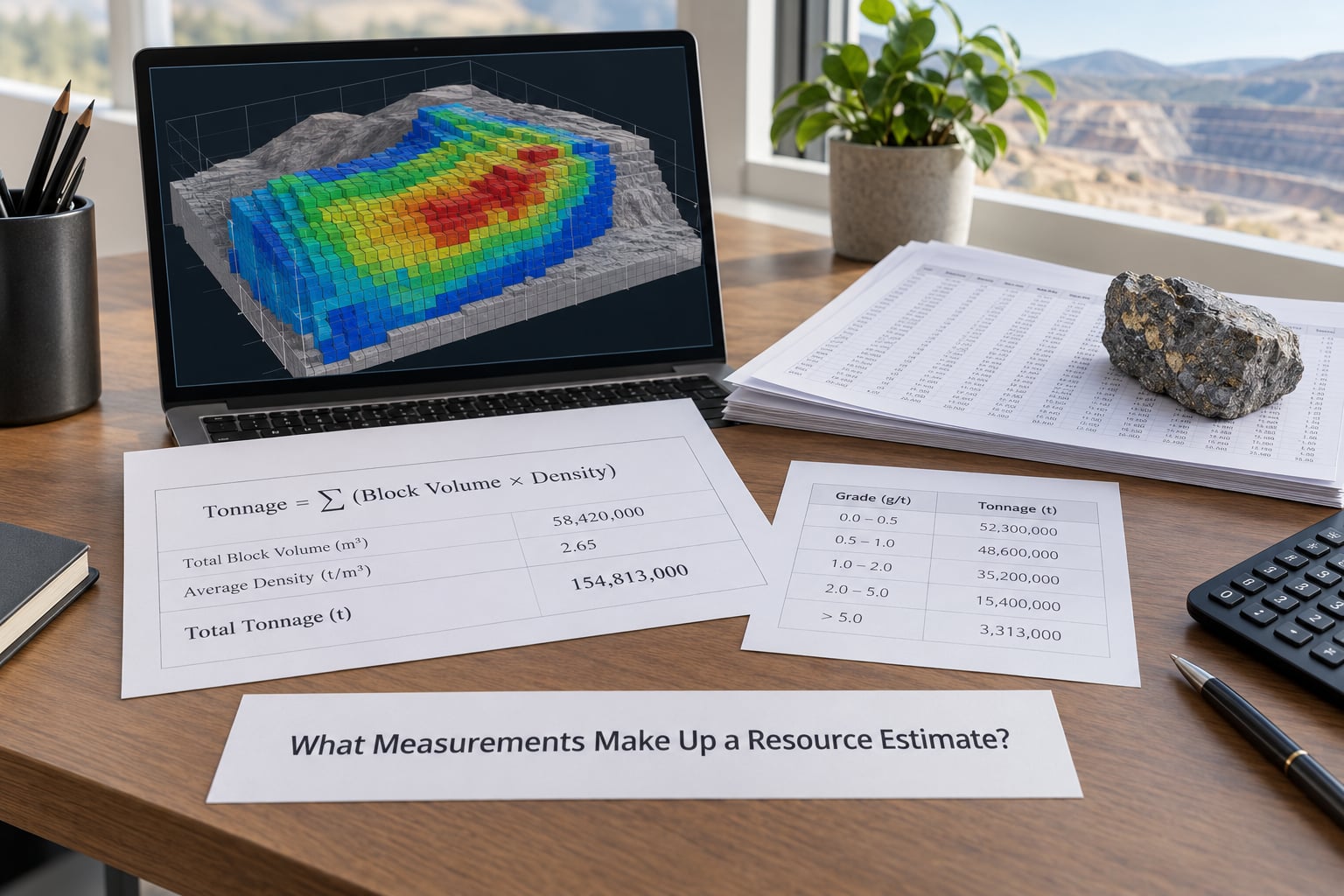
Every resource estimate, however long the technical report, reduces to a handful of numbers. Knowing what each one does makes the rest much easier.
Tonnage is the mass of material, in tonnes, that carries material above the cut-off grade. Grade is the concentration of the target metal within that material, reported as a percentage, grams per tonne, or ounces per ton of rock depending on the commodity. Contained metal is the arithmetic result of the two, and it is the number investors actually quote.
Then come the assumptions. Density converts block volume into tonnes, and a density error flows straight through to the headline. Moisture content matters for bulk commodities where material is reported wet. Metallurgical recovery is the share of contained metal that a plant actually recovers into saleable product, and it is lower than most people assume. Cut-off grade decides which material counts at all. Metal price is the assumption that determines whether a resource has any economic prospects.
A worked example: from tonnes to contained ounces
Take a typical press release line: measured and indicated resources of 500,000 tonnes at 2.0 grams per tonne gold. The calculation is deliberately boring.
500,000 tonnes × 2.0 g/t = 1,000,000 grams of contained gold. Divide by 31.1035 to convert grams to troy ounces, and you get roughly 32,150 contained ounces.
Now apply recovery. A heap leach operation recovering 65% of contained gold produces about 20,900 payable ounces from the same 500,000 tonnes. A conventional mill at 90% recovery produces about 28,900. Same tonnage, same grade, same orebody, and roughly 8,000 ounces of difference purely from processing.
That is why grade alone is a poor way to compare two deposits. When I screen juniors on market capitalisation per ounce of resource, the question I get asked most often is how much of an inferred category to count. The honest answer is that tonnage without grade, recovery and cut-off grade is not comparable to anything.
How Are Mineral Resources Classified?
Resources are classified by how much geological confidence sits behind them, and the categories run in a fixed order. Inferred is the least confident, indicated sits in the middle, and measured is the most confident.
| Category | Confidence and evidence | What it can support | How I weight it in a screen |
|---|---|---|---|
| Measured | Highest confidence. Three or more closely spaced data points, typically a drill spacing of roughly 15 to 25 metres, support the grade and tonnage estimate | Supports detailed mine planning and production scheduling | Treat as close to real, subject to recovery and cost |
| Indicated | Moderate confidence. Adequate spacing, typically 25 to 75 metres, with grade continuity supported by extrapolation | Supports scoping and pre-feasibility studies | Real but with real conversion risk; apply a haircut |
| Inferred | Lowest confidence. Wide spacing, often 75 to 150 metres or more, with continuity assumed rather than demonstrated | Supports exploration targeting and drilling budgets | Treat as a target, not as metal in the ground |
One point that gets lost: the categories describe geological confidence, not economic value. A measured resource is the most reliable estimate of rock, but a measured resource at a grade below the economic cut-off grade will never be mined at all.
That is also why an upgrade from inferred to indicated is treated as the strongest positive signal in a newswire. It means drilling and study work moved material up the confidence ladder, which is real de-risking. A larger tonnage at the same category is a different event. It may reflect a lower cut-off grade rather than better geology.
What Is a Resource Estimate in Mining: How Is One Made?
The pipeline runs from hole in the ground to signed document, and each step introduces its own error. Here is the sequence.
1. Drilling and sampling. Diamond or reverse circulation holes are drilled on a grid. Core or cuttings are sampled, usually in intervals, and the geologist decides how long each sample is. Sample support matters enormously: a one-metre sample and a ten-metre sample do not average the same way.
2. Assay and QA/QC. Samples go to a laboratory, where certified reference materials, blanks and duplicates are inserted to catch contamination and bias. Chain of custody records who handled the material at each step. This is the machinery that existed to prevent the Bre-X fraud, where samples were salted with gold and a company claimed roughly 71 million ounces and a valuation near CAD 6 billion on rock that turned out to be worthless.
3. Geological interpretation. The geologist builds a three-dimensional model of the orebody, the host rock, the alteration zones and the waste envelopes. This is a professional judgement, and two competent geologists can produce materially different shapes from the same assay database.
4. Block model and geostatistics. The deposit is divided into blocks, typically a few metres across, and grades are interpolated into each block using methods such as nearest neighbour, inverse distance weighting or kriging. The variogram and the chosen method are documented so a reader can judge whether the interpolation respects the deposit’s structure.
5. Density and tonnage. Block volumes are multiplied by density to reach tonnes, then filtered by cut-off grade and constrained to a pit shell or underground stope shapes.
6. Classification and review. Blocks are assigned to measured, indicated or inferred based on drill spacing and confidence, then a qualified person reviews the whole thing and signs it. NI 43-101 formalises this as a Qualified Person taking responsibility for the technical report; JORC uses the term Competent Person.
Every stage is a place where a reasonable person could have gone differently. That is the honest framing of a resource estimate. It is a defensible opinion with a stated method, not a measurement of a physical fact.
What Is a Cut-Off Grade and Why Does It Matter?
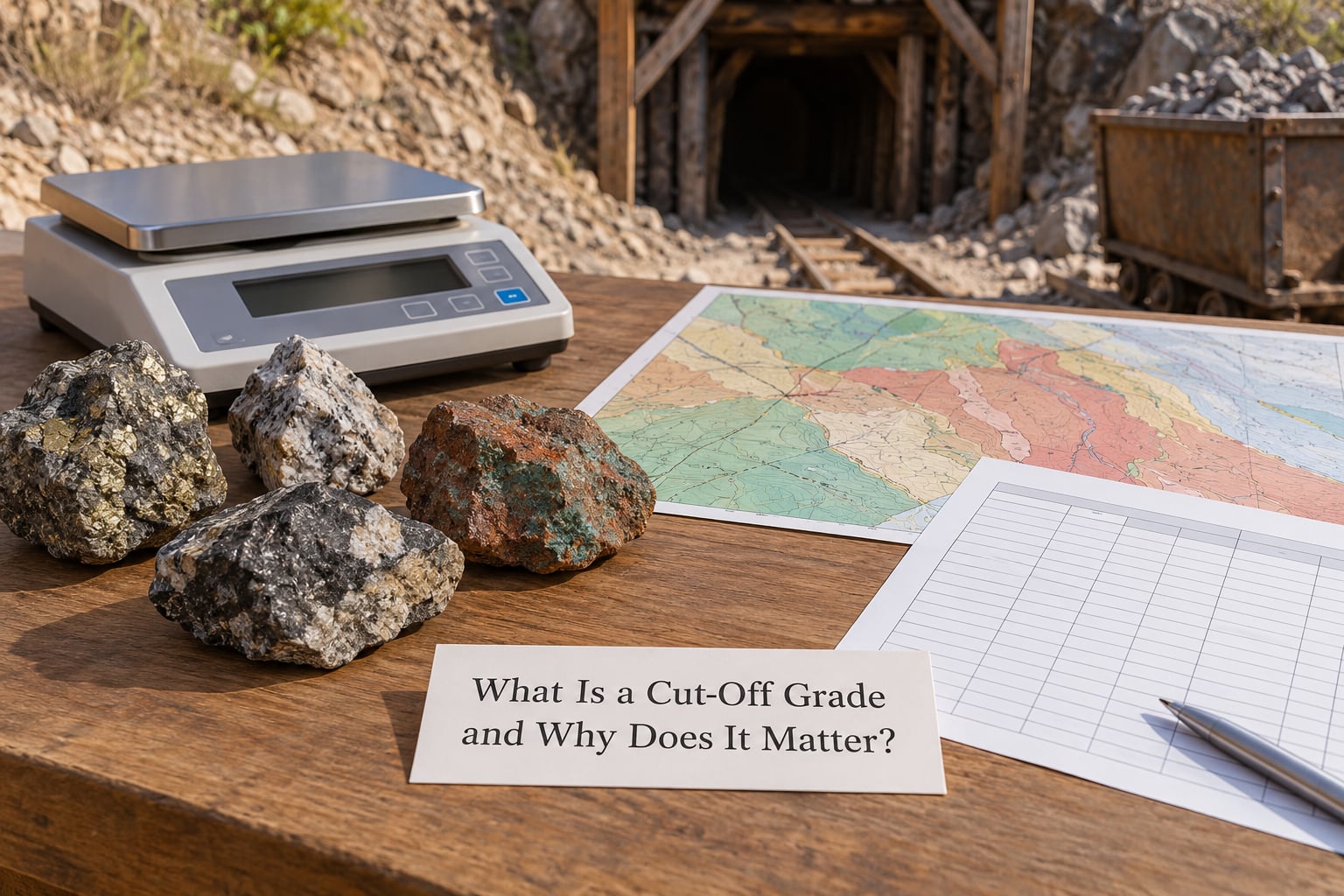
Cut-off grade is the minimum grade at which material is counted in the resource. Everything below it is treated as waste. It is the single most powerful number in the report, and it is usually buried in a footnote rather than in the headline.
The arithmetic is worth sitting with. Take a deposit where grades decline gradually with depth. At a cut-off grade of 1.0 grams per tonne you might have 8 million tonnes averaging 1.6 g/t. Drop the cut-off to 0.6 g/t and the tonnage can rise to 14 million tonnes while the average grade falls toward 1.2 g/t. Contained metal rises, but so does the volume of rock you have to move, haul and process for each gram recovered.
What moves the cut-off grade:
- Metal price. A higher assumed price makes lower grades economic, so the cut-off falls and tonnage rises. This is the most common reason a resource grows between updates.
- Operating cost. A remote or high-altitude site, or a hard-rock mining cost, pushes the cut-off up and tonnage down.
- Recovery. Poor recovery on a particular ore type means marginal material stays uneconomic longer.
- Project objective. Companies mining a high-margin underground or a bulk-tonne open pit will tune the cut-off to match the mine plan they intend to build.
So a bigger tonnage at a lower cut-off grade is not necessarily better news. The comparison that matters is contained metal at a consistent cut-off grade, and the trend across several updates rather than one headline.
What Should Investors Check Before Trusting an Estimate?
Here is the checklist I run before a resource number goes anywhere near a valuation model.
- Who signed it, and are they independent? Under NI 43-101 the Qualified Person takes personal professional responsibility for the report, and the report must be filed publicly with their consent. A company press release repeating last year’s estimate is not the same as a new signed document.
- What is the effective date? A resource estimate is a snapshot. An effective date two years old tells you very little about the current drill database.
- What cut-off grade and price assumption were used? Compare them with the company’s previous estimate and with its peers. A tonnage jump that coincides with a lower cut-off grade is a modelling change, not a geological discovery.
- What is the category split? A headline combining measured, indicated and inferred treats very different material as one number. Split them out.
- How dense is the drilling? Sparse drilling with wide-spaced inferred material is exactly the profile that produced the industry’s worst historic failures.
- Is there metallurgical test work? Without recovery data for the ore types in question, contained metal has no path to a payable product.
- Is the report independent, and has it been reviewed? First-party estimates from a company with a single asset deserve more scepticism than a third-party QP estimate on a project with several deposits.
- What are the legal and permitting facts? A resource in a jurisdiction where tenure is contested, or on land with no water rights, is worth less than the tonnage suggests.
The reporting codes behind the numbers
Codes matter because they define the categories, force disclosure, and assign responsibility to a named professional. They are not interchangeable, but the modern ones share a common international template.
| Code | Jurisdiction | What it governs |
|---|---|---|
| CRIRSCO International Reporting Template | Global | The common framework that harmonises the national codes below |
| JORC Code 2012 | Australia | Listed entities in Australia and New Zealand; Competent Person sign-off |
| NI 43-101 | Canada | Canadian and US-listed issuers, plus venture issuers; defines technical reports and the Qualified Person |
| CIM Definition Standards | Canada | The canonical definition source behind the measured, indicated and inferred categories |
| SAMREC Code | South Africa | Listed companies in South Africa and neighbouring jurisdictions |
| PERC Reporting Standard 2021 | Pan-European | European and UK-listed issuers, including the EU-aligned requirements |
| S-K 1300 | United States | The US domestic disclosure regime for mining properties and mineral resources |
Glossary of the acronyms
MRE means Mineral Resource Estimate. PEA is a Preliminary Economic Assessment, the earliest study that models economics. A PFS is a Pre-feasibility Study, which narrows the options. An FS is a Feasibility Study, the most rigorous economic study before construction, and a bankable FS is what lenders rely on. QP is the Qualified Person, and Competent Person is the JORC equivalent. CIL is carbon-in-leach, a low-grade gold processing method. NPV is net present value, the discounted value of a project’s cash flows. IRR is internal rate of return, the discount rate at which a project’s NPV equals zero. RNI is recoverable net income, the portion of a reserve the company owns after joint ventures, royalties and streams.
Frequently Asked Questions
What is a resource in mining?
A mineral resource is a concentration of material in the ground that has enough geological confidence to be counted, and under most modern reporting codes a reasonable prospect of eventual economic extraction. It is quantified as tonnage at a stated grade and cut-off grade, then split by confidence into measured, indicated and inferred. A resource is a geological statement. It is not the same as a reserve, which must also survive a full economic test.
What is the difference between a resource and a reserve?
A resource measures how much mineral exists and with what confidence. A reserve measures how much of that mineral can be extracted and processed at a profit, after mine design, dilution, metallurgical recovery, costs, commodity prices, permitting and legal title are applied. Resources carry the categories measured, indicated and inferred; reserves carry proven and probable. Typically only 30% to 70% of a resource becomes a reserve, and sometimes far less.
What is a maiden resource estimate?
A maiden resource estimate is the first formal resource for a deposit, published after enough drilling and study work to support classification but before any detailed economic study. It establishes the starting inventory of measured, indicated and inferred material. Because it is a first attempt, expect wider drill spacing, more inferred material and a higher cut-off grade than later updates. A maiden number is the beginning of a project’s reporting history, not a finished figure.
What does indicated and inferred mean in mining?
Indicated material has moderate geological confidence: drill spacing is adequate and grade continuity is supported, so it can support scoping and pre-feasibility study work. Inferred material has the lowest confidence, with wide drill spacing and continuity assumed rather than demonstrated, so it is used for exploration targeting and drill budgets. Both are legitimate resource categories under the major codes, but only measured and indicated material is normally treated as close to real for valuation purposes.
What is the difference between measured, indicated, proven and probable?
Measured and indicated are resource categories describing geological confidence, defined by drill spacing and continuity: roughly 15 to 25 metres for measured, 25 to 75 metres for indicated. Proven and probable are reserve categories describing what is economically mineable, after mine design, recovery, costs and permitting. Measured material is typically classified as proven reserves, and indicated material as probable reserves, but the conversion is far from automatic.
What are the National Instrument 43-101 standards of disclosure for mineral projects?
NI 43-101 is the Canadian disclosure rule for mineral projects, applied to Canadian issuers, US-listed Canadian companies and venture issuers. It requires technical reports prepared and signed by a Qualified Person, with defined report types including a Mineral Resource Estimate, Scoping Study, Preliminary Economic Assessment, Pre-feasibility Study and Feasibility Study. It was introduced after the Bre-X fraud and requires public filing of technical reports, consents and the assumptions behind every number.
Start by Reading the Assumptions
The tonnage is the easy part, and it is never the whole story. Two projects can report the same million tonnes at the same grade and be completely different assets, because one used a 0.5 g/t cut-off grade and a 60% recovery, and the other used 1.0 g/t and 90%.
So when a resource estimate lands, read it in a fixed order: category split first, then cut-off grade, then the price assumption, then the effective date, then who signed it. If a headline number is not broken out that way, the company has not told you enough to act on.
The short version of what a resource estimate in mining actually is: a signed, method-documented opinion about how much mineral exists and how sure anyone is. Useful, essential, and only ever a starting point for the questions that matter.