A mining feasibility study is a detailed technical and economic assessment of a proposed mine that determines whether the deposit can be mined and processed profitably, using geological models, mine and plant designs, cost estimates and a stated commodity price assumption. It is the document boards, lenders and regulators rely on before anyone commits real money.
Most people meet one long before they meet a mine. Junior explorers publish them, senior producers re-cut them every few years as prices move, and analysts use them to judge whether a company’s asset is a business or a rumour. Knowing how one is built tells you which numbers to trust and which to argue with.
Here is the short version before the detail:
- A feasibility study is a decision gate, not a scientific verdict. It converts a geological resource into an engineering and financial plan.
- It is one rung on a ladder. Preliminary economic assessments and scoping studies come first; pre-feasibility and feasibility studies come later, each with tighter accuracy.
- It only converts material into an ore reserve once a mine plan and a processing route exist. Inferred material is excluded from feasibility-stage reserves and economics.
- Every result is conditional on assumptions, above all the commodity price deck and the discount rate. Change those and the headline net present value moves a long way.
- A positive study is necessary for a mine, not sufficient. Permitting, financing, community consent and offtake are settled afterwards.
Table of Contents
- What Is a Mining Feasibility Study?
- What questions does a feasibility study answer?
- How is it different from exploration or a scoping study?
- Why Mining Companies Commission Feasibility Studies
- The Main Stages of a Mining Feasibility Study
- What Does a Mining Feasibility Study Measure?
- Resources versus reserves
- The engineering and cost variables
- How the Study Estimates a Mine’s Economics
- What Is the Difference Between a Feasibility Study and a Bankable Feasibility Study?
- What Risks Can a Feasibility Study Still Miss?
- How to Read a Mining Feasibility Study as an Investor
- Frequently Asked Questions
- What is a feasibility study in mining?
- What are the 5 major components of a mining feasibility study?
- What is an example of a mining feasibility study?
- How much does a feasibility study typically cost and how long does it take?
- Is a positive feasibility study a guarantee the mine will be built?
- What to Check First in Any Feasibility Study
What Is a Mining Feasibility Study?
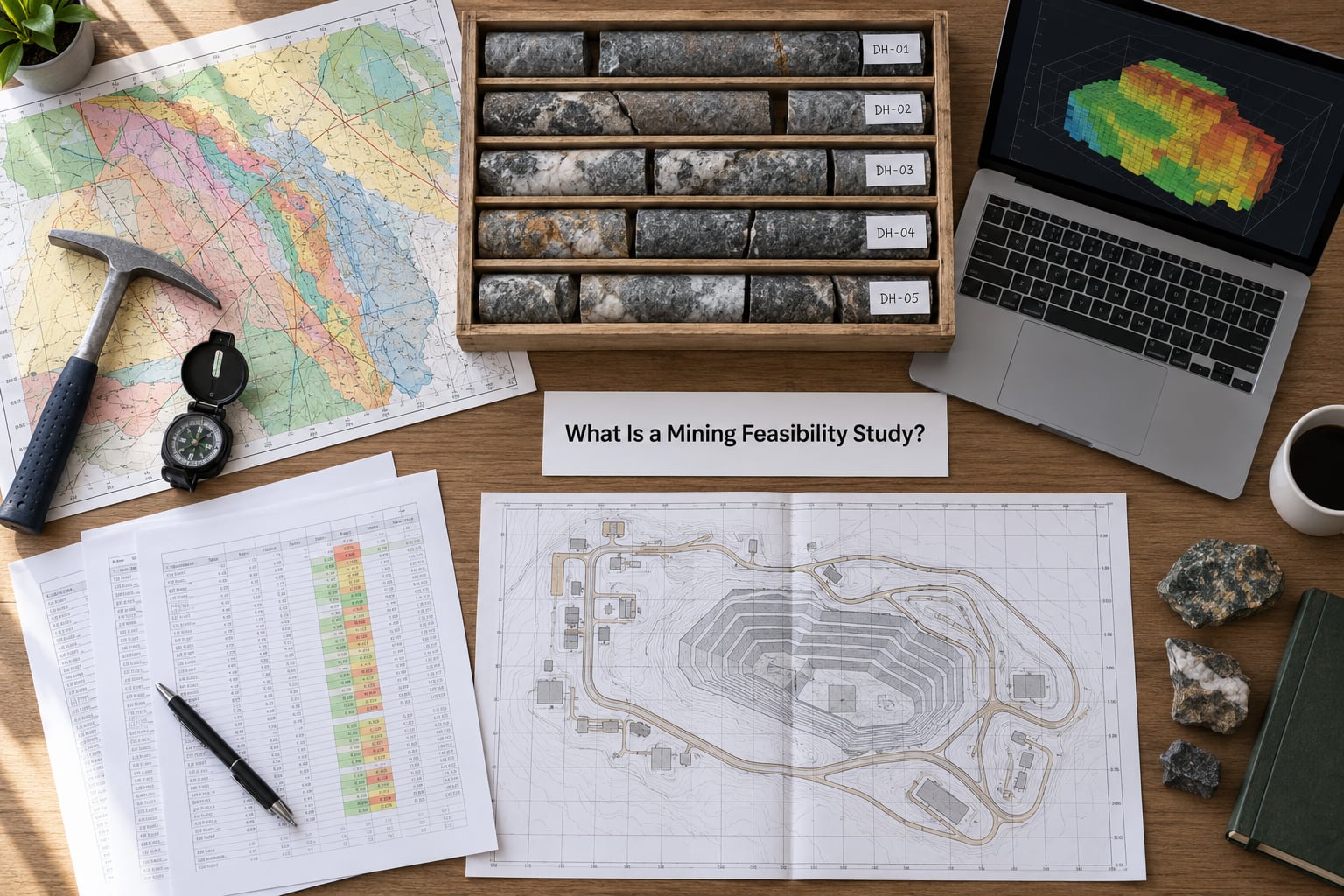
A mining feasibility study pulls geology, mining engineering, metallurgy, infrastructure, permitting, environment and finance into a single document, then tests whether all of those pieces work together and still make money. Each discipline hands a number to the next one, so the study is really a chain of assumptions that every downstream result depends on.
What questions does a feasibility study answer?
- Is there enough ore of the required grade, and where exactly is it?
- Can that ore be recovered using a mine plan and a processing route that work at commercial scale?
- What does the plant and mine cost to build, and what does it cost to run each year?
- What infrastructure, permits and workforce does the site need?
- What metal price, recovery rate and throughput does the project need to clear a return threshold?
How is it different from exploration or a scoping study?
Exploration creates knowledge about the ground. It produces drill assays, geophysics and a geological model, and it does not claim any economics. A scoping study takes that early knowledge and asks a coarse version of the same question an engineer would ask later: roughly what could this deposit be, and roughly what would it take.
A feasibility study answers the same question at a much higher level of definition. Compressor and mill vendors quote real prices, the pit shell is drawn against a specific cut-off grade, the tailings facility is sited, and the cost estimate carries an accuracy class instead of a shrug. That difference in resolution is the whole point of the ladder.
Why Mining Companies Commission Feasibility Studies
Mining commits enormous sums of capital before a single tonne moves. Companies commission feasibility studies to replace guesses with numbers, because a board approving a decision to mine is signing a cheque, not writing a plan.
Four decisions usually sit behind a study. The first is internal: whether to spend the next exploration or engineering dollar, or to walk away. The second is financial: whether the project can carry enough debt, which lenders test by running their own due diligence on the same technical report. The third is legal: a regulator will not process a development application without an approved environmental and social assessment, and the feasibility study usually feeds that submission.
There is also a disclosure reason. Listed companies on the Toronto, London or Australian exchanges, and US issuers reporting to the SEC, must publish technical report results under a recognised code. So a study is frequently public whether or not the company wants it to be, which is why a pre-feasibility announcement can move a share price before the board has decided anything.
What a completed study does not do is settle the project. It removes one layer of uncertainty, then exposes the next one: a thinner orebody than the block model showed, a permit that takes four years, a community that disagrees with the tailings plan. Treating a green feasibility study as a promise is the single most common mistake retail investors make with this document.
The Main Stages of a Mining Feasibility Study
Mine planning moves from the broadest question to the most expensive one, and each stage buys a specific kind of confidence.
| Stage | Purpose | Typical output | Cost accuracy |
|---|---|---|---|
| Exploration and resource definition | Establish that the deposit exists and size it | Drill database, geological model, classified resource | Wide, sampling-dependent |
| Preliminary economic assessment (PEA) | Ask whether the deposit is worth more study at all | Conceptual mine plan, first-pass economics, often measured and indicated material only | Plus or minus 30 to 50 percent |
| Scoping study | Compare real mining and processing options | Shortlisted flowsheet and equipment, trade-off studies | Plus or minus 30 to 35 percent |
| Pre-feasibility study | Test a selected option against capital market expectations | Definitive plan outline, first defensible NPV, first ore reserve estimate | Plus or minus 20 to 30 percent |
| Feasibility or bankable feasibility study | Provide the basis for funding and construction | Detailed engineering basis, vendor quotes, reserve statement, signed technical report | Plus or minus 10 to 20 percent |
| Detailed engineering and construction | Turn the study into buildable designs and contracts | Issued for construction drawings, fixed-price contracts | Firm contract value |
Accuracy bands are conventions, not promises, and some engineering firms will accept wider ranges on a PEA than others. The pattern holds regardless: every rung narrows the error bars on capital and operating costs, and every rung costs money and months to produce.
What Does a Mining Feasibility Study Measure?
The geology section converts drill cores into a three-dimensional block model, which is then cut by a cut-off grade, the minimum grade worth mining. Everything downstream flows from that line. A cut-off grade set too low inflates the tonnage, drags the average grade down and usually raises strip ratio, the amount of waste that must be moved for each tonne of ore.
Resources versus reserves
Three resource categories appear in mining, ordered by confidence: measured, indicated and inferred. Inferred material carries too little geological confidence to be relied on for mine design. Codes are explicit that inferred material may be used for early-stage exploration and PEA economics but is not carried into a pre-feasibility or feasibility ore reserve.
Reserves are the subset of resources proven to be economically mineable. Proven reserves sit at the high-confidence end; probable reserves make up the bulk of most open-pit orebodies. That gap between resource tonnage and reserve tonnage is where a lot of disappointment lives, and it shrinks or grows with every study stage.
The engineering and cost variables
A feasibility study reports throughput at the plant, metallurgical recovery by stage, dilution, geotechnical conditions, and the capital cost of the mine, plant, tailings storage facility, roads, power and water. It also reports operating cost per tonne processed, usually split into mining, milling and general and administrative, plus sustaining capital needed to keep the operation running. It closes the loop with life of mine, closure and reclamation cost, royalties and taxes, and the financing structure assumed. Every one of those is an estimate until tonnes have moved.
Reading any two projects side by side is only fair if the assumptions match. One study may quote a plant at full nameplate capacity while another assumes a shared toll milling facility, and one may price the mine on a nominal 2026 dollar basis while another uses real constant dollars. Normalise those differences before you compare returns.
How the Study Estimates a Mine’s Economics
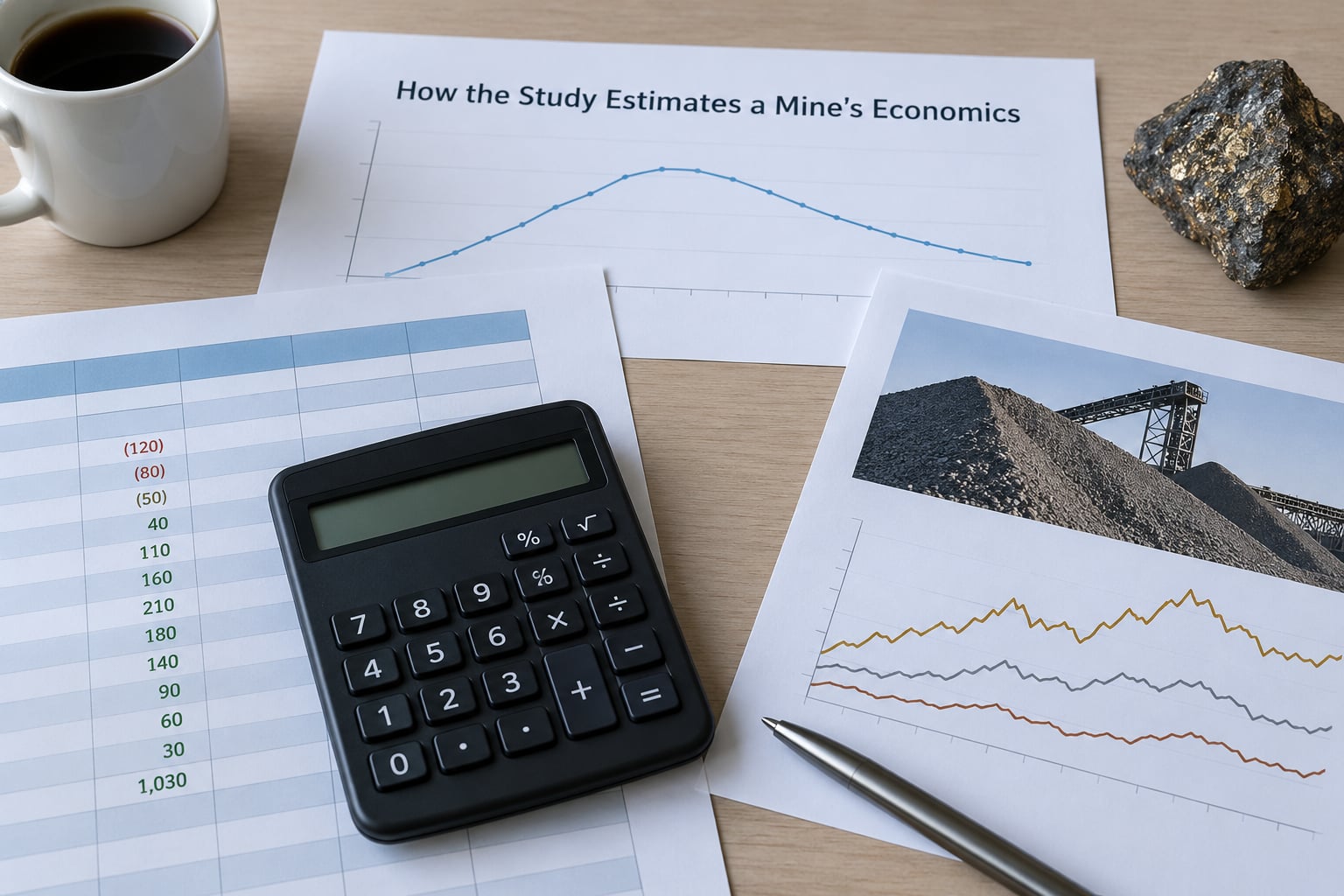
The economics are built bottom-up. Revenue is tonnes mined times grade times metallurgical recovery times the metal price, less selling costs and royalties. Operating costs are deducted to give a margin per tonne, and that margin times annual throughput gives operating cash flow. Initial capital is spread across construction, and sustaining capital is spread across the production schedule. Taxes and closure come out at the end.
Three numbers summarise the result, and each one hides an assumption:
| Metric | What it actually tells you | The assumption to check first |
|---|---|---|
| Net present value | The value of all future cash flow, measured in today’s money and subtracting the cost of building the mine | The discount rate, and whether the figure is after tax |
| Internal rate of return | The return the project earns on capital invested, expressed as a percentage per year | The same discount convention, and whether it is pre-tax or post-tax |
| Payback period | How long until cumulative cash flow covers the money spent | Whether sustaining capital is counted against you |
| Sensitivity analysis | Which single assumption moves the result most when flexed | Whether price, grade and recovery were all flexed independently |
The discount rate deserves more attention than most readers give it. It is the cost of capital applied to future cash flow, and studies commonly use figures in the region of 5 to 8 percent for the base case, with higher rates used to test resilience. Raising the rate lowers the present value of everything further out in a 20-year mine life, which is why two projects with similar headline economics can look very different once the rates are set on the same basis.
The price deck does at least as much work. Most companies run a base case at or near consensus long-run prices and then show downside cases. A study that only publishes its base case is asking you to supply your own view of the metal, and a view is precisely what you should not have to guess about.
What Is the Difference Between a Feasibility Study and a Bankable Feasibility Study?
Both terms describe a full feasibility study, and the distinction is about purpose rather than content. A standard feasibility study is the engineering and economic assessment itself. A bankable feasibility study is one prepared to a standard lenders and underwriters will accept as the technical basis for a financing decision.
What separates them in practice is depth and traceability. Equipment selection moves from approximate sizing to firm vendor quotations. The mine design tightens from a general layout to a scheduled, year-by-year plan. Costs carry a declared accuracy class with a named estimating method. Infrastructure, permitting status and community engagement are documented rather than assumed. The result is a report a bank can underwrite against, typically produced under a code such as NI 43-101, the JORC Code, PERC or the SEC’s S-K 1300 disclosure standard, with a named qualified person taking responsibility for the geology and resource figures.
Bankable means acceptable for submission to financiers. It does not mean a bank has agreed to lend, does not mean a permit is in hand, and does not protect anyone from a commodity price falling the following quarter.
What Risks Can a Feasibility Study Still Miss?
A feasibility study describes the project as accurately as current knowledge allows. It cannot know what the next commodity cycle does, and several risks sit outside its model entirely.
- Price and market risk. The study fixes one commodity price assumption, and a project can be economic at one price and uneconomic at another with no change to the geology.
- Geological risk. Ore bodies are not uniform. Grade, thickness and geometry vary, and the blocks that pay for the mine are rarely the ones the first model emphasised.
- Permitting and legal risk. Environmental approvals, water rights, indigenous consultation and land access each have their own timeline, and none of them is under the engineer’s control.
- Cost and schedule inflation. Capital cost estimates carry accuracy bands, and the band is a measure of confidence in the estimate, not a cap on what the project can spend.
- Infrastructure and construction risk. Power, water and transport arrangements that look routine on paper can be the item that dictates the schedule.
- Community and social licence. Opposition can reshape a project after years of study work, and it is rarely quantified in an economic model.
- Environmental liability. Closure cost, water treatment over decades and acid rock drainage can all outlast the production schedule the model assumes.
Projects with a positive feasibility study still stall in what some in the industry call the study graveyard, and the reasons usually surface only in confidential due diligence rather than in the press release. For an investor, that gap is the thing to watch, not the NPV figure.
How to Read a Mining Feasibility Study as an Investor
Start at the end and work backwards. The headline number is the least informative part of the report until you know what produced it.
- Find the price deck. What metal price did they assume, in real terms, and at what date? Then check what happens to the result if it is 20 percent lower.
- Find the discount rate and tax basis. A pre-tax NPV and an after-tax NPV are different numbers, and both are published, often far apart.
- Check the reserve mix. How much of the reserve is proven, and how much is probable? How much material was in the resource but excluded from the reserve?
- Separate initial from sustaining capital. Initial capital is the build. Sustaining capital is the ongoing spend that keeps the plant running and the reserve producing, and it is where a long life-of-mine schedule quietly hides cost.
- Read the production schedule, not just the average. Ask whether the back half of the mine life relies on lower-grade ore, which usually means more tonnes moved for the same metal.
- Check the mill. Is it a new plant the company has to build and staff, or toll milling at a neighbour’s facility? The second removes capital and risk but adds price exposure.
- Look at the sensitivity table. It tells you which assumption the project actually depends on. If grade and price move the answer and recovery barely does, that is where to concentrate.
- Check the jurisdiction and permitting status. What approvals exist, how long have they taken so far, and is there an offtake agreement, a stream or a royalty that cuts into returns before the equity holder sees any?
- Check the report’s credentials. Which reporting code applies, who signed as qualified person, and is the estimate company independent of the developer?
A few terms show up constantly and are worth keeping straight. A resource is material estimated with geological confidence. A reserve is material shown to be mineable at the assumed cost and price. Cut-off grade is the line deciding which material counts. Life of mine is the production period modelled. And a qualified person is the named individual, working to a code, who takes responsibility for the technical report.
Frequently Asked Questions
What is a feasibility study in mining?
A mining feasibility study is a detailed technical and economic assessment of a proposed mine. It models the deposit, designs the mine and processing plant, estimates capital and operating costs, assesses permitting and infrastructure, and runs those numbers through an economic model to produce net present value, internal rate of return and payback under a stated commodity price assumption.
What are the 5 major components of a mining feasibility study?
The five core components are geology and resource estimation, mining and mine design, metallurgy and processing, infrastructure and services, and project economics including capital cost, operating cost, closure and financing. Environmental, social and legal work runs alongside these, and the permitting status of the project appears in the study even though approvals are obtained separately.
What is an example of a mining feasibility study?
A listed gold company might publish a feasibility study reporting an after-tax net present value of roughly 600 million US dollars at a 5 percent discount rate, an internal rate of return near 27 percent, initial capital of about 700 million and a 12-year mine life. Read that headline only alongside the price deck, the reserve mix and the capital figure, because each assumption can move the result more than the mine plan can.
How much does a feasibility study typically cost and how long does it take?
A full feasibility study usually runs in the region of 5 to 20 million US dollars and takes about 9 to 18 months, depending on deposit complexity, metallurgical test work and baseline data collection. Scoping and preliminary economic assessment stages cost far less and complete faster. Those figures cover the study itself, not permitting, which frequently runs two to three years in parallel.
Is a positive feasibility study a guarantee the mine will be built?
No. A positive feasibility study shows the project can work on paper under stated assumptions. Permitting, community consent, financing, offtake and construction execution all sit outside the model, and many positive studies never reach production. Treat the study as strong evidence about engineering and economics, not a promise about schedules or commodity prices.
What to Check First in Any Feasibility Study
If you read nothing else, read the commodity price assumption and the reserve statement. Everything else in a mining feasibility study is a detailed argument built on those two, and the gap between what a headline net present value claims and what those assumptions support is usually where the real investment debate lives.