
You can invest in nickel through exchange-traded funds, individual mining company shares, futures and options contracts, or physical metal — and the honest answer is that most beginners should start with a fund rather than a single mine. Nickel is a base metal, so it behaves like industrial demand rather than like gold. This guide walks through each route, what actually moves the price, and how to size a position you can live with.
Table of Contents
- How to Invest in Nickel: What You Need
- Step-by-Step
- Set Your Objective and Risk Limit
- Understand Nickel Demand and Pricing
- Choose Your Investment Route
- Research the Company or Fund
- Buy in a Measured Position
- Monitor and Review Your Nickel Exposure
- Common Mistakes
- Treating nickel like a savings account
- Ignoring country risk
- Confusing exploration stories with mines
- Overconcentrating
- Chasing a price move
- Using leverage without understanding the mechanics
- Frequently Asked Questions
- What is the best way to invest in nickel?
- Are nickel mining stocks better than nickel ETFs?
- Can individual investors buy physical nickel?
- How volatile is nickel compared with other commodities?
- Can I invest in nickel through a retirement account?
- How does battery demand affect nickel investments?
- Conclusion
How to Invest in Nickel: What You Need
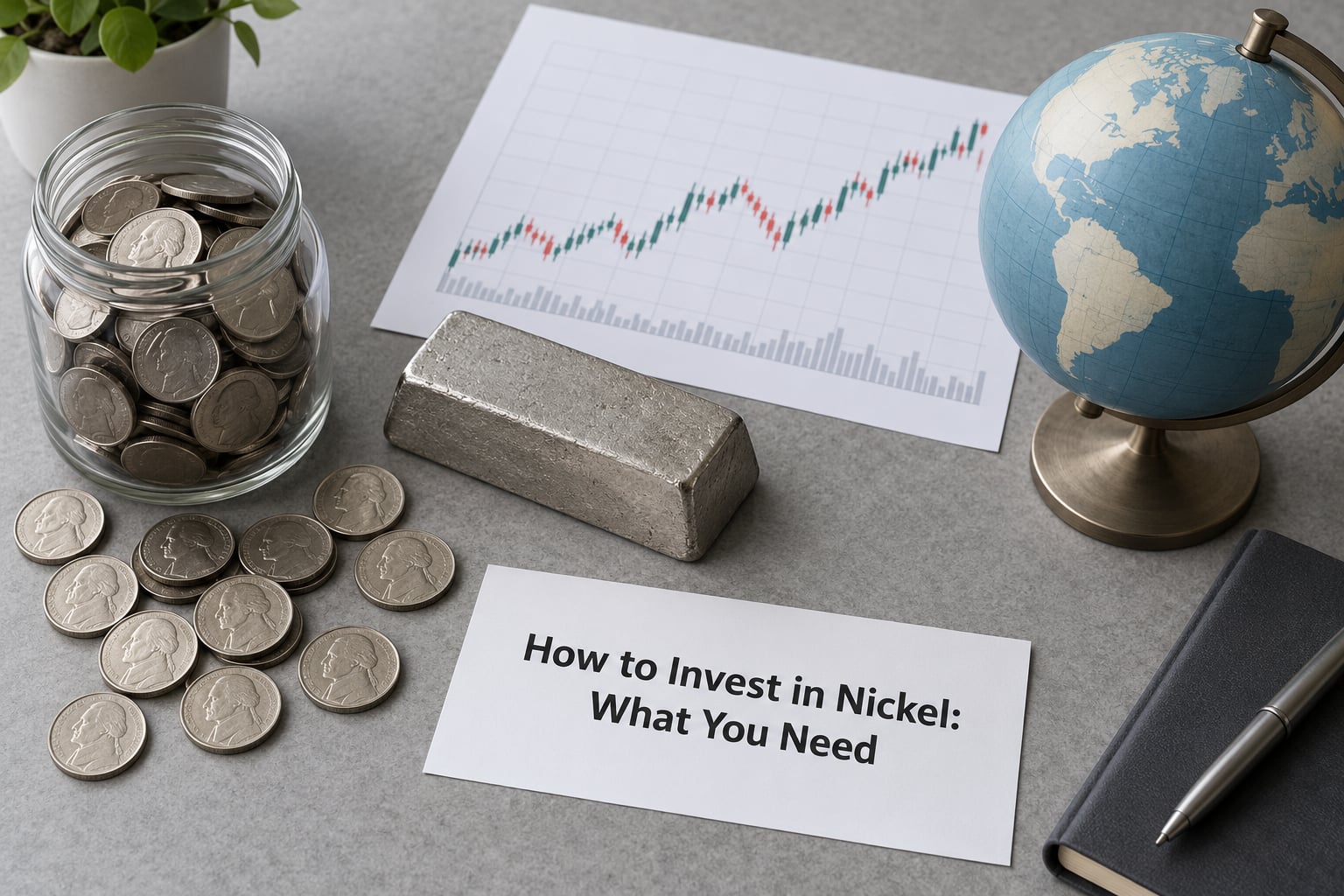
Before you buy anything, decide what you are actually buying. A nickel fund gives you a slice of several miners at once. A single share gives you one company’s cost curve, debt load and management team. A futures contract gives you leverage and a margin call you have to be ready for.
Nickel itself is a silvery base metal used mostly in stainless steel, which accounts for roughly 70% of demand, and increasingly in electric vehicle battery cathodes. The US Geological Survey lists it as a critical mineral. That combination — a heavy industrial base tied to stainless steel plus an electrification story — is what makes it interesting and what makes it volatile.
Here is what you need before starting:
- A brokerage account that covers your country. The same fund can be available on one platform and missing entirely on another, especially in the UK, Canada and Australia. Check before you plan around it.
- An idea of your time horizon. Nickel is a cyclical commodity, not a growth asset, and prices here can sit still for years between major moves. Give the position a horizon measured in years, not quarters.
- A written maximum loss. Decide the figure before you open a position, not after.
- Basic supply and demand context. Understanding where nickel comes from explains most of the price action.
- Access to the right filings. Annual reports, quarterly production updates and fund factsheets are where the real numbers live.
The one piece of context worth getting right early is the quality split. The London Metal Exchange delivers class 1 refined nickel, a specific grade with tight chemical specifications. Much of the world’s mined nickel is class 2 — nickel pig iron, nickel matte and high-pressure acid leaching sulphate — which sells at a discount to the headline exchange price. A miner can be profitable while the LME price looks weak, and the reverse happens too. If you ignore this, every price chart you look at will confuse you.
Step-by-Step
Set Your Objective and Risk Limit
Start by naming what you want the position to do. There are four honest answers, and only one of them is usually right for a first position.
A small satellite position for diversification is the most defensible. You want a slice of industrial commodity exposure alongside a bond and equity core, and you accept it may go nowhere for a while. A pure inflation hedge is a weaker argument than most marketing suggests, because nickel supply can expand faster than demand in a bad year.
Trading for profit is a different job entirely. It needs a defined exit, a risk per trade, and hours you actually have. Long-term growth is the least reliable framing, because nickel miners are commodity businesses whose earnings track the metal, not a compounder’s revenue curve.
Then set the size. For a single cyclical commodity, most sensible portfolios keep it in low single digits as a percentage of total value. Whatever you choose has to survive a 40% drawdown without forcing you to sell, because drawdowns of that size are ordinary in this metal.
Understand Nickel Demand and Pricing
Nickel demand splits into a large steady half and a fast-growing smaller half, and they behave differently.
Stainless steel is the anchor. Roughly 70% of demand goes into stainless steel production, which follows construction, appliances, food processing equipment and industrial capital spending. When global manufacturing slows, stainless demand slows with it, and that usually outweighs anything happening in the battery sector.
EV batteries are the growth engine. Nickel-rich cathodes such as NMC deliver more energy density per cell, which matters for range. The International Energy Agency has projected battery demand rising more than fortyfold by 2040, and nickel-rich chemistries are part of that path. But the honest counterweight is LFP, a lithium-iron-phosphate chemistry that uses no nickel at all and has been gaining share in shorter-range and lower-cost vehicles, including energy storage.
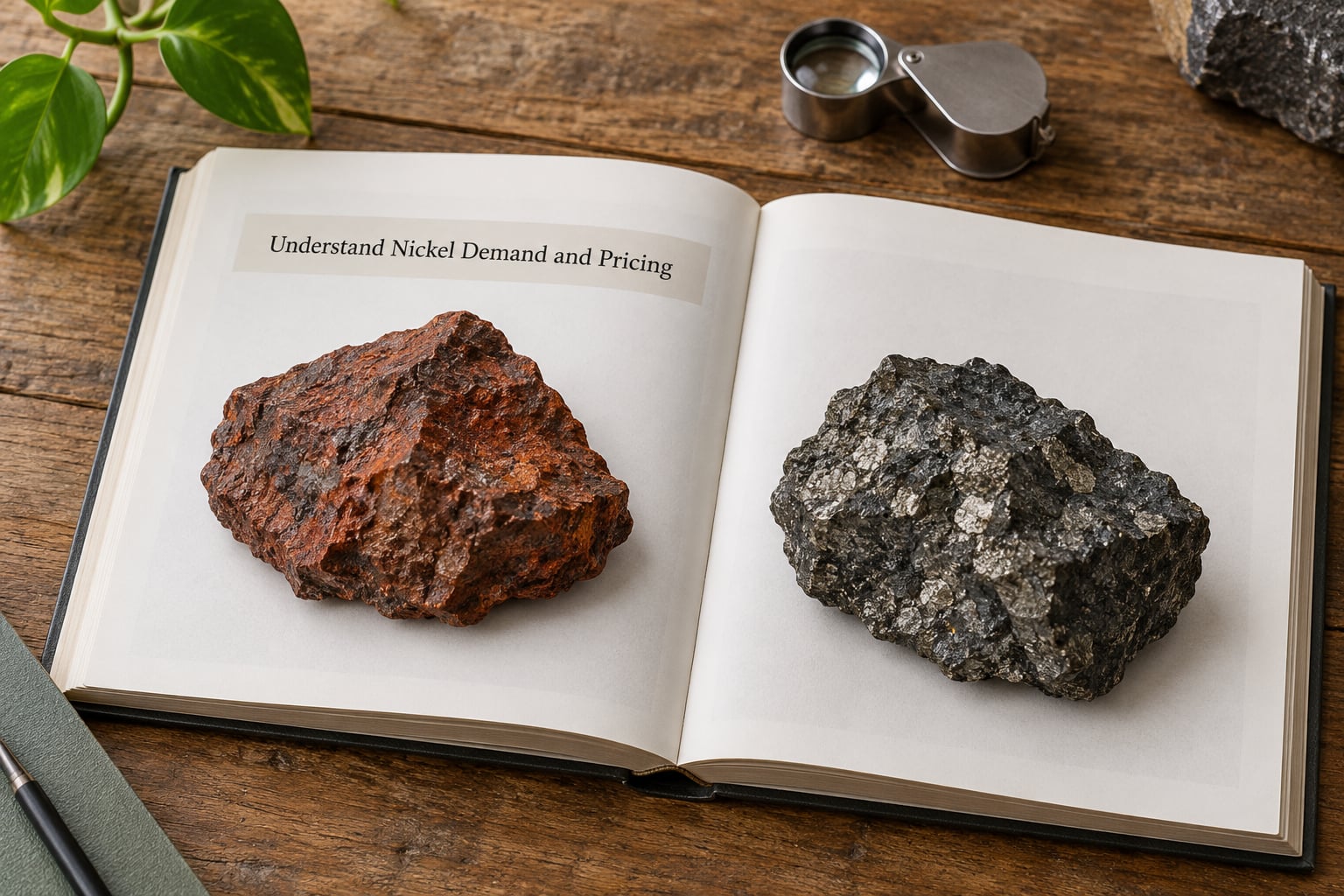
On the supply side, Indonesia now dominates mined nickel output after its ore export ban pushed processing onshore. Philippine and New Caledonian output matters too, along with Canadian, Australian and Brazilian operations. Indonesian policy — specifically how many mining licences and quotas are granted — is the single biggest swing factor most retail investors are not watching. When quotas tighten, prices react hard and fast.
Add exchange-level event risk to that list. In March 2022 the LME nickel market delivered a short squeeze that forced a trading halt and left some traders with margin calls they could not meet. It is the clearest reminder that this is not a market where you experiment with borrowed money.
Choose Your Investment Route
Here is the comparison most guides skip. Read across the row that matches your situation rather than the row you wish matched.
| Route | Capital needed | Borrowing allowed | Complexity | Liquidity | Best for |
|---|---|---|---|---|---|
| Nickel ETF or fund | One share | No | Low | Moderate; spreads can be wide in less popular funds | Most first-time investors |
| Producer shares | One share | Margin, at your broker’s risk | Medium | Good for large caps, patchy for juniors | Investors who want to research individual operations |
| Futures and options | Margin plus substantial capital | Yes, by design | High | Exchange-traded, but leveraged losses | Experienced traders only |
| Diversified metals fund | One share | No | Low | Good | Investors who want base metals, not a single metal |
| Physical metal | Substantial, with storage and insurance | No | Medium | Poor; resale is usually a private sale | Investors who want metal in hand |
On named retail funds, the useful question is not which one is best but what each one actually holds. The Sprott Nickel Miners ETF, ticker NIKL, is the main US-listed pure-play option and tracks a basket of global nickel producers. WisdomTree Nickel gives broad country and exchange access in Europe but trades thin on many retail platforms. The Invesco DB Base Metals Fund holds a diversified basket of base metal miners, so nickel is one position among many. Junior mining products concentrate exploration-stage companies, which carry a very different risk profile from producing mines.
Individual producers divide into three groups. Diversified majors such as Vale and Glencore earn most of their money from other commodities, which dampens both upside and downside. Pure-play producers such as Eramet and Nickel Industries give you direct nickel beta but far more volatility, and Nickel Industries in particular trades on US screens as an over-the-counter listing with a thinner order book. Exploration-stage juniors are closer to venture bets on a geology story than to a business with cash flow.
Physical metal is the least practical route and the most direct one. Nickel is heavy and expensive per unit of value, so storing an amount worth real money costs meaningful space and insurance. Coins and small bars exist, but resale is slow, dealer spreads are wide, and most retail buyers end up holding metal they will never sell.
Research the Company or Fund
For a fund, the checklist is short: what does it hold, what is its expense ratio, how much does it trade in average volume, and does it use derivatives or physical metal? Average daily volume matters more than almost anything else, because retail investors report slippage on thinly traded nickel products, and a limit order is the sensible default.
For a mining company, look at operating cash flow rather than net income. Net income swings with write-downs and financing items; EBITDA and free cash flow tell you what the mine actually produced in cash. Then check four more things:
- Where it sits on the cost curve. A producer near the bottom keeps earning money when the price is weak. A high-cost producer can be loss-making at prices that look healthy.
- Debt against cash flow. Capital-intensive operations expand debt during build phases, and debt turns a price dip into a crisis.
- Reserves versus resources. Reserves are the part you can economically mine. Resources are geological estimates. Exploration stories trade on resources, and the gap between the two is where retail investors get hurt.
- Product mix and jurisdiction. Indonesian pig iron and sulphide concentrate sell into different markets at different discounts, and country risk ranges from mild to severe.
Buy in a Measured Position
Enter in stages rather than at once. Committing part of your intended allocation now and the rest over subsequent periods smooths the timing risk without requiring you to call a bottom.
Use limit orders, not market orders, especially in the thinner nickel products. The difference between the quoted price and the price you get can be large when a fund trades few shares a day.
Keep total commodity exposure bounded. Owning a nickel fund plus two nickel producers plus a base metals fund is concentration, not diversification, even though the tickers look different.
Monitor and Review Your Nickel Exposure
Set a review rhythm, and let it be scheduled. Quarterly production updates and fund factsheets are enough for most positions, plus a price check during major policy or supply events.
Watch a small set of things: quarterly production versus guidance, cash costs per tonne, net debt movement, capital expenditure commitments, and any change to Indonesian quota policy or export rules. For funds, watch the holdings list and the trading volume.
Revisit when the thesis breaks, not when the price moves. A fund that changes its mandate, a producer whose cost curve has shifted permanently, or a policy regime that alters supply assumptions — those are reasons to act. A down 15% quarter that follows a strong run is not.
Common Mistakes
Treating nickel like a savings account
It is not a hedge that compounds quietly. Base metals move with the industrial cycle, often harder than precious metals do. Hold it with a time horizon measured in years, not quarters.
Ignoring country risk
A large share of world supply sits in one jurisdiction with a history of abrupt policy changes. A company can execute perfectly and still have its economics rewritten by a licence or quota decision.
Confusing exploration stories with mines
Junior explorers with exciting press releases are selling a future. Check for cash generation, permitting progress and dilution history before treating them as an operating business.
Overconcentrating
A nickel fund, a nickel producer and a base metals fund all rise and fall together. Combine them into one modest allocation rather than three larger ones.
Chasing a price move
Buying after a sharp rally is how people end up holding the full position at the top of a cycle. Fixed allocation dates beat market timing almost every time.
Using leverage without understanding the mechanics
Futures margin is not a deposit on a purchase. A wrong position produces a daily cash demand you must meet, and the 2022 LME episode showed what happens when the exchange itself intervenes.
Frequently Asked Questions
What is the best way to invest in nickel?
For most beginners, a diversified nickel-focused fund is the best starting point because it spreads exposure across several producers and avoids single-company risk. Individual shares suit investors willing to research a miner’s cost curve, debt and reserves in depth. Futures and options carry leverage and margin demands that only experienced traders should take on. Physical metal gives direct ownership but is expensive to store and slow to resell.
Are nickel mining stocks better than nickel ETFs?
Neither is better in the abstract; they serve different purposes. A fund is lower-maintenance but adds an expense ratio and, for pure-play products, thinner liquidity. Individual shares can outperform sharply when a producer sits low on the cost curve, and can fall just as sharply. Shares also let you add a dividend or a specific jurisdiction. Choose the fund for simplicity and shares only where you have done the operating research.
Can individual investors buy physical nickel?
Yes. Coins, small bars and industrial nickel can be bought from bullion dealers and some refineries. The practical drawbacks are weight, storage and insurance cost, and a weak secondary market. Retail buyers frequently find that selling back requires a private sale at a dealer spread. Physical holding works best if you already plan to keep the metal long term and value having it in hand.
How volatile is nickel compared with other commodities?
Nickel is more volatile than gold and copper and considerably more volatile than broad commodity indices. It has produced sharp drawdowns, and the March 2022 LME short squeeze led to a trading halt. Part of the movement comes from a small, concentrated supply base where policy changes in a single country can move global balances quickly. Size positions accordingly.
Can I invest in nickel through a retirement account?
Usually yes, as long as your plan permits the security. Most brokerage and platform retirement accounts allow exchange-traded funds and listed shares, which covers the common nickel routes. Physical metal is generally not eligible inside a pension or tax-sheltered account. Rules and eligible assets vary by country and by plan, so check your provider’s list before you buy anything.
How does battery demand affect nickel investments?
Battery cathode demand is the fastest-growing part of nickel consumption and the main reason long-range forecasts look constructive. It is not guaranteed. LFP chemistry uses no nickel and keeps taking share in shorter-range vehicles and grid storage, so the share of batteries that are nickel-rich is not fixed. Treat battery demand as a scenario that supports the long-term case, not as a floor under the price.
Conclusion
Start by writing down the job the position is meant to do and the maximum you are willing to lose. Then compare a diversified fund with a more speculative single share, check that your broker actually offers it and how heavily it trades, and size it small enough to survive a 40% drop. Invest only what you can hold through commodity volatility, and review it when the facts change rather than when the price does. Rules, tax treatment and available products differ by country, so check the specifics where you live.