Proven vs probable reserves in mining comes down to confidence. A proven (proved) reserve is the economically mineable part of a measured mineral resource, demonstrated by at least a pre-feasibility study. A probable reserve is the economically mineable part of an indicated, or sometimes measured, resource, where grade and continuity carry more interpretation.
Both numbers come out of the same technical report and both feed the same headline total, which is why retail investors routinely get the distinction wrong. This guide walks through where each class comes from, what it does to a mine plan, and how to read the disclosure without fooling yourself.
Table of Contents
- Proven vs Probable Reserves in Mining at a Glance
- What Are Proven Reserves in Mining?
- What the sign-off actually says
- What Are Probable Reserves in Mining?
- How Are Mineral Reserves Classified and Converted?
- The five classes behind proven vs probable reserves in mining
- Which study can actually declare a reserve
- Why the total keeps shrinking
- Watch for the inclusive convention
- Which Reserve Category Is More Valuable to Investors?
- Why Do Mining Companies Report Both Categories?
- How Do Proven and Probable Reserves Affect Valuation?
- What Errors Can Investors Make When Comparing Reserves?
- How to Read a Mining Company’s Reserve Disclosure
- Frequently Asked Questions
- What is the difference between proven and probable reserves?
- Can an indicated resource become a proven reserve?
- What do reserves mean in mining?
- Are proven and proved the same thing?
- Which study is needed to declare a mineral reserve?
- Why do mining companies report lower reserves every year?
- Conclusion
Proven vs Probable Reserves in Mining at a Glance
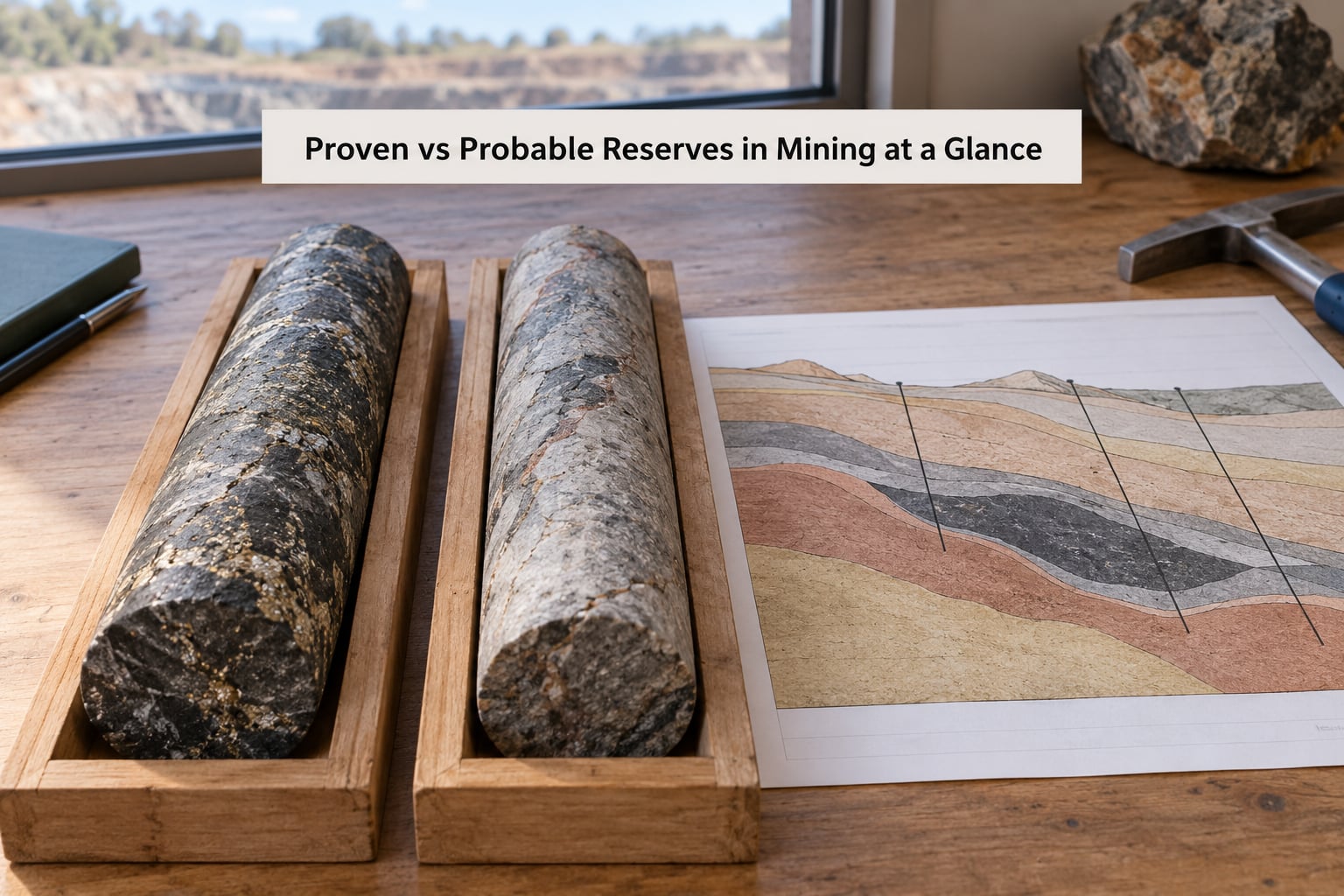
A reserve is not a geological estimate. It is a geological estimate after every mining, metallurgical, legal and economic constraint has been applied, and that is why two different confidence classes end up sitting inside one blended figure. The comparison below is the version you need before you look at any single asset.
| Criterion | Proven (proved) reserve | Probable reserve |
|---|---|---|
| Confidence level | High | Moderate to high |
| Underlying resource class | Measured resource | Indicated resource, sometimes measured |
| Geological meaning | Sampled closely enough that grade and tonnage variation is well constrained across the deposit | Sampled widely enough to establish continuity, with grade variation less tightly constrained |
| Typical drill spacing | Dense infill spacing over most of the footprint | Wider spacing, with infill still concentrated where the mine plan needs it |
| Role in mine planning | Feeds the first years of the schedule and underpins capital staging | Supplies the back end of the mine life and much of the pit or stope shape |
| Cost estimate accuracy | Commonly quoted at plus or minus 10 to 15 percent | Commonly quoted at plus or minus 15 to 25 percent |
| Financing acceptance | Readily accepted by banks and offtake counterparties | Accepted, usually with a wider contingency and a longer payback view |
| Upgrade path | Effectively terminal; it gets mined or it gets written down | Often upgrades to proven as infill drilling and detailed mine design progress |
| What it signals for investors | Near-term production and near-term cash flow | Mine-life visibility and upside, at the cost of more estimation risk |
One useful mental model comes from Abacus Mining’s plain-English framing: think of proven reserves as coins counted and verified in a jar, and probable reserves as coins very likely to be there based on good sampling. The analogy breaks down quickly for large orebodies with complex metallurgy, but it captures the gap in confidence perfectly at the start of an investor’s work.
What Are Proven Reserves in Mining?
A proven reserve starts life as a measured resource, which is the highest-confidence resource class defined by the reporting codes. The deposit has been drilled on a tight grid, samples are assayed with quality control in place, and the geometallurgical model has been built and reviewed by people qualified to sign off on it.
From there, engineers apply the modifying factors: mining method and sequence, dilution from waste, ore losses, metallurgical recovery, infrastructure requirements, permitting status, royalties and streaming obligations. What survives at the assumed commodity price becomes reserve. Anything that fails the economic test stays a resource, no matter how confidently it was drilled.
The key point for investors is that proven is a statement about confidence in the tonnage and grade estimate, not a promise about profit. A proven orebody can still lose money if the commodity price assumption is wrong, if capital costs overrun, or if a community agreement or a royalty agreement eats the margin.
What the sign-off actually says
Under JORC, CRIRSCO and SEC subpart 1300 of S-K 1300, a qualified person or competent person must be named, and their name appears in the technical report. That person takes personal professional responsibility for the estimate and the assumptions behind it. Investors rarely read the name, but its presence tells you somebody with credentials stands behind the number.
What Are Probable Reserves in Mining?
A probable reserve is the economically mineable part of an indicated resource, and in some cases part of a measured resource where modifying factors or continuity leave enough doubt to prevent a proven classification. The confidence is lower, not absent. The material is still expected to be mined and still has to clear the same economic test.
The difference lives in interpretation. Grade continuity and lithological boundaries are extrapolated across wider drill spacing, and the block model carries more smoothing. Nothing about probable material is assumed to be worthless. It simply carries a wider error band, and the wider band has to be priced.
Probable reserves also move. A prospect that reports a large probable reserve this year may report part of it as proven next year, simply because infill drilling tightened the spacing and detailed mine design settled the sequencing. That upgrade path is one of the most reliable sources of good news in junior mining equities, and it is the single best argument for reading the probable share over time rather than treating it as a static number.
How Are Mineral Reserves Classified and Converted?
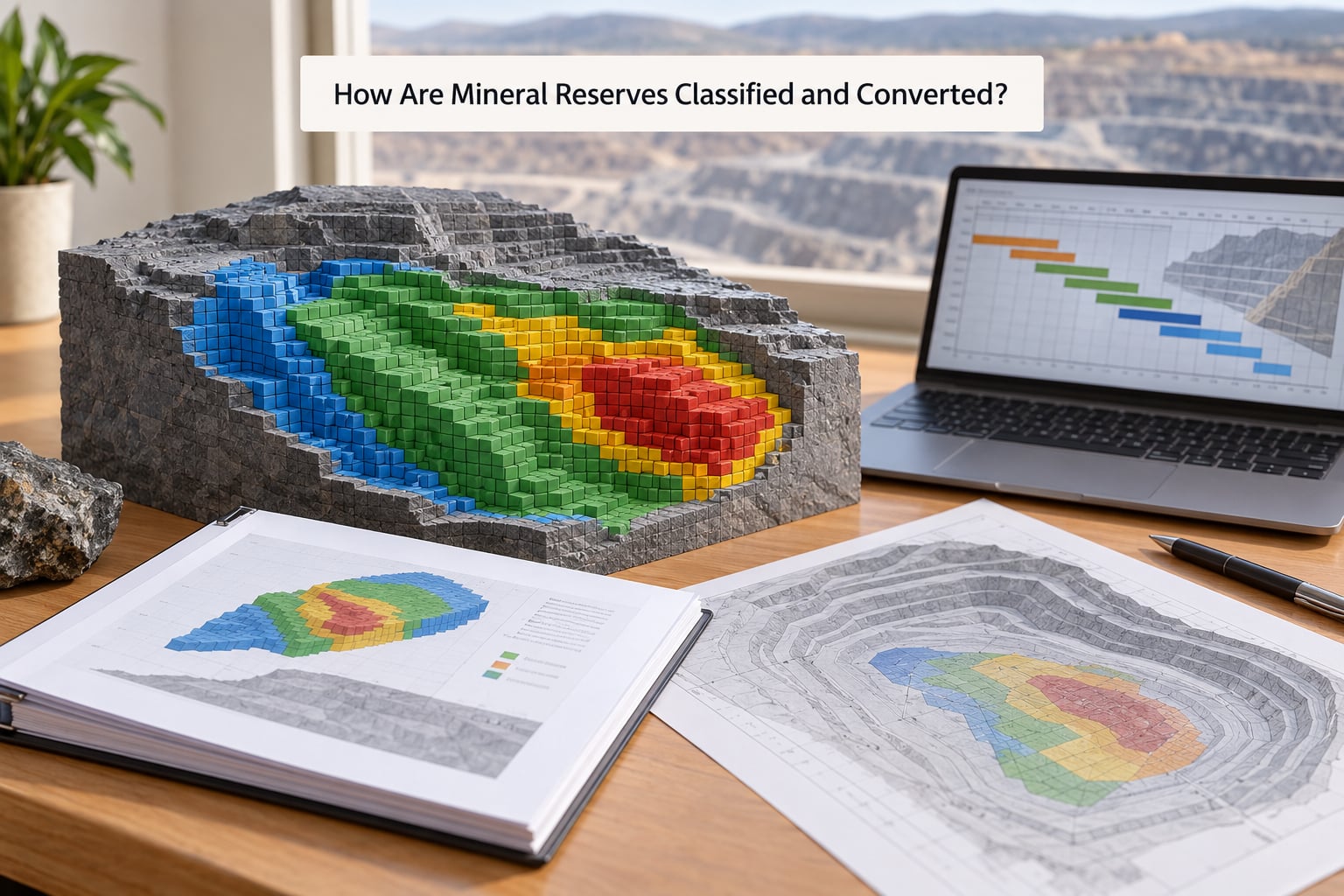
This is the section that clears up most of the confusion, including the one that generates the most forum traffic: how reserve categories map onto resource categories. The mapping is fixed by the codes and it runs in one direction only, from higher confidence to lower confidence.
The five classes behind proven vs probable reserves in mining
| Class | Confidence | Can it become a reserve? |
|---|---|---|
| Measured resource | High | Yes. Converts to proven or probable |
| Indicated resource | Moderate | Yes. Converts to probable only |
| Inferred resource | Low | No. Cannot be converted to a reserve |
| Proven (proved) reserve | High, after modifying factors | Already a reserve |
| Probable reserve | Moderate to high, after modifying factors | Already a reserve |
So the answer to the question that shows up repeatedly on mining forums is no. An indicated resource cannot become a proven reserve under any reporting code. If drilling upgrades the geology enough to support a proven classification, the material first has to be re-classified as a measured resource, and then the mine plan and economics have to be rerun on that new classification.
Inferred resources are excluded by definition. They represent a genuine volume of mineralisation with a legitimate exploration target, but the tonnage and grade carry an uncertainty band so wide that no responsible engineer will sign a reserve statement against them.
Which study can actually declare a reserve
| Study type | Resource estimate | Reserve statement | Cost estimate accuracy |
|---|---|---|---|
| Scoping study | Yes, coarse | No | Plus or minus 50 percent |
| Preliminary economic assessment (PEA) | Yes | No | Plus or minus 35 to 50 percent |
| Pre-feasibility study (PFS) | Yes, detailed | Yes, normally the first | Plus or minus 25 to 30 percent |
| Feasibility study (FS) | Yes, detailed | Yes | Plus or minus 15 to 20 percent |
If a press release quotes reserves without naming a pre-feasibility study or better, that is a red flag worth taking seriously. A scoping study or a PEA may describe a resource in economic terms, but it is not supported by the engineering detail needed to convert that resource into a reserve, and the codes say so plainly.
Why the total keeps shrinking
Reserves are a depleting inventory, not a growing one. Every tonne mined comes out of the proven and probable balance, and a mine that finds more than it consumes replaces reserves through exploration and conversion rather than through drilling alone. So a falling proven and probable total with a stable or rising resource base is normal, not a warning sign.
Watch for the inclusive convention
Some companies state that indicated resources are inclusive of mineral reserves. Newcore Gold’s Enchi study uses that convention. Readers who add the two numbers together, or who treat them as separate pots of value, double-count the same rock. Always check the reporting convention before comparing two tables.
Which Reserve Category Is More Valuable to Investors?
Neither category is more valuable in the abstract. Proven material is worth more per tonne because it carries less risk, and probable material is worth more in aggregate because there is usually a lot of it. The question that matters is what you are trying to fund and when you expect the cash to arrive.
For near-term production, near-term cash flow and financing, proven reserves win outright. They tell you what the next five to ten years of the schedule look like, which is exactly what a lender, a stream or a royalty buyer wants to underwrite. A developer with a small proven number but a funded construction path can raise capital far more easily than one holding a mountain of probable tonnes.
For mine-life visibility, probable reserves are indispensable. Most long-life pits and underground mines are designed so the early schedule draws on proven material while the pit shell and stope sequence are set by probable tonnes. Strip the probable out of any reserve statement and the mine plan collapses into a five-year program.
Grade variability is the quiet risk in the probable bucket. Wider drill spacing means more smoothing in the block model, and smoothed grades flatter a project. The fix is not distrust, it is sensitivity analysis: run the model at a lower grade and see whether the net present value survives.
And remember the difference between reported tonnage and economically recoverable material. Reserves are already net of dilution and losses, but they are still in the ground. The recoverable ounces sit inside them, subject to recovery assumptions that vary a lot by deposit type.
Why Do Mining Companies Report Both Categories?
Because the blend is what the mine plan is built on, and because a single number hides the risk profile. AngloGold’s Arthur project release aggregates its mineral reserve from the probable and proven categories, which is standard practice across the industry. The published P&P total is therefore a weighted average of two very different things.
The mix itself is informative. A company with a proven share above half is telling you its mine plan is largely underpinned by dense drilling. A company with a proven share under a quarter is telling you the opposite, and either the project is early stage or the drilling campaign has not yet caught up with the deposit.
A rising probable share is not automatically bad. Early-stage developers often publish large probable numbers because that is what supports an exploration programme and a preliminary economic assessment. The reserve grows when the drilling converts the resource, so the share of probable in today’s statement is partly a promise about next year’s statement.
There is a serious counterargument worth knowing. A mining engineer writing in a professional forum has pointed out that resources and reserves do not determine what is economically mineable, they merely represent it, and that automated mine design run in Monte-Carlo simulation across conditionally simulated spatial inventories would make the resource and reserve categories obsolete. If that argument holds, the categories are a reporting convenience rather than a physical fact. Banks and regulators still require them, so they stay.
How Do Proven and Probable Reserves Affect Valuation?
Valuation does not read reserves as a multiple of themselves. A mine’s net asset value is built by scheduling the tonnes into the plan, applying the recovery and cost assumptions from the study, discounting the resulting cash flows, and subtracting capital and corporate costs. Reserves determine how long that schedule runs and how confident each year is.
Three levers do most of the work. The first is discount rate, which is how investors price the gap between a proven schedule and a probable schedule. The second is whether probable tonnes enter the model at all, or enter with a probability weighting. The third is the price deck, because a reserve estimate is only valid at the commodity price used to test it.
That last point catches people. Reserve tonnage moves with the price assumption. A higher assumed price converts more of the marginal resource into reserve and extends pit shells; a lower price does the reverse, with no change in geology whatsoever. Two filings can therefore disagree on the same asset for a fully legitimate reason: different price decks, different codes, different effective dates.
The honest conclusion is that more tonnes do not mean more value. Adding a million tonnes of low-grade probable material to a marginal project can lower the net asset value by pushing the pit shell out faster than the grade pays for it. The investors who get hurt are the ones who treated the reserve line as a scoreboard.
What Errors Can Investors Make When Comparing Reserves?
Comparing two orebodies or two companies on headline tonnes is the root of most bad analysis. The specific traps are predictable, and each one has a quick fix.
- Comparing different commodities. Ounces, pounds and tonnes are not interchangeable, and a gold project’s tonne count tells you almost nothing next to a base metal project’s. Convert to a common unit, or to contained metal, before you compare anything.
- Ignoring the cut-off grade. Cut-off grade is the minimum grade below which material is treated as waste rather than ore. Two deposits can each hold ten million tonnes at the same cut-off and behave completely differently in a cash flow model, and a change in cut-off alone can move the reserve number substantially.
- Forgetting ownership and streams. A gross reserve figure may be split by a 20 percent government royalty, a joint venture share or a stream that takes a fixed share of gold production for the life of the mine. Always check whether you are looking at gross or attributable metal.
- Reading reserves as annual production. A 20-million-ounce reserve does not mean 20 million ounces next year. It means the total remaining inventory against the mine life, and production is whatever annual tonnage the plan calls for.
- Overlooking mine life. Short mine life means more capital per ounce and less time to repay it. Long mine life built mostly from probable tonnes means a different risk profile entirely.
- Mixing reporting codes. JORC, CRIRSCO’s International Reporting Template, NI 43-101 and the SEC’s subpart 1300 classify on the same underlying confidence logic but differ in thresholds and disclosure detail. Two documents quoting different numbers for one asset may simply be speaking different codes.
- Double counting. If a table states that resources are inclusive of reserves, adding the columns repeats the same material.
- Ignoring the price assumption. A reserve quoted with no price deck is not a complete statement.
How to Read a Mining Company’s Reserve Disclosure
Work through these eight steps before you build any valuation on a reserve figure. It takes about twenty minutes with the technical report open.
- Identify the reporting framework. Look for JORC, NI 43-101, CRIRSCO, SAMREC, PERC or SEC subpart 1300. If the document names none of them, treat the number as guidance rather than disclosure.
- Check the effective date of the estimate. Reserve figures are only true at that date, and a two-year-old statement may predate the current price environment, the current mine plan and a great deal of drilling.
- Separate proven from probable. Ask for the split in both tonnes and grade, not just the blended total. A blended number cannot tell you anything about near-term production.
- Compare grade against cut-off grade. Then sanity-check the grade against comparable operations. Published grade thresholds move with deposit type, commodity and jurisdiction, so a copper figure above one percent or a gold figure in the one to two gram per tonne range for a shallow orebody reads very differently from the same numbers at depth.
- Look for the price assumption and the cost estimate basis. Reserves quoted without a price deck, an exchange rate and a stated accuracy band are incomplete.
- Find the named qualified person or competent person. Under every modern code the estimate must be signed by someone with relevant experience, and their name should appear in the report.
- Match the numbers to a mine plan and a study stage. If the technical report is a PEA or scoping study, there should be no reserve statement at all.
- Reconcile year over year and across documents. Compare the current table with the previous annual statement and with the company’s investor presentations. Reserve depletion should be explainable by production plus new conversion. A figure that grows far faster than the drilling programme can explain deserves scepticism, and investors who have run their own confirmation drilling often walk away from deals where the technical reality does not match the data room.
Frequently Asked Questions
What is the difference between proven and probable reserves?
A proven (proved) reserve is the economically mineable part of a measured mineral resource, shown by at least a pre-feasibility study. A probable reserve is the economically mineable part of an indicated, or sometimes measured, resource, where grade and continuity carry more interpretation. Proven supports near-term production and financing; probable supplies the longer mine life.
Can an indicated resource become a proven reserve?
Not directly. Under JORC, CRIRSCO, NI 43-101 and SEC subpart 1300, an indicated resource converts to a probable reserve only. To reach proven status the material must first be re-classified as a measured resource through closer drilling and modelling, and the study must then be rerun with the modifying factors and economics applied.
What do reserves mean in mining?
A mineral reserve is the part of a mineral resource that is demonstrably economically mineable. Geologists estimate resources by confidence; engineers and economists then apply modifying factors such as mining method, dilution, recovery, costs, infrastructure and permits. Only the material that survives at the assumed commodity price is reported as a proved or probable reserve.
Are proven and proved the same thing?
Yes, they are the same reserve class. JORC, CRIRSCO and SEC subpart 1300 use the spelling Proved, while many North American disclosures and retail investors say proven. Some codes also distinguish proved from probable using a specific confidence boundary. Check which code a document is written to before comparing its figures.
Which study is needed to declare a mineral reserve?
At minimum a pre-feasibility study, with a feasibility study the normal choice for a producing asset. A scoping study or preliminary economic assessment can define a resource and describe an economic case, but neither carries the engineering detail on mining, recovery, cost and infrastructure that the codes require before material can be classified as a reserve.
Why do mining companies report lower reserves every year?
Reserves are a depleting inventory. Each year the mine extracts tonnes from the proven and probable balance, and replacement depends on new drilling converting resource into reserve. Where production exceeds conversion, the headline total falls even though the resource base is unchanged. That is normal depletion, not a sign the asset has gone bad.
Conclusion
Proven and probable reserves in mining are two confidence levels of the same thing, and the useful question is never how big the headline number is. It is how the split looks, at what grade, at what cut-off, under which price assumption, in which reporting code, and as of what date.
Start by pulling the proven and probable tonnes and grades as separate lines, then check the study stage and the named qualified person. If the project is early, watch the probable share as a leading indicator of conversion. If it is funded and building, the proven share tells you how much of the first five years you can actually count on. Get those two numbers right and most of the analysis follows from them.