To invest in cattle and livestock futures, you open a brokerage account that permits futures trading, study the contract specifications for live cattle, feeder cattle and lean hogs, choose a contract month, and buy or sell that contract with a small margin deposit rather than the full value of the animals. You profit when the price moves the way you predicted and lose when it moves against you. The whole process takes about a week of study before you place anything.
Here is the honest version: this is not a beginner-friendly market. Fewer speculators trade cattle than trade grain, energy or metals, so the order books are thinner, the spreads are wider and a position is harder to exit than it looks on a screen. One live cattle contract represents about 40,000 pounds of animals, well past what most retail accounts should touch on day one.
This guide is educational. It explains how the market works so you can make an informed decision with a broker or adviser. It is not investment advice, and futures trading can lose you more than your initial deposit if you are unmanaged.
Table of Contents
- What You Need
- Step-by-Step: How to Invest in Cattle and Livestock Futures
- Open and Fund a Futures Account
- How to Invest in Cattle and Livestock Futures: Learn the Contract Specifications First
- Choose the Livestock Contract
- Research Supply, Demand, and Seasonal Patterns
- Set a Trade Plan Before Entering
- Place and Manage the Position
- Common Mistakes
- Frequently Asked Questions
- Are cattle futures a good investment?
- How much money do I need to start trading cattle futures?
- What is the minimum margin required for futures trading?
- What are the specifications of a feeder cattle futures contract?
- Is there a cattle futures ETF, and what about cattle-related shares?
- Do I take delivery of cattle when I trade a futures contract?
- Conclusion
What You Need

You need seven things lined up before you trade anything, and most beginners fail at the first one.
A regulated futures commission merchant. In the United States that means a firm registered with the Commodity Futures Trading Commission and its clearing members registered with the National Futures Association. Check the BASIC registration records before you transfer any funds, and read the fee schedule rather than the headline commission. Round-turn commissions look tiny per contract; the data and platform fees are where most beginners get surprised.
A platform that actually carries cattle data. You need streaming quotes, at least a year of continuous contract history, depth of book, and a chart that lets you overlay a second contract. If your platform cannot show you the spread between nearby and deferred months clearly, it is not built for this market.
The contract specifications, printed. Download the specification sheet for every contract you consider from CME Group and read the contract size, listed months, minimum price fluctuation, delivery and settlement method, and final settlement procedure. You should be able to recite the tick value without looking.
Margin plus a buffer. Initial margin is a deposit, not a price. You also need enough spare cash that a move against you does not immediately trigger a margin call. Brokers can and do liquidate a position when equity falls below maintenance margin, and they do not need your permission or a phone call first.
Scheduled data sources. The USDA National Agricultural Statistics Service release calendar, the USDA Economic Research Service, CME Group settlement data, and packer cut-out and boxed beef prices published by the major processors. Set a recurring reminder for the reports that actually move the market.
Written risk rules. Maximum loss per trade as a share of the account, a maximum number of contracts open at once, and a rule on what you do during a margin call. Write them down before you take a position, not during one.
A trading journal. A spreadsheet is fine. Record the contract, the date, the entry price and time, the reason, the stop, the exit, the result in cash and in ticks, and what you would do differently. This is the only thing that reliably separates people who improve from people who repeat the same expensive mistake.
Step-by-Step: How to Invest in Cattle and Livestock Futures
The process below runs in order for a reason. Each step produces the input the next one needs, and skipping the middle steps is what turns a cattle trade into a coin flip.
Open and Fund a Futures Account
Compare at least three regulated brokers on four points: the per-contract round-turn commission, the per-tick platform fee, the account minimum, and whether the platform carries the specific contracts you want to trade. Futures-enabled accounts normally require signing a futures risk disclosure and waiting for approval, which can take several days.
Fund the account with the margin you need plus a cushion. Deposit an amount you could lose entirely without changing your living situation. If the deposit would strain the household budget, the right move is not a smaller contract, it is a different market.
Be clear-eyed about who should not do this. If you cannot absorb the loss of your margin, if you need the money inside a year, or if you want a set-and-forget position you do not have to monitor, cattle futures are the wrong tool. Broad stock index funds or a diversified portfolio do that job better.
How to Invest in Cattle and Livestock Futures: Learn the Contract Specifications First
Every contract is a promise with a defined size, a defined month and a defined way of ending. Find the specification page for your contract on CME Group and read five fields.
- Contract size. How many pounds or animals the contract covers.
- Minimum price fluctuation and tick value. The smallest move the market can make and what that move is worth per contract.
- Listed months. Which delivery months the exchange lists. Live cattle traditionally list even months; feeder cattle list a different, more spread-out set.
- Settlement method. Physical delivery or cash settlement.
- Final settlement price and time. The published average that decides the outcome as the contract expires.
Cattle quotes are in cents per pound, and this trips up nearly everybody. A quote reading 218.85 means 218.85 cents per pound, which is 2.1885 dollars per pound. It does not mean 218 dollars. Multiply by the contract size and you get the notional value of the position, which is the number that matters for position sizing.
| Contract | Ticker | Contract size | Tick value | Settlement |
|---|---|---|---|---|
| Live cattle | LC, electronic LE | 40,000 lb | USD 10.00 | Physical delivery |
| Feeder cattle | FC, electronic GF | 50,000 lb | USD 12.50 | Cash, to the CME Feeder Cattle Index |
| Lean hogs | HE | 40,000 lb | USD 10.00 | Physical delivery |
| Pork belly | PB | 40,000 lb | USD 10.00 | Physical delivery |
| Class III milk | DC | 200,000 lb | USD 10.00 | Cash, to the settlement price |
Specifications change and the exchange periodically adjusts contract units, margin and listed months. Verify every figure against the current CME Group specification page for the contract and month you intend to trade, and treat any table you find online, including this one, as a starting point rather than the authority.
Cash settlement matters more than most explanations admit. Feeder cattle contracts settle in cash against the CME Feeder Cattle Index, a seven-day average of reported cash prices across twelve states. Nothing is delivered. You close out in cash and no animal ever changes hands, which is the reason delivery-averse retail accounts are able to trade feeder cattle at all.
Choose the Livestock Contract
Cattle contracts track different animals at different stages of production, which is why live and feeder prices can move in opposite directions for the same herd over the same year.
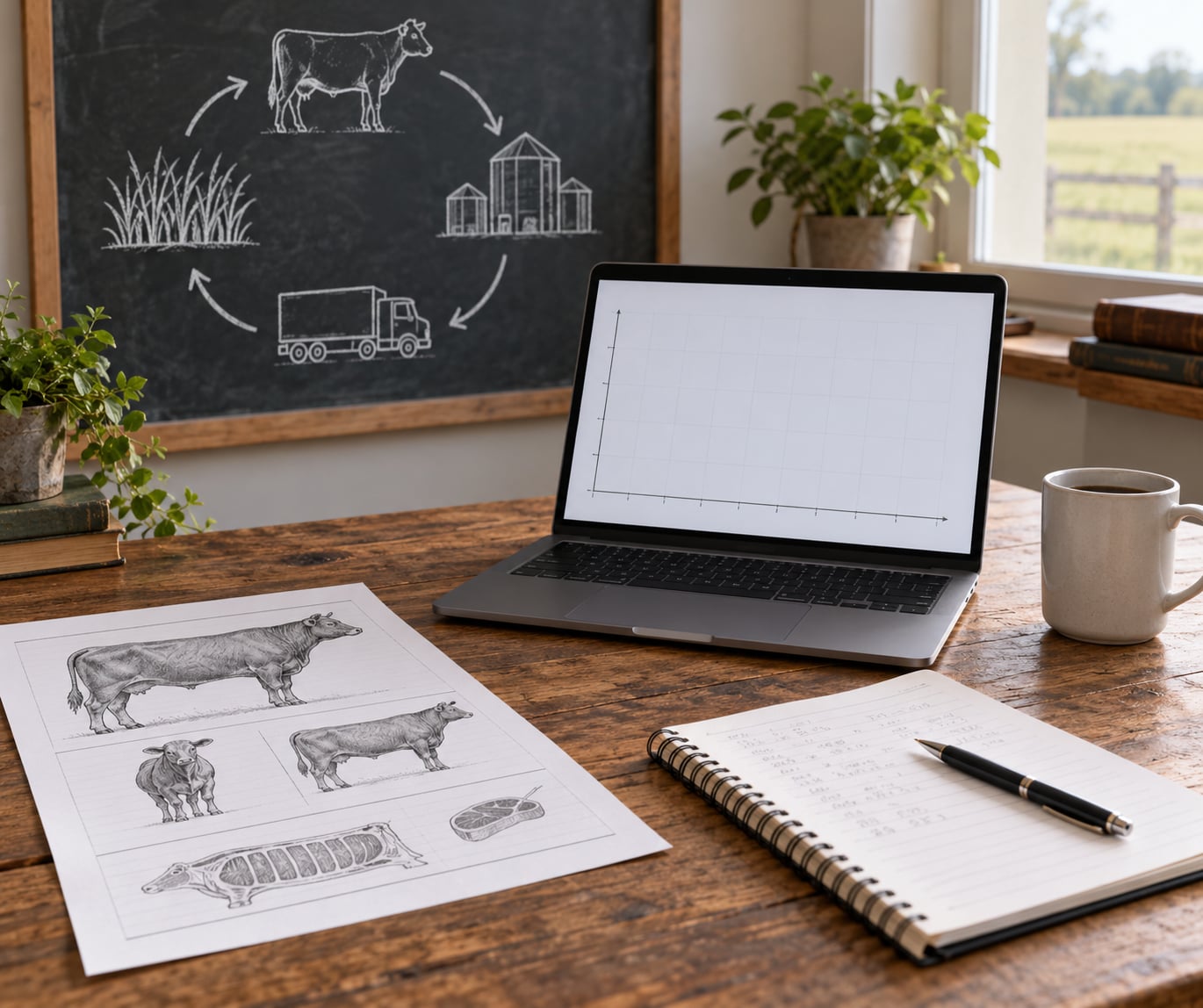
A cow-calf producer weans a calf at roughly 450 to 700 pounds. That animal is feeder cattle, and it is sold into a feedlot. The feedlot adds a few hundred pounds of grain and roughage over several months, and the animal leaves as finished cattle between 1,200 and 1,400 pounds. Finished cattle are live cattle, and they go to a packing plant. So the cycle runs: cow-calf herds produce feeder calves, feedlots turn feeders into live cattle, packers turn live cattle into boxed beef.
| Factor | Live cattle | Feeder cattle |
|---|---|---|
| Weight range | About 1,200 to 1,400 lb finished steers and heifers | About 450 to 849 lb calves and yearlings |
| Production stage | Finishing, near the packing plant | Post-weaning, on grass or entering a feedlot |
| Main risk to the trader | Slaughter weight, packer demand, cut-out value | Corn and forage cost, pasture and weather |
| Price driver to watch | Boxed beef cut-out and packer margins | Nearby corn futures and feed cost |
| Settlement | Physical delivery to packers | Cash against the CME Feeder Cattle Index |
| Retail liquidity | Thin | Thin |
The practical read for a beginner: feeder cattle is the cleaner speculative vehicle because the settlement price is a published cash index rather than a negotiated delivery, and its contract month list gives you a choice of delivery windows. Live cattle reflects the beef cut-out and packer demand, which is a much harder fundamental to forecast. Lean hogs and pork belly are separate protein markets with their own drivers, and lean hogs is where the seasonal production cycle is cleanest. Pork belly behaves more like a food-service demand story than a herd story.
Check open interest and the spread between the bid and ask before you commit to any of them. A contract with almost no open interest is a contract you will struggle to exit at a fair price.
Research Supply, Demand, and Seasonal Patterns
Six forces move cattle prices, and no single headline explains a move. Use them together.
- Beef demand. Consumer spending at the grocery counter, restaurant and food-service activity, and the boxed beef cut-out published by processors. Live cattle follow the cut-out closely.
- Feed cost. Corn, and to a lesser degree barley and soybean meal, drives finishing costs. When a feeder calf is cheap and corn is cheap, the economics of feeding animals improve and feeder demand rises.
- Herd size and the cattle cycle. The US cow herd expands and contracts over roughly two to four year cycles. Producers keep back heifers when prices are strong, which shrinks the calf crop two years later, which tightens supply and pushes prices up again. That single mechanism explains most multi-year cattle price structure.
- Weather and drought. Drought in the Plains cuts pasture and forage, forces early liquidation of cows that were meant to breed, and can wipe out a calf crop in a single season.
- Trade policy and export demand. Tariffs and import rules move live cattle and lean hog prices fast, sometimes within hours of a headline.
- Disease events. Foot-and-mouth and other outbreaks close export markets abruptly. These are rare and unpredictable, which is exactly why they cannot be part of a trading plan.
The single most important scheduled release is the USDA National Agricultural Statistics Service Cattle on Feed report, published monthly on the third Friday. It covers feedlots with capacity above a threshold, which is where the large majority of US supply is finished. Three numbers do most of the work:
- Placements. Calves moved into feedlots. A number well above expectations means producers expect good margins and that feeder cattle are worth more.
- Marketings. Cattle sent to slaughter. Heavy marketings pressure live cattle prices and tell you how much supply is already committed.
- Other. A residual category; a surprisingly large figure usually signals data revisions or unusual movement worth reading the footnotes for.
Read the release against expectations rather than against the previous month. A placement number that rises but lands below what traders already priced in is a bearish surprise. Also read the whole report, including the region-by-region breakdown, because Plains numbers can move opposite to the national total.
Seasonality is real but weaker in futures than in the old cash market. Northern-hemisphere grilling season tends to firm the beef complex, and the autumn and winter holiday window does similar work, but these tendencies routinely get overridden by herd economics. Treat them as a tilt, not a signal.
Set a Trade Plan Before Entering
Write the plan before the order, then trade it. Seven lines are enough:
- The thesis in one sentence, and why it is not already priced in.
- The entry price and the order type you will use.
- The level that proves you wrong, and the rule for exiting when it prints.
- The profit target or the trailing rule that will get you out.
- The maximum cash you are willing to lose on this position.
- The reason you are taking the trade at all, in a sentence you will read again after a loss.
- The date or price condition for rolling to the next contract month.
Position sizing follows from line five. Decide your per-trade risk first, then work backwards to the number of contracts, and use the tick value to do it in cash rather than in expectation.
Worked example. Suppose you allow yourself a risk of 300 per trade and your stop on a feeder cattle position sits eight ticks away. At a tick value of 12.50 per contract, eight ticks of loss is 100 per contract, so a 300 risk allowance buys three contracts. If you cap risk at 1 percent of an account holding 20,000, your allowance is 200 and the honest answer is two contracts. On one contract the position notional is roughly 100,000 of feeder cattle exposure, which shows why the number of contracts matters more than the deposit.
Never let the number of contracts be decided by how confident you feel. Confidence is not a sizing input. Cut position size when the market is moving fast, when you are trading a contract you do not know well, or when you have just taken a loss and want to make it back.
Spreads reduce exposure. A calendar spread between two feeder cattle delivery months, or a long live cattle and short feeder cattle position, aims at the relationship between two contracts rather than the outright price. Spreads usually carry lower margin and lower risk per contract, which makes them the natural first trade for someone learning the market. The cattle crush, pairing cattle against corn, is a more advanced expression of the same idea.
When a contract month nears expiry you must roll into a later month or exit. The exchange publishes the first notice and last trade dates, and your broker will typically notify you before the position closes itself. If the nearby month trades above the deferred month the curve is in backwardation and a long roll often pays you; if below, in contango, it often costs. Check the shape of the curve before you decide which month to hold.
Place and Manage the Position
In a thin book, order type matters. A market order in a fast cattle market can fill several ticks worse than the screen showed, and you may not get the size you asked for. Use a limit order at a price you are willing to pay, and enter in stages rather than all at once when the book is wide.
Watch margin rather than the price of the contract. Your deposit is small relative to the position, so a modest adverse move is a large percentage of your equity. Know the maintenance level your broker uses and know your own exit level in advance, because the margin call arrives whether or not your thesis is intact.
Log the trade when you enter it, not when you close it. Entry price, size, time of day, the release or headline that triggered it, and your emotional state. Then when you exit, record the result in cash and in ticks and grade the decision separately from the outcome. A profitable trade from a bad process is still a bad trade, and this is the distinction most retail traders never learn to make.
Leave when the plan says to leave. A target hit, an invalidation level printed, or a thesis broken by a report are all legitimate exits. Widening a stop on a losing position because the market is moving against you converts a planned small loss into an unplanned large one, and it is the fastest route to forced liquidation.
On the tax side, if you are trading in the United States, most physical commodity futures held as a trading business qualify for Section 1256 treatment, which generally means 60 percent of gains taxed at long-term rates and 40 percent at short-term rates regardless of holding period, with losses subject to a higher net capital loss limit. Your broker reports on Form 1099. Rules vary by country and change, so check with a tax professional before assuming how your account will be treated.
Common Mistakes
Here are the errors that repeat in this market, and what you do instead.
- Trading a full contract on a small account. One live cattle contract covers 40,000 pounds and one feeder contract 50,000 pounds, so a single contract is more than most retail accounts should carry. Fix: size from your risk allowance per trade, and if that works out to zero contracts, wait until the account is larger or trade a smaller-notional contract at another exchange.
- Ignoring margin until it arrives. A margin call is a deadline, not a suggestion. On futures trading forums the single most common beginner question is what happens when a long position drops, and the answer is that the broker will close it for you, at a price that includes the loss plus fees. Fix: keep a maintenance buffer and know the number before you enter.
- Leaving a position unattended. A widely circulated anecdote on trading forums describes a retail trader who forgot an open live cattle position and found it closed for them. It gets repeated because it happens. Fix: alerts for first notice day and margin thresholds, and no position left open without one.
- Trading with no plan. Entering because a chart moved is not a thesis. Fix: the seven-line plan, written before the order.
- Chasing a report release. Prices move a large amount in the seconds after the Cattle on Feed numbers print. Fix: decide whether you want to trade the report or trade between reports, and place the order accordingly.
- Believing futures means owning cattle. These are cash-settled or delivery-settled financial contracts. There is no animal, no pasture and no grazing income. Fix: keep the mental model of a margin-driven price bet on a protein supply cycle.
- Skipping the contract details. Delivery months, tick values and settlement procedures differ between live and feeder cattle and get revised. Fix: read the current CME Group specification sheet for the contract and month you trade.
- Arguing the market is manipulated instead of studying it. A recurring theme on ranch and commodity forums is distrust of packer influence over the settlement process. The settlement index is calculated from published cash prices under published rules, and livestock markets have traded under those rules for decades, but the debate is a distraction from the work of sizing a position. Fix: if you cannot accept the settlement method, do not trade the contract.
- Overtrading a market with no retail flow. Cattle is a small, professional market. Chasing activity that is really news reaction, in a book with wide spreads, is how accounts leak. Fix: trade less, size smaller, and wait for the setups you wrote down.
Risk tips worth keeping in front of you: risk a small planned share of equity on any single idea, never more than you can fund from income if the trade goes wrong; keep total open exposure modest relative to margin; assume you cannot exit a full position on a bad headline; and never add to a losing futures position to lower your average price. That last one is a stock-market habit that has no place in a contract that can go against you by more than your entire deposit.
Frequently Asked Questions
Are cattle futures a good investment?
Cattle futures are a specialised trading vehicle rather than a conventional investment. They offer direct exposure to the beef supply cycle without owning animals, but they carry margin exposure, thin liquidity and wide spreads, and most retail accounts lose money. They make sense for experienced traders who can size positions properly and monitor them, and for ranchers hedging real price exposure. They do not suit passive long-term investors or anyone who cannot absorb a full loss of margin.
How much money do I need to start trading cattle futures?
More than the margin figure suggests. Initial margin on one live or feeder cattle contract runs into thousands, and you need a maintenance buffer above it so a normal adverse move does not trigger a margin call. Because one contract represents 40,000 to 50,000 pounds of exposure, many small accounts should trade zero or one contracts and learn with a simulation first. Deposit only what you could lose without affecting your living situation.
What is the minimum margin required for futures trading?
There is no single minimum for futures trading in general. Each contract carries its own initial margin figure, set and periodically revised by the exchange through its clearing members, and your broker applies the exchange requirement or a house version of it. Live and feeder cattle contracts typically require several thousand per contract. Margin is a deposit rather than a purchase price, so it is not the amount you can lose.
What are the specifications of a feeder cattle futures contract?
A feeder cattle futures contract covers 50,000 pounds of feeder animals, quoted in cents per pound, with a minimum price fluctuation worth 12.50 per contract. It is cash settled against the CME Feeder Cattle Index, a seven-day average of reported cash prices across twelve states, so no cattle are delivered. The pit ticker is FC and the electronic ticker is GF. Confirm the current listed months and margin with CME Group before trading.
Is there a cattle futures ETF, and what about cattle-related shares?
No pure cattle futures ETF exists. Broad agricultural and commodity funds hold a small cattle and livestock allocation diluted across many markets, so they are a poor proxy for a cattle view. For equity exposure, the listed names are beef processors and vertically integrated producers such as Tyson Foods, whose results depend on cut-out prices, packer margins and volumes as much as on cattle costs. Shares cap your losses and remove margin calls but add company risk on top of market risk.
Do I take delivery of cattle when I trade a futures contract?
No. Feeder cattle contracts are cash settled against a published cash price index, so no animal changes hands. Live cattle and lean hog contracts are delivery-based, but retail traders close those positions before the delivery process begins, and brokers will not let an account reach an unintended delivery without warning. If a position reaches its first notice day, the standard action is to exit or roll, not to accept delivery.
Conclusion
Start with one contract, one contract month, and one written plan. Learn the feeder cattle specification until you can recite the contract size, tick value and settlement method without looking, practise order entry in a simulation, and when you trade live, risk a small planned share of your equity with a maintenance buffer behind it. Read the Cattle on Feed release every month, keep a journal, and treat any position you cannot fully exit as a position you cannot take.
Spec figures in this guide are for orientation and reflect published exchange details as of October 2026. Contract sizes, tick values, listed months and margin change, so verify everything on the current CME Group contract page and with your broker before committing capital. Consider it educational information rather than financial advice.