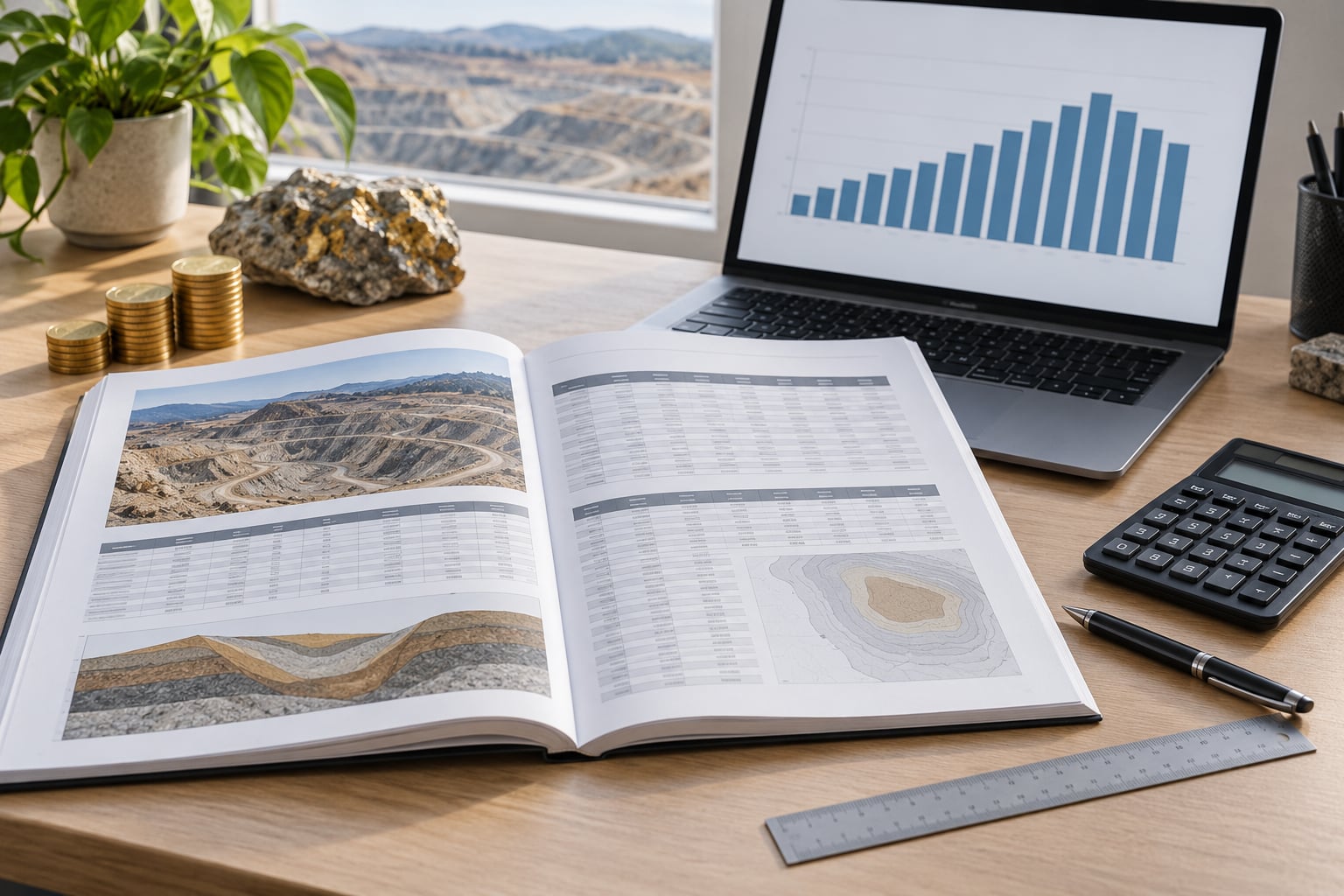
To value a gold mining company, start with its proven and probable reserves, convert them into mineable ounces, apply a conservative gold price and a realistic cost per ounce, discount the resulting cash flows at about 5% real, subtract net debt, then divide by fully diluted shares to get a net asset value per share. You compare that number with the share price using the P/NAV ratio.
That chain takes a few hours of spreadsheet work for a single-mine company and considerably longer for a portfolio. This guide is educational, not investment advice. Rules, reporting standards and market conditions vary by country and change over time, and no valuation is a prediction of future returns.
Table of Contents
- What You Need
- The documents to pull first
- The operating parameters
- The assumptions you supply
- Step-by-Step: How to Value a Gold Mining Company
- 1. Confirm the Company’s Assets, Ownership and Reporting Quality
- 2. Separate Mineral Reserves from Mineral Resources
- 3. Estimate Mineable Production and a Realistic Mine Life
- 4. Build the Gold-Price, Cost and Capital Assumptions
- 5. Value Each Mine With Discounted Cash Flow and Risk Adjustments
- 6. Add Corporate Value and Account for the Balance Sheet
- 7. Compare Intrinsic Value With the Market Price to Value a Gold Mining Company
- Common Mistakes
- Frequently Asked Questions
- What is the best method to value a gold mining company?
- How do I calculate the net asset value of a gold miner?
- Is the gold reserves-to-production ratio a useful valuation metric?
- How should I value a mining company that is still in development?
- What multiples are commonly used to value gold mining stocks?
- Conclusion
What You Need
Before touching a valuation model you need four things: the company’s own disclosure, the physical operating parameters of its mines, a set of price and cost assumptions you can defend, and the corporate items that sit between asset value and shareholder value.
The documents to pull first
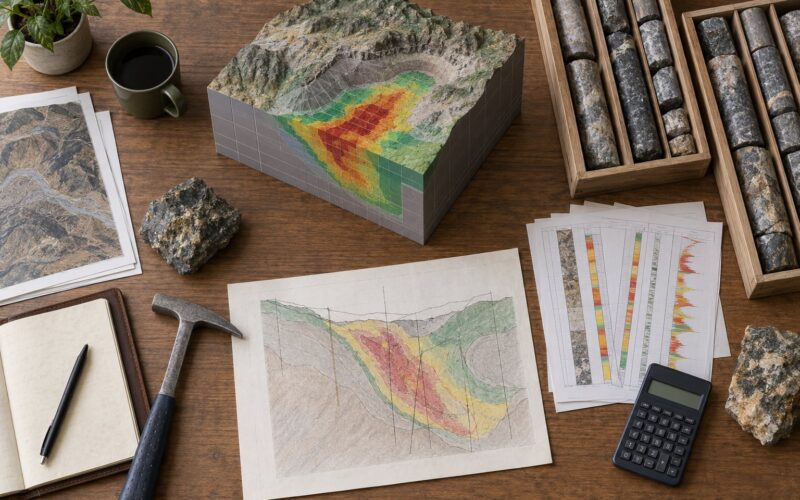
Start with the annual report and the reserve statement. The reserve statement gives proven and probable ounces by mine, usually stated net-attributable to the company’s ownership share. Then find the latest technical report: a feasibility study for a development project, or the annual reserve disclosure for producing mines.
- Annual report and audited financial statements (company investor relations site, SEDAR+ in Canada, or SEC EDGAR in the United States)
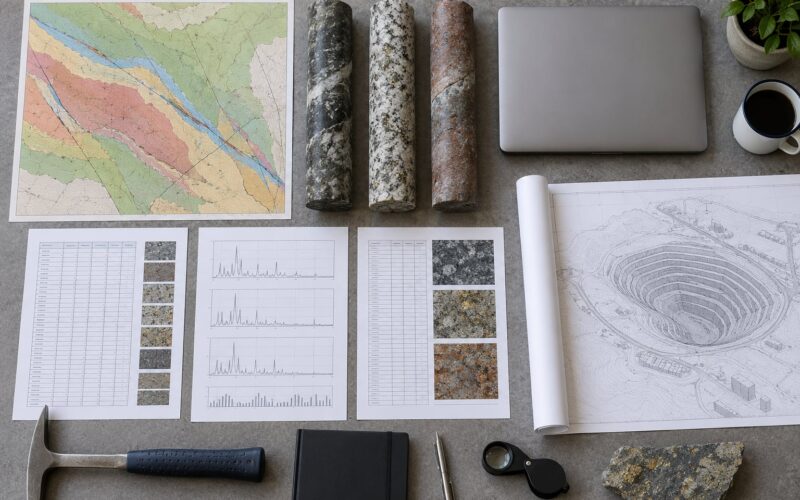
- Reserve and resource tables by deposit, with tonnage, grade and recovery
- The most recent NI 43-101 technical report for any development project
- Guidance for next year’s production, all-in sustaining cost and capital spending
- Balance sheet detail: cash, debt, lease liabilities, reclamation provisions
- Share count, options, warrants and convertible instruments, plus the date of the last equity raise
NI 43-101 governs disclosure in Canada, the JORC Code covers Australia and much of the rest of the world, and S-K 1300 replaced the old US reserve rules. All three require a qualified person to sign off on the numbers, which is exactly why they are worth trusting more than a conference presentation.
The operating parameters
For each mine you need the mining method, throughput, head grade, recovery, cut-off grade and remaining mine life. You also need sustaining capital, which is the money required to keep the mine producing at current rates, as distinct from growth capital spent building something new.
The assumptions you supply
A valuation is mostly assumptions. The gold price deck, the cost trajectory, the discount rate and the probability you attach to a permit or a mine plan are inputs you choose, and two analysts can produce two very different answers from identical filings. Write your assumptions down before you calculate anything so you can see what moved.
Step-by-Step: How to Value a Gold Mining Company
Work through the seven steps below in order. Skipping the early ones is where most bad valuations come from, because every later number inherits the errors of the earlier inputs.
1. Confirm the Company’s Assets, Ownership and Reporting Quality
List every producing mine, development project and exploration prospect in one table, with the company’s ownership interest in each. A 30% interest in a mine is 30% of the cash flow, not 30% of the headline ounces, and joint-venture partners often hold the right to block a budget.
Then check the reporting quality. Read the auditor’s opinion, look for restatements, and see whether reserve estimates have been revised downward since the last year. A company that quietly cut its reserve grade by a fifth is telling you something that no cost table will.
This step worked if you can name every material asset, state the ownership percentage for each and describe the reserve trend over three years. A clean, reconciled asset list is the sign you did it properly.
2. Separate Mineral Reserves from Mineral Resources
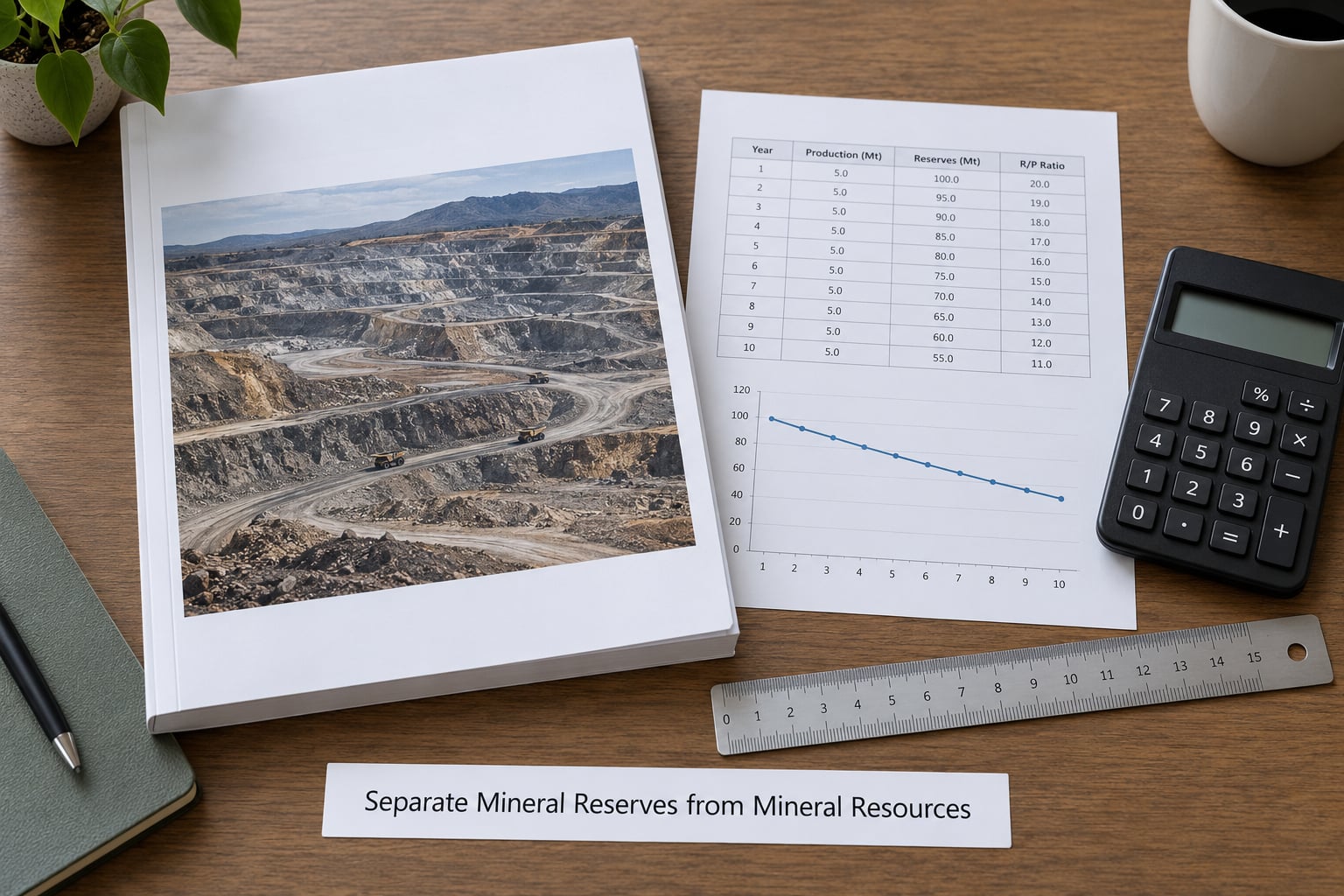
Reserves and resources are not the same thing. Measured, indicated and inferred resources are estimates of how much material exists; proven and probable reserves are the portion a company is confident it can legally and economically mine at the time of the estimate. Inferred material can never be valued as a reserve, and measured and indicated material still has to survive a pit design, a processing plant and a cut-off grade before it becomes a reserve.
Two figures carry most of the analytical weight. The first is the reserve-to-production ratio, which divides total reserves by annual production to give a rough mine life in years. The second is grade, because ounces mined at a lower grade usually cost more per ounce to recover.
Use the least aggressive figures that still survive scrutiny. If a technical report shows a headline reserve that assumes a much higher gold price than the one you use, the reserve is price-dependent and your recoverable ounces are lower than the reserve table implies.
3. Estimate Mineable Production and a Realistic Mine Life
Turn reserves into production by applying recovery, dilution and throughput. The chain is roughly: ore tonnes mined times head grade times recovery equals payable ounces. Then divide total payable ounces by annual production to get mine life, and check that answer against the company’s own stated remaining life.
Grades normally decline as a mine matures, unless the company is stacking higher-grade ore or mining a different orebody. That decline pushes costs per ounce up in later years, so a flat cost assumption across a fifteen-year mine plan is usually optimistic.
Sanity-check the result against what the company actually produced last quarter. A model that promises a step change in throughput deserves a hard look at the capital cost, the permit status and the plant’s actual nameplate capacity before you believe it.
4. Build the Gold-Price, Cost and Capital Assumptions
Revenue equals payable ounces multiplied by your realized gold price. Realized price is spot minus small refining charges, and it can be lower if the company sells forward. Never model the full spot price forever, and never model above spot without disclosing that you did.
On the cost side, start with all-in sustaining cost, the industry measure developed under World Gold Council guidance that includes mining, processing, sustaining capital, royalties and site costs. VanEck, using Newmont guidance, put the split roughly at labour 35% to 50% of that total, fuel and energy 15% to 20%, consumables 15% to 20%, and other costs including royalties 10% to 20%.
As of August 2026, VanEck reported gold trading near 4,000 per ounce while sector all-in sustaining cost in the second quarter of 2026 was averaging below 2,000 per ounce. Those figures explain the very wide margins across the sector, and they also explain why so many producers are pushing growth projects right now.
The important caution is that AISC is not free cash flow. It excludes growth capital, interest, tax, working capital and acquisitions. Junior investors see the problem clearly: in a thread on r/wallstreetsmallcaps, West Red Lake Gold figures were read directly off the release, at roughly 4,300 per ounce realized against AISC of about 3,284 in its second quarter. That spread looks like profit until financing and expansion spending are subtracted.
5. Value Each Mine With Discounted Cash Flow and Risk Adjustments
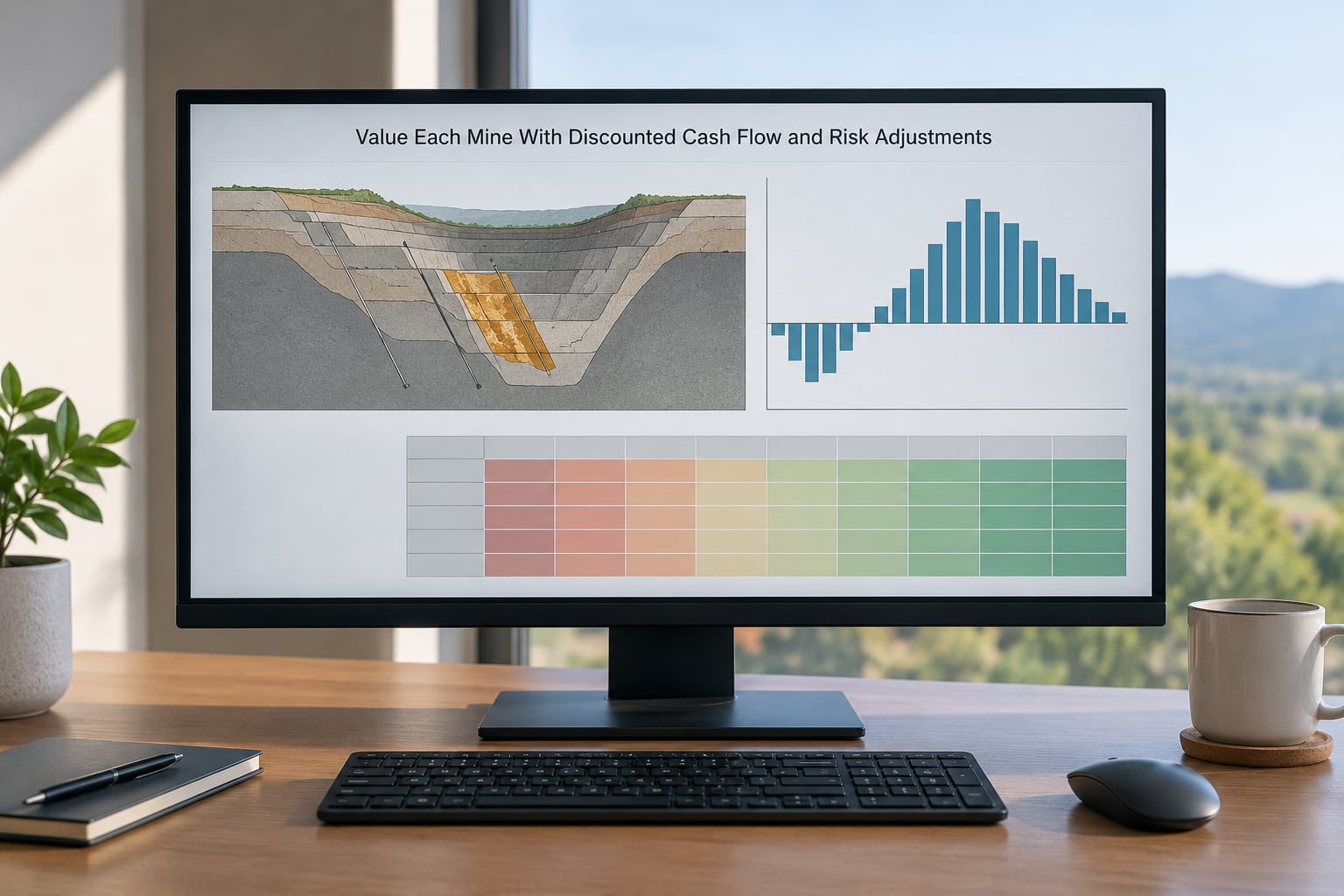
Value each mine separately. For each year of its remaining life, work out revenue, subtract operating costs, subtract sustaining capital and any growth capital for that mine, subtract tax, and that is the year’s free cash flow.
Discount each year’s cash flow back to today. The long-standing convention for gold assets is about 5% in real terms, meaning before inflation, which is unusually low for an equity and reflects the relative stability of gold and of producing-asset cash flows. A PGO mining valuation webinar from 2019 described 5% real as the gold industry tradition with a long-run cost of capital nearer 5% to 6% real.
You can raise the rate for specific reasons: a jurisdiction with unstable tax or permitting rules, a single-asset company with no diversification, a mine in construction rather than production, or an assumption you simply do not trust. Raising the rate is a legitimate way to price in risk; quietly assuming everything works is not.
As a simple hypothetical illustration, a single mine producing 100,000 payable ounces a year at a realized price of 3,000 per ounce with all-in sustaining cost of 1,600 leaves roughly 140 million before growth capital, interest, tax and working capital. On those assumptions the operating margin is about 1,400 per ounce. Cross that per-ounce margin off against the company’s actual cash from operations each year and you will see within a year or two whether the assumptions are honest. These figures are invented for illustration and describe no real company.
Sum the discounted cash flows across all mines and you have enterprise value at the asset level. Then test whether permitting or construction delays would materially reduce that value, since a two-year delay on a large project can cost more value than a moderate change in the gold price.
6. Add Corporate Value and Account for the Balance Sheet
Next bridge enterprise value to equity value. Add cash and short-term investments. Subtract debt, lease liabilities, royalty obligations, reclamation and closure liabilities, and the after-tax cost of corporate overhead. Also deduct the capital you believe is required to fund development projects that are not yet producing.
For exploration prospects with no cash flow, most analysts assign only a fraction of the project’s risk-adjusted value, often between a tenth and a third, and the lowest fraction for early-stage exploration. Treat that exploration value as optionality, not as reserves.
Divide the resulting equity value by fully diluted shares, meaning basic shares plus in-the-money options, warrants and convertibles. This is the number most people get wrong. If a junior is at the point of raising equity to fund its next project, the diluted count that includes that planned raise is the honest denominator, otherwise you value the mine and ignore the cash it needs.
7. Compare Intrinsic Value With the Market Price to Value a Gold Mining Company
The final step is the comparison, and it needs a range rather than a point. Run the model on three gold price scenarios, something below spot, something at spot, and something above. Extend the same range to costs: a flat cost case, and a case where costs rise faster than the company assumes.
Produce three NAV figures, one per scenario. Divide the company’s market capitalization by each one to get P/NAV in the conservative, base and optimistic cases. A producer trading at 0.8 times your base-case NAV is priced below your estimate; one at 1.5 times is priced above it. A developer or explorer should trade at a much wider discount, because the risk is larger and the timeline longer.
Then ask the harder question: is this stock cheap, or is it undervalued? Cheap means the multiple is low. Undervalued means the multiple is low because the market disputes one of your assumptions, and the gap will only close if the company proves that assumption. Institutional investors working in the junior space make this distinction routinely, and it prevents a lot of wasted time on value traps.
Finally, make sure you state which companies use which price decks. If one manager models at a gold price far above the price another manager assumes, comparing their P/NAV ratios directly is comparing two different currencies.
Common Mistakes
These are the errors that show up most often, with a fix for each.
- Using headline reserves as if they were production. Reserves are a quantity, not an annual number. Fix: convert reserves to payable ounces, apply throughput and recovery, and check the implied mine life against the company’s own guidance.
- Valuing inferred resources as reserves. Inferred material has the lowest confidence in the resource classification system and can disappear entirely under a pit design. Fix: value inferred and early exploration at a heavy discount, or exclude it and note the exclusion.
- Modeling today’s gold spot price forever. Fix: run at least three price scenarios and disclose each deck. Companies that model above spot produce NAV numbers that are not comparable with peers.
- Treating AISC margin as free cash flow. Fix: subtract growth capital, interest, tax and working capital from the margin. Reconcile your modelled free cash flow against the company’s reported cash from operations each year.
- Ignoring capital intensity. Fix: model sustaining capital explicitly, rising it in later years as grades decline, and test whether the mine still covers sustaining spending at a much lower gold price.
- Applying the same multiple to every miner. A single-asset developer should not trade at a producer’s P/NAV. Fix: stage-adjust the discount, and use comparable company analysis only against companies at the same stage and in a comparable jurisdiction.
- Overlooking dilution and double-counting value. Fix: use fully diluted shares including warrants and planned raises, subtract remaining development capital, and count cash and exploration value once. Comparing net asset value across juniors on different share bases is one of the most common errors in the space.
A red flag worth naming separately is promotional management. Investors on mining forums frequently point out that heavily promoted names tend to underperform, and the pattern is easy to see in the filings: a price deck above spot, a resource that never upgrades out of inferred, and a steady stream of equity raises. That combination describes an equity story, not a mine plan.
Frequently Asked Questions
What is the best method to value a gold mining company?
For a producing gold miner, net asset value built from a discounted cash flow at roughly a 5% real discount rate is the standard method, benchmarked against peers with P/NAV and EV/oz. Real options valuation suits pre-revenue exploration assets, and comparable company analysis works best for companies at the same stage and in comparable jurisdictions. Most published NAV models use a 5% real rate for producing gold assets, which is well below a typical equity cost of capital.
How do I calculate the net asset value of a gold miner?
Sum the after-tax discounted cash flows of every mine over its remaining life, using your gold price deck, cost assumptions and a real discount rate. Add cash and any risked exploration value, then subtract debt, leases, royalties, reclamation liabilities and the capital still needed for development projects. Divide by fully diluted shares, including options and warrants. The result is net asset value per share, and market capitalization divided by that gives P/NAV.
Is the gold reserves-to-production ratio a useful valuation metric?
Yes, as a quick screen rather than a valuation. Dividing proven and probable reserves by annual production gives an implied mine life, and a short mine life often means higher future capital spending and more dependence on finding new reserves. It says nothing about grade or cost, so two companies with the same ratio can have very different margins. Use it to frame questions, never as the answer itself.
How should I value a mining company that is still in development?
Value the project’s after-tax cash flows from its technical report and discount them at a higher rate than you would use for a producer, reflecting construction, permitting and funding risk. Then risk the result, meaning you apply a probability to the project reaching production, and typically value exploration ground separately at a small fraction of risked value. Market capitalization compared with that risked NAV gives a P/NAV figure that should sit well below one.
What multiples are commonly used to value gold mining stocks?
The common ones are P/NAV, which divides market capitalization by net asset value and is the sector’s headline metric, EV per ounce of reserves or resources, EV/EBITDA, price to cash flow, and free cash flow yield. Each works differently: EV/oz ignores cost structure and mine life, while P/NAV reflects your own assumptions. Use multiples to compare companies at the same stage and to check your own model, not as a replacement for building it.
Conclusion
Start by building one conservative production and cost model for a single company. Read the reserve statement, convert reserves into payable ounces, apply a defensible gold price and a real cost per ounce, and reconcile the resulting free cash flow against two years of reported results.
Then value producing assets separately from development projects, subtract the balance sheet items between asset value and shareholders, and divide by fully diluted shares. Compare the result with the share price across three price scenarios rather than one.
Before you commit to the answer, go back and stress the largest assumptions. In most models they are the gold price deck, the reserve grade and the discount rate, and the gap between your valuation and the market price is usually explained by one of them.
Updated for October 2026.