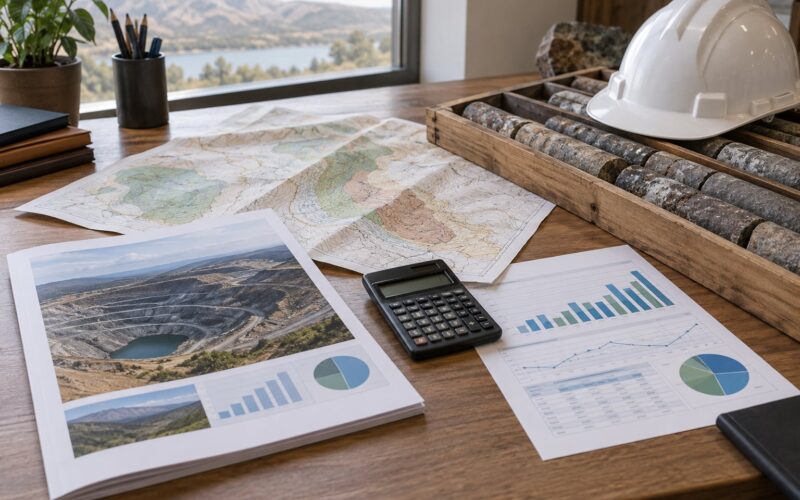
To research a junior mining stock, work through a fixed order: identify the company’s stage, read the independent technical report, stress-test the resource and drill numbers, check permits and jurisdiction, vet management and insider ownership, rebuild the diluted share count and cash burn, confirm the stock is liquid enough to exit, then value it against peers. Give yourself a full day per company on the first pass. Most of the work is free and public, and none of it requires a broker account.
This is a research method, not investment advice. Junior mining equities are speculative, most lose money, and nothing here is a recommendation to buy or sell a particular security. Rules, tax treatment and disclosure requirements vary by country, so check the rules where you live and where the company is listed.
One number frames everything that follows. On the order of one in a thousand junior mining companies ever becomes an operating mine. When the base rate is that low, the quality of your process matters more than any single idea you pick, because most of your ideas will be wrong.
Table of Contents
- What You Need
- Primary filings and disclosure databases
- Technical reports under a recognised disclosure code
- Market and financial data
- Reference material for the macro view
- A written record
- Step-by-Step: How to Research a Junior Mining Stock
- 1. Define the Company and Its Stage
- 2. Understand the Commodity and Market
- 3. Check the Mineral Rights and Permitting
- 4. Evaluate the Geology, Resource, and Mining Plan
- 5. Read the Financial Statements and Cash Position
- 6. Review Management, Ownership, and Governance
- 7. Model the Investment Case and Valuation
- 8. Test the Thesis and Identify What Could Go Wrong
- 9. Make a Documented Decision
- Common Mistakes
- Chasing the headline
- Treating resources as production
- Ignoring the share count
- Believing the investor presentation
- Buying after the spike
- Ignoring liquidity and exits
- Counting news releases instead of progress
- Skipping the jurisdiction question
- Frequently Asked Questions
- What is considered a junior mining company?
- How do you research a stock before you buy?
- How do you value a mining company with no cash flow?
- How do I know if a mining stock is being promoted?
- How many junior mining companies become producing mines?
- What are the best Canadian copper mining stocks?
- Conclusion: Start With Evidence, Not a Mining Story
What You Need

You need four things before you look at a single chart: primary filings, technical reports, market data, and a place to write your work down.
Primary filings and disclosure databases
Every serious mining company publishes its material documents. In Canada those live on SEDAR+ for TSX and TSX-V issuers, and on EDGAR for companies listed in the United States. Australian companies file continuous disclosure announcements on the ASX website, and South African issuers list on the JSE. A company that will not tell you which database it files in is a company you walk away from.
Technical reports under a recognised disclosure code
Canadian-listed issuers report under NI 43-101, Australian and many other international issuers use JORC, and SEC registrants in the US use the new SK-1300 standard. Each requires an independent qualified person to sign off on the science. That signature is the single most useful quality filter you have, because it means somebody with professional liability prepared or reviewed the numbers.
Market and financial data
You need a quote source with volume, a chart with a history going back several years, a share structure showing every warrant and option, and the last four or six quarters of financial statements. Sector tools such as Stockhouse, Stockwatch, S&P Capital IQ and company investor-relations pages cover this between them.
Reference material for the macro view
The USGS Mineral Commodity Summaries give you production and reserve context by country. The Fraser Institute Survey of Mining Companies publishes an annual jurisdiction ranking that is useful as a starting point, though it measures investor sentiment as much as objective risk. Commodity price history from a recognised exchange or agency anchors your price assumptions.
A written record
Keep a one-page file per company: the stage, the resource, the cash position, the share count, your valuation, and the specific evidence behind each. Investors who track a personal watchlist of tickers and compare them side by side tend to hold their nerve better in a drawdown than investors who react to whatever trends that week.
Step-by-Step: How to Research a Junior Mining Stock
Do these nine steps in order, and do not skip ahead to valuation. Each one changes what the next one is worth. If a step produces a disqualifying answer, stop there and save yourself the rest.
1. Define the Company and Its Stage
Write down what the company actually is, in one paragraph, before you evaluate anything. A junior mining company is a pre-revenue exploration or development business listed on a small-cap exchange, usually the TSX-V or ASX, looking for or building toward producing from a mineral deposit. It has no operating mine, no revenue and usually no earnings, so valuation methods built on profits simply do not apply yet.
Then name the stage. The life-cycle stage determines which documents matter, which valuation method fits, and where the risk sits.
| Stage | Revenue status | How you value it | Dominant risk |
|---|---|---|---|
| Explorer | None | Land package and exploration upside against spend | The geology is simply wrong |
| Developer | None | Net present value of a permitted project, often as price to NAV | Financing and permitting delay |
| Producer | Yes | Discounted cash flow, EV/EBITDA, price to NAV | Operating costs and grade |
| Royalty or streaming | Minimal operating cost | Net present value of the royalty stream | Counterparty and project permitting |
How to tell it worked: you can state the company’s stage in one sentence, name its projects, say which country each sits in, state what percentage the company owns versus a joint-venture partner, and say whether an earn-in obligation is outstanding. If the project is held through a joint venture, find out who pays for the next drill hole and what happens if the company cannot.
2. Understand the Commodity and Market
Establish what the deposit would produce and who sets the price. Gold, copper, uranium and lithium each respond to different drivers, and a junior’s fate is tied to a commodity cycle it does not control.
Ask four questions. What is global supply and how concentrated is it? What drives demand for the next decade, and is that demand forecast or just asserted in the investor presentation? What does the price history look like across a full cycle rather than the last eighteen months? And what substitutes exist if the price moves against you?
Check the macro overlay too. Junior equities tend to move with the broad risk appetite for resource equities rather than with the metal itself, so a rising copper price with collapsing equity sentiment is a different environment from a rising copper price in a strong tape. How to tell it worked: you have a defensible view on the price assumption behind the company’s own study, and you can say whether you think that assumption is conservative or aggressive.
3. Check the Mineral Rights and Permitting
Confirm the company legally owns or controls the ground. Look for the title, the claims or licences, any royalties or encumbrances, and whether a joint-venture partner holds an earn-in. Then work through permitting: exploration permits first, then environmental assessment, then the mining licence and any community or land-access agreements.
Count what is still outstanding rather than what is done. A junior with two outstanding approvals out of nine is a different investment than one with eight outstanding. Note the social licence question too, particularly for projects near communities that depend on the land or water, and check whether the company has a history of resolving disputes.
Use the jurisdiction ranking as context, not as a verdict. A stable mining jurisdiction still has permitting timelines, fiscal terms and export policy that can shift. How to tell it worked: you can list every approval still required and roughly how long each typically takes in that country.
4. Evaluate the Geology, Resource, and Mining Plan
Read the most recent technical report before you read anything the company wrote for the public. Find the study type first, because it tells you how much confidence the numbers deserve.
| Study | What it answers | Confidence | Cost and effort |
|---|---|---|---|
| Preliminary economic assessment (PEA) | What the deposit could be | Wide ranges, early assumptions | Lowest |
| Pre-feasibility study (PFS) | What it should be | Mid-range, still open to change | Moderate |
| Feasibility study (FS) | What it will be | Detailed enough to support financing | Highest |
A preliminary economic assessment is a screening document, not a promise. Capital and operating cost estimates routinely move by 30 to 50 percent between a PEA and a feasibility study, and a company that presents PEA economics as though they were bankable figures is telling you something about its communication.
Then interrogate the resource itself. Resources are not reserves and neither is production. Measured material carries the highest confidence, indicated is lower, and inferred is the category most often used to inflate a headline figure.
| Category | Confidence | How to treat it |
|---|---|---|
| Measured | High | The only category most analysts will lean on directly |
| Indicated | Medium | Usable, with a discount |
| Inferred | Low | Heavy discount or excluded entirely |
Check the grade against the tonnage, because a large low-grade deposit is a different animal from a small high-grade one and needs different mining, capital and processing assumptions. Look at the cut-off grade: resource tonnage moves with it, so a headline number depends heavily on an assumption buried in an appendix. Ask whether metallurgical test work exists and what the recovery rate is, because refractory ore or a complex flowsheet quietly raises capital and lowers payable output. If there is no test work at all, say so and treat the project as unproven.
When you read drill results, watch for the two numbers most often used to flatter a company. True width is the actual thickness of the ore; down-hole length is the length of the hole through it. A headline using down-hole length overstates how much ore a hole intersected. Also check the cut-off grade used, whether results come from one hole or a run of them, whether the assay lab and methods are named, and whether independent watchers verified anything. How to tell it worked: you could write a two-sentence plain-English summary of the deposit, and you would have to name what is still unknown.
5. Read the Financial Statements and Cash Position
Skip the highlights page and open the statements. For a pre-revenue junior the numbers that matter are: cash on hand, quarterly operating burn, any debt or convertible instruments, and committed capital spending.
Divide cash by quarterly burn to get the cash runway in quarters, then multiply by four for months. Twelve to eighteen months is a reasonable working minimum, because raising capital in a weak tape on bad terms is the single most common way a good exploration programme gets stalled. Under six months of runway and the company is a financing candidate before it is anything else.
Read the going-concern language in the notes, not the summary. Then look at the share count history. How many shares were outstanding two years ago compared with now, and how much of the increase came from options and warrants rather than from drilling? How to tell it worked: you can state the cash runway, the annual burn, and roughly how many financings occurred in the last three years.
6. Review Management, Ownership, and Governance
Look at what the team has actually shipped, not what it says it will do. Check the qualified person who signs the technical report, the project’s board, and the funding history. Then cross-reference the same people with the companies they worked at before. Teams that have taken a prior project through permitting, construction and production are a different proposition from teams that raise money and move on.
For alignment, look at insider ownership, options and compensation. Ten to twenty percent held by insiders and directors is a reasonable signal that their money is exposed to the same outcome as yours. Note any related-party transactions, non-arm’s-length arrangements with directors, and a pattern of share issuance at or near the low rather than through a planned structure.
Governance markers worth a second look: a board that has been stable, disclosure that includes the bad news, and a company that corrects a public estimate rather than quietly issuing a new one. The difference between a promoter and a builder usually shows up in the disclosure first and the press release second. How to tell it worked: you can name what each director and officer did at a previous company, and you know roughly what share of the company they hold.
7. Model the Investment Case and Valuation
Most juniors have no cash flow, so you value them against a resource, a study, or a peer group. Start with enterprise value, which is market capitalisation plus debt minus cash. The market pays that figure for the assets, which is why the cash balance matters so much: a company with a large cash pile and a small market cap is being valued near its cash balance, not on the deposit.
Worked example, in plain units so the math is what you take away: a company with a market capitalisation of 300 million, no debt and 120 million of cash has an enterprise value of 180 million. If it declares 3 million contained ounces, that is 60 per ounce of resource. If a peer group trades at 90 per ounce, the shares look cheap on that measure alone. Now repeat it using only measured and indicated ounces and see how much the number moves. That gap is the whole argument between bulls and bears.
| Metric | What it measures | Best for | Watch out for |
|---|---|---|---|
| EV per ounce | Enterprise value divided by contained metal | Gold and silver developers | Ignores grade, cost and stage |
| EV per pound | Enterprise value divided by contained metal | Copper, aluminium, nickel | Same blind spots as EV per ounce |
| EV per resource tonne | Enterprise value per tonne of resource | Bulk commodities with low unit values | Grade differences swamp the ratio |
| Price to NAV | Share price against risked net present value | Projects with a feasibility study | Whose assumptions are in the NAV |
| Risked NPV | NPV after discounting by probability of success | Comparing projects of different maturity | Judgement sits in the probability, not the model |
Every one of these inputs is an assumption someone chose. The metal price, the discount rate, the probability of success, the capital cost and the recovery rate can each move a risked valuation by more than the difference between two companies. Write your inputs down and then change them one at a time. How to tell it worked: you can rebuild the valuation yourself in a spreadsheet, and you know which single assumption matters most to the answer.
8. Test the Thesis and Identify What Could Go Wrong
Build three cases. The upside case assumes the resource converts, permitting lands on schedule and the commodity price holds. The base case assumes some slippage on every line. The downside case assumes a financing on poor terms, a permitting delay and a weaker price, all at once.
Then run the failure list against each. Dilution is the default outcome for most juniors, not a risk to be priced. Permitting can move years. Geology can disappoint at depth. Capital and operating costs can rise 30 percent without anyone doing anything wrong. The commodity price can fall. The jurisdiction can change tax terms or export rules. And execution can fail quietly, through missed milestones and unmet budgets, long before anything visible happens.
One forum observation worth keeping in mind: retail posters regularly estimate that roughly 95 percent of junior miners never mine anything beyond investor money. Whether you accept that exact figure or not, the direction of it is not disputed. How to tell it worked: your downside case assumes a substantial loss, and you have decided in advance what that loss costs you in the portfolio.
9. Make a Documented Decision
The last step of how to research a junior mining stock is the one people skip. Write down, in plain sentences, the thesis, the key assumptions, the evidence for each one, the gaps you could not close, and the price or news event that would change your mind.
Then choose one of three honest outcomes: invest, watch, or drop it. Watching is a real answer and a common one. Record what you would need to see next, such as a preliminary economic assessment, a permit milestone, or two more quarters of drilling at the target, and put a date on when you will check.
On position sizing, keep any single speculative junior a small share of your total portfolio, and diversify across several companies, commodities and jurisdictions. In a sector where nearly all of the outcomes are bad, correlation is your real risk: a single bad financing environment can hit every junior you own at once, no matter how independent the projects look on paper. If you cannot describe the exit, including whether you can actually get out at a sane price, then you are not finished. How to tell it worked: a stranger could read your file and reach the same conclusion you did.
Common Mistakes
These are the errors that recur, and each has a simple correction.
Chasing the headline
Reading the press release before the technical report means you anchor on the company’s framing. Read the filing first, then decide whether the release is an accurate summary or selective emphasis.
Treating resources as production
A mineral resource is a geological estimate, and reserves are the economically mineable portion. Neither is an operating mine, and the gap between them is where most of the loss lives. Ask when the first ounce is realistic, and what has to happen first.
Ignoring the share count
Valuing a company on the share price while ignoring 60 percent of the share count already issued to option holders, warrant holders and lenders is the most common arithmetic error in the sector. Always value on a fully diluted count.
Believing the investor presentation
Presentations are marketing documents that carry disclosure language because they have to. The technical report is the same information written for someone who can be professionally liable for it.
Buying after the spike
The pattern is well known on the forums: buy the rumour, sell the news. A strong drill result that gaps the stock higher is frequently where the well-informed sellers exit. Decide your entry and your maximum price before the release, not during it.
Ignoring liquidity and exits
Some juniors trade so little that you cannot exit without moving the price against yourself. Check average daily volume, the spread between bid and ask, and the number of shares in the float before you decide how much of the company you can realistically own.
Counting news releases instead of progress
A busy news feed can mean a busy company or a busy publicist. Judge the company by milestones, months of cash at a stable burn, and the amount of money spent on actual fieldwork versus on marketing and conferences.
Skipping the jurisdiction question
Plenty of good geology sits somewhere you do not want to own. Fiscal terms, permitting culture, contract enforcement, and the possibility of a change in government all belong in the analysis, weighted honestly rather than assumed away.
Frequently Asked Questions
What is considered a junior mining company?
A junior mining company is a pre-revenue exploration or development business listed on a small-cap exchange, most often the TSX-V or ASX, searching for or building toward producing from a mineral deposit. It has no operating mine, no revenue and usually no earnings, so valuation methods built on profit do not apply yet. Most juniors fail, and only about one in a thousand ever becomes a producing mine.
How do you research a stock before you buy?
Work in a fixed order: name the company’s life-cycle stage, read the independent technical report under NI 43-101 or JORC, stress-test the resource by category and grade, check mineral rights and outstanding permits, vet management and insider ownership, rebuild the fully diluted share count and cash burn, confirm the trading setup is liquid, then value against peers on enterprise value per ounce or risked net present value. Do not jump to valuation early.
How do you value a mining company with no cash flow?
Use relative and asset-based measures instead of earnings methods. Calculate enterprise value as market capitalisation plus debt minus cash, then divide it by contained metal to get EV per ounce or EV per pound, or compare the share price with the risked net present value from a feasibility study. The weakness of all of these is that the answer moves with the commodity price, the discount rate and the probability you assign, so test the sensitivity.
How do I know if a mining stock is being promoted?
Look for a burst of press releases with no corresponding technical work, targets that keep moving, a technical report signed off by a connected party rather than an independent qualified person, insider selling alongside public buying, and insider ownership well below the 10 to 20 percent range. A share price that moves far more than any operational news justifies, on thin volume, is the classic signature. Unsolicited messages urging you to act quickly are a further warning.
How many junior mining companies become producing mines?
The figure most often quoted is roughly one in a thousand, and retail posters independently estimate that the large majority never mine anything beyond investor money. Definitions differ, since some count projects reaching feasibility rather than production, and the record is not audited in one place. Treat the direction as reliable even if the exact number is debated, because the only realistic response is a repeatable process and strict position sizing.
What are the best Canadian copper mining stocks?
This article does not recommend individual securities, and picking one from any list skips the work that decides the outcome. Apply the same nine steps to every candidate: life-cycle stage, independent technical report, resource category and grade, permitting status, management track record, fully diluted share count and cash runway, trading liquidity, then valuation against copper peers on enterprise value per pound. The list is the easy part; the process is what separates a good project from a good headline.
Conclusion: Start With Evidence, Not a Mining Story
Researching a junior mining stock well means following a fixed order and refusing to jump to the valuation. Stage, technical report, resource, permits, management, share count, liquidity, valuation, then a written decision with the downside case attached. The order is the point, because each step narrows the range of things that can go wrong and none of it depends on a hunch.
Start today by pulling the last technical report and the most recent financial statements from SEDAR+, EDGAR or the ASX announcements page. Write down the company’s stage, its cash runway, and the three approvals still outstanding. Everything after that is refinement. Framework reviewed for 2026, and it will need the same pass whenever the reporting standards or your market’s conditions shift.