Palladium is volatile because almost everything that sets its price is concentrated in a small, fast-moving market. Most mine supply comes from Russia and South Africa, roughly 80% of demand goes into automotive catalytic converters, and far fewer traders stand ready to buy when sentiment flips than there are in gold.
That combination means a modest change in expectations turns into an outsized price move. Understanding why palladium prices are so volatile starts with three ingredients: a shallow market, demand tied to one industry, and supply tied to two countries.
Table of Contents
- Why Palladium Prices Are So Volatile?
- How Palladium’s Market Structure Creates Big Price Swings
- What Makes Palladium Demand So Sensitive to Auto Sales?
- Why palladium loadings move without any change in car sales
- Why Supply Shocks Have Such a Large Impact
- How Substitution and Recycling Change the Balance
- How Thin Liquidity and Investor Positioning Amplify Volatility
- Why Macro Events Trigger Sudden Palladium Moves
- How Investors Can Monitor Palladium Volatility
- Frequently Asked Questions
- Why did palladium prices crash?
- Why are palladium prices falling right now?
- Is palladium more valuable than gold?
- Why is palladium more volatile than gold and silver?
- What are the most rare metals?
- Will electric vehicles end palladium demand?
- Conclusion
Why Palladium Prices Are So Volatile?
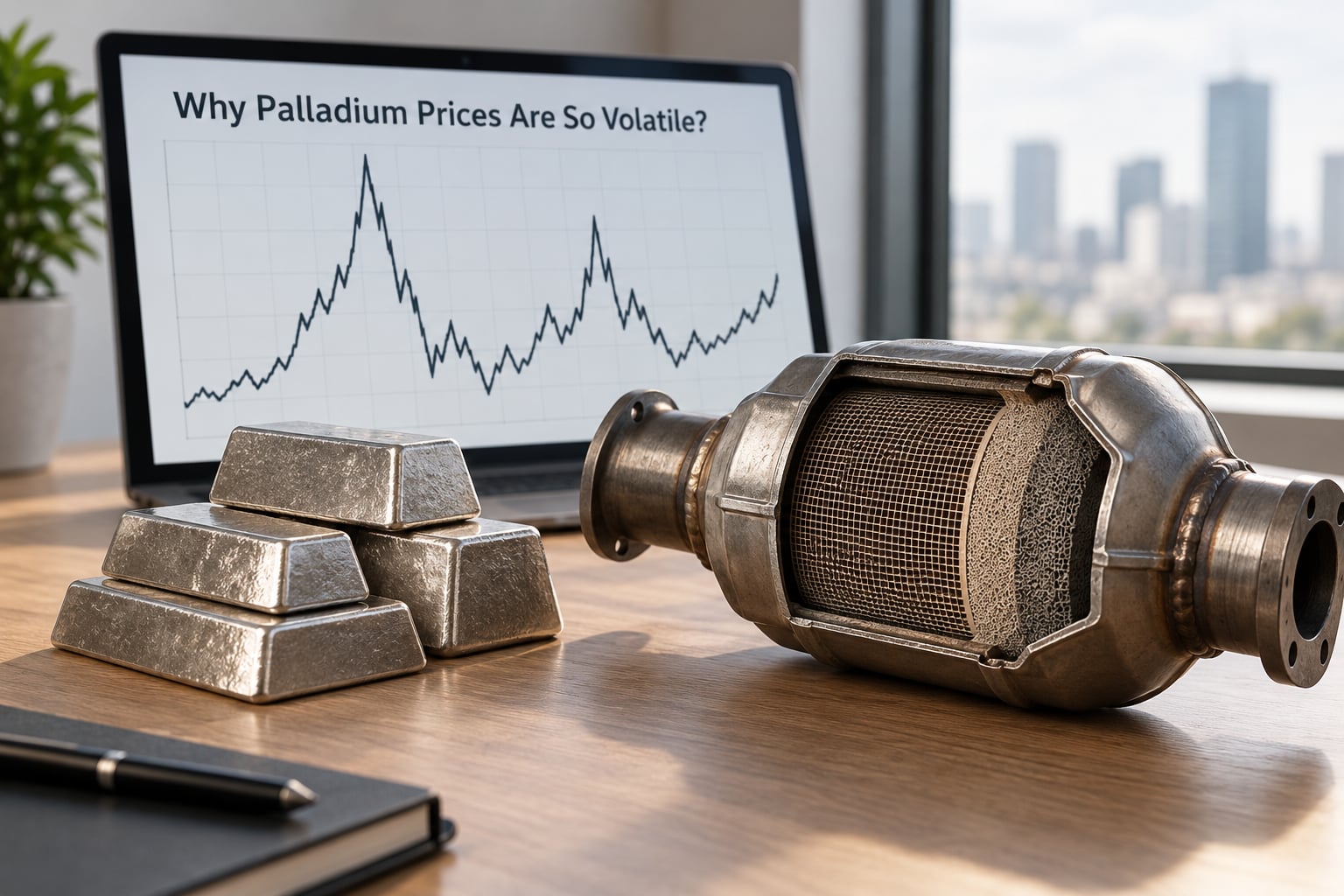
Palladium prices are volatile because supply and demand are both narrow and fragile. About two countries supply most mined metal, most demand comes from automotive catalytic converters, and the market is thin enough that a forecast change moves the whole price. Small expectation shifts become large price swings, in both directions.
Those seven drivers show up repeatedly in the price record:
- Concentrated mine supply. Russia and South Africa together account for the majority of mined palladium, so a power cut, labour dispute or export restriction hits a very large share of world supply at once.
- Single-industry demand. Around 80% of consumption goes into autocatalysts, which ties palladium directly to light-vehicle production and the pace of the shift to electric drivetrains.
- A shallow trading market. Annual mine supply is measured in millions of ounces against gold’s much deeper market, so each order moves price further.
- Fast headline repricing. Geopolitical events, sanctions and mine outages get priced in within hours, well before physical metal actually changes hands.
- Substitution and thrifting. Catalytic converter makers can shift toward platinum or use less palladium when prices rise, which caps rallies and deepens falls.
- Slow secondary supply. Scrap recycling responds on a lag of roughly six to twelve months, so shortages stay shortages long enough to produce spikes.
- Leveraged positioning. Futures markets with margin calls and stop orders force buying and selling that has little to do with the metal itself.
None of these drivers is unusual for a commodity. What makes palladium stand out is how they stack on top of each other, and how little depth sits underneath them when sentiment turns.
How Palladium’s Market Structure Creates Big Price Swings
Palladium belongs to the platinum group metals, a family that includes platinum, rhodium, iridium and osmium. The group shares refining routes and mine sites, which links the metals to each other, but each has its own balance sheet.
The physical market is small. Annual mine supply runs in the low single-digit millions of ounces, and a meaningful slice of that comes as a by-product of nickel, copper and chrome mining rather than from dedicated palladium operations. Producers cannot simply turn up output when the price rises, because the mines are built around a different metal.
The benchmark price is set through the London Platinum and Palladium Market, the wholesale auction where refiners and traders clear metal at the end of each session, with futures on CME used for hedging and price discovery beyond that fix. A relatively small number of refiners, traders and funds hold inventory, and the London OTC market — the venue where most physical trades happen — publishes far less depth information than an equities exchange.
The result is a market where you cannot always trade size at the price you see. When several buyers want the same ounce at once, the price moves instead of filling the order. That single feature explains a surprising share of the day-to-day swings people notice on a palladium chart.
What Makes Palladium Demand So Sensitive to Auto Sales?
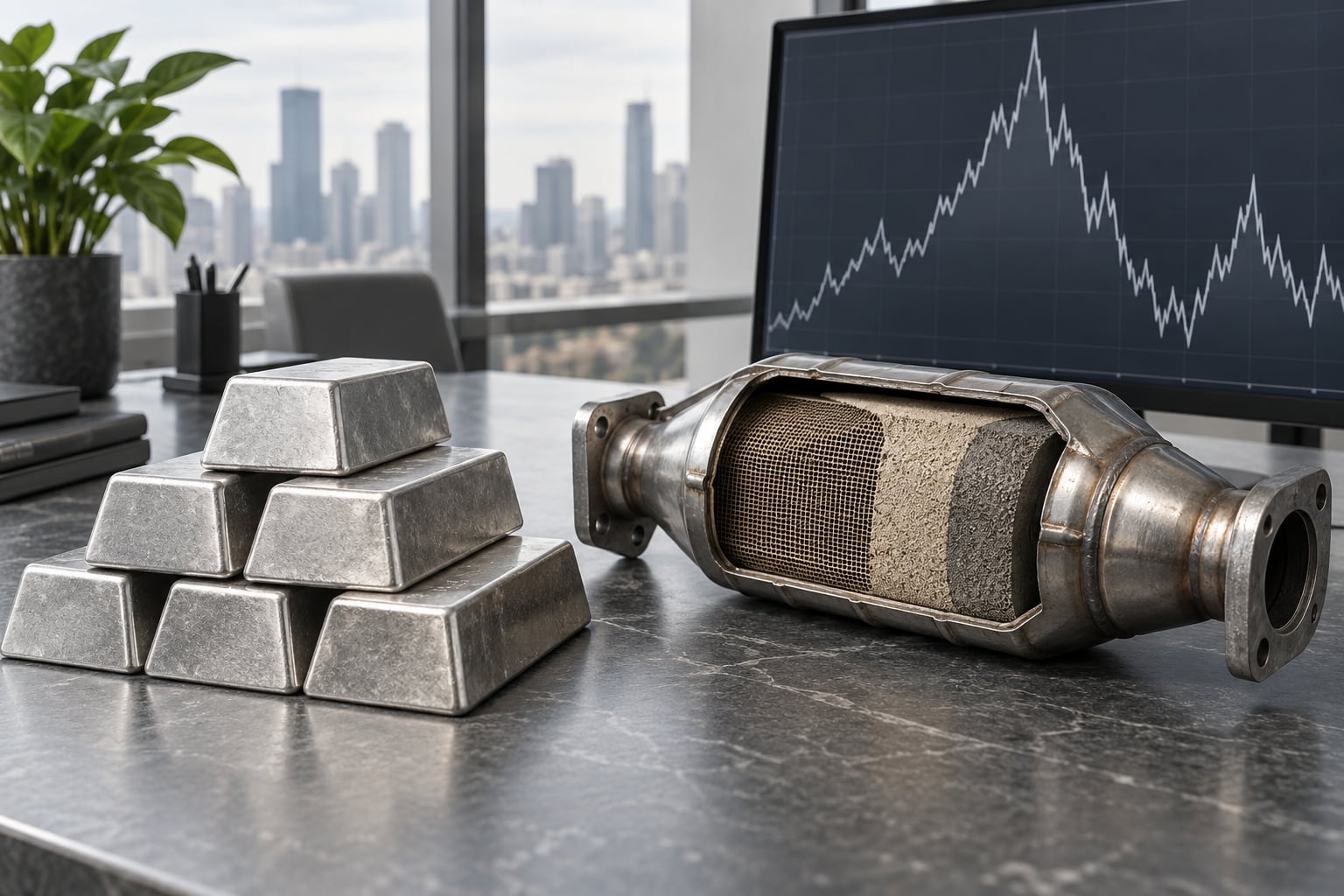
Palladium is used as a catalyst in the three-way catalytic converter that gasoline vehicles need to treat exhaust. The catalyst sits on a ceramic honeycomb coated with platinum, palladium and rhodium, each doing part of the chemical work of converting nitrogen oxides, carbon monoxide and hydrocarbons into safer gases.
Palladium is preferred for that role because it works at a lower operating temperature than the alternatives and tolerates the leaded fuel residues common in older engines. Its loadings can be adjusted by the catalyst maker, though, which matters more than most people realise.
Why palladium loadings move without any change in car sales
Catalyst makers respond to price. When palladium climbs, they can thin the palladium layer, substitute platinum at higher loadings, or change the mix so a hybrid or lighter vehicle carries less of it. That happens quietly, and it means demand can shrink while vehicle production is flat or rising.
Hybrids sit in the same boat. They have an engine, so they still need a catalytic converter, but they burn less fuel and typically carry a smaller catalyst. The move from conventional cars to hybrids to battery-only vehicles has therefore trimmed palladium content per vehicle year after year.
Automaker inventory cycles add the rest. Catalytic converters are ordered months before vehicles roll off the line, so a quarter of weak vehicle production can wipe out orders that had already been placed. When production recovers, the same converters have to be bought at then-current prices.
Forum readers describe this as the thing they never see coming. On Quora, the recurring question is why palladium trades near or above gold per ounce when it looks like a lesser metal, and the honest answer sits in this section: the automotive cycle decides how much of it gets bought, and the vehicle mix quietly decides how much per car.
Why Supply Shocks Have Such a Large Impact
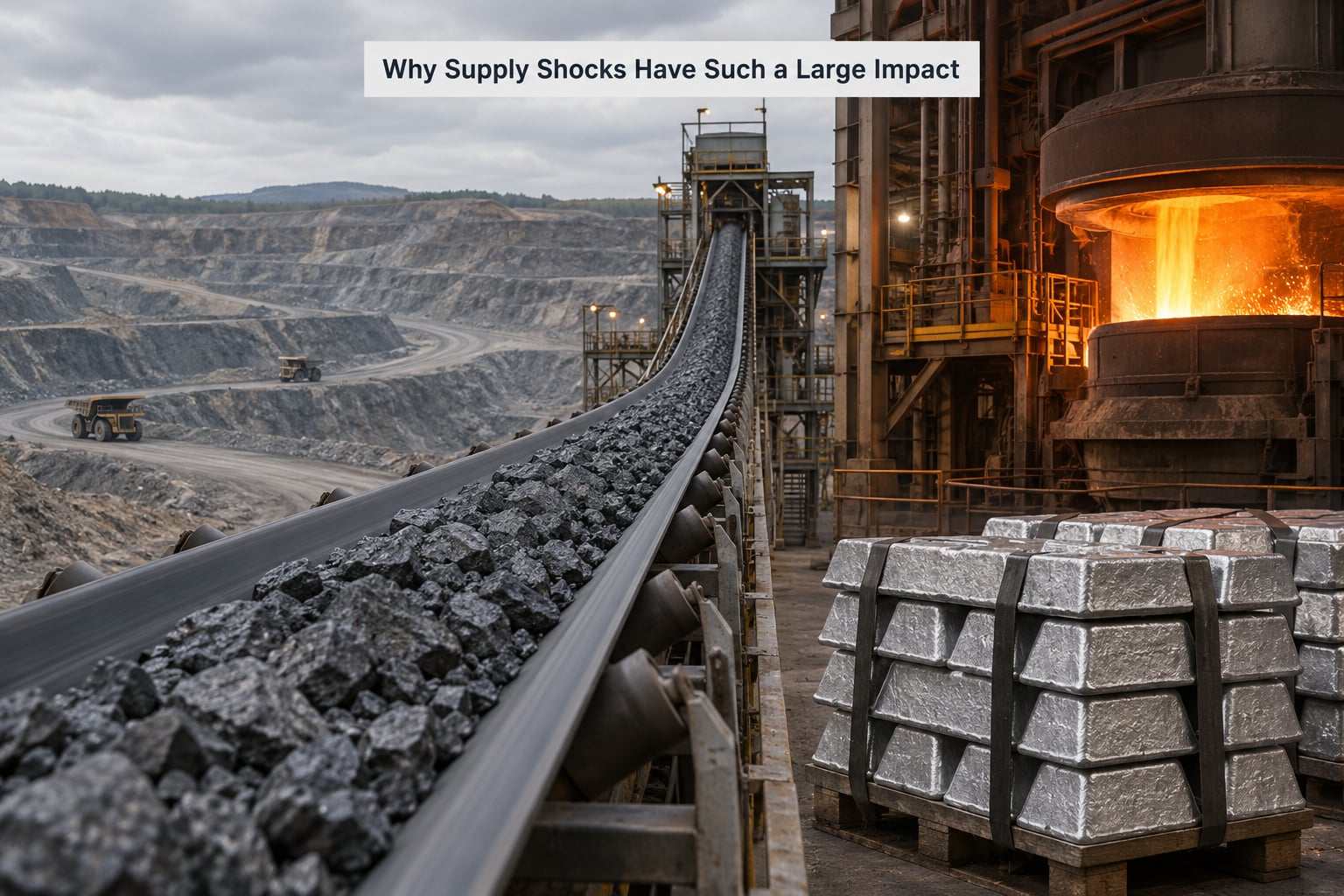
When one region supplies a large share of a small market, a problem there is not a local problem. South African operations face deep-level mining, labour disputes and periodic electricity supply constraints. Russian supply is exposed to sanctions, export licensing and shipping insurance, all of which can change overnight.
Refining matters as much as mining. Palladium is often recovered alongside platinum group concentrates, and the refining stage — where the metal is separated into saleable grade — is concentrated in South Africa, Russia, Zimbabwe and Japan. A furnace problem or a smelter outage can restrict supply that sits in the ground.
Not every supply event deserves the same reaction. Here is how the risk categories differ:
| Supply risk | Typical cause | Usual price effect | How long it lasts |
|---|---|---|---|
| Routine | Normal grade variation, scheduled maintenance, seasonal output | Small, absorbed by inventory | Days to weeks |
| Cyclical | Vehicle production swings, automaker destocking, refinery maintenance windows | Directional drift over a quarter | One to two quarters |
| Sudden | Mine outage, power cuts, sanctions, export bans, labour strikes | Sharp repricing within hours, often partly retraced | Days to weeks, sometimes a headline cycle |
That last row is the one that produces the headlines. Sudden risks are unpriced until they appear, so the market reacts harder to them than to slow deterioration that everyone could see coming.
How Substitution and Recycling Change the Balance
Palladium sits next to metals that can do similar work. Platinum handles part of the same reaction, rhodium is used where extreme temperature resistance matters, and catalyst chemistry keeps improving. When palladium gets expensive, the industry’s response is thrift and substitution, both of which cap how high a rally can run.
Thrifting means using less metal for the same result. Substitution means swapping one metal for another. Both reduce palladium demand per vehicle without any change in how many vehicles are built, and both tend to accelerate once a price move is big enough to justify requalifying a catalyst, which takes months.
Recycling works the other way. Spent catalytic converters are collected, shipped to refiners and returned to the market as secondary supply. The catch is timing: there is a lag of roughly six to twelve months between a price spike and the scrap response. During that window the market has already absorbed the shock, which is why rallies can overshoot and then fade as old converters arrive.
Hydrogen fuel cells are the offsetting story, and the only demand source that would grow rather than shrink with the vehicle mix. Palladium is the working catalyst in the fuel-cell stacks used in hydrogen vehicles, and electrolyser projects for hydrogen production use it too. Volumes are still tiny next to autocatalyst demand, and the pace depends on policy and infrastructure decisions made years ahead, so the bull case stays a forecast rather than a fact.
How Thin Liquidity and Investor Positioning Amplify Volatility
Thin markets move more for the same reason small boats rock more: there is less mass resisting the change. Palladium’s annual supply is a tiny fraction of the gold market’s, and the number of participants quoting meaningful size is smaller still. Fewer bids and offers means each order clears at a worse price.
Trading mechanics then compound it. Futures contracts are leveraged, so a modest price move triggers margin calls that force selling, and the same forced selling pushes price lower. Stop-loss orders cluster around obvious levels, so a move through one of them triggers a second wave of the same trade. Algorithmic traders react to price and flow rather than to supply and demand, which speeds up both directions.
Traders report daily moves of three to five percent during stress, with overnight gaps that make conventional stop placements unreliable. That pattern is normal for this market rather than a sign that something is broken.
The comparison with the other major metals makes the point plainly:
| Metal | Market depth | Primary demand driver | Supply concentration | Typical behaviour |
|---|---|---|---|---|
| Palladium | Small | Automotive catalysts | Very high, two dominant regions | Wide ranges in both directions, headline sensitive |
| Platinum | Small to moderate | Autocatalysts and industrial uses | High, southern Africa dominant | Wide ranges, slower supply response |
| Silver | Large | Industrial use plus investment demand | Moderate, spread across many countries | Frequent sharp moves on investment flows |
| Gold | Very large | Investment and central bank demand | Low | Large moves but low percentage ranges |
Gold can rise ten percent and still look calm next to a five percent week in palladium. Part of that is psychology: buyers of a precious metal expect stability, so unusual moves in palladium feel more alarming than the same move in an industrial metal.
Why Macro Events Trigger Sudden Palladium Moves
Palladium trades in dollars, so a stronger dollar makes it dearer for overseas buyers and tends to pressure the price. Rate expectations matter through the discount rate applied to future demand, and inflation expectations influence whether investors want an industrial metal at all.
Industrial growth data from China carries unusual weight, because Chinese vehicle production is a large share of the global autocatalyst market. Weak manufacturing prints there get read as weak palladium demand within minutes.
Risk sentiment works in the opposite direction from the usual safe-haven story. When investors rotate into metals broadly, palladium often rises alongside gold and silver because it rides the flow. When the rotation reverses, it falls faster than gold because there is less depth beneath it.
Macro catalysts and metal-specific fundamentals can point different ways. A weak dollar can lift the whole metals complex while Russian supply concerns are easing, and the net result tells you more about positioning than about the physical market. Reading the two layers separately keeps you from over-reading a single headline.
How Investors Can Monitor Palladium Volatility
You cannot remove volatility from a market like this, but you can stop reacting to single price spikes by watching the drivers instead. A practical week-to-week checklist:
- Global light-vehicle production. Monthly output figures tell you whether autocatalyst orders are rising or falling.
- Electric and hybrid share of sales. The pace of drivetrain change is the slow-moving variable that decides palladium per vehicle.
- South African mine and refinery news. Power supply, labour disputes and furnace outages are the fastest-moving supply risks.
- Russian export and sanctions developments. Licensing rules and shipping insurance costs change without warning.
- Substitution signals. Catalyst makers announcing thrifting or platinum use in new formulations tell you demand is being capped.
- The dollar and China data. These set the macro backdrop the price is trading against.
- Futures positioning and open interest. Crowded longs make a downside move faster; crowded shorts do the same to the upside.
- Realized volatility and spreads. Physical bid-ask spreads on retail palladium are wide, and wider still in stress.
Physical buyers report being put off by dealer spreads on palladium bullion, which is a real cost separate from the metal price. If you are buying metal rather than trading a contract, that spread deserves more attention than a chart pattern.
This article is general information about how a commodity market behaves. It is not investment advice, and no method described here predicts where palladium goes next.
Frequently Asked Questions
Why did palladium prices crash?
The main reason was a demand and supply reset after an extraordinary spike. Record vehicle production expectations faded, catalyst makers thrifted and substituted toward platinum, electric vehicle adoption trimmed palladium per vehicle, and recycled metal began arriving months after prices peaked. Thin market depth and leveraged futures positioning then turned a gradual correction into a fast one.
Why are palladium prices falling right now?
Prices tend to fall when the market believes autocatalyst demand will shrink faster than supply responds. Hybrid and battery-only vehicle growth reduce palladium per vehicle, substitution caps rallies, and South African and Russian supply keeps arriving regardless of price. When investors also pull back from commodity exposure, the thin market amplifies the move.
Is palladium more valuable than gold?
Value per ounce and usefulness are different questions. Gold’s market is far deeper and its demand comes mostly from investors and central banks, so it behaves like a store of value. Palladium’s demand is mostly industrial, which gives it higher price swings as a share of its value. Palladium can trade near or above gold per ounce without matching gold’s stability.
Why is palladium more volatile than gold and silver?
The difference is market depth and demand composition. Gold and silver sit in much larger markets with far more participants quoting size, so the same order moves price less. Palladium’s annual mine supply is a small fraction of gold’s and roughly 80% of its demand comes from one industry, so supply or forecast changes reprice the whole market quickly.
What are the most rare metals?
Rarity usually means annual production rather than total abundance. Platinum group metals, including palladium, rhodium, tantalum and iridium, are produced in small tonnages each year, and some platinum group elements are rarer in annual output than gold. Rarity alone does not set price: demand, substitutability and market depth matter just as much.
Will electric vehicles end palladium demand?
Electric vehicles built without an engine do not need a three-way catalytic converter, so each battery-only car removes demand that gasoline cars generated. Hybrids still have engines and still need catalysts, though usually smaller ones. Hydrogen fuel cell vehicles also use palladium as a working catalyst, which offers a partial offset, but that volume remains small compared with autocatalyst demand today.
Conclusion
Palladium volatility is not one cause but an interaction: concentrated supply in two mining regions, demand tied almost entirely to vehicle production, substitution that caps rallies, recycling that arrives too late to smooth them, and a thin market where leveraged positioning does the rest.
Start with the two numbers that matter most — global vehicle production and the pace of Russian and South African supply — before reacting to a single spike. A price move makes sense once you know which of those seven drivers is pulling.