You cannot buy rare earth elements directly the way you might buy gold. Nearly all retail exposure comes through the companies that mine, separate and refine them, or through funds that hold those companies. That means the practical answer to how to invest in rare earth elements is a choice of vehicle — an exchange-traded fund, a producer share, or a broader critical-materials fund — plus a written plan for sizing and reviewing the position.
The demand case is not subtle. Rare earths are the elements behind the permanent magnets in electric vehicle traction motors, wind turbine generators, robotics actuators, consumer electronics and defence systems. The supply case is equally concentrated: China accounts for roughly 70% of rare earth mining and close to 90% of the processing and refining capacity that turns ore into separated oxides, and that refining step is where almost all the world’s usable output actually gets made.
That concentration is the whole investment thesis, and it cuts both ways. The same country that makes the supply chain a strategic asset also makes it a source of policy risk, because export restrictions can change with little notice. Prices move violently in both directions, and the sector is far too volatile to sit in the core of most portfolios.
Table of Contents
- What You Need Before You Buy Anything
- Step-by-Step: How to Invest in Rare Earth Elements
- 1. Define your objective and time horizon
- 2. Learn the supply chain, because the chain is the investment
- 3. Choose how to invest in rare earth elements — and what each route actually buys you
- 4. Research individual companies and projects honestly
- 5. Size the position and diversify deliberately
- 6. Monitor catalysts, risks and your exit conditions
- Common Mistakes in Rare Earth Investing
- Tips for Building a Long-Term Rare Earth Portfolio
- Frequently Asked Questions
- What is the best way to invest in rare earth elements?
- Can individual investors buy rare earth elements directly?
- Are rare earth element investments a scam?
- Should I invest in rare earth mining stocks or a diversified fund?
- How much should I invest in rare earth elements?
- Can I invest in rare earth elements through a retirement account?
- Conclusion
What You Need Before You Buy Anything
You need money you will not need for several years. Rare earth producers can be down 50% or more on a single permitting or policy headline, and a three-year horizon is a minimum rather than a comfort zone.
You need a brokerage account, and possibly more than one. A standard US retail broker covers US-listed ETFs and shares. Australian names such as Lynas Rare Earths trade on the ASX and are often reached by US investors through an OTC ticker like LYSCF, which is a different security with different liquidity and no shareholder protections you would get domestically. Non-US investors should also check whether an accumulating share class exists for a fund, because the distributing version of some widely held metals ETFs triggers an annual tax bill in the UK.
You need primary sources, not just summaries. The USGS Mineral Commodity Summaries gives production, import reliance and reserves data that most commentary ignores. Company quarterly reports and technical disclosures tell you what is actually being built. China customs export data gives you the earliest read on whether a policy story is real.
Finally, you need written limits: a maximum allocation, a rebalancing rule, and the specific evidence that would make you sell. Investors who skip this step tend to buy on headlines and sell on panic, which is exactly the behaviour that makes this theme expensive to hold.
Step-by-Step: How to Invest in Rare Earth Elements
1. Define your objective and time horizon
Decide what the position is for before you pick a ticker. If you want commodity leverage to rising rare earth prices, a producer share gives you more of it than a fund. If you want to hold a theme without picking winners, a fund is the honest choice. If you want income, this is the wrong theme — most producers return capital sparingly, and the funds largely do not distribute.
Then write down the horizon. A five-to-ten year thematic hold is the only framing that survives the drawdowns. Anything shorter is a trade on news sentiment, and the retail forums that attract the most rare earth chatter are largely full of people asking whether the trade is already over.
2. Learn the supply chain, because the chain is the investment
Most people lose money in this theme by buying the wrong link. Understanding the sequence is not optional background; it decides which company’s profits you are actually exposed to.
The first step is the deposit. Rare earths come from a few deposit types: hard-rock and disseminated orebodies such as bastnäsite and monazite, and ion-adsorption clays typical of southern China, which can carry the valuable heavy rare earths. Ore is crushed, milled and concentrated into a concentrate, then leached with acid or alkali and run through solvent extraction to separate each element into its own oxide. The oxides are reduced to metal and alloyed into permanent magnets, which is where neodymium, praseodymium, dysprosium and terbium matter most.
Owning a mine is not the same as owning a refiner. A miner sells concentrate, often under an offtake agreement to a processor, and its economics depend on the concentrate price. A processor earns the spread and captures the margin that comes from controlling the scarce step. When policy chatter moves prices, that spread can behave very differently from the ore price. Read the processing sections of the annual report before the reserve tables, because that is where the scarcity lives.
3. Choose how to invest in rare earth elements — and what each route actually buys you
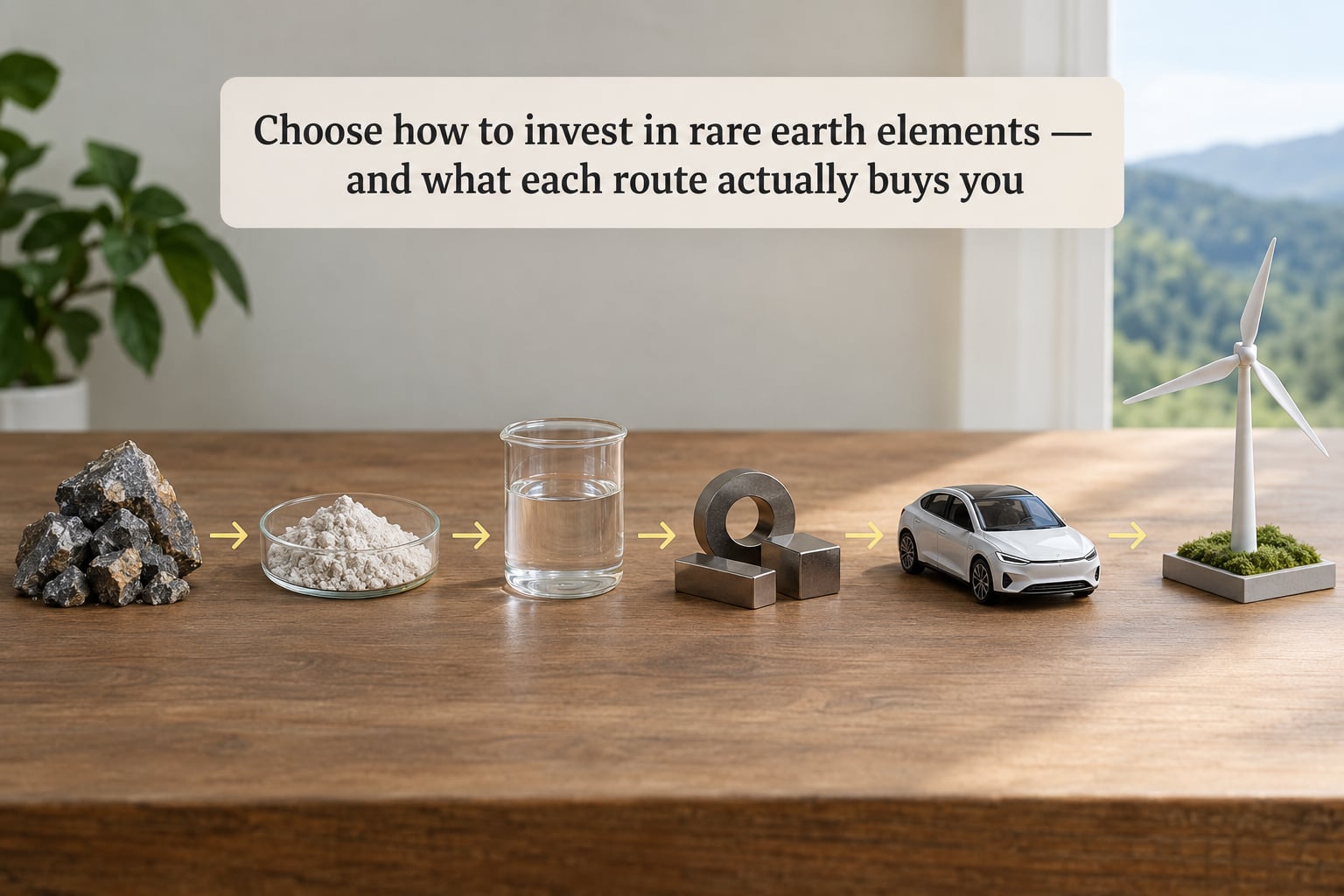
Exchange-traded funds. The broadest route, and the default for most people. REMX from VanEck holds global rare earth and strategic metals producers; EART from Global X covers rare earths plus a broader critical-materials basket; REXC from Sprott is built to exclude China entirely; SETM is a critical-materials fund rather than a pure rare earth vehicle. Read the fund’s country breakdown before you buy, because two of the three major rare earth funds hold substantial Chinese holdings while still being described as diversified.
Individual producers. MP Materials operates the Mountain Pass mine and processing facility in the US and has become the headline domestic supply story. Lynas Rare Earths is the largest non-Chinese separation capacity, with operations in Australia and Malaysia. Energy Fuels produces monazite and has been building downstream separation. These give you real leverage and real concentration risk in a single management team, single jurisdiction and single project.
Broader critical-minerals strategies. Funds covering copper, uranium, lithium and PGMs alongside rare earths dilute the theme but also spread across a commodity cycle you are less likely to misjudge.
Physical and futures exposure. Both exist in specialist markets, but neither suits most retail accounts. Physical rare earths are not a practical retail holding, and futures contracts roll, margin and expire in ways that make them a professional instrument.
4. Research individual companies and projects honestly
For any producer you consider, ask a fixed set of questions. What are the reserve and resource figures, and what were they measured against? What is the ore grade, and does it support the capital cost in the feasibility study or has that estimate doubled? Where is the project, in which country, and who owns the land? What permits are in hand versus merely applied for? Is there a funded construction path or a slide deck? Where does the material actually go — is there an offtake agreement, and with whom?
Then look at separation capacity, because a producer shipping concentrate captures a fraction of the value. Check the balance sheet and the cash cost per unit, and note whether the company is raising equity every quarter. Finally, look at valuation and be honest that an option on a future mine is worth a very different number from a producing asset with cash flow.
5. Size the position and diversify deliberately
The consensus guidance, and the guidance I would give, is 2-5% of a diversified portfolio as a satellite sleeve, held alongside a broad core. Not as a core holding. Not as 20% because the theme excites you this quarter.
Diversification inside the sleeve matters too. Two miners with the same jurisdiction, the same offtake partner and the same processing bottleneck are one bet, not two. Spread across geography and across the value chain — a fund holding both miners and processors does this for you automatically, which is a genuine argument for the fund route that rarely gets made.
Be aware of correlation with the rest of your portfolio. If you already hold a mining or technology sleeve, rare earths will amplify that exposure rather than offset it. And keep real-asset context in mind: rare earths sit alongside gold, silver and the platinum group metals as an inflation-linked theme with a very different risk profile, so the allocation decision is one about the whole real-assets bucket, not about rare earths in isolation.
6. Monitor catalysts, risks and your exit conditions
Track a short list of things that actually change the thesis: offtake agreements signed or cancelled, permitting milestones, production and shipment volumes reported quarterly, rare earth oxide prices, Chinese export policy and customs data, recycling and urban-mining capacity coming online, cost inflation on capital projects, and equity raises that dilute your stake.
Write down what would prove you wrong. Mine-grade assumptions that get revised down, a separation plant that misses its ramp schedule, or a Chinese export policy that stays permanently wide open and removes the scarcity premium are all falsifiers. Set a review trigger — a scheduled quarterly check plus any rule for immediate re-examination — rather than reacting to price.
Common Mistakes in Rare Earth Investing
Confusing rare earths with adjacent critical minerals. Lithium, copper, graphite and uranium have different demand drivers and different cycles. A fund that lumps them together is not a rare earth investment; check what you actually own.
Buying a supposedly ex-China fund without reading the country table. Open the fund’s holdings and look for Chinese listings directly. This is the single most repeated question in retail discussions and the easiest mistake to avoid, taking five minutes.
Chasing headlines. The sector trades on policy news. Buying after an export-control headline and selling after a trade deal is how people lose money in a theme whose long-term demand is genuinely growing. Fix: decide your position size before the news and rebalance on a calendar, not a headline.
Treating every deposit as an economic deposit. A large measured resource is not a mine. Many early-stage projects never reach production, and pre-revenue explorers are the most common regret in the retail communities that discuss this sector.
Ignoring jurisdiction and permitting risk. A deposit in a jurisdiction with permitting history or a fragile power supply carries years of delay risk that no reserve figure captures.
Overweighting a single producer. Company-specific risk — a management team, a contractor dispute, a capital raise — can dominate everything else. A 5% satellite allocation that is entirely one stock is a 5% single-company bet wearing a commodity label.
Ignoring fund size and fees. Small niche funds carry closure risk, and a high expense ratio on a volatile thematic sleeve is a permanent drag you pay every year while waiting.
Tips for Building a Long-Term Rare Earth Portfolio
Buy in stages. Split the intended allocation across several purchases rather than one entry, which reduces the cost of being early or late on a theme that moves on policy.
Favour transparent economics. A producer publishing reserve estimates with a competent independent reviewer and clear cash costs gives you something to re-check later; a company with only press releases gives you nothing to test the thesis against.
Separate exploration from production in your own notes. Early-stage assets get almost all of the upside in a hype cycle and almost none of the cash flow; producers fund the drawdowns. Different roles, different position sizes.
Check whether management is paid in equity and holding it. Insider ownership is not proof of skill, but a large recurring sale program is worth asking about.
Rebalance on a rule you set in advance, such as a semi-annual check or a threshold band around your target weight, and rebalance the sleeve back to size regardless of which direction it moved.
Document your exit thesis while you are still calm. A page that says what evidence would change your mind is worth more than any return forecast, because it turns a volatile theme into a managed position.
Frequently Asked Questions
What is the best way to invest in rare earth elements?
For most people, a rare earth or critical-materials exchange-traded fund is the best route, because it spreads exposure across dozens of miners and processors instead of one management team. Funds differ in ways that matter: broad global funds hold substantial Chinese holdings, ex-China funds avoid them, and broader critical-materials funds dilute the theme. Individual producer shares give more leverage and more risk. There is no single best vehicle, only the one matching your concentration tolerance.
Can individual investors buy rare earth elements directly?
Not practically. There is no retail spot market where you can buy neodymium oxide or dysprosium metal the way you might buy gold ounces, and no widely accessible physical vehicle for retail buyers. Exposure comes through company shares, exchange-traded funds, or institutional futures contracts that require margin and roll management. A few dealers sell small quantities of rare earth metals for laboratory or industrial use, but those markets are thin and priced by quote rather than by an exchange.
Are rare earth element investments a scam?
No, but there is a lot of hype attached to them. The underlying demand from electric vehicles, wind, robotics and defence is real, and the supply chain is genuinely concentrated. What is unreliable is the promotional framing: many tickers sold as rare earth plays are exploration companies with no production, and many funds marketed as diversified hold a quarter of their assets in Chinese producers. The theme is legitimate; the marketing around it frequently is not.
Should I invest in rare earth mining stocks or a diversified fund?
The fund is the better default for most investors, because it removes single-company and single-jurisdiction risk and rebalances holdings that stop delivering. Individual producer shares make sense only if you want to accept the risk that one project is delayed, one export policy shifts, or one balance sheet needs capital. A reasonable middle ground is holding most of the sleeve in a fund and a small portion in one producer whose economics you have actually read.
How much should I invest in rare earth elements?
Most guidance in this space points to roughly 2-5% of a diversified portfolio, treated as a satellite sleeve rather than a core holding. The sector’s realised volatility makes larger allocations hard to hold through a drawdown, and correlation with mining or technology holdings means a bigger position may be adding concentration rather than diversification. Size it so that a 50% decline in the sleeve leaves your financial plan intact, and rebalance back to target on a schedule you set now.
Can I invest in rare earth elements through a retirement account?
Yes, most exchange-traded funds and producer shares that trade on US exchanges can be held inside an IRA or other tax-advantaged account, which has the advantage that gains stay untaxed until withdrawal. Two things to check first: the account type changes the volatility picture rather than reducing it, and non-US investors should confirm with a tax adviser whether an accumulating versus distributing share class is more suitable, since the distributing option can create an annual bill. Rules vary by country and by account.
Conclusion
Start with the process, not the ticker. Write down what you want the position to do, learn where the profit actually sits in the supply chain, compare the fund route against the producer route on cost and concentration, and then size it as a small satellite sleeve you can hold for five years without changing your mind. Check the country breakdown of any fund before you buy, and write down in advance the evidence that would prove the thesis wrong.
The demand story for rare earths is durable. The prices you pay for it will not be calm, and the mistakes are mostly avoidable. Take the first step this week: build a research list of two funds and three producers, read one annual report from each, and let the numbers tell you which link in the chain you actually want to own.
This article is general information about an investment theme, not personalised financial advice. Rules, fund details and tax treatment vary by country and change over time, so check current figures with the provider and speak to a qualified adviser before investing.