Mining dilution hurts shareholders when a company issues new shares and the cash raised does not add at least as much value as it spreads your ownership across a larger company. In practice that shows up in three places: your percentage claim falls, earnings per share shrink, and the price usually drops when new shares are sold at a discount. Dilution is a cost, not a verdict. The real question is whether the company pays that cost for something worth more than what it gives up.
I read financing announcements for a living, and the pattern is consistent enough to write down. Junior miners are structurally short of cash, so they come back to the market again and again. A single raise is usually survivable. The damage comes from serial raises, each one smaller than the last, priced at a deeper discount, each one followed by another.
This is general education on how mining capital structures work, not investment advice. Rules, reporting standards and disclosure thresholds vary by country and change over time, so check the filings yourself before acting on anything here.
Table of Contents
- What Is Mining Dilution?
- How Mining Dilution Hurts Shareholders
- Your ownership percentage falls
- Voting power shrinks with it
- Earnings per share gets divided across more shares
- Your claim on future cash flow is smaller
- Why Mining Companies Issue New Shares
- How Mining Dilution Happens Step by Step
- How Mining Dilution Affects Share Price
- How to Calculate Mining Dilution
- Which Types of Mining Dilution Create the Most Risk?
- Warning Signs of Harmful Mining Dilution
- When Can Mining Dilution Benefit Shareholders?
- How to Assess Dilution Before Buying a Mining Stock
- Frequently Asked Questions
- Is mining dilution always bad for shareholders?
- What does fully diluted shares outstanding mean in mining?
- How do warrants dilute mining shareholders?
- Why does a mining stock fall after an equity financing?
- How much dilution per financing round is normal for a junior mining company?
- What is the non-dilutive alternative to equity financing in mining?
- Conclusion
What Is Mining Dilution?
Mining dilution is the reduction in existing shareholders’ ownership percentage when a mining company issues additional shares to fund exploration, mine development, acquisitions or operating shortfalls, without existing shareholders buying those shares proportionately. Your shares still exist. There are simply more of them, and you own a smaller slice of the same business.
Debt does not dilute you. If a company borrows, it owes the money back with interest and the share count stays where it is. Equity financing is different because the lender becomes an owner, and that ownership is permanent.
A few terms show up constantly in mining filings and are worth having straight before going further.
| Term | What it means in mining |
|---|---|
| Shares outstanding | Common shares actually issued and outstanding today. This is the number most data providers quote. |
| Fully diluted share count | Outstanding shares plus every security that can reasonably become a share: warrants, options, convertible notes, share-based compensation. This is the real claim on the company. |
| Warrant overhang | The volume of warrants outstanding that can be exercised into new shares, plus the volume-weighted strike price relative to the current price. |
| Cash runway | Months of spending the current treasury balance covers at the current quarterly burn rate. Under about 12 months is tight. |
| Cash shell | A listed company whose cash has largely been spent and whose main asset is its listing rather than its project. |
| Shelf registration / ATM | Pre-registered capacity to sell shares into the market over time, often used for drip-fed raises rather than one negotiated placement. |
How Mining Dilution Hurts Shareholders
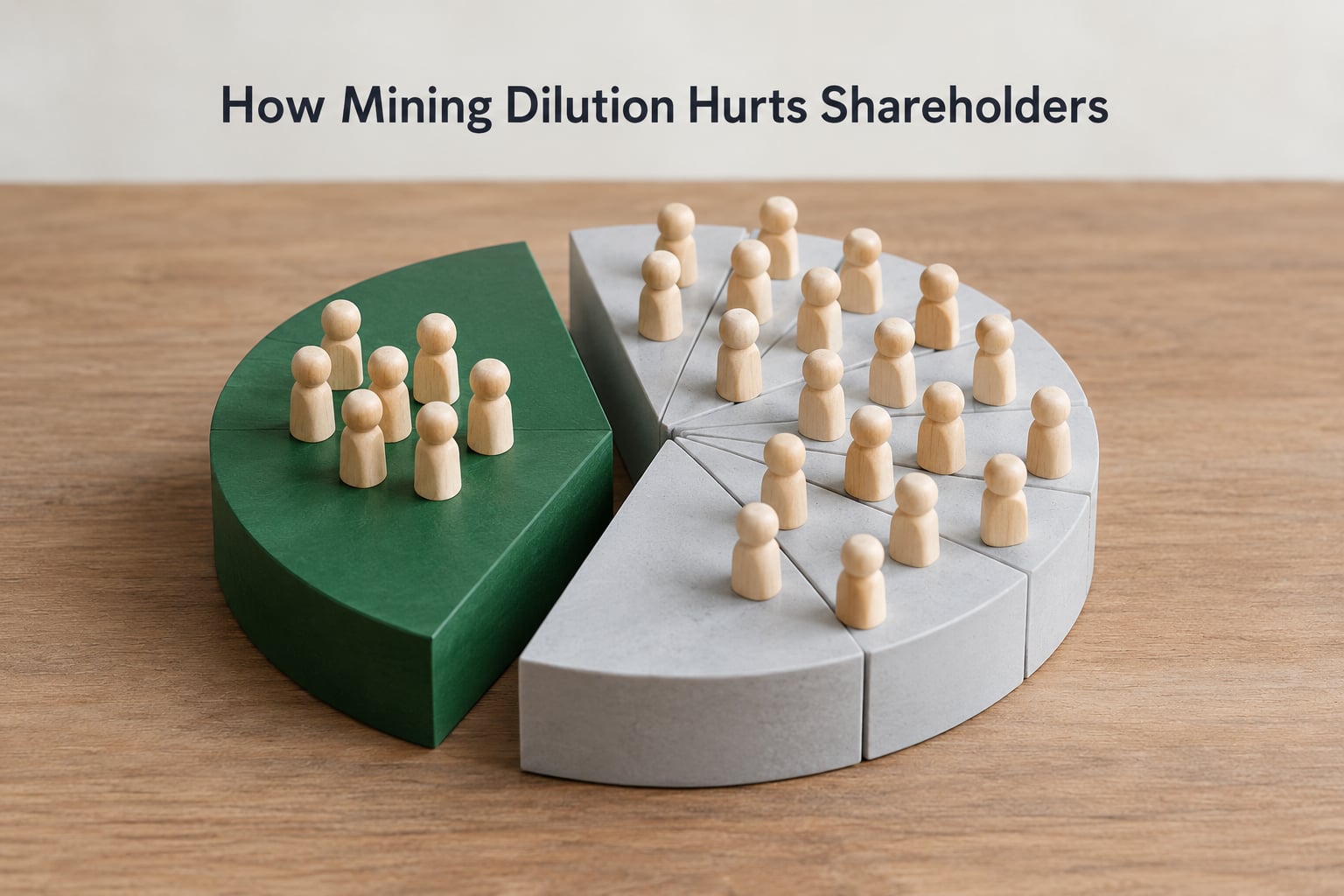
There are four distinct channels, and they do not all hit at the same time.
Your ownership percentage falls
If you hold 1 million shares of a company with 100 million outstanding, you own 1%. After the company issues 40 million new shares, the same 1 million shares represent 0.71%. Your position did not shrink. The denominator did.
Voting power shrinks with it
Ownership percentage is voting percentage. On most matters a retail holder’s vote makes no practical difference, but control blocks do move. A founder or insider who held 20% before a raise holds materially less after it, and large shareholders who bought during a placement end up owning far more of the company than the founders who built it.
Earnings per share gets divided across more shares
Once the mine is producing, earnings per share is simply net income divided by the weighted average share count for the period. Add shares and, with income unchanged, EPS falls. Two years of margin improvement can be erased in accounting by one raise.
Your claim on future cash flow is smaller
This is the one investors most often miss. If the project works, the value gets split across every share, not just the ones issued before the raise. A mine with the same reserves is worth less per share after a 40% issuance, and that difference does not wash out at production.
There is a second-order effect too. The market prices a company on expected returns per share. A raise tells investors two things at once: the company needed money, and the money will not be enough to finish the job. Both messages lower the multiple.
Why Mining Companies Issue New Shares
Mining burns cash before it makes any. A discovery has to be drilled out, a resource has to be modelled, a deposit has to be permitted, feasibility work has to be paid for, construction has to be financed, and commissioning happens months before the first payable ounce. Most companies never reach the producing stage at all, and pre-revenue juniors simply cannot fund that sequence from anything else.
The recurring financing situations are these.
- Exploration. Drill programmes, assays, geophysics and resource modelling. A round usually funds one clear work programme with a defined end date.
- Development. Permitting, feasibility studies, detailed engineering and land acquisition before any revenue exists.
- Construction. The largest raise a company ever does, often alongside a debt package or a stream.
- Capital overruns and delays. Costs run high, schedules slip, and the budget for the next phase has to be rewritten.
- Operating shortfalls. Production runs below plan, costs run above plan, or metal prices fall below the assumptions in the budget.
- Acquisitions. Buying a project, another company, or claims and equipment. Often done with shares because the seller wants to keep upside.
- Rescue financings. A raise on short notice when the treasury is nearly empty. These carry the worst terms and the deepest discounts.
- Warrant and convertible conversion. Dilution that arrives through the side door, triggered by exercise or conversion rather than a new placement.
How Mining Dilution Happens Step by Step
Here is a clean example with round numbers. A junior holds 100 million shares outstanding and has never been profitable. It needs to fund a two-year drill and feasibility programme.
It issues 40 million new shares to a group of institutional and strategic investors at a discount to the last traded price, attaching warrants that could add another 20 million shares later.
| Measure | Before the raise | After 40M new shares | Change |
|---|---|---|---|
| Shares outstanding | 100 million | 140 million | +40% |
| Holder with 1 million shares, ownership | 1.00% | 0.71% | 29% less |
| Dilution from the issuance | — | 28.6% of the company | — |
| Net income (unchanged, hypothetical) | 20 million | 20 million | none |
| EPS | 0.20 | 0.14 | -29% |
| Fully diluted shares including warrants | 100 million | 160 million | +60% |
Two things stand out. The dilution percentage is the new shares divided by the post-issue count, not the new shares divided by the old count. A 40 million share issuance sounds like 40% dilution and is really 28.6%. And the fully diluted figure matters more than the basic one: at 160 million fully diluted shares, the holder above owns 0.63%.
Now add the second raise. Twelve months later, at a lower price because the drill results disappointed, the company issues another 70 million shares. Against 140 million outstanding, that is 33.3% dilution, and the original holder is now at 0.35%.
Nobody did anything wrong. Each raise was rational on its own terms. Together they produced what serial dilutors call a base decline, where the share count climbs faster than project value for years.
How Mining Dilution Affects Share Price
Announcements usually move the price down, for reasons that have little to do with the cash itself.
The first is the discount. Selling 40 million shares at a discount to the last trade means the market price has to fall toward the issue price to clear the extra supply. The discount is the market’s estimate of how much value transfers from old holders to new buyers.
The second is the signal about funding. An equity raise says the current plan does not have enough money behind it. Investors mark the timeline further out and apply a higher discount for the extra years of execution, spending and commodity price risk.
The third is the arithmetic of expectations. You are not diluted by the money itself, you are diluted by what that money buys. If the raise funds a study that converts a resource into a reserve, doubles the resource, or de-risks a permitting path, the per-share value can go up even though your percentage went down.
Financing discounts also stack. Institutional placements in junior mining commonly carry a discount to the last close plus warrants, and the deeper the discount the more urgent the raise was. A small raise priced near the market with a long runway reads very differently from the same raise priced at a steep discount with warrants attached.
How to Calculate Mining Dilution
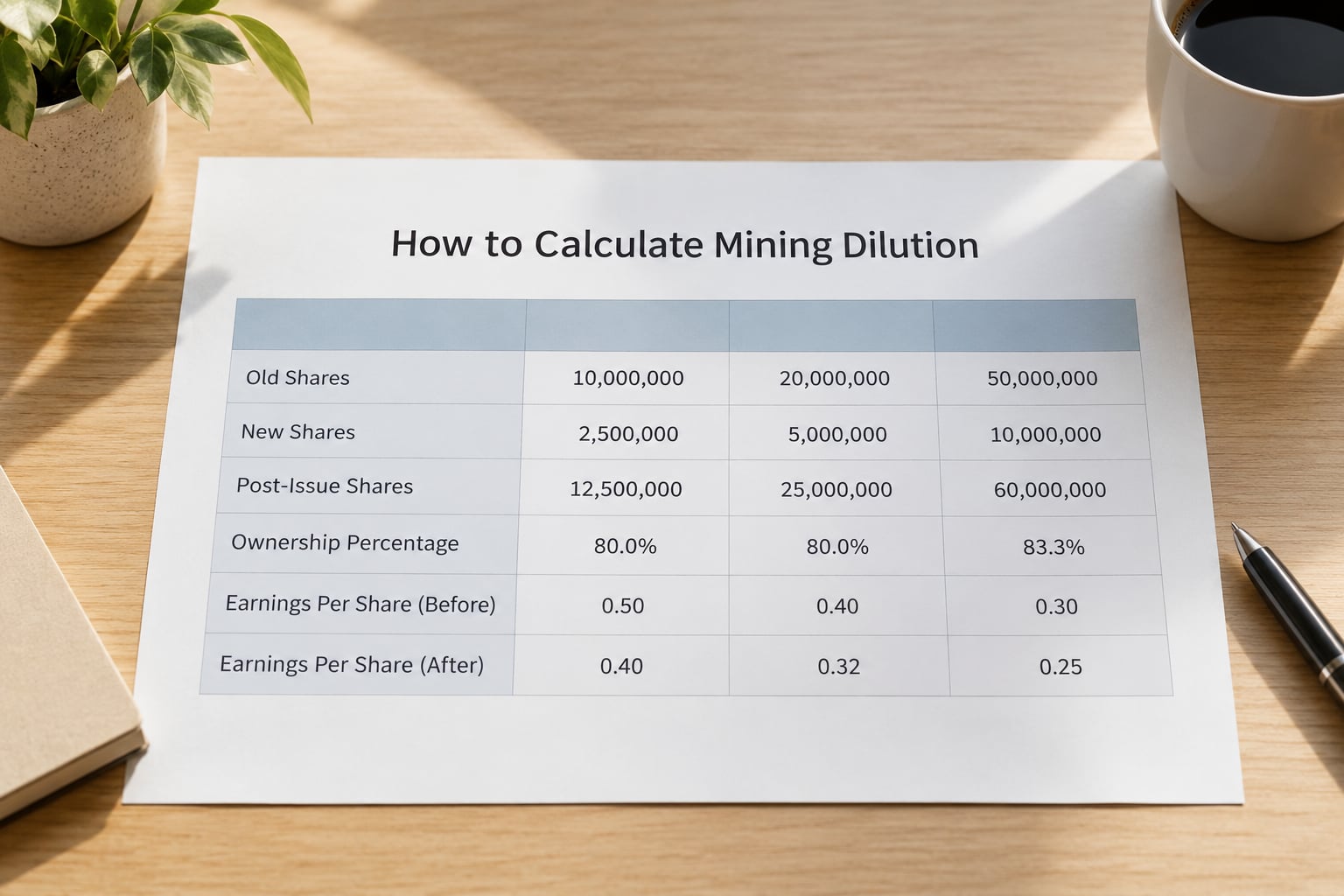
Every number you need comes from a filing, usually the cover page of a quarterly report or a registration statement. Basic shares outstanding, warrants outstanding with strike and expiry, convertible notes with conversion terms, and net income for the period.
- Ownership after an issue: your shares ÷ (existing shares + new shares) × 100
- Dilution percentage: new shares ÷ (existing shares + new shares) × 100
- EPS after an issue: net income ÷ weighted average shares outstanding
- Fully diluted shares: basic shares + in-the-money warrants + options + convertible shares
- Warrant coverage ratio: warrant shares ÷ basic shares outstanding
- Months of runway: treasury balance ÷ average quarterly operating cash burn × 3
The formula worth having open in a spreadsheet is this one, which asks whether a raise is accretive at all:
Value per share after = (company value + cash raised) ÷ fully diluted shares after the raise
Plug in a company with a pre-money value of 300 million, a raise of 60 million at a modest discount, and 100 million shares going to 160 million fully diluted. Pre-money value per fully diluted share is 3.00. Post-money value per fully diluted share is 360 ÷ 160, or 2.25. That raise was dilutive by 25% per share on the numbers alone, and the project has to create more than 60 million of extra value to recover it.
Run the same formula with a raise that funds a study worth it, and the answer flips. That is the only test that separates the two kinds of raise, and it takes about ten minutes with data straight out of EDGAR or the equivalent national filing system.
Which Types of Mining Dilution Create the Most Risk?
Not all dilution carries the same weight. The mechanism matters as much as the size.
Strategic equity financing is usually the least harmful. A raise to a partner, a trading house, or a strategic investor that brings offtake or project backing along with it funds a defined programme, prices near the market, and arrives with a long runway. Dilution happens once and then stops.
Repeated emergency financing is the worst. Small raises, short notice, deep discounts, warrants attached. Each one signals the previous plan failed, and the price at which you get hit is set by the company’s urgency rather than by the project’s value.
Warrant and option overhang is the sleeper. Warrants issued alongside a raise cost nothing today but tie up a chunk of the share price ceiling, because the market knows the volume that can be sold into it. An option pool that resets and grows quietly each year dilutes without an announcement.
Convertible debt looks patient on day one and arrives later. The money is not dilutive until conversion, but conversion often triggers exactly when the price recovers, and the strike is usually set at a discount to the market price at issue. You get diluted on the good news.
Non-participating preference arrangements from project or royalty partners can rank ahead of common shareholders on part of the economics. That is not share dilution, but it takes a slice of the cash flow your other shares are supposed to share, and it is easy to miss when you only look at share counts.
Streaming and royalty financing sits on the other side of the line. Selling the right to a fixed portion of future production for cash today brings in money without issuing shares, though it also permanently reduces what each share receives from that mine. It trades ownership for a lighter balance sheet rather than diluting the count.
Warning Signs of Harmful Mining Dilution
Most destructive dilution is visible in advance if you know where to look. These are the patterns I watch for.
- Raising again far sooner than planned. A round budgeted for 24 months that gets replaced in 8 months is telling you the budget was wrong.
- Share count climbing every year with no milestone reached. Three years of drilling and still no study, no resource update, no feasibility work.
- Discounts widening round after round. Each financing at a lower price than the last, with more warrants attached each time.
- Use of proceeds phrased as working capital or general corporate purposes. Vague wording on a mining raise usually means salaries rather than drills.
- Financing used to repay earlier obligations or related-party debt. Your dilution funded someone else’s exit.
- Insiders and directors absent from the placement. If management is not buying alongside you in a private placement, ask why.
- Reverse splits to keep the listing price up. Consolidating share counts is not a fix. It makes the share count legible again, which is exactly what was hidden.
- Cash runway under 12 months with a large construction or development phase ahead. The next raise is coming before the value catalyst.
On thresholds for a normal round: exploration-stage raises in the 10% to 20% range, priced at or near the market with a clear milestone, are routine. 20% to 35% is common when a company funds a full drill programme or a pre-feasibility study. Above roughly 35% to 40% in a single raise, or three raises inside two years, you are looking at a pattern rather than a plan, and the cost of capital for that project has quietly moved permanently higher.
When Can Mining Dilution Benefit Shareholders?
Four conditions separate an accretive raise from an expensive one. The money has to go into something that creates more value per share than the shares it cost.
The raise funds a defined milestone. A drill programme with a specified hole count, a feasibility study with a stated completion date, a permitting step with a known agency. A raise that buys 18 months of exploration without a decision point at the end is a raise that buys another raise.
The capital covers the full programme plus a buffer. Sizing a raise for 12 to 24 months of work, with contingency, is one of the clearest signs a management team is planning rather than reacting. The alternative is a raise the company will need to top up within a year, at a worse price, into a weaker market.
Insiders participate on the same terms. Directors and officers buying through a private placement, or taking shares rather than cash for their fees, is the alignment signal I weight most heavily in a small cap.
Terms are not punitive. A modest discount, a modest warrant package, no forced resale registration that dumps the placement shares into the market immediately.
Run the value-per-share formula from the calculation section and you will usually find the answer. A raise that funds a study with a real chance of re-rating the resource can leave each share worth more than before. A raise that funds another year of drilling at the same grade is just an expensive way to stay alive.
How to Assess Dilution Before Buying a Mining Stock
I run the same sequence every time, in this order, before the project story gets a say.
Pull the share count history. Go back three years in the filings and list shares outstanding at each reporting date. Growth is the headline. A company that has gone from 40 million shares to 250 million in three years is telling you something about its cost of capital whether or not the resource is exciting.
Build the fully diluted number, not just the basic one. Add warrants, options and convertibles. Then check the warrant strike prices against the current price: anything below market is live supply, and the volume-weighted average strike tells you where the price tends to stall.
Read the cash burn and the runway. Operating cash flow in the quarterly filings, divided into treasury balance, gives you months. Then look at what the company has committed to spend next, not what it hopes to spend.
Trace the financing history. Form 8-K filings for material agreements, registration statements for new shelf capacity, and the prospectus supplements for pricing terms. Look for repeat participants and for the discount on each round. The same funds coming back is a good sign; a revolving cast of newcomers is not.
Model the next two raises. Take the current share price, apply a realistic discount and size, and see how far the share count moves before the catalyst you are buying for arrives. If the answer is two more raises before first gold, size the position for that.
Finally, value it per fully diluted share. Enterprise value, project NPV, and exploration spend all have to be divided by the fully diluted count. Headline numbers divided by basic shares are the single most common way retail investors overpay in this sector.
Frequently Asked Questions
Is mining dilution always bad for shareholders?
No. Dilution reduces your percentage claim on the company, but it can create or preserve value if the capital is raised on reasonable terms and invested in a project whose returns exceed what the new shares cost. The test is value per fully diluted share after the raise against value per share before it. A raise that funds a real milestone at a fair price can leave each share worth more than it was.
What does fully diluted shares outstanding mean in mining?
It is the basic count of issued and outstanding common shares plus every security that can reasonably become one: outstanding warrants, options, share-based awards, and convertible notes. Mining companies quote both numbers because the difference is the dilution investors have not seen yet. When you value a project, compare its value per fully diluted share, not per basic share.
How do warrants dilute mining shareholders?
Warrants let holders buy shares later at a fixed exercise price, usually attached to a financing. They do not change the share count today, but exercise adds new shares. The larger concern is the overhang: while a big block of warrants sits below or near the market price, that volume is expected supply, which caps how far the share price can run before those holders sell.
Why does a mining stock fall after an equity financing?
New shares are usually sold at a discount, so the price has to fall toward the issue level to clear the extra supply. Ownership and earnings per share are spread across a larger company, and investors apply a higher discount for the extra time, spending and execution risk the raise implies. A stock can still rise if the raise funds a catalyst the market values more than the shares it costs.
How much dilution per financing round is normal for a junior mining company?
Roughly 10% to 20% is routine for exploration funding priced near the market with a defined milestone. 20% to 35% is common when a company funds a full drill programme or a pre-feasibility study. Above about 35% to 40% in one raise, or three raises inside two years, you are usually looking at a structural funding problem rather than one planned transaction.
What is the non-dilutive alternative to equity financing in mining?
Streaming and royalty financing. A streamer or royalty buyer pays cash today for the right to a fixed share of future production or revenue, so no new shares are issued. The tradeoff is that the arrangement permanently reduces what each share receives from that asset. It suits a mine with defined production and reserves, which is why it is rare for early exploration-stage projects.
Conclusion
The share count is not the thing to worry about on its own. A company that raises capital and doubles the share count can still create more value per share than one that hoards cash and never advances, and the reverse is just as common. What matters is whether each issue raises the value attributable to each share, and that is a number you can check yourself.
Start with one job: open the filings, pull the share count for each of the last three years, add the warrants and convertibles, and build a fully diluted timeline. Then run the next two raises through the formula and see whether the catalyst you are buying for arrives before the share count runs away from you. That single exercise tells you more than any resource estimate.