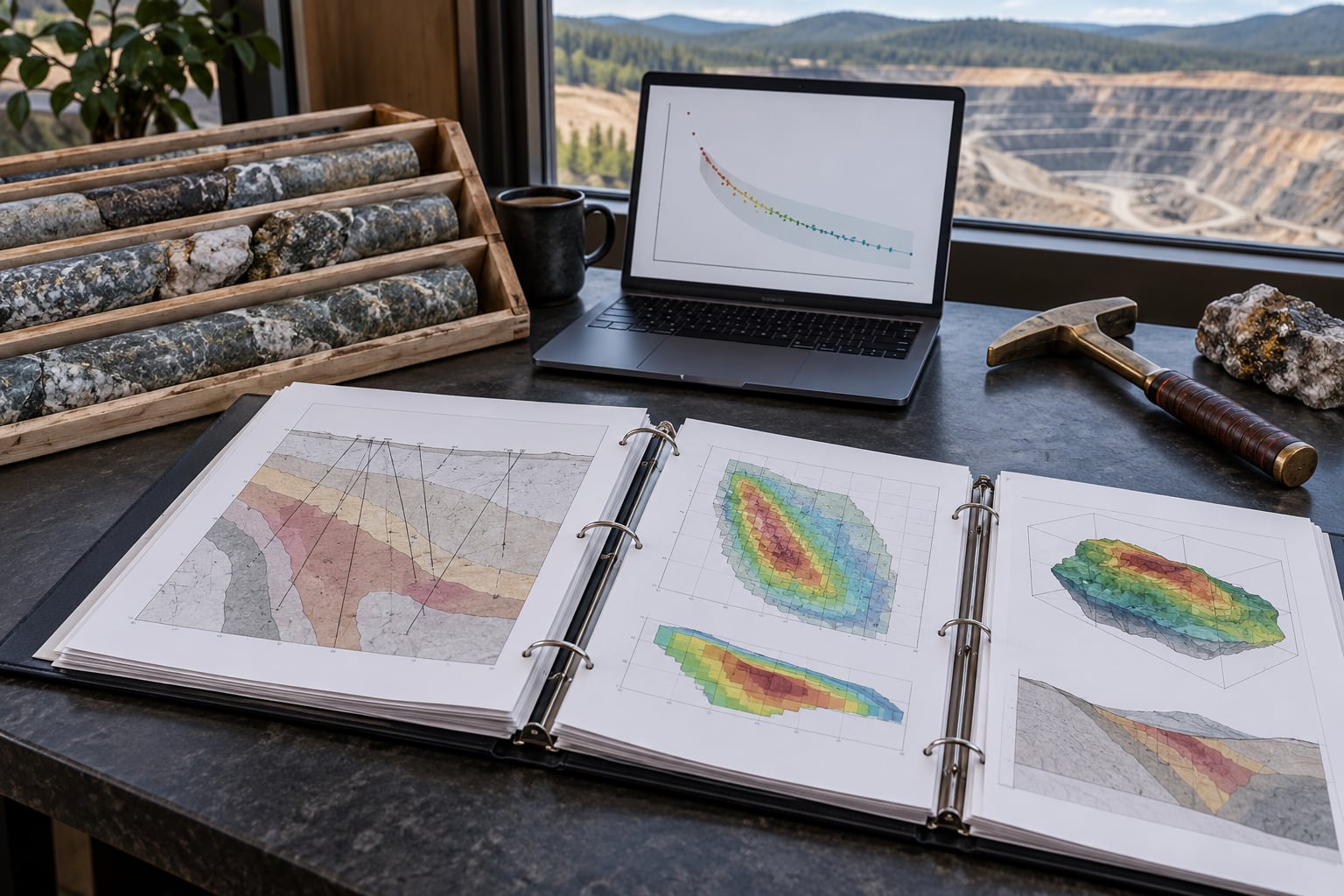
A JORC report and an NI 43-101 report are both public disclosures of mineral exploration results, mineral resources and ore reserves. The difference is the regime behind them: a JORC report follows the Australasian Joint Ore Reserves Committee Code and is signed off by a Competent Person for companies listed in Australia, while an NI 43-101 report follows National Instrument 43-101, a Canadian securities regulation, and is prepared or supervised by a Qualified Person for companies listed in Canada.
So there is no winner. The right standard follows your listing venue, your investor base and the stage the project has reached. What does not change between them is the classification vocabulary: both codes grade resources as Measured, Indicated or Inferred and reserves as Probable or Proven, because both sit inside the CRIRSCO international reporting framework.
This page lays out the practical differences, what a technical report actually contains, what it costs to produce, and the specific numbers an investor should look at before treating any resource figure as real. It is written for shareholders and analysts who read these filings without writing them.
Table of Contents
- What Is a JORC vs NI 43-101 Report at a Glance
- What Is a JORC Report?
- What a competent person has to be
- What Table 1 actually does
- What Is an NI 43-101 Report?
- Who counts as a qualified person
- Where the report lives
- JORC vs NI 43-101: The Main Differences
- Resource and reserve categories in both codes
- Which Standard Is More Rigorous?
- Which Report Is Easier and Cheaper to Prepare?
- Which One Should Investors Use?
- How to read a JORC vs NI 43-101 report as an investor
- Where to download the report
- Frequently Asked Questions
- Is JORC better than NI 43-101?
- Can a mining company use both JORC and NI 43-101?
- What is the difference between measured, indicated, inferred, probable, and proven resources?
- Does a JORC or NI 43-101 report guarantee that a mine is profitable?
- Which report is used most often for mining investments?
- How can an investor compare JORC and NI 43-101 resource numbers?
- Conclusion
What Is a JORC vs NI 43-101 Report at a Glance
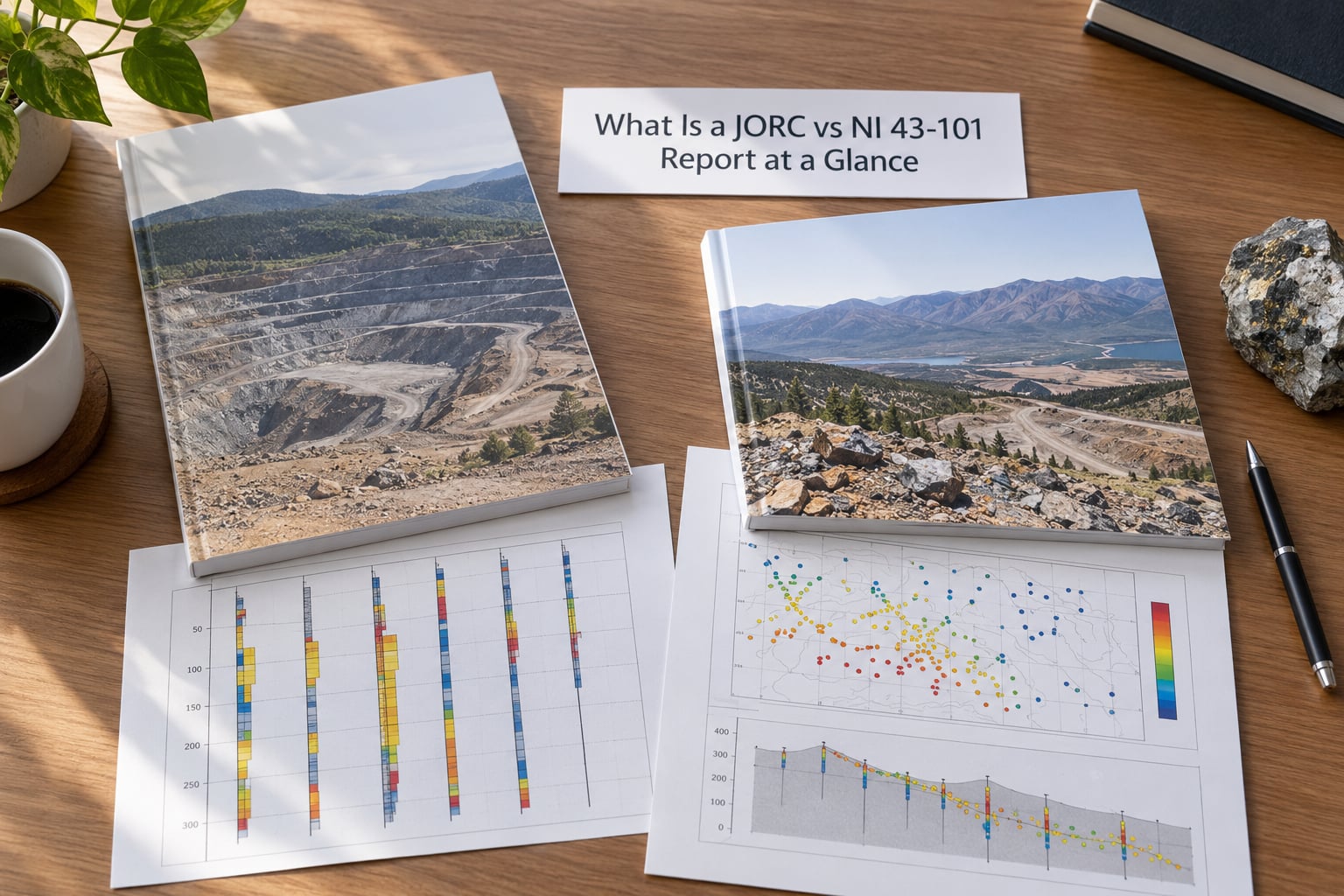
The one-line answer: NI 43-101 is a legal securities instrument with prescriptive rules and a mandatory public filing. The JORC Code is a professional code of practice that the Australian Securities Exchange carries in its listing rules, so it binds ASX-listed issuers but sits one step below primary legislation.
| Criterion | JORC Code | NI 43-101 |
|---|---|---|
| Full name | Australasian Code for Reporting of Exploration Results, Mineral Resources and Ore Reserves | National Instrument 43-101, Standards of Disclosure for Mineral Projects |
| Type of instrument | Professional code of practice, incorporated into ASX listing rules as an appendix | Securities legislation adopted by Canadian provincial and territorial regulators |
| Legal status | Binding through the exchange listing rules, not primary legislation | Legally binding; contravention is a securities law matter |
| Governing body | Australasian Joint Ore Reserves Committee, sponsored by AusIMM, the Australian Institute of Geoscientists and the Minerals Council of Australia | Canadian Securities Administrators, with the CIM as a supporting body |
| Signatory title | Competent Person | Qualified Person |
| Signatory membership basis | Member or Fellow of AusIMM or the Australian Institute of Geoscientists, or a Recognised Foreign Association listed by the exchange | Good standing with a professional association, or a Recognised Foreign Association of recognised stature |
| Signatory experience requirement | At least ten years of relevant experience, with at least five in the deposit type and stage being reported | At least five years of experience in mineral exploration, mine development, operation or project assessment |
| Core reporting framework | Table 1 of the JORC Code, plus clause-by-clause compliance checklists | Form 43-101F1, a prescribed table of contents running to more than twenty numbered items |
| Reserve terminology | Ore Reserves | Mineral Reserves, following the CIM Definition Standards |
| Prescriptiveness | Sets what must be reported and the standard of evidence; allows flexibility in format | Prescribes the document structure, the sections and the order in one place |
| Publication requirement | Results go to the market through announcements; full reports are common but not always lodged as a single document | The full technical report must be filed and is publicly available on SEDAR+ |
| Typical use | ASX and NZX listed companies, Australasian projects, annual reserve statements | TSX and TSX-V listed companies, Canadian-listed juniors, project finance diligence |
The three-line version most readers need: JORC is a code, not a law. NI 43-101 is a regulation. Both hand personal professional responsibility for the numbers to a named individual, and both produce the same five resource categories.
One practical wrinkle caught many readers off guard: because the two codes share a classification system, a company can produce a single study prepared under both and say so in one line of a press release. FireFly Metals, for example, described its Green Bay study in August 2026 as prepared in accordance with the JORC Code (2012 Edition) and NI 43-101.
What Is a JORC Report?
A JORC report is a public disclosure of exploration results, mineral resources and ore reserves prepared and signed off by a Competent Person under the JORC Code. The code was established in 1971 by the Joint Ore Reserves Committee and is sponsored by the Australasian Institute of Mining and Metallurgy, the Australian Institute of Geoscientists and the Minerals Council of Australia. The edition most companies work to is the 2012 version, which reorganised the code around a set of reporting tables that companies complete clause by clause.
The code became compulsory for companies listed in Australia and New Zealand once it was appended to the ASX listing rules. That is the detail most often missed: JORC is enforced through the exchange, so the pressure comes from listing requirements rather than from a regulator acting directly on the report.
What a competent person has to be
A Competent Person is not a job title anyone can adopt. The person must have at least ten years of experience in mining or mineral exploration, including at least five years in the style of deposit and the stage of the project being reported. They must also be a member or Fellow of AusIMM or the Australian Institute of Geoscientists, or of an overseas body the ASX recognises.
The reason the membership requirement exists is accountability. A Competent Person takes personal professional responsibility for the report and can lose standing with their association if the work does not hold up. I have found the credential on the signature page to be the fastest way to sort a serious study from a company news release dressed up as a report.
What Table 1 actually does
Table 1 is the reporting checklist that gives the JORC Code its shape. It sets out the classification criteria a company must meet before it can call material Measured, Indicated or Inferred, and Probable or Proven, and it spells out the modifying factors that have to be disclosed: cut-off grade, recovery, dilution, geometry, density and the commodity price assumption behind the pit shell or underground design.
In practice most companies publish Table 1 alongside the estimate so a reader can see the criteria being applied without hunting through 200 pages of text. A resource statement that omits the cut-off grade and the price assumption is the tell that a number has been lifted out of its context.
What Is an NI 43-101 Report?
An NI 43-101 report is a technical report filed under National Instrument 43-101, Standards of Disclosure for Mineral Projects. It is the disclosure regime for mineral projects, reserves and resources used by issuers listed on Canadian exchanges, and it takes the form prescribed in Form 43-101F1, a table of contents with more than twenty numbered items covering property description, history, geology, mining, metallurgy, economics, risk factors and certification of the Qualified Persons.
Unlike JORC, NI 43-101 is a legal instrument adopted by the securities regulators in each Canadian province and territory. Disclosure of mineral projects is prescribed and the report must be filed publicly, which means the full document sits on SEDAR+ and, for US-listed issuers, on EDGAR.
Who counts as a qualified person
The instrument defines a Qualified Person through three statutory criteria, and all three have to be met:
- They must be an engineer or geoscientist with at least five years of experience in mineral exploration, mine development or operation, or mineral project assessment, or a combination of them.
- They must have relevant experience that is specific to the subject mineralisation and to the technical report being signed.
- They must be in good standing with a professional association, or with a Recognised Foreign Association of recognised stature.
Note how the two regimes differ on tenure. A Qualified Person needs five years. A Competent Person needs ten. Neither number is a quality signal on its own; both exist to establish that the signatory has seen enough projects of that type to recognise a bad estimate.
Where the report lives
Anyone confused about whether these filings are public should know this: the technical report is not a private document that a company shares selectively. It is filed in full and it is searchable. Canadian filings sit on SEDAR+, US filings on EDGAR, and ASX announcements sit on the Australian Securities Exchange site and the company investor relations page.
What makes them feel private is length. The canonical NI 43-101 document runs to around 44 pages of rules and requirements; real technical reports run past 300 pages, and some large projects run well beyond that. Nobody reads them end to end. That is why the summary tables matter so much.
JORC vs NI 43-101: The Main Differences
Eight differences explain almost every practical disagreement between the two frameworks.
- Legal force. NI 43-101 is a securities regulation with legal force. The JORC Code is a professional code that reaches companies through the ASX listing rules. When you weigh risk, this is the largest single difference between them.
- Prescriptiveness. NI 43-101 prescribes the document itself through Form 43-101F1, down to the section order. JORC prescribes the content and the standard of evidence through Table 1 while leaving format to the company.
- Publication. A full NI 43-101 technical report must be filed and is freely available. JORC results reach the market through announcements, and while full reports are increasingly lodged, there is no single mandatory document in the same way.
- Signatory title and experience. Competent Person at ten years, usually through AusIMM or the Australian Institute of Geoscientists, versus Qualified Person at five years with good standing in a professional association.
- Terminology. JORC reports Ore Reserves. Canadian reports following the CIM Definition Standards call them Mineral Reserves. The same announcement will often use both words, which is confusing the first time you see it.
- Disclosure trigger. NI 43-101 reaches any written or public disclosure about a mineral project by a Canadian-listed issuer, including press releases and marketing material. JORC attaches to the reporting obligations of ASX-listed companies and their announcements.
- Economic analysis limits. NI 43-101 prohibits using Inferred mineral resources as a basis for an economic analysis. Neither code allows Inferred material to be converted into reserves, and a study that quietly does so is defective under both.
- Global fit. The JSE, LSE and HKEX accept either framework, and international lenders tend to work comfortably with NI 43-101 because it is prescriptive and filed. CRIRSCO reporting standards such as SAMREC, SAMVAL and the PERC standard exist so that projects outside Canada and Australia can be reported to a comparable standard.
Resource and reserve categories in both codes
| Category | What it means | Usable in an economic analysis? |
|---|---|---|
| Measured resource (JORC, CIM) | High confidence in grade, tonnage and geometry from tight-spaced drilling with good data | Yes |
| Indicated resource | Reasonable confidence in grade and continuity, supported by wider-spaced drilling | Yes, with disclosure |
| Inferred resource | Low confidence; used to define the shape of a deposit and plan follow-up drilling | No. Economic analysis may be shown for context but cannot be the basis of it under NI 43-101 |
| Probable reserve (Ore Reserves under JORC, Mineral Reserves under CIM) | Technically and economically mineable with lower confidence | Yes |
| Proven reserve | Technically and economically mineable with high confidence | Yes |
Because both codes inherit these definitions from the same international lineage, the categories are comparable line for line. That is why a measured and indicated resource figure from an ASX-listed company can be set beside a Canadian one without any translation step. It is the one part of the comparison that is genuinely straightforward.
| Venue | Code normally required |
|---|---|
| ASX, NZX | JORC Code |
| TSX, TSX-V | NI 43-101 |
| LSE, JSE, HKEX | Generally accepts either, plus CRIRSCO-aligned codes such as SAMREC or PERC |
| US SEC registrants | S-K 1300 with SEC Industry Guide 7, which does not use the Qualified Person or Competent Person structure at all |
Which Standard Is More Rigorous?
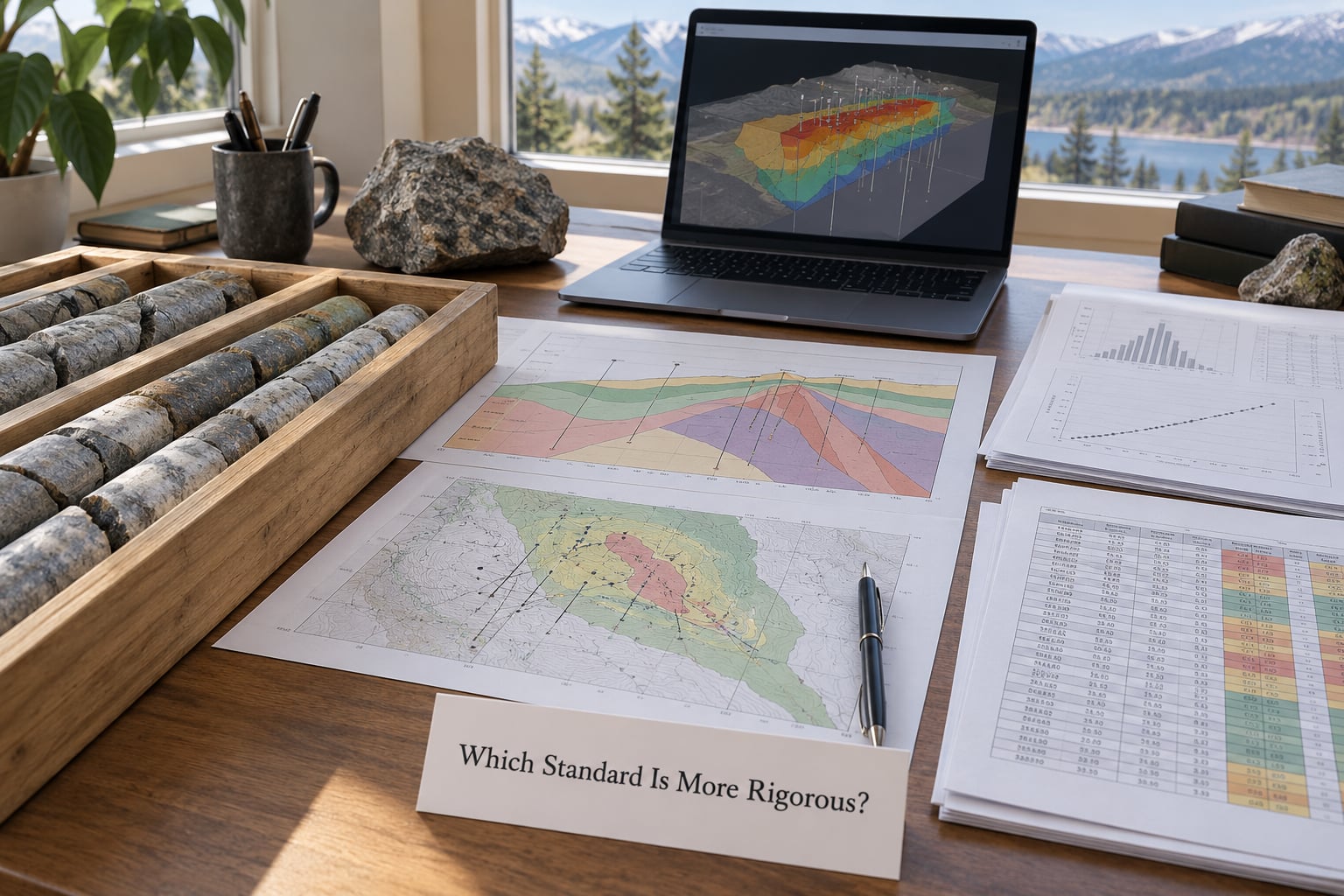
Neither, in the abstract. Both are reporting frameworks with different purposes, and neither guarantees technical quality. The question of rigor is answered by the geology, the sampling, the assay methods, the block model, the recovery assumptions and the economic inputs rather than by the name on the cover.
There is a fair argument that NI 43-101 demands more process because the document itself is prescribed, must be filed in full and carries legal consequences for a false or misleading disclosure. There is an equally fair argument that JORC demands more evidential rigour because the ten-year Competent Person requirement and the Table 1 criteria test the estimate harder. Neither argument settles the question, and any person selling you a definitive answer on this is selling something.
What does settle it, in practice, is a short list of things you can verify:
- A named signatory with a verifiable professional association membership, and their name in the right title for the jurisdiction.
- An explicit statement of which code and which edition the work follows, down to the table or section.
- A full report filed publicly rather than a summary release.
- Independent authorship rather than in-house reporting by the company’s own geologists.
- Visible commodity price assumptions and cut-off grades, and whether the price is a three-year average, a spot figure or a forward-looking management number.
An estimate prepared to neither standard, signed by someone without the right membership, or shown with no modifying factors at all should be treated as an internal working assumption rather than a result. That is where I start discounting, regardless of which code the announcement cites.
Which Report Is Easier and Cheaper to Prepare?
Neither code is meaningfully cheaper than the other in the same project. What drives cost is the deposit, the stage of study, the drilling already in hand, the metallurgical testing, the number of disciplines involved and whether a second code has to be satisfied at the same time. A company that has to produce a single study compliant with JORC, NI 43-101 and a Valmin report will pay more than a company running one code on a well-drilled project, regardless of which code is nominally easier.
As rough order-of-magnitude guidance for scoping a study, in-range resource updates on a well-drilled deposit typically run into the tens of thousands, while a first full technical report with metallurgy and economic analysis runs well into six figures. Those are indicative bands, not quotes, and they move with jurisdiction and consultant availability.
Six factors move the number more than the standard does:
- Deposit complexity. Narrow vein geometry, variable grade distribution and complex metallurgy require more drilling, domaining and test work than a bulk-tonnage deposit with simple mineralogy.
- Study stage. A scoping study to PEA level is a fraction of a feasibility study with a reserve conversion.
- Drilling extent. The single largest driver. Infill drilling needed to move material from Inferred or Indicated into Measured and Measured and Indicated into Proven dominates the budget.
- Metallurgy. Comms are expensive. Test work, flowsheet development and recovery estimation often exceed the resource estimate work itself.
- Data room status. Reconciling historical drill collars, surveys and assays into one usable database is unglamorous and frequently underestimated.
- Independent consultants. Every code requires an independent signatory. Securing a QP or CP with no conflicts and a free slot adds time before work even starts.
Dual compliance is the item that surprises new issuers. Re-running an estimate so it satisfies a second classification and disclosure framework, and having it signed by someone credentialed under both, is where timelines slip. Industry-reported benchmarks for full dual-compliance work put the elapsed time at six months or more from first drilling cut to a compliant study, with additional spend running into the hundreds of thousands for a late-stage project.
Timelines also age. A study compiled under the JORC Code in one era is not automatically current under a later edition of NI 43-101, and companies that note this in filings are effectively warning readers not to treat an old estimate as a current compliant resource. Check the date before you treat the standard as satisfied.
Which One Should Investors Use?
Follow the listing venue and the lead investor base, then verify the details. An ASX-listed company reporting to the JORC Code is telling you the estimate was prepared for an Australian audience under Australian listing obligations. A TSX or TSX-V issuer filing a Form 43-101F1 is telling you the estimate sits inside a Canadian securities regime with a public filing behind it. The code tells you the jurisdiction, the regulator and how much of the underlying work was forced into the public domain.
For a project in a third country, both can appear in the same sector and sometimes in the same news flow, which is why dual-listed developers tend to publish the same study under both codes rather than maintaining two estimates.
How to read a JORC vs NI 43-101 report as an investor
Nobody finishes a 300-page technical report. Read the sections in this order and you get most of the value in an hour.
- The signature and certification pages. Name, credential, association and whether the person is independent of the company. On a Canadian filing this is the Qualified Persons Certificate; on a JORC document it is the competent person statement and Table 1 clause checkboxes.
- The summary table. Resource and reserve tonnage and grade by category, with the cut-off grade and the commodity price assumption printed next to it.
- The classification criteria. Under JORC this is Table 1. Under NI 43-101 it is the section explaining how the estimate was prepared and what the CIM definitions require.
- The mining and metallurgy sections. Whether the deposit is actually mineable at the assumed rate, and whether recovery assumptions are measured or borrowed from a similar deposit.
- The economic analysis. Check what it is based on. Inferred material cannot carry it under NI 43-101. Check the price deck: a three-year average under SEC Industry Guide 7 and a forward-looking management price are not the same input.
- The date and the code edition. A 2012 Edition JORC study and a current NI 43-101 filing are not interchangeable, and neither describes the deposit as it stands today.
The red flags worth pausing on: a headline tonnage with no category breakdown, no cut-off grade, or no price assumption attached; an estimate prepared by the company’s own team with no independent signatory; a resource presented as a reserve; a feasibility study whose economics lean on Inferred material; and a technical report that exists only as a press release summary. Each of those is common in the junior mining space and each of them is disqualifying on its own.
Where to download the report
ASX announcements and annual reports are on the Australian Securities Exchange site and the company’s investor relations page. Canadian filings sit on SEDAR+, and US filings on EDGAR. Private projects seeking international capital often publish the full report on their own website specifically because lenders and acquirers want it. If a company will not give you the full document, that is itself a signal.
Frequently Asked Questions
Is JORC better than NI 43-101?
Neither is more rigorous in the abstract, because they serve different purposes. NI 43-101 is legally binding Canadian securities legislation with a prescribed document format, while the JORC Code is a professional code that reaches ASX-listed companies through the exchange listing rules. Both use the same Measured, Indicated, Inferred, Probable and Proven categories under CRIRSCO. Judge quality by the signatory, the drilling, the assumptions and the review, not by the code name.
Can a mining company use both JORC and NI 43-101?
Yes. Because both codes sit inside the CRIRSCO reporting framework and share classification definitions, a single study can be prepared to satisfy both, signed by someone credentialed under each, and described as dual compliant in one line of a press release. The FireFly Metals Green Bay study in August 2026 is one example. Dual compliance adds cost and elapsed time, usually six months or more on a late-stage project, and opens the project to both investor pools.
What is the difference between measured, indicated, inferred, probable, and proven resources?
Measured, Indicated and Inferred are resource categories describing confidence in grade, tonnage and geometry, based on drill spacing and data quality. Inferred is the lowest confidence and is used mainly to shape follow-up drilling. Probable and Proven are reserve categories, meaning the material has been shown to be technically and economically mineable. Inferred material cannot be converted into reserves, and under NI 43-101 it cannot form the basis of an economic analysis.
Does a JORC or NI 43-101 report guarantee that a mine is profitable?
No. Both codes set standards for how a resource or reserve is estimated, classified and disclosed. Neither one guarantees permitting, funding, construction, production, commodity prices or operating margin. The economic case inside a technical report is built on assumptions about price, cost, recovery and throughput that can all move. Treat the economics as a scenario with stated assumptions rather than a forecast, and read the risk factors section.
Which report is used most often for mining investments?
It depends on where the company is listed rather than on the commodity. ASX and NZX listed companies report under the JORC Code. TSX and TSX-V issuers file NI 43-101 technical reports, which are also widely used for project finance and acquisition diligence. The LSE, JSE and HKEX generally accept either. US SEC registrants use S-K 1300 with SEC Industry Guide 7, which does not use the Qualified Person structure at all.
How can an investor compare JORC and NI 43-101 resource numbers?
Check the category breakdown first, since both codes use the same Measured, Indicated and Inferred labels for the same underlying confidence levels. Then normalise the inputs: cut-off grade, commodity price assumption, recovery, dilution and the reporting date. A Measured and indicated figure quoted at one price deck is not comparable with a Measured, indicated and inferred figure quoted at another. Watch for terminology differences, with Ore Reserves under JORC and Mineral Reserves under the CIM standards.
Conclusion
JORC and NI 43-101 are not competing grades of truth. They are two disclosure frameworks serving different regulators and different investor bases, and they produce the same resource categories because both belong to the CRIRSCO international reporting family. The practical distinction that matters most is legal force and publication: NI 43-101 is binding regulation with a mandatory public filing, while the JORC Code reaches ASX-listed companies through the exchange listing rules.
Start with four checks before you go further. Identify the issuer’s listing venue, which tells you the governing code. Check the signatory and their professional association membership. Note the project stage and the report date, because compliance status has a shelf life. Then read the modifying factors, cut-off grade and commodity price assumption printed next to every headline tonnage, because that is where the real difference between two companies claiming similar ounces usually sits.