You do not need a commodity account to invest in copper. Most beginners buy a copper ETF through an ordinary brokerage account in about fifteen minutes, and the harder part is deciding how much to put in and why. Copper ETFs track the metal, copper miner ETFs track mining shares, copper futures use leverage, and physical copper is metal you store yourself.
This guide is educational, not financial advice. Returns are never guaranteed, past performance does not predict future results, and any decision about money should follow your own research or a conversation with a qualified professional.
Table of Contents
- What You Need
- Step-by-Step: How to Invest in Copper for Beginners
- Step 1: Set Your Investment Goal and Time Horizon
- Step 2: Learn What Moves the Copper Price
- Step 3: Compare the Main Ways to Invest in Copper
- Step 4: Check Fees, Spreads, Taxes, and Account Requirements
- Step 5: Choose a Diversified Position Size
- Step 6: Open the Right Account and Make the Investment
- Step 7: Monitor the Thesis and Know When to Review It
- Common Mistakes
- Frequently Asked Questions
- How much copper should a beginner put in their portfolio?
- What is the easiest way for a beginner to invest in copper?
- Is a copper ETF better than buying physical copper?
- Are copper mining shares a good way to get exposure?
- Why do beginners usually avoid copper futures?
- Do copper investments pay dividends or any income?
What You Need
You need five things settled before you pick an investment, and none of them is a tool or an app.
- A goal. Long-term diversification, a bet on electrification demand, income, or simply learning how commodity investing works.
- A time horizon. Copper moves in multi-year industrial cycles, so money you need within three years is the wrong money for this.
- An honest view of risk. Copper has historically moved in double-digit percentage swings within a single year, so a 20 to 30 percent drop should not force you to sell.
- Capital you can leave alone. Small amounts work, because most copper funds trade in fractional shares.
- An account. A standard brokerage account is enough for ETFs and mining shares. Copper futures require a separate futures-enabled account and approval.
The difference that trips up most newcomers is between owning the metal indirectly and owning it at all. An ETF gives you a share of a fund that holds copper futures. A miner ETF gives you a share of a fund that holds mining company shares. Physical copper gives you actual metal, in a room you control. Each behaves differently, and so do the costs.
Step-by-Step: How to Invest in Copper for Beginners
Here is the process I would follow, in order. It takes one afternoon for the research and about twenty minutes at the keyboard.
Step 1: Set Your Investment Goal and Time Horizon
Write down one sentence describing what the copper position is for before you buy anything. “I want a small slice of an industrial commodity that my bond and index holdings do not already provide” is a workable sentence. “I want to make money fast” is not, because copper will not reliably cooperate with it.
Then set the horizon. Copper demand tracks global industrial activity, which is why traders nicknamed it Dr. Copper, and that link works over years rather than quarters. If you cannot leave the money untouched for five years or more, pick a different topic to study first.
Step 2: Learn What Moves the Copper Price
Copper is priced globally in US dollars, and five things move it most.
Construction and manufacturing demand. Wiring, plumbing and building wire are the classic end uses, so housing starts and factory output in China and elsewhere matter more than consumer spending.
Electrification demand. An electric vehicle carries roughly 90 kg of copper against about 20 kg in a combustion car. An onshore wind turbine runs to several tonnes, and a hyperscale data centre can absorb thousands of tonnes on its own. Grid upgrades and renewable buildout add to the same bucket.
Mine supply. Ore grades at existing mines keep declining, and a new mine typically takes a decade or more from discovery to first production. That long lead time is why a strong demand year can run into a wall of metal that cannot arrive quickly.
Inventories. Warehouse stocks on the London Metal Exchange, the global benchmark venue, and on COMEX in the US show how much spare metal exists. Falling stocks with rising prices usually signal tightening supply. Watch those numbers on the exchanges’ own sites rather than through commentary.
The dollar and interest rates. Copper is priced in dollars, so a stronger dollar often weighs on the metal, and higher rates raise the cost of carrying inventory.
Step 3: Compare the Main Ways to Invest in Copper
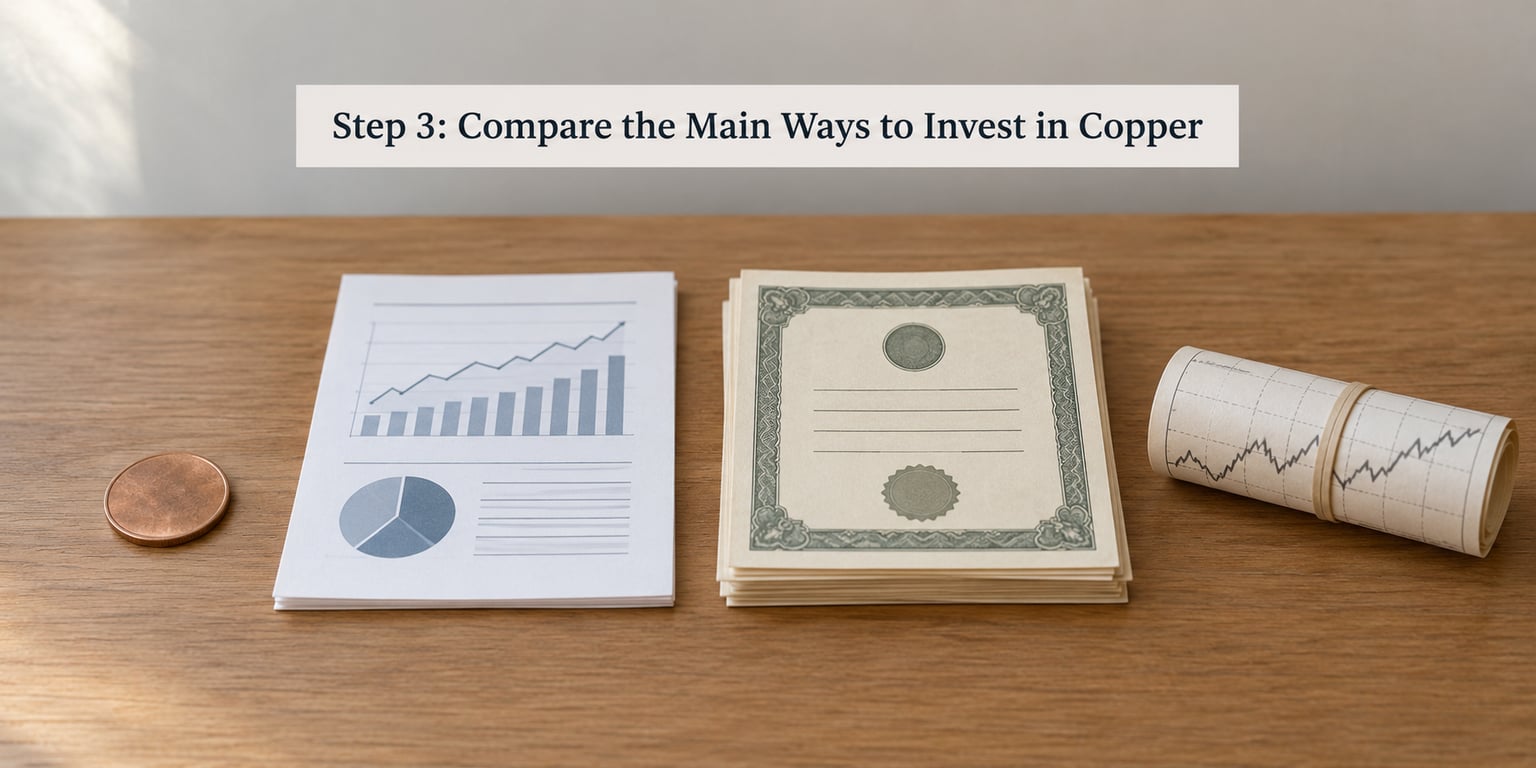
There are four routes, and only one of them requires a special account.
Copper ETFs and exchange-traded notes. These hold copper futures and track the metal’s price, which makes them the closest thing to owning copper without storing it. CPER is the widely used US example, and JJC is an exchange-traded note that works the same way in most respects. Funds that hold futures roll their positions as contracts expire, and that rolling can add or subtract return over time depending on whether the market is in contango or backwardation.
Copper miner ETFs. COPX holds mining company shares rather than metal, so it is technically an equity fund that happens to sit on copper. Miners carry operational leverage in both directions: costs, ore grades, labour strikes and permitting setbacks all hit the share price, and bad quarters can produce losses even when the copper price is flat.
Individual mining shares. Large producers such as Freeport-McMoRan, Southern Copper, BHP, Rio Tinto and Teck Resources give you copper price exposure plus a company’s debt, cost curve and country risk. Beginners have no edge on any of those. A single-company bet is where a copper thesis quietly turns into a stock-picking thesis.
Copper futures. The COMEX HG contract covers 25,000 pounds of copper, and you post margin rather than paying the full value. That is leverage, which magnifies gains and losses alike, and contracts expire on a fixed date. Leveraged instruments are a poor first purchase.
Physical copper. Bars, coins and scrap exist, and the retail route carries a premium over the metal’s value plus storage, insurance and a wide bid-ask spread when you sell. Copper has also never built the deep resale market that gold and silver enjoy, so the exit can be thinner than buyers expect. Experienced buyers tend to argue that sourcing scrap at or below metal value beats paying a retail premium.
For almost everyone starting out, a broad commodity ETF is the simplest choice. It has no leverage, one clear expense ratio, and daily liquidity in a normal account.
Step 4: Check Fees, Spreads, Taxes, and Account Requirements
Before you buy, find five numbers on the issuer’s own fact sheet or prospectus rather than a comparison site.
- The expense ratio, expressed as a percentage of assets. That is the ongoing cost you pay every year regardless of the copper price.
- The bid-ask spread, which is the gap between the price you pay and the price you receive. It is small in a liquid ETF and wide in physical copper.
- Trading commissions or platform fees at your broker.
- Storage and insurance costs if you are buying physical metal, including whether your home insurer covers it.
- Margin requirements if futures are even on your radar, along with the daily settlement process.
Tax treatment matters too, and it depends entirely on where you hold the position. In the US, selling a fund held inside a traditional IRA is usually handled differently from selling the same fund in a taxable account, where gains may be taxed as capital gains. Futures receive their own tax treatment, and physical metal has rules about collectibles and reporting. Rules, rates and thresholds change, and they differ by country and account type, so check the current treatment with your broker or a tax professional before you rely on it.
Step 5: Choose a Diversified Position Size
There is no universal percentage. The honest answer is that copper behaves like a cyclical satellite rather than a core holding, because it has no yield, it pays no dividend and it leans hard on the industrial cycle.
A range many beginners land on is roughly 2 to 5 percent of a diversified portfolio, treated as money you could lose half of without changing your life. If you are unsure, start at the bottom of that range. Two useful rules beat any formula: never use money earmarked for bills, a house deposit or an emergency fund, and never let one commodity, or one mining company, dominate the portfolio.
Watch for overlap. Silver and copper can both track industrial demand, so holding a metals fund that already owns silver miners plus a copper miner fund is closer to a single bet than it looks. If you also own a global index fund, check what it already holds before adding a miners fund on top.
Step 6: Open the Right Account and Make the Investment
This is the mechanical part, and it takes four moves.
- Choose a regulated broker. Pick one that is registered in your country, offers the funds you want, and publishes its fee schedule plainly. You do not need a premium tier.
- Open and verify the account. Expect identity checks and a tax form. A standard brokerage account covers ETFs and shares; futures sit behind a separate approval and a futures-enabled account.
- Read the fund documents. At minimum, skim the prospectus and the risk disclosure section. It is where the fund explains its futures approach and its main risks in plain legal language.
- Place the order. Search the ticker or fund name, choose an amount in dollars or in fractional shares rather than whole units, and use a limit order if you care about the exact fill price. Then write down the date, the price, the amount and your one-sentence reason. That note is what you will read when you review the position later.
Nothing here needs to be rushed. There is no advantage in buying copper today rather than in two weeks, because you are building a position, not chasing a headline.
Step 7: Monitor the Thesis and Know When to Review It
Monitoring is not watching the price tick by tick. A useful check, done a few times a year, asks four questions.
- Is my original reason for holding still true, or has it quietly become “it went up a lot”?
- Have demand indicators and exchange inventories moved in the direction my reason assumed?
- For funds: has the expense ratio changed, and how far has the fund drifted from what it tracks?
- Has copper grown large enough in my portfolio that it now drives my results on its own?
For mining shares, add a fifth question about the company’s own results: production, costs, debt and any change in reserve estimates. For physical copper, ask honestly whether you would still be happy holding it, since metal sitting in a drawer earns nothing.
Review your position when the thesis breaks or when your financial situation changes, such as a new job, a move or a change in time horizon. Selling because a monthly report made you nervous is a different decision, and usually a worse one.
Common Mistakes
Confusing a fund with the metal. A copper ETF holds futures contracts, not bars in a vault. That is a feature, not a bug, but it means roll costs and tracking difference are part of your return.
The fix: read the fund’s approach in its prospectus and know which part of your return comes from the metal price and which part comes from the structure.
Buying leveraged futures without understanding margin. A 25,000-pound HG contract can move against you by more than the margin you posted, sometimes within a day. This is the mistake that ends accounts, and it is why most guides, including this one, steer beginners toward unlevered funds.
The fix: treat futures as a later topic, learn the settlement mechanics first, and never trade a contract you cannot afford to be wrong on.
Ignoring total costs. An expense ratio, a wide spread and storage fees add up quietly. Physical copper is the worst offender, because the premium you pay over metal value often does not come back when you sell.
The fix: list every cost in one place before you buy, and compare the total against the simplest fund option.
Concentrating in a single miner. One company’s permitting dispute, labour strike or cost overrun can wipe out a year of copper gains.
The fix: if you want miner exposure, use a fund that holds dozens of companies rather than one share.
Chasing a price spike. Copper headlines cluster after big moves, which is exactly when the risk of buying is highest. This is the green metal hype trap that regulars on metals forums keep warning each other about.
The fix: if a move is the main reason you are interested, wait for it to settle and use a dollar-based plan instead of a price-based one.
Forgetting currency and tax. Copper is priced in dollars, so a weak dollar can flatter a local-currency investor’s return, and tax rules differ sharply between account types.
The fix: check how the position is taxed where you live, and re-check the rule whenever you move it between accounts.
Frequently Asked Questions
How much copper should a beginner put in their portfolio?
Most beginners treat copper as a satellite holding rather than a core one, and a commonly used range is roughly 2 to 5 percent of a diversified portfolio. The number matters less than two rules: do not use money needed for near-term expenses, and check what your other funds already hold so you are not doubling up on industrial metals. Review the figure against your own finances and risk tolerance, and consider talking to a qualified professional before committing a large share of savings.
What is the easiest way for a beginner to invest in copper?
A copper exchange-traded fund bought through a normal brokerage account is the easiest route for most beginners. It requires no special approval, no leverage and no storage, it trades daily during market hours, and you can buy it in fractional shares for a small dollar amount. Search the ticker in your brokerage app, choose an amount, and place the order. Always check the expense ratio and the fund’s futures approach on the issuer’s own fact sheet first.
Is a copper ETF better than buying physical copper?
For gaining price exposure, yes. A copper ETF trades instantly, costs a visible expense ratio and carries no storage or insurance bill. Physical copper involves retail premiums over the metal value, secure storage, and a resale spread that can be wide because retail copper is not as liquid as gold or silver. Physical copper makes more sense if you actually want usable metal. Investors who prefer raw metal often argue that buying scrap at or below metal value beats paying retail premiums.
Are copper mining shares a good way to get exposure?
They give you copper exposure plus company risk. Mining shares carry operational leverage, so cost inflation, permitting delays, labour disputes or a bad balance sheet can hurt the share price even when copper is steady. Broad mining funds spread that risk across many producers, while buying one company concentrates it. Copper mining shares are also equity holdings, so they can fall sharply in a general market sell-off. Nothing here is a recommendation to buy any particular share.
Why do beginners usually avoid copper futures?
Because they are leveraged and they expire. A COMEX copper contract covers 25,000 pounds and is bought on margin, so a modest price move produces a large percentage gain or loss, and a margin call can force you out. Contracts also have an expiry date and a settlement process that has to be managed. Futures are a legitimate hedging and trading tool for experienced investors, but unlevered funds give you copper price exposure without that machinery.
Do copper investments pay dividends or any income?
Copper metal pays no income at all. Copper exchange-traded funds generally do not distribute meaningful income either, and their return comes from changes in the metal price plus the fund’s structure. Mining companies may pay dividends, but those payments vary with profits and are sometimes suspended during weak commodity markets, so they cannot be relied on. If you need dependable income from your portfolio, copper is the wrong holding for that job.
Start with the boring part. Write down your goal, your horizon and a position size you would not miss, then buy a small unlevered copper fund inside the brokerage account you already have. Add to it on a schedule rather than on a headline, write down why you bought it, and revisit that note once a year instead of watching the price every day.