Learning how to buy silver for beginners comes down to three things: understand the spot price, choose between coins, bars, rounds or a fund, and buy from a dealer you have actually checked. Everything else — premiums, storage, taxes — follows from those three decisions.
I have watched a lot of first-time buyers over the years, and the same pattern repeats. Somebody spends weeks picking a metal, then discovers on the way to the checkout that the dealer charges a premium over spot nobody mentioned, that their state taxes bullion purchases, and that the cheapest-looking item is the hardest thing to sell later. None of that is complicated once you know it is coming.
This guide walks through the whole process in order, including the part most articles skip: what happens when you sell. It is educational information about how the silver market works, not personalised financial advice, and nothing here predicts where the price goes next.
Table of Contents
- What You Need to Buy Silver for Beginners
- The four forms of physical silver
- A budget you set before you look
- Dealer shortlist
- Words you will meet immediately
- Storage and tax, sorted early
- Step-by-Step: How to Buy Silver
- 1. Decide What You Want Silver to Do
- 2. Choose Coins or Bars
- 3. Learn the Premium and Total Cost
- 4. Check the Seller and Silver Details
- 5. Place and Confirm the Purchase
- 6. Receive, Inspect and Store It Safely
- Common Mistakes
- Frequently Asked Questions
- How much silver should a beginner buy?
- Are silver coins or bars better for beginners?
- Why do I pay more than the spot price for silver?
- Is physical silver better than a silver ETF?
- How should I store silver, and are there taxes?
What You Need to Buy Silver for Beginners
Before you spend anything you need four things settled: which form of silver you are buying, how much you are putting in, which two or three dealers you will compare, and where the metal will sit once it arrives. Every beginner mistake I have seen traces back to skipping one of those.
The four forms of physical silver
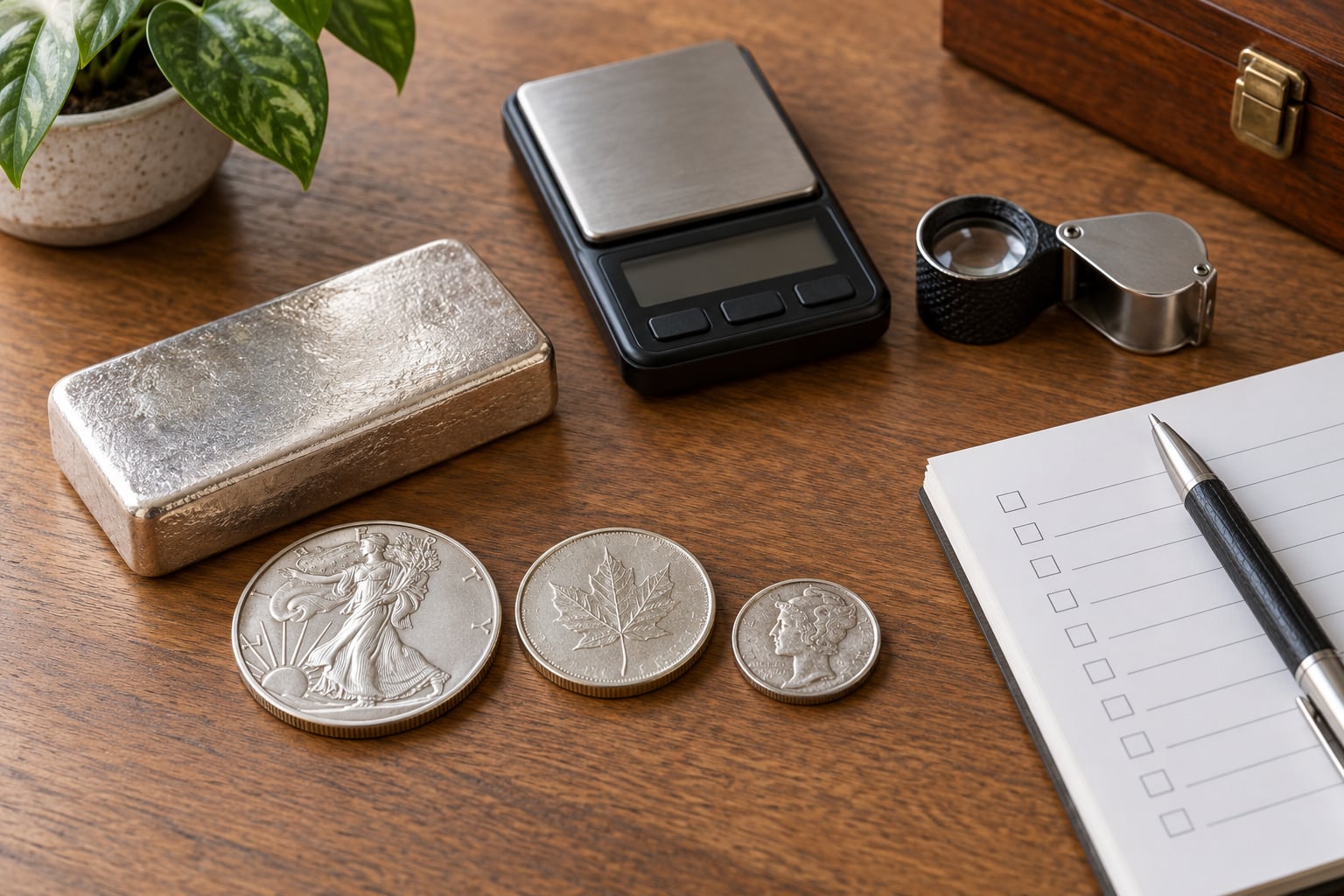
Silver bullion comes in a few shapes, and they trade off against each other. The main axis is premium against liquidity: the more recognisable a product is, the more a dealer charges on top of the metal, and the easier it is to sell later.
| Form | Typical fineness | Premium over spot | Liquidity | Best for |
|---|---|---|---|---|
| Sovereign mint coins | 0.999 fine, one troy ounce | Highest | Very high | First-time buyers who want an easy exit |
| Minted bars | 0.999 or 0.9999 fine | Moderate | Good | Holding a mid-size position |
| Cast bars | 0.999 or 0.9999 fine | Lowest | Weak | Larger holdings, planned for the long term |
| Private mint rounds | 0.999 fine, no legal tender status | Low | Moderate | Lower cost per ounce, stacked as a hobby |
| Junk silver (90 percent coin) | 0.900 fine | Near melt value | Low | Precious metal exposure at the lowest premium |
Two things stand out. Sovereign coins such as the American Silver Eagle or the Canadian Maple Leaf carry the biggest premium because of their legal tender status and their instantly recognisable designs. Cast bars are the mirror image: the cheapest metal you can hold, and the hardest to move when you want cash.
There is a fifth option that is not physical at all — a silver exchange-traded fund, which tracks the metal price through a brokerage account. It is worth understanding purely so you can decide it is not for you, because it solves the storage problem by creating a different one: you hold a fund company’s promise, not a metal.
A budget you set before you look
Decide an amount and a timeframe before browsing, because browsing is where people get carried away. Stackers on the r/Silverbugs forum and TheSilverForum repeat the same advice: work out why you are buying and what your plan is before you spend anything at all. That is dull, and it works.
Set a ceiling on the premium you will accept per ounce and stick to it. If a dealer is asking well above the going rate for the same coin, walk away — there will be another dealer tomorrow, and the metal does not care who sells it to you.
Dealer shortlist
Pick two or three sellers in advance rather than clicking the first search result. Experienced buyers on r/Silverbugs typically compare a short list of established dealers and still check a local coin shop, because premiums move around and a shop you can drive to is useful for smaller quantities.
On each dealer, look for a published buyback price, insured and signature-required shipping, a written returns policy, a physical address and verifiable reviews from buyers. A dealer who publishes what they will pay you back has nothing to hide about the spread they make.
Words you will meet immediately
Spot price is the wholesale price of one troy ounce of fine silver on the commodity market, quoted in dollars and cents. Premium is what the dealer adds on top of spot for minting, handling and shipping. Melt value is the metal content alone, ignoring the premium. Fineness is purity, expressed in thousandths. Assay and hallmark are the marks a refinery or mint stamps on a piece to certify weight and purity.
Troy ounce is worth pausing on. Silver is priced by the troy ounce, roughly 31.1 grams, and that is the unit on every screen and invoice you will ever see.
Storage and tax, sorted early
Decide where the metal lives before the order arrives. Home safe, bank safe deposit box and third-party vault each have different costs and different levels of risk, and the answer changes how much of a position makes sense.
On tax, rules vary by country and state and change without much warning. In the United States, sales tax treatment of bullion differs by state and local jurisdiction, and bullion coins that qualify as collectibles can be taxed at a higher federal rate than ordinary long-term capital gains. Check your own jurisdiction with the relevant authority rather than taking a forum’s word for it.
Step-by-Step: How to Buy Silver
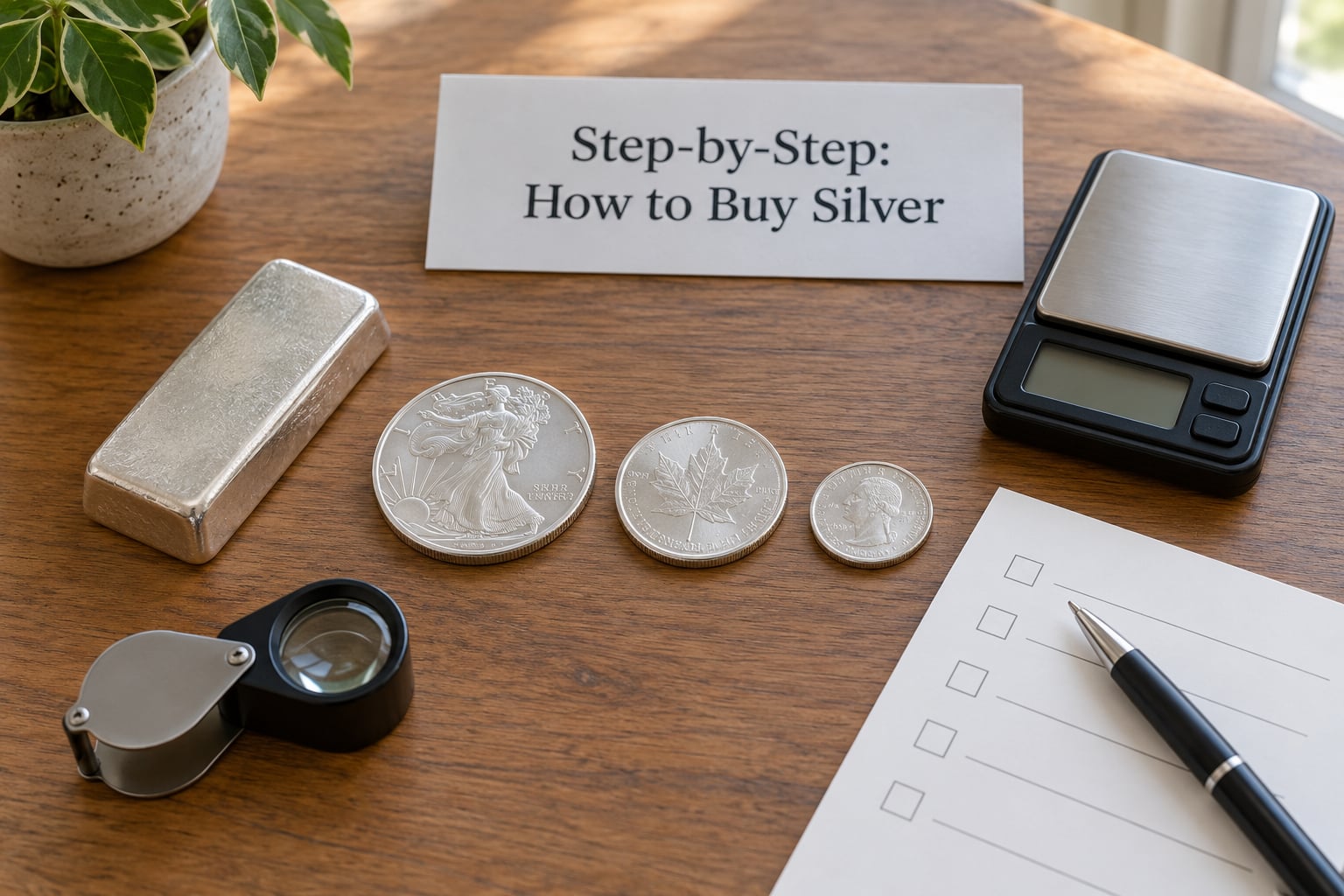
1. Decide What You Want Silver to Do
Write down what the silver is for before you pick a product. Physical metal suits someone who wants to own something tangible outside a brokerage account. A fund or futures suit someone who wants price exposure cheaply and can sit through the paperwork. Both are legitimate — they just answer different questions, and mixing them up is expensive.
Also pick a horizon. Physical silver carries a premium on the way in and a spread on the way out, so short holding periods are where that friction hurts most. If your money is needed within a year, keep it in something liquid instead.
2. Choose Coins or Bars
Coins win on recognisability. A one-ounce sovereign coin from a national mint has a face value, a widely known design and a market where every serious dealer recognises it, which is exactly why its premium is the highest of any physical format.
Bars win on cost per ounce. As the size goes up, the minting cost per ounce falls, so a heavy bar sits much closer to melt value. That is also its problem: a ten-ounce bar attracts a smaller pool of buyers than a one-ounce coin, and reselling one means finding someone who wants that exact bar.
Fractional sizes exist for the same liquidity reason. Half-ounce, quarter-ounce and tenth-ounce products carry a higher premium per ounce but fit a small budget and are easier to place than a heavy bar.
Minted bars are struck and finished, cast bars are poured into a mould. The metal content is identical, so the difference is finish and price, not purity.
3. Learn the Premium and Total Cost
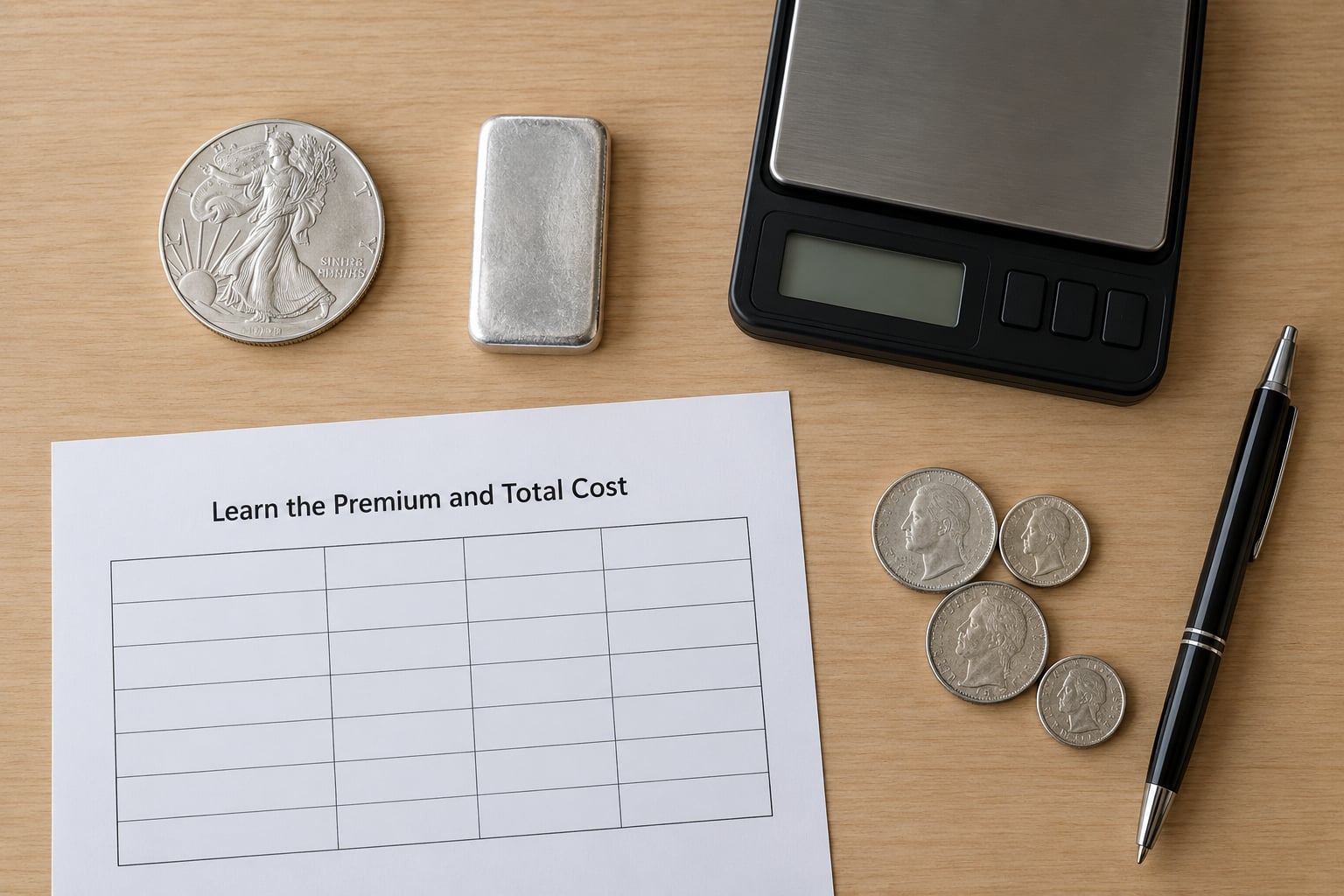
The real cost of a silver purchase is not the spot price. It is the metal, plus a dealer premium, plus shipping and insurance, plus payment fees, plus tax where it applies, plus storage, minus the spread you will take when you sell. Beginners who compare products on spot alone end up with the expensive choice more often than not.
Here is a purely illustrative example, using round placeholder figures rather than live market data. Suppose one troy ounce of silver trades at 30 dollars at the moment of purchase. A one-ounce sovereign coin might be offered at 36 dollars. Add 12 dollars of insured shipping, a 4 dollar card payment fee and 5 percent sales tax on the item, and your all-in cost is roughly 53 dollars for an ounce whose metal value was 30.
Now the exit. Dealers buy back at spot minus a spread, so that same coin might be bid at 24 dollars a few years later at an unchanged spot price. You paid about 53 dollars and would receive 24 — a loss of roughly 29 dollars per ounce on an unchanged metal price.
Two things follow. Fixed costs like shipping hurt small orders badly, which is why a sensible first purchase is a meaningful one rather than the smallest thing the site will let you buy. And the number to watch is the premium, not the headline price — a premium of 6 dollars on top of a 30 dollar spot is far kinder to you than a premium of 6 dollars on a 60 dollar spot.
4. Check the Seller and Silver Details
Read the product listing before you read the marketing. You are looking for weight in troy ounces, fineness, dimensions, mint or refiner name, condition, and whether it arrives sealed or in a card. If a listing leaves out the fineness or describes the weight in grams without converting, that is a reason to move on.
Then check the seller’s policies: what happens if the item arrives damaged, is that shipping insured and does it require a signature, and what is the stated buyback price. These three answers are what separate a dealer you can trust with your first order from one you cannot.
Walk away from pressure. Discounts that appear only if you act now, claims that everyone is buying and supply is about to run out, and requests to pay outside the normal checkout flow are all reasons to close the tab. A reputable dealer has no problem with you taking a day.
5. Place and Confirm the Purchase
Once you are satisfied, add the product and read the final total before paying. Confirm the cart matches what you researched — the correct size, the correct mint, the correct quantity. A surprising total is a signal to go back rather than push through.
Pay the way you said you would, then save the order confirmation, the invoice and any serial or lot number on the listing page. If the confirmation shows a different weight or purity than the product you clicked, resolve it before the order ships.
6. Receive, Inspect and Store It Safely
When the package arrives, open it promptly and check it against the invoice: correct item, correct weight, correct mint marks. A small digital scale reading the declared troy weight and a magnet test are the two fastest sanity checks. Silver is not magnetic, and plated fakes frequently fail both the weight and the ring test that real metal passes.
Look for the hallmark or assay marks on bars, and check that a sovereign coin’s design matches the year you ordered. If something is wrong, photograph it before it leaves your hands and contact the dealer straight away — most published returns policies depend on prompt notice.
Then store it. Whatever you choose, record every piece in a spreadsheet or notebook: date, dealer, item, weight, premium paid, serial number. That inventory is what lets you sell efficiently later, and it is the only proof you will have if a piece goes missing.
Be realistic about home storage. A house is not a vault, and no safe is theft-proof. If the amount is meaningful to you, a professional vault with insurance is the sensible route, and its annual cost belongs in your total-cost arithmetic from step 3.
Common Mistakes
Comparing products on spot price instead of premium. Two identical coins can differ by several dollars an ounce, and that gap is the entire decision. Fix: sort every candidate by premium per ounce and ignore the headline figure.
Buying the smallest order possible. Shipping and payment fees do not scale down, so a tiny order carries them at a punitive rate. Fix: size the first purchase so fixed costs stay a small share of the metal.
Confusing a paper product with ownership. A fund or futures position tracks a price. It does not put metal in your hands, and it carries its own fees. Fix: decide honestly which one you are after before you buy.
Choosing a heavy bar for flexibility. Lowest premium, worst liquidity. If you might need cash in a hurry, the premium you saved is not worth the search. Fix: stick to sizes that a normal dealer stocks.
Skipping seller checks. A great price from an unverified seller is not a bargain. Fix: check the published buyback, the shipping terms and the returns policy every time, even for a dealer you have used before.
Forgetting the sell side. Work out roughly where you would have to sell before you buy, not after. Fix: price the exit early, and hold a format with a real market.
Borrowing to buy a volatile metal. Silver has moved sharply in both directions and margin amplifies both. Fix: only trade with money you could lose entirely, and understand how margin works before you use it.
One more, and it is the quiet one: not keeping records. A simple inventory is a couple of hours of work and it saves you real money and real argument when you eventually sell.
Frequently Asked Questions
How much silver should a beginner buy?
Start with an amount that keeps fixed costs small as a share of the metal, and that you can leave alone for several years. A sensible first purchase is a meaningful order of widely recognised one-ounce coins rather than the smallest item a dealer will sell. Buy metal you understand rather than a large position you cannot afford to hold through a price swing.
Are silver coins or bars better for beginners?
Coins, for most first-time buyers. Sovereign mint coins have the highest premium but the strongest liquidity, because every serious dealer and collector recognises them. Bars cost less per ounce, especially in larger sizes, but exit more slowly since fewer buyers want that exact bar. Choose coins first, then move to bars once your position is big enough for the premium saving to matter.
Why do I pay more than the spot price for silver?
Spot is the wholesale metal price. A dealer adds a premium to cover minting, refining, handling, insurance and margin, and the premium is usually wider for small pieces and for less common designs. Compare products by premium per ounce rather than by total price, and check that premium against several dealers before you buy.
Is physical silver better than a silver ETF?
Neither is better for everyone. Physical metal gives you ownership of an asset held outside any brokerage account, at the cost of a premium on entry, a spread on exit, storage and storage insurance. A fund tracks the metal price cheaply and liquidly, but you hold a fund company’s promise and pay its ongoing fees. Your goal decides which trade-off you want.
How should I store silver, and are there taxes?
Store metal in a home safe, a bank deposit box or an insured private vault, and keep a written inventory of everything you own with dates, weights and serial numbers. On tax, treatment differs by country and state and changes often. In the United States, bullion sales tax varies by jurisdiction, and qualifying collectible coins may be taxed at a higher federal rate than standard long-term gains. Confirm current rules locally.
If you do one thing from this guide, make it this: pick a single widely recognised one-ounce coin, write down the highest premium per ounce you are willing to pay, and price that exact coin at three verified dealers. The format, the premium and the seller are the decision. Everything after that is bookkeeping.