You can get a reasonable answer on how to tell if gold is real at home in about ten minutes: read the hallmarks, weigh the piece, hold a strong magnet near it, and compare its weight to its size in water. Four quick checks will rule out most fakes, though none of them is proof, and anything worth real money deserves a jeweler’s machine before you buy or sell it.
The short version of the process, in the order I’d run it:
- Hallmarks and weight — a karat stamp plus a plausible weight tells you whether the seller is lying about the metal.
- Magnet test — gold is not magnetic, so a piece that snaps to a neodymium magnet is not gold.
- Density test — pure gold is about 19.32 g/cm³, far denser than the base metals used in cheap fakes.
- Surface and wear check — plating wears thin at edges first, and real gold never tarnishes or turns your skin green.
Before any of that, it helps to be clear about what you’re testing for. Solid gold means the whole piece is alloyed gold, marked 10K, 14K, 18K or 24K. Gold-filled means a thick layer of gold bonded over a brass core, usually stamped 1/10 14K. Gold-plated and vermeil mean a very thin layer of gold, sometimes under a micron, over whatever the base metal happens to be.
Those three cheaper versions look identical to solid gold until something rubs off the edges. That is exactly why the checks below focus on marks, mass and wear rather than color.
Table of Contents
- What You Need
- Step-by-Step: How to Tell If Gold Is Real at Home
- 1. Check the Hallmarks, Weights, and Size
- 2. Use the Magnet Test Carefully
- 3. Perform a Density or Water-Scale Test
- 4. Make a Non-Destructive Visual and Scratch Test
- 5. Confirm with Professional Testing
- Common Mistakes
- Frequently Asked Questions
- How can I test gold with water at home?
- What color does gold turn when it’s fake?
- Can you test gold by scratching it?
- What do pawn shops use to test gold?
- How do you tell gold-plated jewelry from solid gold?
- Does real gold stick to a magnet?
- Conclusion
What You Need
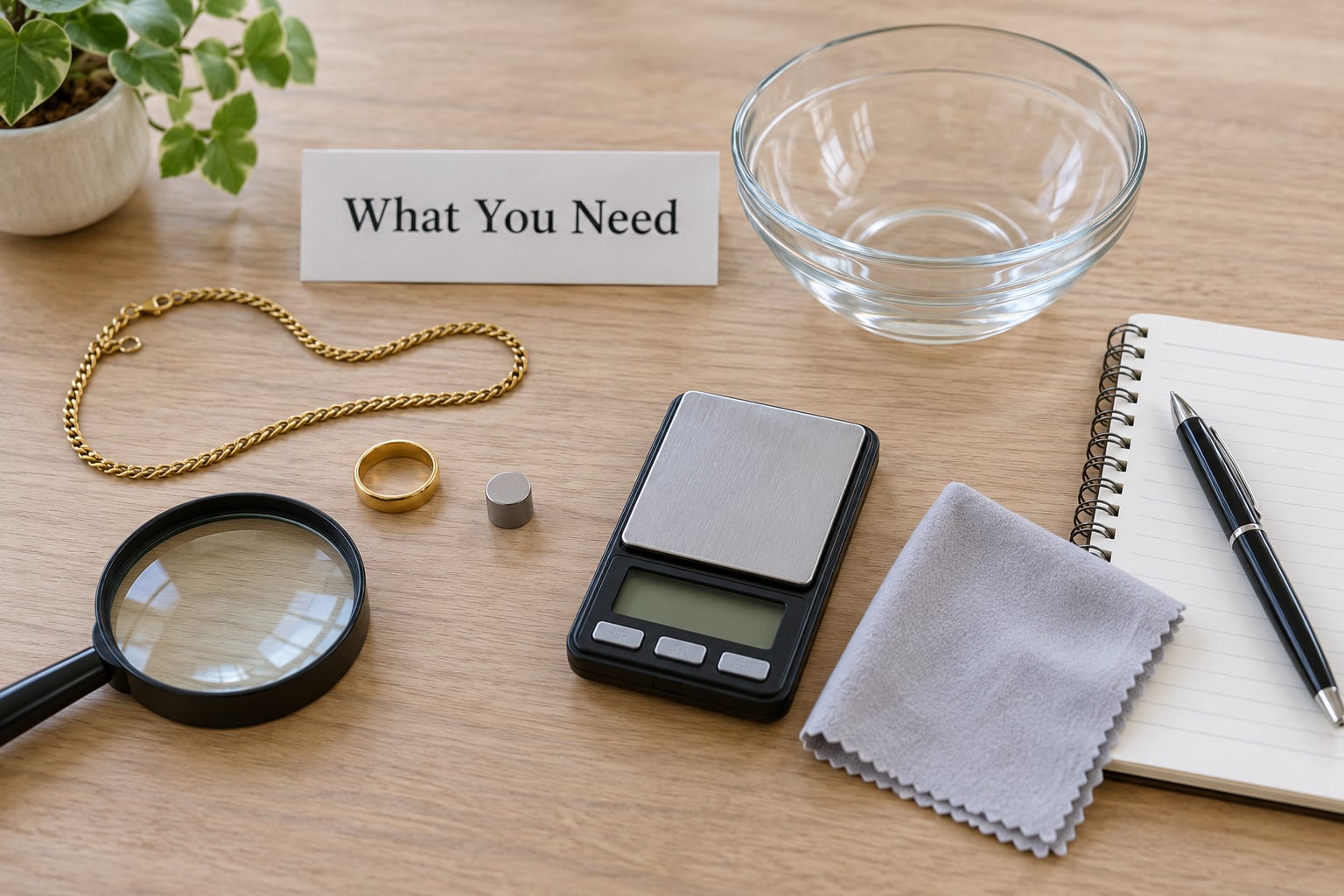
Clear a flat, well-lit surface first. You’ll want to look at the piece from several angles, which is hard on a cluttered table.
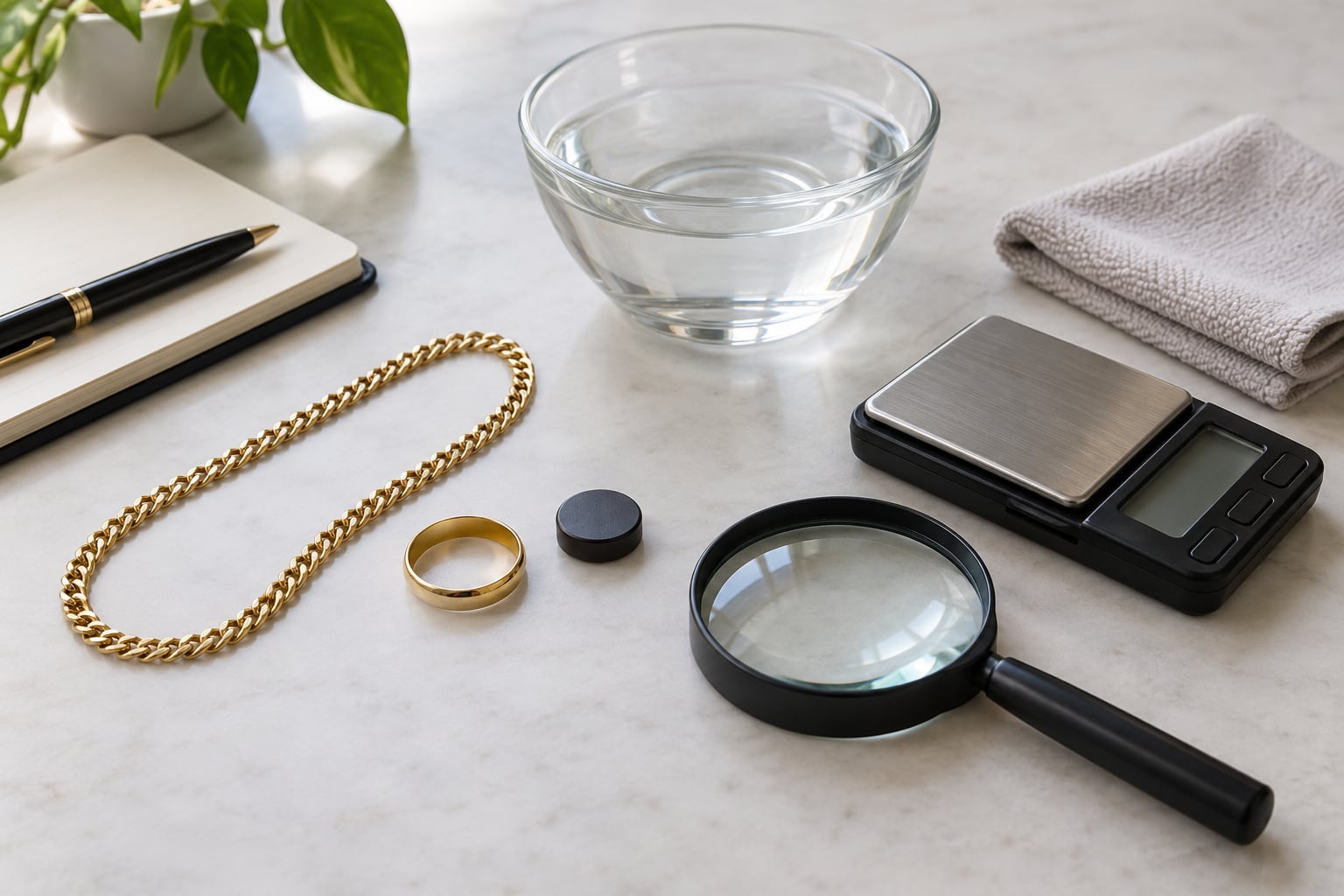
- A magnifying glass or loupe, for reading tiny stamps inside a clasp or on a ring band.
- A neodymium magnet. A fridge magnet is too weak to tell you anything useful.
- A digital scale that reads to 0.01 g if you have one. A kitchen scale that only shows whole grams won’t help much.
- A small graduated container of water, plus a ruler or calipers for measuring size.
- A soft cloth and something to write on.
- Any paperwork that came with the piece: a receipt, a previous appraisal, a hallmark certificate.
Keep whatever documentation turns up. A dated bill of sale is often more persuasive than any home test you can run.
Step-by-Step: How to Tell If Gold Is Real at Home
1. Check the Hallmarks, Weights, and Size
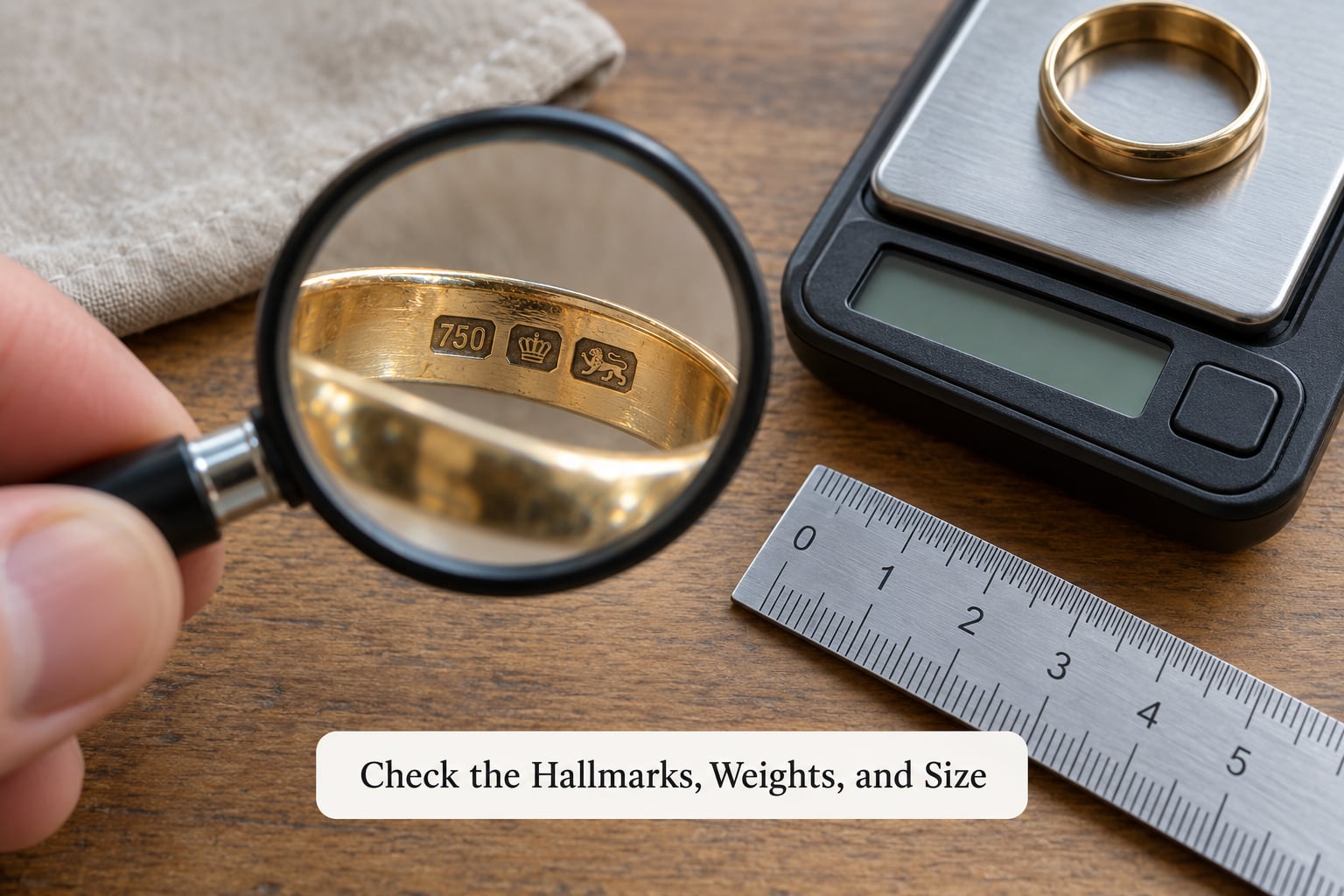
Look for a stamp and read it carefully. US pieces use karat numbers (10K, 14K, 18K, 22K); European and many Asian pieces use fineness per thousand, so 585 means 14K, 750 means 18K and 417 means 10K. Look for an assay office symbol beside the number, since a fineness stamp on its own is easy to fake.
Then weigh it. A 14K ring should feel roughly consistent with its stated size, and a chain’s stated length and link count should match what you can measure. A bar or coin stamped with a weight that misses its mark on a decent scale is a counterfeit until proven otherwise.
What this check can’t establish: marks are a claim, not a verification. Counterfeits are routinely stamped with a real assay mark and a plausible karat number. It also says nothing about purity beyond the number itself, which is why you check it first and treat it as a starting point.
While you have the piece in your hand, check the wear. Gold plating goes first at the edges, the back of the band, and where a ring rubs against another ring. If the exposed color underneath is yellower, paler or redder than the surface, that is a base metal showing through. Real gold does not tarnish, so any darkening on an untarnishable metal is worth a second look.
2. Use the Magnet Test Carefully
Gold is not ferromagnetic, so a solid or plated gold piece should not be pulled toward a strong magnet. Bring a neodymium magnet close to the clasp, the band and any clasp findings, since small steel springs are sometimes trapped in clasps and are a normal false positive.
What a positive result proves: it is not gold, or the piece is far too heavily alloyed to be worth testing. What a negative result proves: almost nothing. Gold-plated brass, aluminum, silver and tungsten-filled pieces are all non-magnetic, which is precisely why this test is paired with the others rather than trusted alone.
3. Perform a Density or Water-Scale Test
This is the most informative home test because density is hard to fake cheaply. Pure gold has a specific gravity of about 19.32 g/cm³. Common alloys land lower: 24K around 19.3, 22K around 17.5, 18K around 15.6, 14K around 13, and 10K around 12. All of those sink in plain water, while brass, copper and most fakes either float or sit suspiciously close to the line.
To do the simple version, drop the piece into a container of water and watch. Sinking rules out the cheapest fakes. Floating means hollow, plated over a light core, or solid base metal. To get real numbers, weigh the piece dry, then weigh the same container filled with water, then weigh it submerged, and divide the difference by the water reading to get specific gravity.
Two limits worth knowing. Household scales quantize too coarsely for anything under a few grams, and adding salt to the water only reaches about 1.2 g/cm³, which still isn’t enough to separate brass from gold. Density also has one deliberate loophole: a tungsten core inside a gold-plated shell can be machined to hit gold’s exact density.
4. Make a Non-Destructive Visual and Scratch Test
Start without touching anything. Genuine gold has a warm, slightly deep yellow that stays consistent across the piece, while fakes often show a color break at the edges, a greenish or reddish cast, or a surface that is uniformly too bright. Pyrite, sold as fool’s gold, shows a brassy gleam with a dark granular crust rather than a smooth surface.
The ceramic test comes next, and it is mildly abrasive. Drag the piece across an unglazed porcelain tile or the unglazed bottom of a mug. Real gold leaves a bright gold streak; brass leaves a darker, duller line. The problem is that a plated piece also leaves a gold streak, because the surface is gold. The test tells you the outside is gold, nothing more.
Skip anything that uses a knife, a file or a coin on a piece you care about. Scratch marks do not buff out of solid gold. If you want to try a liquid, plain white vinegar or a squeeze of lemon will darken copper-rich alloys within a few minutes and leave gold alone, but both are mild enough that many fakes pass. A butane flame or a cigarette lighter will discolor plated pieces irreversibly, so treat any video recommending it as entertainment rather than a method.
5. Confirm with Professional Testing
Home checks screen. They do not certify. If a piece is going to be insured, pawned, sold to a jeweler or bought as an investment, get it tested by a business that has the right equipment and gives you a written result.
X-ray fluorescence, usually called XRF, is the modern standard. It reads the alloy composition non-destructively in a few seconds and is what most independent testers and many pawn counters use. A jeweler’s bench test pairs a touchstone with calibrated nitric acid of different strengths: 10K acid leaves 10K untouched, 14K acid dissolves 10K and 14K, and 18K acid will dissolve anything claiming to be 18K or lower. That three-step sequence is the workflow jewelers described in gold-buying forums, and it’s the step that actually establishes purity.
Ask for the result in writing, with the karat stated and the date. If you’re sorting an estate collection, mobile testers will come to you, which beats carrying a box of pieces back and forth.
Common Mistakes
Treating a magnet pass as proof. Plated brass, aluminum and tungsten cores are all non-magnetic. The magnet test is a fast way to catch the worst fakes, nothing more.
Assuming a water test settles it. Tungsten is dense enough to be machined to match gold’s density almost exactly, and it defeats the magnet and water tests at the same time. Density narrows the field; it doesn’t close the case.
Using a diamond tester. These are thermal conductivity probes built for gemstones. Many readers already own one, and many readers have been told to use it on gold. It produces false positives and means nothing for metal purity.
Scratching an heirloom to prove a point. Toothpaste, baking soda and ceramic are all abrasive. On a 10K piece, softer alloy, a shine test can leave a permanent dull scar on the part you can see most.
Trusting a hallmark on its own. Stamps are copied constantly. A real assay symbol next to a plausible karat number raises the odds slightly; it does not settle the question.
Judging by color. White gold, rose gold and gold vermeil all look different from yellow gold, and none of those differences tell you anything about what’s underneath.
Safer habits: photograph the piece before you test anything, test the least visible spot if you test at all, and get anything of real value tested before money changes hands.
Frequently Asked Questions
How can I test gold with water at home?
Drop the piece into a clear container of water. Real gold and every common gold alloy are denser than water, so they sink immediately. Floating usually means a hollow piece, something plated over a light core, or a base metal such as aluminum. For actual numbers, weigh the item dry, weigh the container of water, then weigh the item submerged, and divide the dry loss of weight by the water reading. That gives specific gravity to compare against roughly 19.3 for 24K and about 12 for 10K.
What color does gold turn when it’s fake?
There’s no single fake color, so watch the surface instead. Brass and copper fakes usually streak green, orange or brown where the item has been scratched. Cheap plated pieces show a different color at the edges once the plating wears through. Rose and white gold alloys can turn a wearer’s skin green over time because of the copper in the alloy, which is normal and doesn’t mean the piece is fake.
Can you test gold by scratching it?
Only in a limited way, and it’s the one test I’d skip on anything you care about. A scratch reveals what’s at the surface, not what’s inside. Gold-filled and gold-plated pieces will both show gold because the outer layer is gold, while a solid piece shows gold too, so the test tells you almost nothing. It also leaves a mark that won’t buff out of solid gold. Use an inconspicuous spot on the back of a band if you must, or skip it.
What do pawn shops use to test gold?
Most counters use a fast combination rather than a single method: a magnet, a scale or specific gravity check, and an electronic gold tester or touchstone acid test on a filed corner. Independent testers usually bring X-ray fluorescence equipment, which reads the alloy composition non-destructively in seconds. Pawn shops buy below market, so a house test result in your favor doesn’t guarantee their offer. Get your own independent result before you accept any figure.
How do you tell gold-plated jewelry from solid gold?
Weight is the first clue, because plating adds almost nothing to mass, so a plated piece feels like the base metal it is. Edge wear is the second: the plating wears thin first at the back of a band, around a clasp, and where rings touch. You may also find a stamp like 1/10 14K, GF, or EP, which means gold-filled or electroplated rather than solid. Vermeil is plated too, so color and weight do not tell you how much gold is actually there.
Does real gold stick to a magnet?
No. Gold is not ferromagnetic, so neither solid gold nor gold plating will be pulled toward a magnet. If a strong neodymium magnet grabs the piece, it contains a magnetic metal such as iron or nickel and is not what you thought it was. The reverse isn’t true, though. Plenty of fakes are non-magnetic too, including gold-plated brass and tungsten-filled pieces, so a magnet test only catches the obvious problems. Use it first, never last.
Conclusion
Start with the marks, the weight and a strong magnet. Those three take five minutes, damage nothing, and remove most fakes from consideration before you get invested in a piece. Add the density check next if you have a small scale, and treat any acid, scratch or flame test as something to leave to a professional.
For inherited jewelry, investment bullion or anything you’re about to buy or sell, an XRF reading or a proper touchstone acid test is the answer you can actually rely on. Sellers on forums are blunt about it: no single home test settles the question, and the ones that look most convincing online are usually the ones that get fooled.