Learning how to buy physical gold bars safely comes down to four controls: an established dealer you can verify, documentation that matches the bar in your hands, a price you can check against the live spot market, and insured delivery to a secure destination. Most of the bad stories in precious metals come from skipping one of those four steps.
The recurring question on buyer forums is shorter than the query: am I being ripped off. A serial number copied from the screen onto a plated bar, a premium twice what the market allows, a package that sits unattended on a porch. None of those are hard to avoid once you know where to look, and this guide walks the whole process from budget to storage.
One framing note before we start. This is general educational information about buying a physical commodity. It is not investment, tax, or legal advice, and rules on taxes, storage, and dealer regulation vary by country and state. Check the specifics where you live before you transfer money.
Table of Contents
- What You Need
- Step-by-Step: How to Buy Physical Gold Bars Safely
- Set a budget and choose the right bar format
- Shortlist reputable gold dealers and verify their credentials
- Verify the seller before you buy physical gold bars
- Confirm the price and payment terms in writing
- Arrange insured, trackable delivery or insured collection
- Inspect the bar promptly after delivery
- Store or arrange custody securely
- Common Mistakes
- Paying only through traceable, protected methods
- Accepting delivery without inspection
- Frequently Asked Questions
- How do I know if the gold bar I bought is real?
- Can I buy gold bars at a bank?
- What is a reasonable premium over spot on a gold bar?
- Should I buy gold bars or gold coins?
- How much does it cost to store gold bars?
- Are gold bars taxed, and does the IRS know if I buy them?
- Conclusion
What You Need
Prepare seven things before you contact anyone. Scrambling to find a serial number after payment is the part that costs people money.
- A budget and a bar size in mind. Decide the total you are willing to commit, including costs beyond the metal itself.
- A shortlist of at least two dealers. Comparing one offer against another is the only reliable way to spot an inflated price.
- Product details in writing. Weight, purity, mint or refiner, serial number, assay card, and buyback terms.
- Identity and payment documents. Established dealers are required to know who they are selling to. Have government ID and a payment method in your own name ready.
- A receiving plan. Someone home, a PO box or address that accepts insured parcels, or an appointment to collect in person.
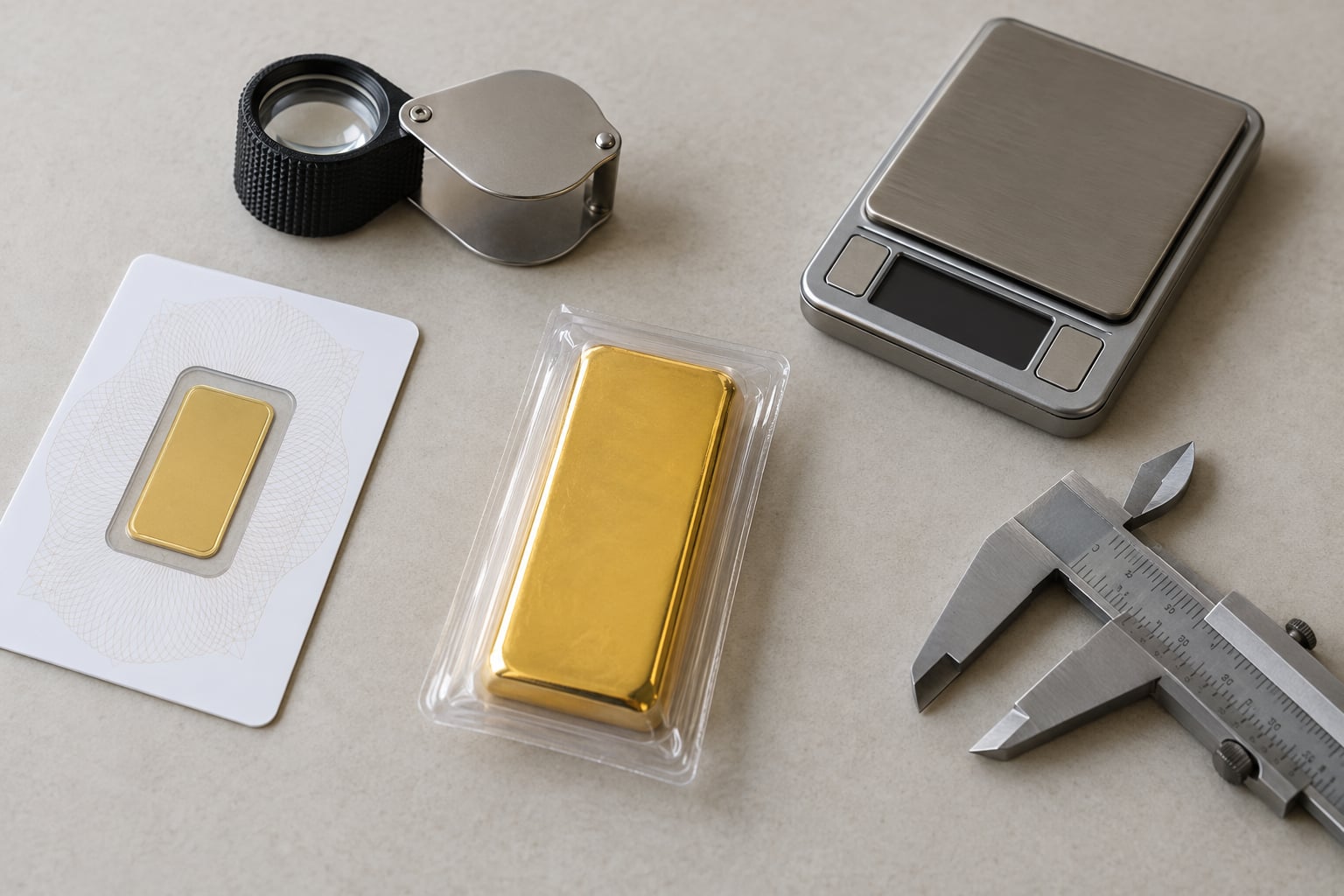
- Inspection tools. A jeweller’s loupe, digital scale accurate to a tenth of a gram, calipers, and a strong magnet.
- A storage decision. Home safe, bank box, or professional vault, with insurance arranged to cover it.
Step-by-Step: How to Buy Physical Gold Bars Safely
Seven stages, in order. Each one ends with a check you can actually perform rather than a feeling that things look fine.
Set a budget and choose the right bar format
Decide your ceiling first, then pick the format. Gold is priced in troy ounces, and a bar’s cost is the live spot price for its weight multiplied by its fineness, plus a dealer premium. Smaller bars carry a much heavier premium as a percentage because the refining, packaging, and shipping costs barely shrink with weight.
Typical dealer premiums move roughly like this, and they shift with market conditions, so treat them as a benchmark rather than a quote.
| Bar size | Approximate dealer premium over spot | Best for |
|---|---|---|
| 1 gram | 8 to 15 percent | Testing the waters with a small, spendable amount |
| 10 gram | 4 to 8 percent | Gifts and modest monthly accumulation |
| 1 troy ounce | 2 to 5 percent | Most first-time buyers; deep secondary market |
| 10 troy ounces | 1 to 3 percent | Larger allocations where resale matters less |
| 1 kilogram | 1 to 2 percent | Institutional or wealth-hold use; thin resale pool |
Also budget for the costs that are easy to forget: insured delivery, storage fees, and the buy-sell spread you will pay when you eventually sell. Run that last one backwards. A 10 percent premium looks small next to a bar you can only sell to two or three buyers on a good day.
Check it worked: you can state your ceiling in one sentence, and you know which size sits inside it.
Shortlist reputable gold dealers and verify their credentials
Verify the business itself before you look at any product. A real dealer has a physical address you can visit, a published phone number that reaches a person, a business registration, and a track record you can read in places they do not control.
Look for reviews spread across Google, the Better Business Bureau, and Trustpilot rather than concentrated on one platform. Check complaint records, and note how the business handles them. Industry membership such as the London Bullion Market Association or a mint’s direct-distributor list is a positive signal, but treat any single badge as evidence rather than proof.
Ask directly whether they are registered with FinCEN as a precious metals dealer. In the United States a registered dealer must comply with anti-money-laundering rules and file a Form 8300 for cash payments over 10,000 dollars, which is a useful sign that someone is running a real reporting business. Whether registration is required depends on the transactions, so ask rather than assume.
One pattern worth noticing from buyer communities: discounts and incentives get treated as a warning sign more often than a deal. A price materially below the market usually means something is wrong with the product or the seller.
Check it worked: the dealer answers a direct question about registration, buyback spread, and delivery insurance without evasion.
Verify the seller before you buy physical gold bars
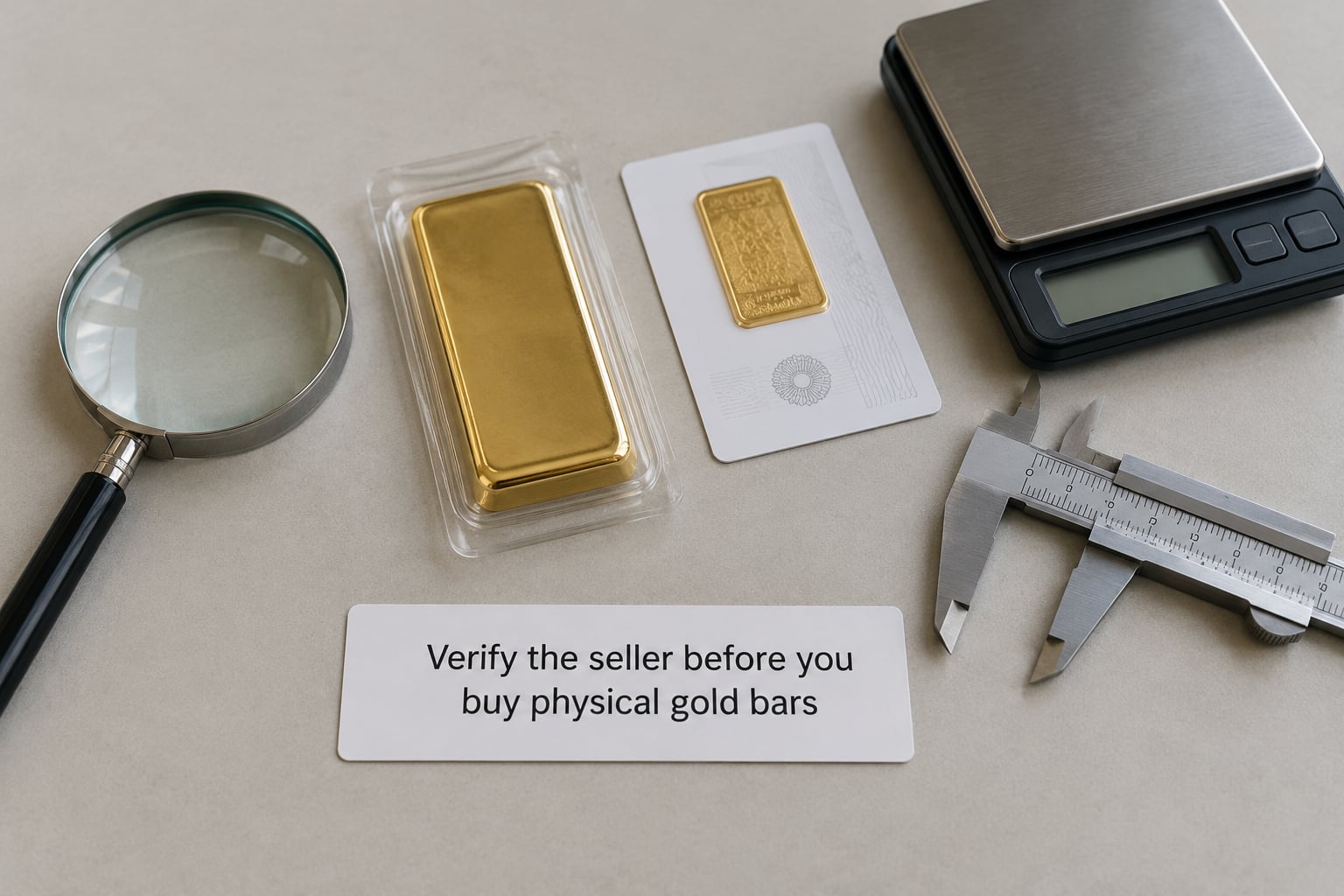
Run a concrete due-diligence check on the item itself. You want product photographs showing both faces, the exact weight in grams or troy ounces, the stated fineness, the mint or refiner name, the serial number, and a picture of the assay or certificate card.
Confirm the refiner is recognised. PAMP Suisse, Valcambi, Argor-Heraeus, Metalor, Umicore, Rand Refinery, Sunshine Mint, the Royal Canadian Mint, the Perth Mint, and the U.S. Mint all produce bullion with hallmarks buyers recognise at a glance. Bars with no identifiable refiner, a vague weight, or a serial number that is not on the packaging are a reason to stop.
Then get the commercial terms in writing: the premium, any shipping charge, insurance, the buyback price or spread, and the returns policy. Over the phone is not enough for a five-figure item.
Check it worked: you can match every number on the listing to something stamped on the bar or printed on its card.
Confirm the price and payment terms in writing
Compare the quoted total against the live spot price at that moment. Pull the premium out yourself: take the quoted price, subtract the spot value of the weight, and divide by the spot value. If the resulting percentage sits far outside the range for that bar size, ask why in writing.
Establish whether payment is due before the bar moves or on delivery. Then confirm the payment method the dealer names on its own official site, and check whether your bank or card issuer’s buyer protection applies to a metals transaction. Method limits matter too; a payment that exceeds a daily transfer cap often pushes people toward the riskier options you are trying to avoid.
Check it worked: you have an invoice showing the item, the weight, the total, the payment method, and the delivery terms.
Arrange insured, trackable delivery or insured collection
Require signature on delivery, tracking, and a declared value that matches the transaction. Ask in advance whether the package is insured for the full amount, whether declared value fees are billed to you, and what the carrier’s coverage ceiling is for a precious metals parcel. Many standard policies cap far below the value of a large bar.
Someone should be there to receive it. A parcel left on a step is the most common failure point, and it is entirely avoidable. If you are collecting in person instead, book an appointment, inspect the item in the shop before payment clears, and ask whether they will test it on the spot. Being able to test before you finalise the purchase is a genuine advantage of local coin shops over online dealers, and buyers on forums say so often.
Check it worked: you know the carrier, the tracking number format, the insurance ceiling, and who will sign.
Inspect the bar promptly after delivery
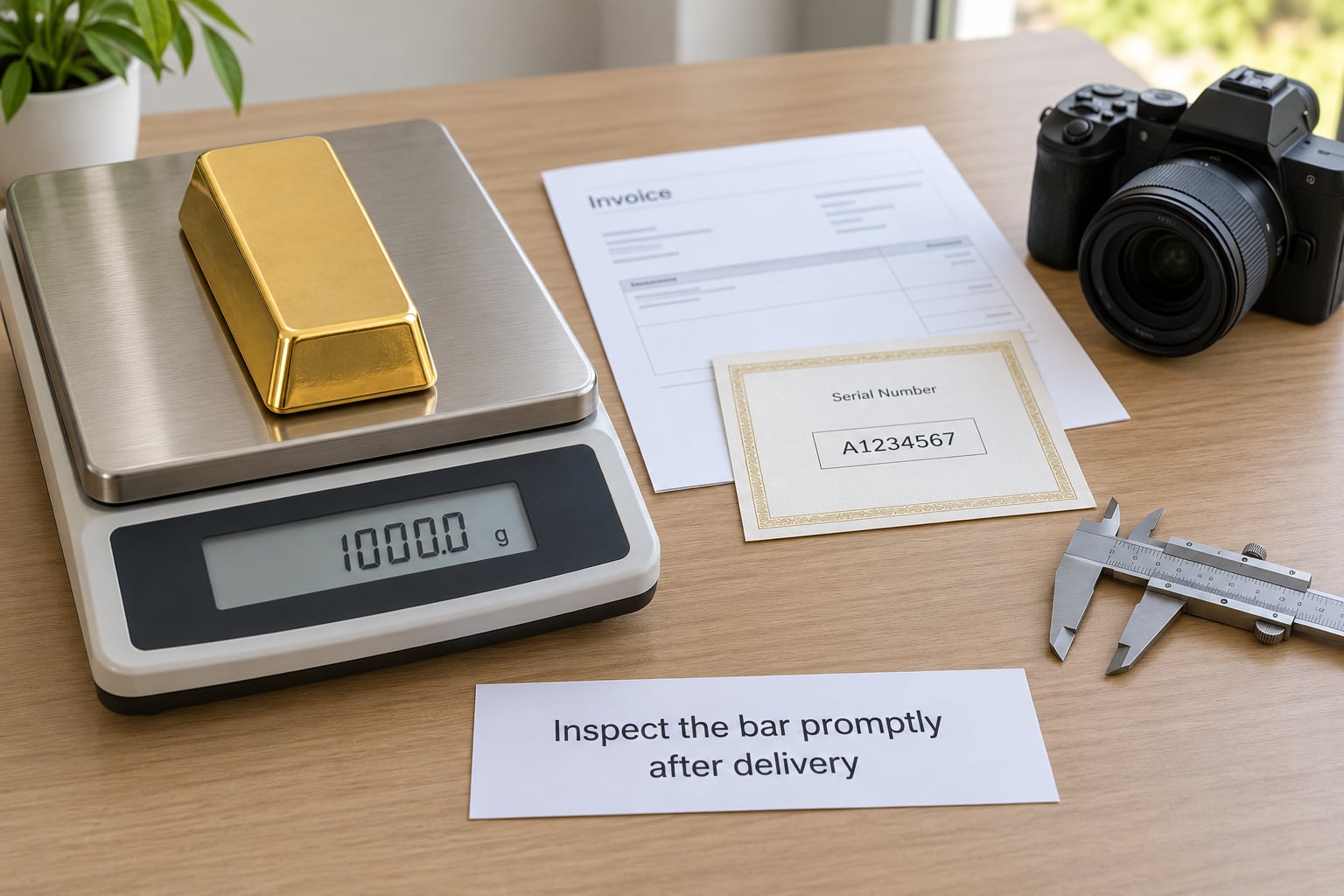
Photograph the sealed package before you cut anything. Check the outer wrapping for signs of disturbance, confirm the weight of the parcel against the courier’s figures, and record any damage in writing with photos before accepting.
Once you open the tamper-evident seal, work through the same list you would use in a shop. Weight first: compare the measured weight to the stated troy ounces using your scale, allowing for the assay card and packaging. Then check the dimensions with calipers, read the fineness and refiner hallmarks on both faces, and match the serial number on the bar to the serial number on the card character by character.
Run a magnet over it. Pure gold is not magnetic, so any strong attraction is a warning sign, though it is not proof of fraud on its own. Surface scratches, edge milling, and casting seams vary by refiner and are not by themselves evidence of anything.
For a large purchase, pay for a professional check. XRF and ultrasonic testing can confirm alloy composition below the surface, and a dealer or independent appraiser can do it in minutes. If anything conflicts with the paperwork, contact the seller through its official channels before you resell the bar onward.
Check it worked: weight, hallmarks, and serial number all agree with the invoice and the assay card.
Store or arrange custody securely
Match custody to the value and to how quickly you might need access. A home safe keeps the metal accessible and depends on your own security, and standard homeowners coverage often caps precious metals far below the bar’s worth unless you add a rider or a standalone policy. A bank deposit box is off-site and private, but bank deposit contents are not federally insured, so you would still want a separate metals policy. A professional vault offers the strongest physical security and usually the highest recurring cost, quoted as a percentage of value per year.
If you use a vault, check whether the holding is allocated to you specifically or pooled. Unallocated storage means you hold a claim against the vault’s inventory rather than a specific bar, which reintroduces the counterparty exposure that owning physical metal was supposed to remove. Jurisdiction matters to some buyers too; metal held outside your country of residence sits under that country’s law.
Keep the invoice, the assay card, the serial number, and a photograph of the bar together. Basis records make a future sale far easier to document.
Check it worked: the location, the insurance, and the allocation status are all documented, and you can produce the paperwork in under a minute.
Common Mistakes
The errors below are avoidable, and judging by the buyer questions I have read, common. Buying without a live quote. Trusting testimonials on a seller’s own page. Skipping the serial number check because the packaging looks professional. Storing metal outside any insured option. And treating a hallmark like 999 fine as a complete description of purity rather than a statement of nominal fineness that still needs verification.
Two of these deserve more detail because they cause the most damage.
Paying only through traceable, protected methods
The mistake: paying through a channel chosen for speed or because someone suggested it. Wire transfers to an individual, gift cards, cryptocurrency, peer-to-peer payment apps, and cash handed to a courier are all overrepresented in fraud complaints involving precious metals.
The fix: use the method the established dealer names on its own official site, ideally one your bank can reverse or dispute. Confirm the receiving account name matches the business entity. If anyone pressures you to pay within hours, to split a payment to stay under a reporting threshold, or to pay in a different currency than the invoice, that pressure is itself the red flag. Walk away, then verify the business through a phone number you looked up yourself rather than one in the message.
Accepting delivery without inspection
The mistake: signing for the parcel, tearing it open on the kitchen table, and finding a problem three months later when you try to sell. By that point the seller’s responsibility has usually ended.
The fix: photograph the sealed package, check the outer wrapping and parcel weight, and document any discrepancy with the courier before accepting. Then inspect promptly, within days, and keep the packaging. If the serial number, weight, or hallmarks do not match the paperwork, contact the seller through its official channels in writing before moving the bar or using it. A prompt, documented dispute is far easier to resolve than one raised weeks later.
Frequently Asked Questions
How do I know if the gold bar I bought is real?
Check four things before you consider it settled. Weigh the bar and compare the measured weight to the stated troy ounces. Read the refiner hallmark and fineness stamp on both faces. Match the serial number on the bar to the one on the assay card, character by character. And confirm the card was issued for that refiner. A magnet should not attract it. For a large purchase, pay for XRF or ultrasonic testing.
Can I buy gold bars at a bank?
In the United States, rarely. Most retail banks stopped stocking physical bullion, and the ones that once did usually limited customers to existing account holders at a poor premium. A handful of institutions sell through their own investment desks rather than over the counter. Local coin shops and established dealers are the realistic channels, though a bank deposit box is still useful for storage even when the bank sells no metal.
What is a reasonable premium over spot on a gold bar?
Roughly 2 to 5 percent for a 1 troy ounce bar, 4 to 8 percent at 10 grams, and 8 to 15 percent at 1 gram, with larger bars falling toward 1 to 2 percent. These benchmarks move with market conditions, so recompute the premium yourself each time rather than trusting a listed number. If a quote sits far outside the range for that weight, ask the dealer to explain the difference in writing.
Should I buy gold bars or gold coins?
Bars usually carry a lower premium per ounce and wider spreads, especially in larger weights. Coins cost more to buy but resell more easily because thousands of buyers trade them worldwide. One troy ounce is the usual compromise for a first purchase: a manageable amount, a low premium, and a deep buyer pool later. Fractional weights work well for regular small purchases and gifts.
How much does it cost to store gold bars?
It depends entirely on where you put it. A home safe is a one-time purchase plus whatever insurance rider you add. Bank boxes run from a modest annual fee to several hundred a year for larger sizes, and their contents are not federally insured. Private vaults typically charge a percentage of the stored value per year, often around 0.5 to 1 percent. Dealers that offer storage for customers usually bill monthly or annually.
Are gold bars taxed, and does the IRS know if I buy them?
Physical gold purchases are generally not subject to sales tax in most states, though a few states treat precious metals differently, so check locally. Sales of bullion held more than a year are taxed as collectibles at the higher long-term capital gains rate. Large cash payments trigger a Form 8300 report from the dealer. Rules vary by country and state, so confirm the specifics where you live.
Conclusion
Start with the part that costs nothing: write down your budget, pick a bar size, and shortlist two or more established dealers. Ask each of them for the same written details, compute the premium over spot for yourself, and compare. Only then confirm payment terms, insured delivery, and storage so the bar has somewhere safe to go when it arrives. That sequence is how you buy physical gold bars safely in 2026 without relying on anybody’s promise.