How to store silver without tarnishing comes down to four things: clean it, dry it completely, seal it away from air, and keep it away from sulfur. Tarnish is not rust and it does not eat into the metal. It is a thin film of silver sulfide that sits on top, and it can be polished off. You cannot stop it forever, but you can push it out by months or years with the right setup.
Most people store silver wrong in one of two ways. Either it sits in a nice jewelry box on the dresser, exposed to the room, or it gets sealed into whatever bag is nearby without a second thought about what is inside that bag. Both tarnish. The difference is how long.
Here is what I would set up first, and how I would store coins, jewelry and flatware differently, since those three do not belong in the same container.
Table of Contents
- What You Need Before You Store Silver Without Tarnishing
- Step-by-Step: Five Storage Methods That Work
- 1. Clean and Dry the Silver Before You Put It Away
- 2. Store Silver Without Tarnishing in an Airtight Container
- 3. Wrap Silver Separately in Non-Reactive Materials
- 4. Control Humidity and Moisture
- 5. Keep the Storage Location Stable and Safe
- Storage Methods Compared: What Each One Buys You
- How to Store Silver Coins, Jewelry and Flatware Separately
- Common Mistakes That Ruin Silver Fast
- Frequently Asked Questions
- Is plastic safe for storing silver without tarnishing?
- Does silica gel damage silver or make it cloudy?
- Should silver be stored in newspaper, tissue, or cotton?
- How should silver coins, jewelry, and silverware be stored differently?
- What is the best way to store silver long term?
What You Need Before You Store Silver Without Tarnishing
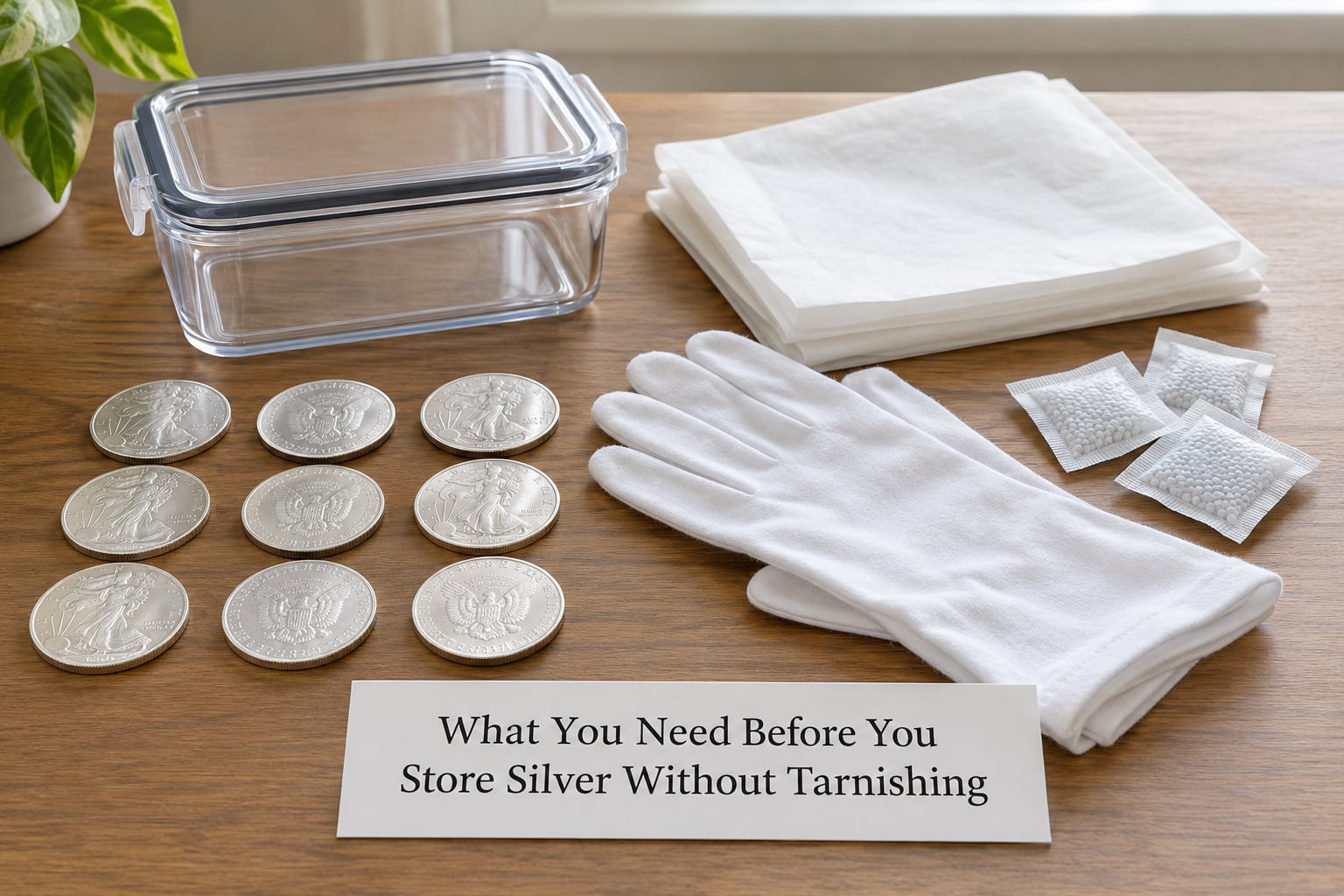
Start by knowing what you actually own, because the three common types of silver behave differently in storage.
Sterling silver, stamped 925, is 92.5% silver and 7.5% copper. The copper is why sterling tarnishes faster than pure metal. Fine silver at 999 is nearly pure and slows down a little. Silver-plated pieces, marked EP or EPNS, are a thin silver skin over a base metal. The base metal can corrode, discolor the plating and pit the surface, and no amount of tarnish prevention fixes that.
Beyond identification, gather the following:
- A gasket-sealed plastic container, plastic capsules, or heavy-duty resealable bags. The seal matters far more than the brand.
- Acid-free tissue paper, cotton flannel, or polyethylene sleeves made for collectibles. Nothing that sheds fibers or has a coating.
- A silica gel packet or color-indicating desiccant, kept in a separate small bag so the beads never touch the metal.
- Clean cotton gloves, or clean dry hands washed with unscented soap and fully dried.
- A soft polishing cloth for the piece you just cleaned. Skip anything gritty.
- A small hygrometer if you want to actually track the room instead of guessing at it.
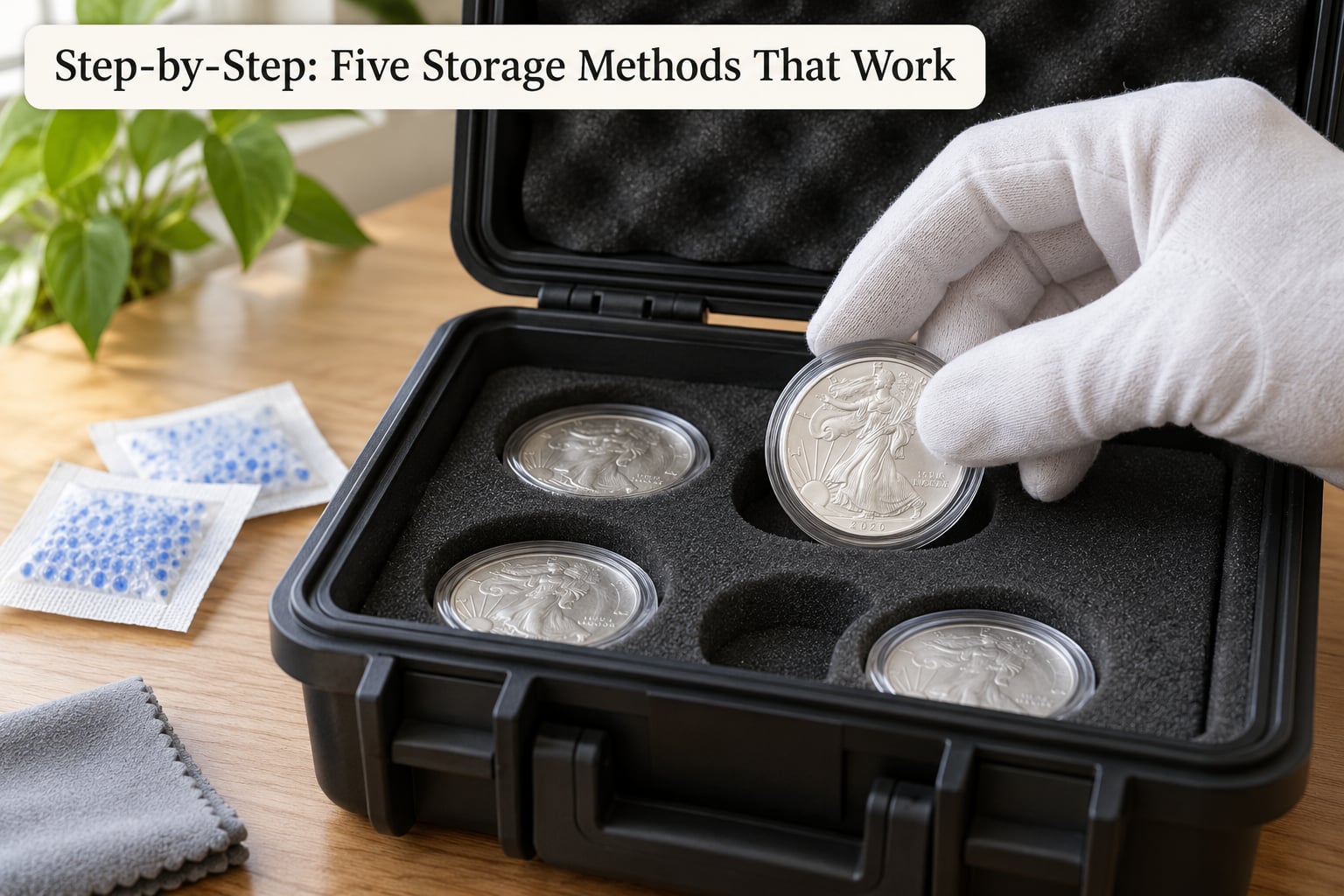
Step-by-Step: Five Storage Methods That Work
1. Clean and Dry the Silver Before You Put It Away
Any fingerprints, skin oils or trapped moisture under a lid will keep working on the metal while it sits there.
Wipe each piece with a soft polishing cloth and let it air dry on a clean cotton cloth until it feels completely dry to the touch, including inside hollow items like candlesticks. Skip toothpaste and silver dips. Toothpaste is abrasive and leaves micro-scratches that hold tarnish later. Dips strip a thin layer of metal and can strip plating entirely off plated pieces.
How do you know you got it right? The piece should look bright and even, with no smudges and no cool or damp patches, before it goes into anything sealed.
2. Store Silver Without Tarnishing in an Airtight Container
Airtight is the single most effective thing you can do, because tarnish needs two inputs: sulfur and moisture.
Sulfur arrives as hydrogen sulfide gas from outdoor air, from automobile exhaust, from natural gas, from smoke and from some paints and glues. The reaction is simple enough: four parts silver plus oxygen plus two parts hydrogen sulfide produce silver sulfide and water. That dark film, only a fraction of a micron thick at first, is what turns a coin grey and then black.
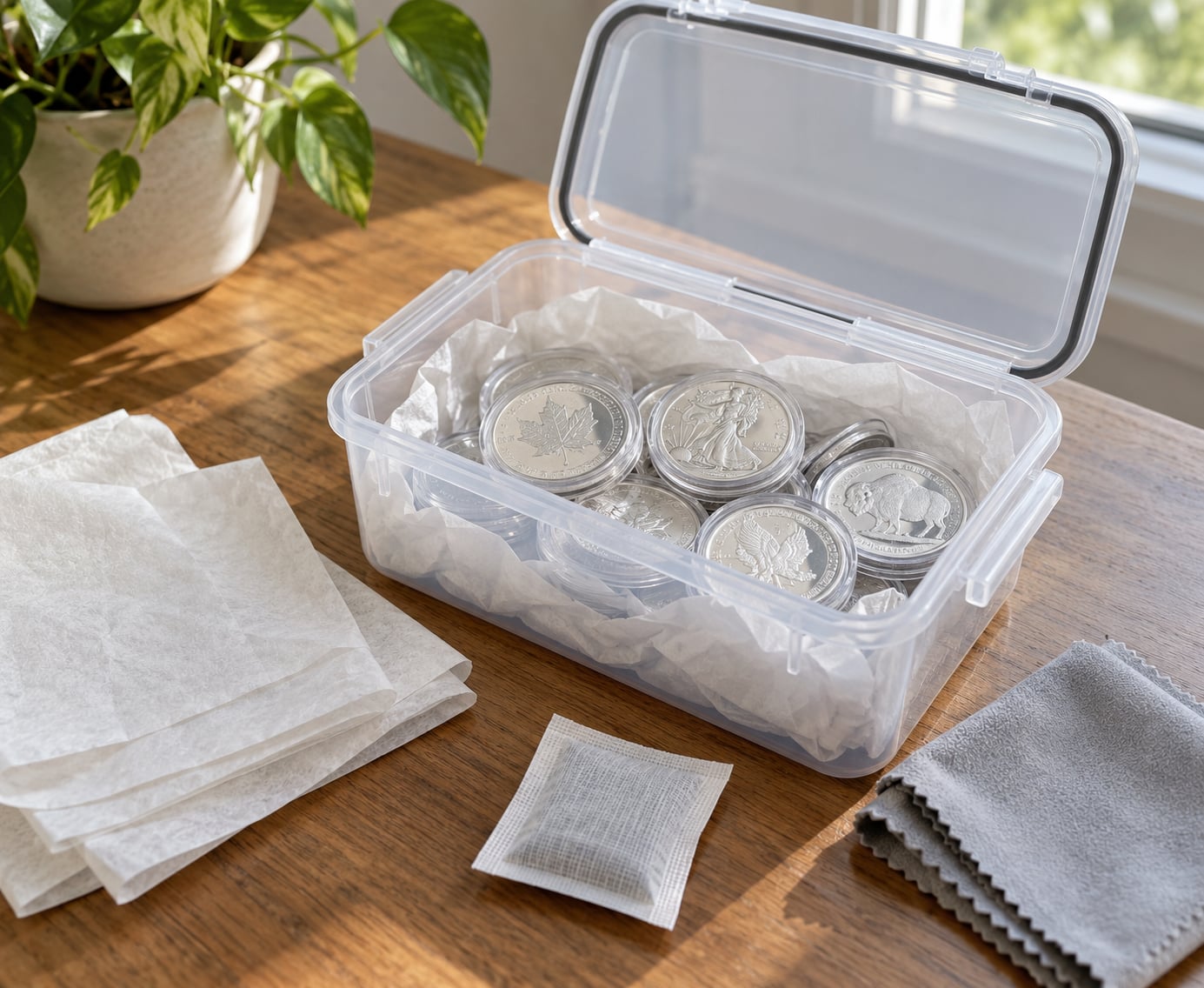
Seal the container, squeeze the air out of a bag where you can, and close it. Notice a few things you may already own. A resealable food bag does an acceptable job for short periods, though the plastic stiffens and the seal gets unreliable over a few years. A screw-top plastic tub with a rubber gasket holds its seal far longer. For coins, a hard plastic capsule blocks contact and scratches at the same time.
How do you know it worked? Leave a coin inside for a week, then open it. If the surface is dry, cool-neutral to the touch and unchanged, the seal is doing its job.
3. Wrap Silver Separately in Non-Reactive Materials
Pieces touching each other scratch, and scratches give sulfur a better surface to grip.
Wrap coins individually in acid-free tissue, put jewelry in a soft flannel pouch or a polyethylene sleeve, and roll flatware in cotton or muslin. Tissue or paper alone does nothing about sulfur, but it stops abrasion, and that alone cuts the visible dulling.
Skip tissue paper from a craft drawer, printer paper, and anything treated with a flame retardant or an anti-static coating. Those additives are exactly the compounds you are trying to avoid.
How do you know it worked? Every piece should be separable from its neighbor without scraping, and nothing should shift when you tip the container.
4. Control Humidity and Moisture
Moisture is the second half of the reaction, and the half people forget.
Keep relative humidity below roughly 50 percent in the room, and as stable as possible. A closet on an interior wall beats a basement, an attic, a garage, or a spot next to an exterior wall where temperature swings all day. If you want a number rather than a guess, an inexpensive hygrometer on the shelf will tell you more than any rule of thumb.
Silica gel helps in humid rooms, and it is safe if it stays sealed in its own paper or cloth sachet. Indicator types change color as they fill. Leave them out of reach of children and pets, since indicator packets can contain cobalt chloride.
How do you know it worked? Check the hygrometer a few times across a week rather than once. If it reads under 50 percent and does not swing wildly, leave the setup alone.
5. Keep the Storage Location Stable and Safe
Constant movement and fresh air both work against you.
Pick one spot, put everything in it, and try not to open it repeatedly to look at pieces. Each opening lets in new air. The exception is your inspection routine, which is worth doing every three to six months.
Two location warnings nobody mentions. A home safe keeps silver secure, but some safe interiors, door seals and lining materials off-gas, and the safe then traps those compounds right next to your metal. Air it out empty for a while before putting silver in, and if you notice tarnish developing only inside the safe, test a batch stored outside it. And if you travel with silver, carry it in a sealed bag with a strip inside rather than loose in a carry-on, where it can sit for hours in warm, damp air.
How do you know it worked? At inspection time, a piece that still shows dark patches after a year in the container has been exposed to something, and the container is where you start looking.
Storage Methods Compared: What Each One Buys You
| Storage method | Protection | Best for | Replace or check | Expected tarnish-free time |
|---|---|---|---|---|
| Gasket-sealed plastic tub | High | Jewelry, flatware, mixed collections | Check seal every 6 months | Several years indoors |
| Resealable food bag with air squeezed out | Medium | Short-term holding, small jewelry pieces | Reseal or move contents every few months | Months |
| Anti-tarnish bag or treated pouch | Medium to high | Jewelry worn weekly | Replace pouch every 6 to 12 months | 6 to 12 months per pouch |
| Coin capsules and tubes | High for scratch protection | Bullion coins and proof coins | Reseal tubes annually | Years if sealed |
| Safe deposit box | High for theft, medium for tarnish | High-value holdings | Inspect every 3 to 6 months | Often still tarnishes; sulfur seeps in |
| Anti-tarnish strips and silica gel | Support, not primary | Adding to any sealed container | Strips every 3 to 6 months | Adds months, not years |
Read the table as a stack rather than a menu. A container plus a wrapping layer plus an active scavenger plus a dry room is what a good setup looks like. Any one of those alone is a partial answer.
How to Store Silver Coins, Jewelry and Flatware Separately
Coins want scratch protection first, because damage from handling is harder to undo than tarnish.
Bullion coins and rounds go into hard plastic capsules, then into a sealed tube or bag. Collectors on r/Silverbugs treat capsules as close to essential for proof coins at .999 and above, since a single scratch on a mirrored field costs more than any amount of tarnish ever will. Cardboard coin holders and standard PVC flips are worth avoiding. They can release sulfur and plasticizer over time, and a flip that looks perfectly clean can still haze what it touches. If a coin has already contacted PVC, stop handling it with bare fingers and let a specialist look at it.
Jewelry goes in individual flannel pouches or polyethylene sleeves, kept apart so chains do not knot around pendants. Pieces with porous stones such as pearls, opals or turquoise should not go through a hot cleaning method at all.
Flatware and candlesticks get wrapped in cotton or muslin rolls. Hollow pieces need to be dry inside before sealing, and the hollow interior is where dampness hides longest. Mixed-material pieces with wood, leather or stone inlays need special handling, since those materials can off-gas or hold moisture against the metal. Seal them separately, or remove the piece to its own archival container.
One distinction worth learning early: tarnish versus toning. Tarnish is a dull grey or black film that wipes or polishes off. Toning is deliberate color, usually on vintage pieces, that sits in the recesses and does not clean away. Collectors regularly argue for preserving natural toning rather than polishing it away, and on a numismatic piece the polished look can cost you buyers.
Common Mistakes That Ruin Silver Fast
Wrapping silver in newspaper is the classic one. Newsprint ink contains sulfur compounds, and the stain sets in hard enough that it often needs a specialist to lift.
Cardboard boxes are the same problem without the ink. Paper fibers and adhesives release acids and sulfur slowly, and collectors have reported coins hazing inside ordinary cardboard holders within months.
Rubber is a genuine sulfur source. Rubber bands, rubber grips, rubber-backed polishing wheels and erasers all outgas enough to darken silver that touches them. It is an old jeweler’s rule for a real reason.
Felt, velvet, wool and flannel-lined boxes are a softer version of the same trap. Velvet especially traps dust and sulfur-bearing fibers, and a box advertised as anti-tarnish is only truly anti-tarnish if it contains an active sulfur scavenger. Many are just a fabric lining.
Toothpaste is the most widely repeated bad cleaning advice on the internet, and it is abrasive. It scratches the surface, and scratched silver tarnishes faster.
Sealing damp silver traps the problem in place. Same with putting a warm piece straight into a bag; the condensation forms where you cannot see it.
Bare-hand handling transfers skin oils and sulfur from your hands. Gloves help, but cotton gloves that shed fibers are their own problem. Wash, dry thoroughly, and handle only the edges.
Frequently Asked Questions
Is plastic safe for storing silver without tarnishing?
Yes. Polyethylene plastics such as resealable food bags, capsules and gasket-sealed tubs are safe for silver and are the most common storage used by collectors. The plastic blocks air and sulfur better than cloth. Use PVC-free material, keep the bag or tub sealed, and expect resealable bags to stiffen and lose their seal after a few years, so move the contents into something sturdier for long-term storage.
Does silica gel damage silver or make it cloudy?
No. Silica gel is a desiccant, not a tarnish chemical, and it does not react with or discolor silver. Keep it in its own paper or cloth sachet so the beads cannot scratch a piece or sit against a polished surface. Use color-indicating types so you can tell when it is spent, and keep every packet out of reach of children and pets since some indicator packets contain cobalt chloride.
Should silver be stored in newspaper, tissue, or cotton?
Never newspaper. Printing ink carries sulfur compounds and will stain silver, and the stain is hard to reverse. Plain tissue paper can also be acidic, so use only tissue labeled acid-free. Untreated cotton or muslin is safe and useful for wrapping flatware and hollow pieces because it separates them and lets pieces breathe. Add a sealed container around the wrap, since wrapping alone does nothing about airborne sulfur.
How should silver coins, jewelry, and silverware be stored differently?
Coins need scratch protection, so put them in hard plastic capsules, then in a sealed tube or bag, and skip cardboard holders and PVC flips. Jewelry goes in individual flannel pouches or polyethylene sleeves so chains do not tangle. Flatware and candlesticks should be wrapped in cotton or muslin rolls and stored dry, with hollow interiors fully dried before sealing, because damp trapped inside a hollow piece is the most common way flatware still tarnishes.
What is the best way to store silver long term?
Airtight storage in a cool, dry, dark location with individual wrapping and an active anti-tarnish strip, checked every three to six months. Keep relative humidity below about 50 percent, replace strips every three to six months, and avoid basements, attics, garages and exterior walls where temperature swings. For high-value holdings, a safe deposit box handles theft well but not tarnish, since sulfur still seeps in, so seal the metal before it goes in.
If you do one thing today, take your silver out of whatever it is currently sitting in, give each piece a clean and a full dry, and put it into a sealed container with an anti-tarnish strip inside. Then leave it alone and check back in six months. That single change does more than any product on any shelf, and it costs almost nothing.