There are four ways to invest in gold: buy the metal itself, buy a fund that holds it, hold gold inside a self-directed retirement account, or buy shares in the companies that mine it. Most beginners start small, pick one route, and cap the whole thing near a tenth of their portfolio.
That is the honest version of the pitch. Gold pays no interest, no dividend and no rent. Your return is the change in price, minus what you pay to buy, store, insure and tax it. Treat it as insurance for a portfolio, not as an engine that produces income.
Before any of it, get the basics in order: an emergency fund, high-interest debt cleared, every employer match captured. Search r/Gold for a thread about a 40,000 dollar windfall and the recurring answer is the same, from people who actually own the metal. Sort the foundations first, then add gold.
One more thing before you read on. This is educational information, not financial advice. Tax rules, account limits and fund costs differ by country and state and change over time, so confirm the current numbers with the IRS or a tax professional before you move money.
Table of Contents
- What You Need
- Step-by-Step
- How to Invest in Gold for Beginners: Set Your Goal and Time Horizon
- How to Invest in Gold: Choose the Right Form of Gold
- How to Check Costs and Authenticity Before You Buy
- Build a Staged Purchase Plan
- When to Review and Rebalance Your Gold
- Common Mistakes Beginners Make With Gold
- Frequently Asked Questions
- What is the best way for beginners to invest in gold?
- How much should a beginner invest in gold?
- Is buying physical gold better than a gold ETF?
- What are the risks of investing in gold?
- Do gold investments need to be stored at home?
- How does gold fit into a diversified investment portfolio?
- Conclusion
What You Need
Three questions decide whether gold belongs in your plan at all: how much cash you can genuinely leave alone, how long you can wait without selling, and what job you want gold to do. Answer those first and the choice of instrument becomes a much smaller problem.
- Emergency cash. Three to six months of living costs sitting in an account you can reach today. Gold is not an emergency fund, because selling it in a hurry means eating the dealer spread.
- Expensive debt gone. Clearing a credit card balance or similar high-interest borrowing is a guaranteed return. Gold is a hope. Pay the guaranteed one first.
- Employer match captured. A 401(k) or workplace match is part of your compensation. Leaving it on the table to fund bullion is an expensive trade.
- A stated time horizon. Gold has delivered long stretches of flat, disappointing years. If you need the money inside five years, this is the wrong asset.
- A risk budget. Decide the maximum share of your portfolio gold can ever occupy before you buy, and write the number down.
Three core concepts carry the rest of this guide. Owning bullion means holding coins or bars yourself, or having an approved depository hold them for you. Fund exposure means buying a share of a pool of gold, usually through an exchange-traded fund, where a trust holds the metal and you hold the fund share. Mining shares are company stock, not gold: their value depends on costs, production, politics and management as much as on the metal price.
Those three behave very differently in a bad year, which is exactly when you will want to know which one you bought.
Step-by-Step
The whole process is six steps, and they run in this order for a reason. Account setup takes an afternoon. Every purchase after that takes about ten minutes. The hard part is not the mechanics; it is sitting still while the price does something unhelpful.
How to Invest in Gold for Beginners: Set Your Goal and Time Horizon
Write down one sentence before you open any account: this gold is here to do a specific job for me. For most beginners the honest job is diversification, a small hedge against the portfolio taking a bad hit, not a plan to make rent.
There are three common goals, and they lead to different choices. If you want exposure to the metal price with no fuss, a fund is the answer. If you want something you can hand to a child, or hold through a crisis with no counterparty at all, physical bullion fits. If you want income, gold is the wrong instrument entirely and mining shares or a mining fund are the only route that pay anything.
Then set the horizon honestly. Gold is a five-to-ten-year-plus hold, and gold is famously good at doing nothing for years at a time. If your horizon is under five years, or if you are saving for a house deposit, a car or a tax bill, buy something else and come back later.
A poster on r/Bogleheads put the balanced version better than I can: gold is insurance and savings, and both can be true in the same portfolio. That is the frame I would use.
How to Invest in Gold: Choose the Right Form of Gold
There are four routes. They differ on cost, liquidity, control and tax treatment, and the table below puts them side by side so you can stop mixing them up in your head.
| Route | What you actually own | Main cost | Liquidity | Best for |
|---|---|---|---|---|
| Physical bullion | Coins or bars, in your hands or in an approved depository | Premium over spot, usually 8-12 percent on common coins, plus storage and insurance | Slower, and you sell to a dealer below spot | People who want no counterparty and plan to hold for decades |
| Gold fund or ETF | A share of a trust holding gold, in a normal brokerage account | Expense ratio, typically 0.15 to 0.40 percent a year | Instant during market hours, at the market price | Beginners, small regular amounts, anyone rebalancing often |
| Gold in a self-directed IRA | Bullion held for a retirement account by a custodian | Custodian fees, storage fees and dealer commissions | Limited until retirement age in many setups | People already rolling over a 401(k) and wanting tax deferral |
| Mining shares and mining funds | Equity in companies that sell gold | Equity risk, management fees, 0.5 percent or so on the big miners funds | Very liquid during market hours | Investors who want amplified exposure to gold and accept dividends and far more volatility |
Here is what each one actually feels like to own. A physical coin is a thing in a drawer. Its value is the melt value plus whatever a buyer will pay that day, and the buyer sets that price, not you. A gold fund is a brokerage line item that tracks the metal price minus the fund’s fee, and it tracks it closely: over a decade the difference between the fund and the metal is almost entirely that fee, compounded.
A self-directed retirement account, usually called a gold IRA when it holds metal, wraps bullion in tax deferral. It also wraps it in a custodian’s storage fee and, this is the part that trips people up, whatever commission the dealer charges the account. That commission is a sales cost that never appears in the fund’s expense ratio. Ask for the total in writing before you fund one.
Mining shares are a different animal. They magnify the gold price in both directions, pay some dividends, and can fall hard while gold is rising if costs, grades or politics move against them. Major producers such as Newmont and Barrick Mining are the usual starting names; streaming and royalty companies such as Wheaton Precious Metals and Franco-Nevada are a steadier middle path that earns a fee on other people’s production. If you are new, read the equity risk before you read anything else on this list.
There is a fifth option worth naming so you can rule it out. Gold jewellery is almost always a bad investment: making charges, retail markup and resale losses can eat a large share of the metal value. Buy jewellery to wear, not to store.
How to Check Costs and Authenticity Before You Buy
Cost is where beginners lose money quietly, so here is the arithmetic rather than a reassurance. When you buy a one-ounce coin from a dealer, the retail price includes a premium over the spot price. Buyers on r/Gold report paying roughly 10 to 12 percent over spot on common bullion. On the way out, the same dealer buys back at a discount, and buyers report closer to 20 percent under spot. That round trip is the real cost of physical gold, and it is why small denominations are a trap.
That is also why a one-ounce coin beats a one-gram bar for a beginner. The premium is a largely fixed manufacturing and distribution cost, so the smaller the bar the more of your money it consumes. A 25 dollar purchase in a small bar is mostly premium, and it is close to unsellable back to a dealer at anything like its price.
Storage is the other half of the bill. A home safe costs money once and carries theft and home-insurance questions. A bank safety deposit box costs a modest annual fee but has access limits and often excludes precious metals from the bank’s own liability coverage. A third-party depository, such as an IRS-approved one, runs an annual storage and insurance fee per item and is the cleanest option for larger holdings. Bigger bars are usually stored more cheaply per ounce than small ones, for the same reason they cost less to buy per ounce.
Funds charge their cost openly. As of October 2026, widely held physical-gold funds ran roughly: SPDR Gold Shares at 0.40 percent, iShares Gold Trust at 0.25 percent, abrdn Physical Gold Shares at 0.17 percent, Franklin Responsibly Sourced Gold at 0.15 percent, and Goldman Sachs Physical Gold at 0.18 percent. The two big miners funds, VanEck Gold Miners and VanEck Junior Gold Miners, were around 0.51 and 0.52 percent. Check the current figure on the fund’s own page before you buy, because these move. This article was last checked in October 2026; gold trades around the clock, so look up a live spot price from a major financial data provider before you size any order rather than trusting a number in a guide.
Then check authenticity. For anything you hold, look for a fineness stamp of .999 or better, which is 24 karat pure. Keep the assay card and the serial number, photograph both, and record them the day the package arrives. Verify the serial number against the mint or refiner’s own verification page. For American Gold Eagle, Canadian Maple Leaf and Krugerrand coins, the weight, diameter and design details should match the refiner’s published specifications. Insist on insured, tracked shipping and inspect the package on camera before you sign, because a delivery signature you do not witness is a lost dispute.
Finally, learn what you will owe. In the United States, gold coins and bars are generally treated as collectibles for tax purposes, which means a long-term gain can be taxed at up to 28 percent, and short-term gains are taxed as ordinary income. Gold held inside a retirement account usually defers the tax until withdrawal. Some states and countries treat the purchase itself differently, and no national treatment is universal, so treat all of this as a prompt to check rather than a settled answer.
Build a Staged Purchase Plan
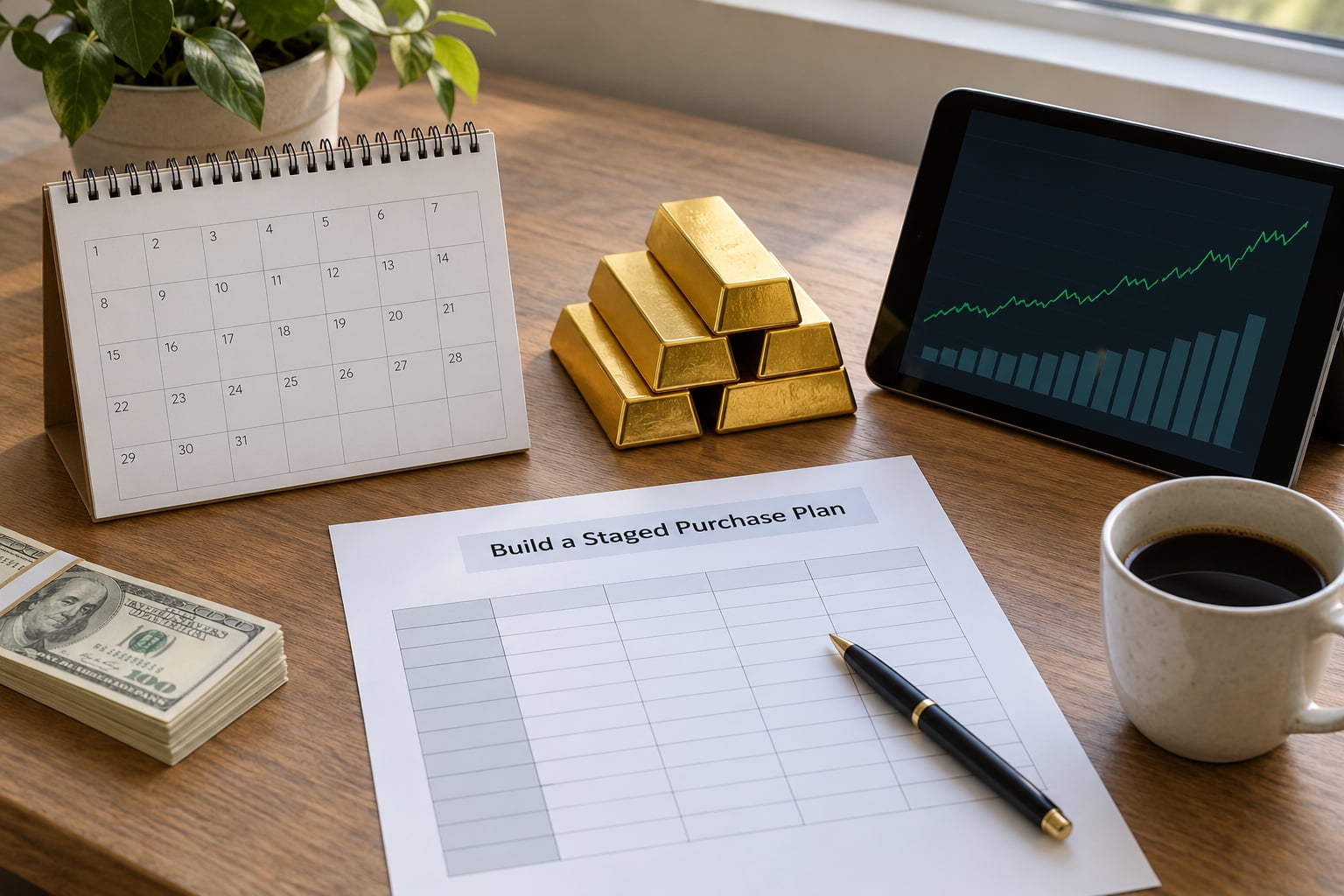
Staging is the part that saves you from the worst outcomes. Instead of one large purchase on a day you feel confident, you commit a fixed amount of money on fixed dates. Buy 50 or 100 USD of the same fund on the first trading day of each month for a year, or one 1 oz coin per quarter. You end up with the same total, and you never had to call a bottom.
It also suits small budgets. A beginner on r/Gold asked how to start investing with 25 to 50 USD per paycheck. The practical answer in that thread was fractional fund shares or small periodic bullion buys, not one large purchase, and that remains the sensible version. Most fund providers let you buy a fraction of a share, so a fixed monthly amount works at any scale.
Set three numbers before the first order: the maximum you will put in per year, the dates you will buy on, and the ceiling as a share of your portfolio. Popular research ranges for that ceiling range from 5 to 10 percent in some guidance, 5 to 15 percent in Morningstar’s work, and up to 20 percent in some adviser materials. Pick one, write it down, and stop revisiting it monthly.
Also give yourself a rule for surplus cash. If you are waiting on a car, a deposit or a year of expenses, that money is not gold money. The other mistake to pre-commit against is upgrading. One ounce today, ten ounces after two good years, is how people end up with a position sized by enthusiasm rather than by a plan.
When to Review and Rebalance Your Gold
Gold is a quiet asset that occasionally moves in a way that makes headlines. Checking the price daily tells you nothing you can act on and reliably makes you a worse decision-maker. Pick a review rhythm instead: once a quarter for a fund, once a year for physical, and immediately only if your own circumstances change.
In a portfolio, gold usually earns its place by moving less in the same direction as everything else. The point is not that it goes up. The point is that in the stretches when equities and bonds fall together, it often holds steadier, which softens the total. Over a long period its value is a claim on the same real asset from a decade ago, which is the honest way to describe what it preserves.
Rebalance on a rule rather than a feeling. Check once a year, compare gold’s share of the portfolio to your written ceiling, and if it has drifted several percentage points above it, sell back down to the target. If it has fallen below, use new contributions to top it up rather than buying extra. That single rule stops you from trimming gold after a collapse and adding it back after a spike, which is the most common way retail investors lose money in any asset.
And keep the time horizon in front of you. Most of the value of holding gold for a decade comes from not having sold it during a bad year. The people who regret gold are almost never the people who held too long; they are the people who bought at a peak, needed the cash early, and sold through the dealer spread into a loss.
Common Mistakes Beginners Make With Gold
Here is the list, and most of it comes straight from forum threads rather than from textbooks.
Chasing a rally. The most common question on the first-time buyer threads is some version of is it smart to sell right now. Nobody knows, and the answer that has historically worked best is to have decided your allocation and stuck to it before the move started.
Buying too much of it. A 40,000 USD windfall in a single metal position is a very different risk profile from the same money spread across a portfolio. Size the position to your written ceiling, not to your enthusiasm on the day the price feels low.
Treating mining shares as gold. Mining equity can fall 40 percent in a year when gold is flat or rising. If you want the metal, buy the metal. If you want amplified exposure and dividends, own that deliberately and know what you signed up for.
Paying for collectible coins. Numismatic coins are the most common bait aimed at first-time buyers, and a precious-metals forum thread on newbie mistakes named the pattern clearly. A coin advertised for its rarity carries a large premium over melt value and a thin resale market. If you are investing rather than collecting, buy the lowest-premium bullion the reputable mints produce and skip the story about scarcity.
Starting with tiny denominations. One-gram and one-eighth-ounce pieces exist to be sold to beginners, not to help them. The premium per gram is punitive and the buyback market for them is thin.
Diying the storage and the paperwork. The same forum thread flagged DIY-ing too much and underestimating storage fees as the two main traps. A home safe that is not actually fire-resistant or bolted down, and a note in a drawer with no serial numbers, are the two details that turn a small loss into a large one.
Skipping verification on delivery. Check weight, dimensions, fineness stamp, serial number and assay card before you sign. It takes four minutes.
Using gold to pay off debt. A beginner on r/investingforbeginners asked whether to sell gold to get out of debt. Selling metal to clear a high-interest balance is often the correct financial move and the wrong gold decision, in that order. The metal was never meant to be the cash reserve.
Buying from whoever called you. No legitimate dealer guarantees returns or pressures a decision on a phone call. Check how long the business has operated, its BBB record, whether it is registered with the CFTC where relevant, and whether the price they quote includes shipping, insurance and the buyback spread. If the answer to any of those is fuzzy, walk.
Frequently Asked Questions
What is the best way for beginners to invest in gold?
For most beginners the best starting point is a small position in a physically backed gold fund bought through an ordinary brokerage account, because it costs under half a percent a year, is liquid during market hours and needs no storage. Add physical bullion later, once you understand the premium and spread you pay on entry and the discount you take on exit. Treat gold as a diversifier capped near 5 to 10 percent of your portfolio, not as a growth asset.
How much should a beginner invest in gold?
Most guidance caps gold between 5 and 15 percent of a portfolio, and many advisers start at the lower end. Work out that percentage of your investable assets first, then divide it by the number of purchases you plan to make. A beginner adding 50 or 100 USD a month reaches a sensible position in a few years without concentrating risk or needing to time a single large entry.
Is buying physical gold better than a gold ETF?
Physical bullion gives you direct ownership, no counterparty and something that leaves the country with you if you choose, but you pay a premium of roughly 8 to 12 percent to buy and sell back at a discount, plus storage and insurance. A gold fund tracks the metal price closely at a fraction of a percent a year, with no storage, but adds counterparty and custodian risk. If you want exposure rather than an object, the fund is the cheaper answer.
What are the risks of investing in gold?
The main risks are a long flat stretch with no income, a real loss if you are forced to sell during one, and total cost of ownership that quietly erodes returns. Gold pays no dividend, no interest and no rent, so every year you hold it the return is zero before price movement. Prices also fall, sometimes sharply, and physical gold carries theft, storage and authenticity risk on top. Nothing about holding gold is guaranteed.
Do gold investments need to be stored at home?
No. Physical gold has three common homes. A home safe is a one-off cost but carries theft and insurance questions, and a cheap fire-resistant box is often not either. A bank safety deposit box costs a modest annual fee but limits access and may be excluded from the bank’s own liability cover. A third-party IRS-approved depository charges annual storage and insurance per item, which is the cleanest option for larger holdings.
How does gold fit into a diversified investment portfolio?
Gold earns its place as a diversifier rather than a return engine. It tends to move differently from equities and bonds, so a small allocation can soften total portfolio volatility during the stretches when everything else falls together. It also tends to sit around 5 to 10 percent in most balanced portfolios, with some research allowing up to 15 percent. Revisit the share once a year and rebalance back to whatever number you wrote down.
Conclusion
Start with the boring part. Decide what job gold is doing in your portfolio, write down a maximum share somewhere you will see it, and pick one route rather than three. If the metal itself appeals to you, start with a small physically backed fund and add a one-ounce coin once you have watched the premium and spread for yourself.
Then make the first purchase small, on a date you set in advance, from a dealer or provider you have vetted. And if the emergency fund is thin or the credit card balance is not zero, finish those first. The metal will still be there.