Selling precious metals creates a taxable event, so the short answer to how to report precious metals sales on taxes is straightforward: you report the gain or the loss, not the metal itself. The IRS treats physical gold, silver, platinum and palladium as collectibles, which changes where the figure lands on your return and how heavily it can be taxed. Report every sale that produced a gain or a loss, whether you sold to a dealer, a melt shop or a private buyer, and whether or not anyone handed you a tax form.
Most of the difficulty is paperwork rather than math. Physical bullion has no automatic information return the way a brokerage account does, which means the numbers on your return come from your own records. Get those records right and the rest is a short sequence of forms.
This guide covers the U.S. federal process. State rules, and rules outside the United States, can differ in important ways.
Table of Contents
- What You Need
- Step-by-Step: How to Report Precious Metals Sales on Taxes
- 1. Identify the Transaction and Tax Treatment
- 2. Reconcile Proceeds and Adjustments
- 3. Calculate Cost Basis and Gain or Loss
- 4. Check for Special Reporting Rules
- 5. Complete the Correct Forms
- 6. File, Review, and Keep Records
- Common Mistakes
- Frequently Asked Questions
- Do I have to pay taxes when I sell physical gold or silver in the United States?
- What is my cost basis if I no longer have the original purchase receipt?
- Will my precious-metals sale appear on a Form 1099-B?
- How is selling a precious-metals ETF taxed differently from selling physical bullion?
- How long should I keep records of precious-metals purchases and sales?
- Conclusion
What You Need
Gather these before you touch a tax form. Missing one of them is what turns a simple sale into a two-hour research project.
- Purchase invoices or dealer receipts for every piece you still own or have sold, showing the date, the quantity and the total amount paid.
- Trade confirmations and order forms from your brokerage, if you bought or sold through an account rather than face to face.
- Year-end account statements, which usually total the year for you even when individual trade details are missing.
- A prior-year Form 1099-B or substitute statement, if you hold metal at a broker or in a self-directed account.
- Quantity and purity details per piece, such as troy ounces and fineness, so you can allocate basis across a partial sale.
- The forms for the tax year in question, including Form 8949, Schedule D and Form 1040.
Physical metal sales often produce no tax form at all. There is no standard rule requiring a dealer to issue a 1099-B for every gold transaction, so the burden of proof sits with you. That is also why records matter for longer than a single filing season: an audit can reach back several years, and you need the original purchase document to support the basis you claimed at the time.
Keep everything in one place from the day you buy. A spreadsheet, a portfolio tracker or a folder of scanned invoices all work, as long as you can pull the details for a single piece when you need them.
Step-by-Step: How to Report Precious Metals Sales on Taxes
Six steps cover almost every retail case. Work through them in order and the filing itself takes minutes.
1. Identify the Transaction and Tax Treatment
Start by naming what you actually sold, because the classification decides everything downstream.
- Investment-grade bullion such as gold bars and silver rounds is a capital asset classified as a collectible.
- Numismatic coins follow a separate collectibles test based on whether their value is driven by the coin itself rather than its metal content.
- A precious-metals ETF is a security. It produces a 1099-B and follows the holding period rules for other investments.
- A mining company stock is an ordinary investment with no connection to the metal rules.
Tax classification is a determination, not a guess based on what the piece looks like. When a coin sits between categories, or when a dealer described it one way and you think it fits another, get a written opinion from a qualified tax professional or a credentialed appraiser before filing.
2. Reconcile Proceeds and Adjustments
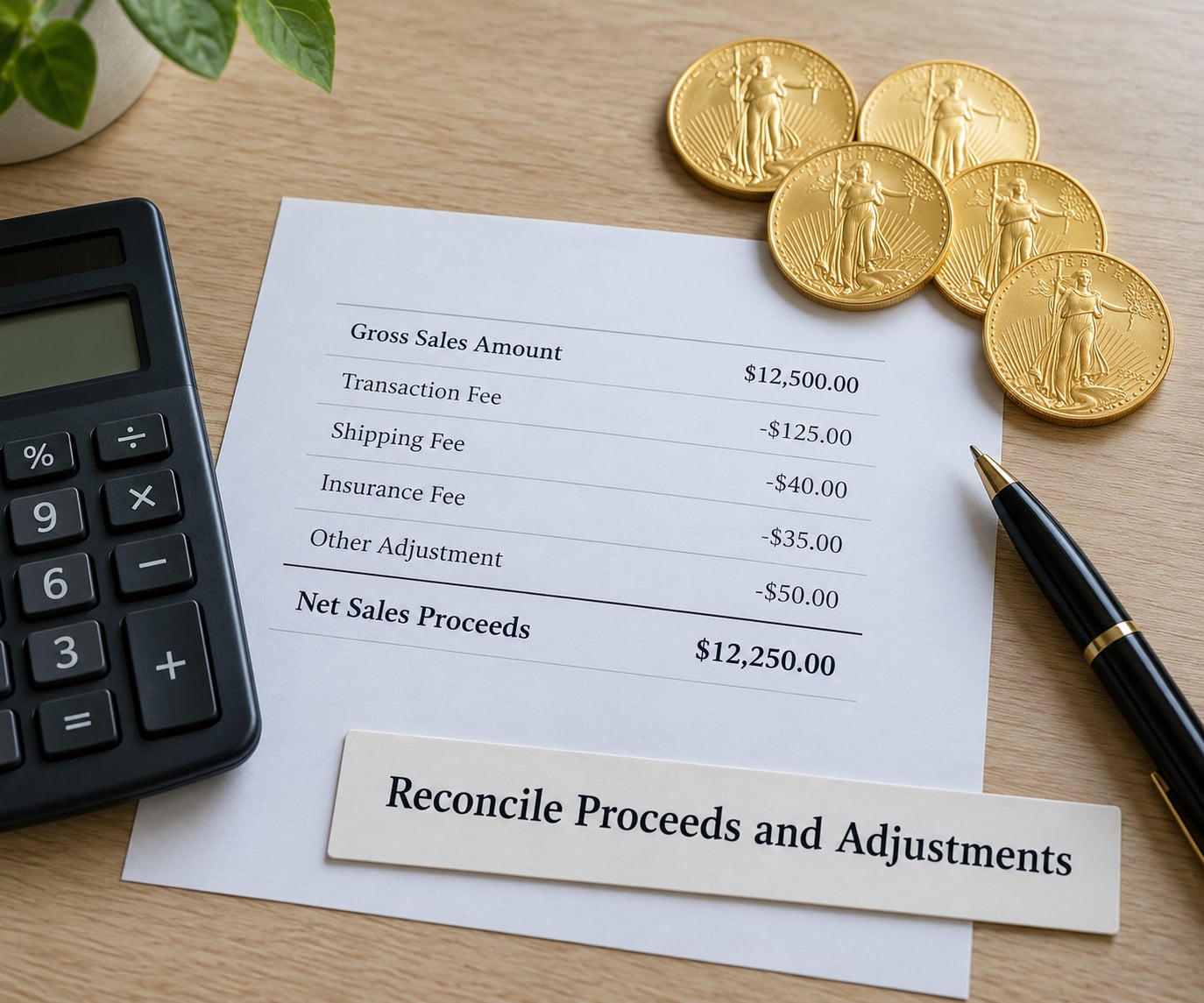
Find the gross amount the dealer or buyer paid you, then adjust it for anything that changes the real proceeds. Shipping and insurance charged at sale, dealer commissions and assay or melt fees generally reduce the amount you realized.
Reconcile against the document itself. Dealer statements sometimes show the metal value at a reference price and then deduct a spread, so the number on the invoice is not always the number that belongs on your return. Bank or card statements are useful corroboration when a dealer receipt is thin or handwritten.
One limit is worth knowing: on a personal capital-gain sale you generally cannot deduct your own selling expenses, and the miscellaneous itemized deductions that once covered them were suspended for most taxpayers. Selling costs tied to a trade or business are a different matter and belong to Schedule C rather than Schedule D.
3. Calculate Cost Basis and Gain or Loss
Cost basis is everything you paid to acquire a specific piece, plus the allowable acquisition costs such as the dealer premium above metal content and the shipping and insurance you paid on the way in. Holding costs such as storage or vault fees are not part of basis.
Subtract that basis from net proceeds. A positive result is a realized gain, a negative result is a realized loss, and zero means the sale breaks even.
| Scenario | Net proceeds | Allocated basis | Gain or loss | Holding period |
|---|---|---|---|---|
| Six one-ounce coins bought 400 days ago | 12,600 | 11,100 | Gain of 1,500 | Long term |
| Two bars sold back at a loss | 3,400 | 3,720 | Loss of 320 | Long term |
| A single coin sold at the purchase price | 1,850 | 1,850 | No gain or loss | Any |
Here is the arithmetic behind the first row. You bought ten one-ounce coins on an invoice totalling 18,500, including the premium and insured shipping, and twenty months later sold six of them for 12,600 net of the dealer spread. Allocated basis is 18,500 multiplied by six divided by ten, which is 11,100. The realized gain is 1,500, held more than a year, so it is a long-term collectible gain.
Which tax lots you sell is your choice, provided you can support it. Specific identification lets you name exactly which coins you sold, which matters most when you bought the same coin at very different prices. FIFO is the default if you do nothing. Average cost is not available for collectibles, and any method you do use has to be applied consistently rather than picked whichever way is most flattering.
Holding period rules also differ by instrument, and the wash sale rule can disallow a loss when you buy substantially identical metal within the window around the sale. Restruck bullion and coins of the same series have drawn scrutiny on this point, so treat a loss plus a repurchase as something to check before you do it.
4. Check for Special Reporting Rules
Precious metals sit in the collectibles bucket, and that bucket carries a higher ceiling than ordinary long-term gains. Net collectible gains can be taxed at up to 28% at the federal level, while long-term gains on everything else are capped at 20%. Short-term treatment has no special ceiling at all; those gains are taxed at your ordinary income rates.
The classification also decides where the figure goes. Collectible gains are reported in the collectibles section of Form 8949 and carried to the matching line of Schedule D, with short-term amounts in Part I and long-term amounts in Part II.
If a broker issued a Form 1099-B, compare its reported basis against your own. When the two disagree, the number on your return is the one backed by your records, and Form 8949 carries adjustment codes for explaining the difference. Brokers report basis on a default method and often cannot see acquisition costs such as the premium you paid or fees your tracking system excluded.
5. Complete the Correct Forms
For a typical U.S. taxpayer filing a federal return, the chain is short and always the same.
- Form 8949 lists each sale: description, date acquired, date sold, proceeds, basis and the gain or loss. Box code A, B or C tells the IRS whether the broker reported the figures, reported them but you are overriding them, or never reported them.
- Schedule D totals the Form 8949 figures. Part I handles short-term activity, Part II handles long-term activity, and each has its own collectibles subsection.
- Form 1040 picks up the Schedule D totals into your income and capital loss lines.
When a broker sends a Form 1099-B with basis you agree with, the summary route at the bottom of Schedule D can save you from listing every lot individually. If no form was issued, or if the form is wrong and you are adjusting it, you report the sale on Form 8949 yourself. That is not optional bookkeeping; the sale is reportable either way.
A note on retirement accounts. Metal held inside a self-directed IRA or similar vehicle is not a capital gain when it is distributed, because you have never had a personal basis in it in the first place. The withdrawal is an ordinary income event with its own separate rules, and this article does not cover those.
6. File, Review, and Keep Records
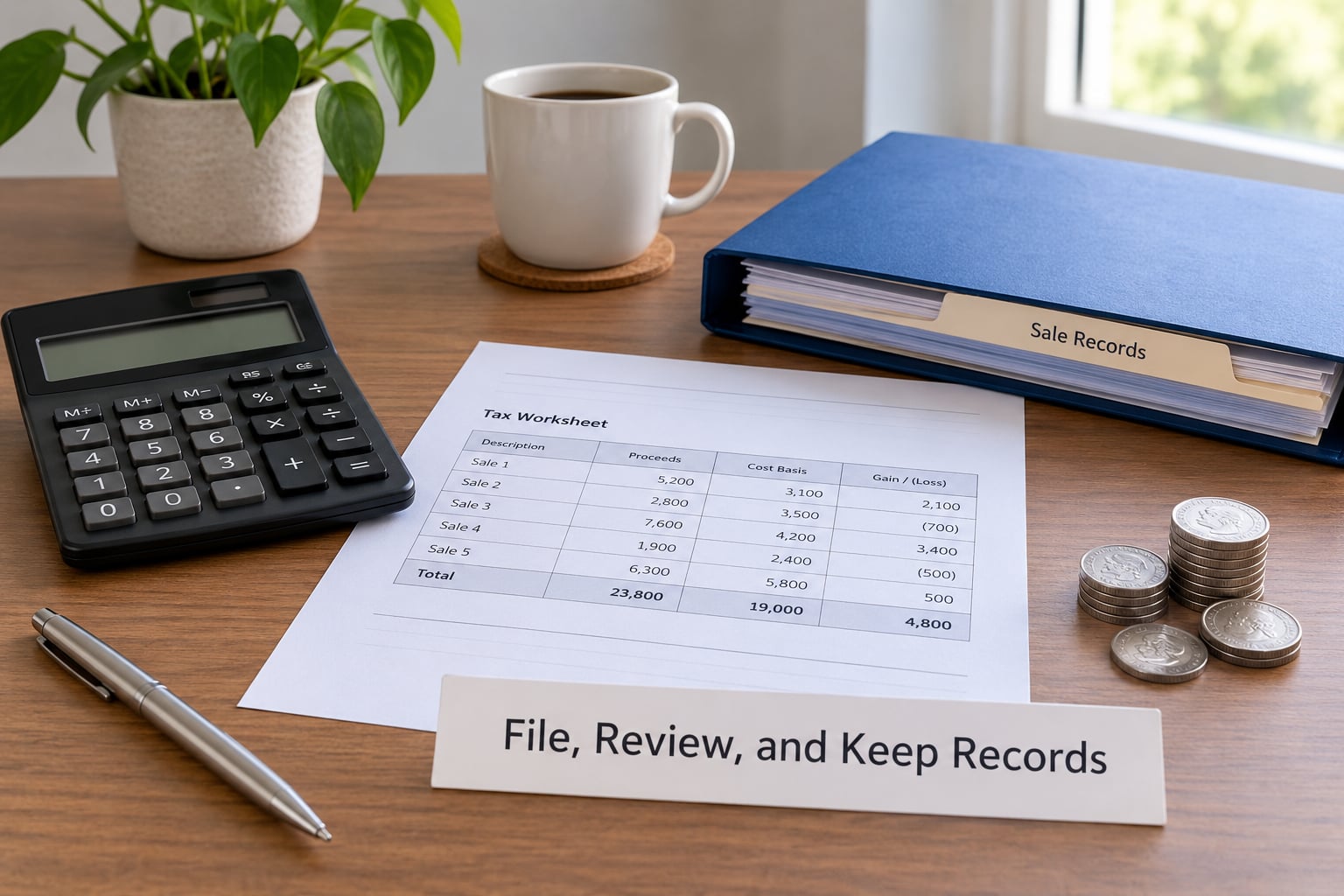
Run a final pass before you submit. Add up the per-sale figures and confirm the total matches the proceeds on your statements. Recheck the arithmetic on the allocation of basis across a partial sale, since that is where errors concentrate.
Then look forward. Carry the basis of any metal you still hold into your records for next year, and carry forward any capital loss you cannot use this year. File your records somewhere durable, not just in an email you will lose.
One last thing to flag clearly: this is general education about a common process, not individualized tax or legal advice. Rates, thresholds and form instructions change, and your facts may not fit the general case. A CPA, enrolled agent or tax attorney can confirm the treatment before you file.
Common Mistakes
Almost every correction that comes back on a precious-metals filing traces back to one of a handful of errors.
- Treating gross proceeds as profit. Fix: subtract basis first, then deduct selling-related charges. The check amount is not your gain.
- Ignoring the premium you paid over metal content. Fix: include the full invoice price as basis, including the premium and inbound shipping.
- Failing to reconcile a Form 1099-B. Fix: compare the reported basis with your documents every year and use Form 8949 adjustments when they differ.
- Switching lot methods when the answer is not flattering. Fix: apply specific identification or FIFO consistently, and be able to show which lots you sold. LIFO and average cost are not available for collectibles.
- Overlooking collectible treatment. Fix: check whether the metal sits in the 28% category rather than assuming ordinary long-term rates.
- Mixing personal sales with trading activity. Fix: keep hobby sales and business sales in separate accounts with separate records. Frequent dealing can make activity a trade or business, which is a different tax regime.
- Failing to carry basis or losses forward. Fix: track remaining basis lot by lot and note any unused capital loss for the following year.
Three habits prevent most of these. File documents by account, then by tax year, then by metal type, so a partial sale is easy to reconstruct. Reconcile your records against the year-end statement the moment it arrives rather than at filing season. And when a piece is ambiguous, write down why you classified it the way you did while the details are fresh.
Frequently Asked Questions
Do I have to pay taxes when I sell physical gold or silver in the United States?
Yes, if the sale produced a gain. The IRS classifies physical gold, silver, platinum and palladium as collectibles, so the gain or loss flows to Form 8949 and then Schedule D on your Form 1040. Short-term gains are taxed at ordinary income rates; long-term collectible gains can reach 28%. A loss is deductible against capital gains, subject to limits. Not reporting is what creates problems, not reporting a modest gain.
What is my cost basis if I no longer have the original purchase receipt?
Start with what survives: the dealer invoice, order confirmation, bank or card statement, or a portfolio tracker entry. Match the date and quantity to the piece you sold, then add allowable acquisition costs such as the dealer premium and inbound shipping. If no document survives, reconstruct the amount as best you can from contemporaneous records and historical metal prices, and document the method. A best-effort reconstruction supported by evidence is far better than a zero basis.
Will my precious-metals sale appear on a Form 1099-B?
Often not. A 1099-B is generally issued for sales through a brokerage account or a reportable dealer transaction, while many private sales and melt-shop transactions produce no form at all. Whether a form arrives and whether you must report are two separate questions. If no form arrives, you still report the gain or loss on Form 8949 using your own records. If a form arrives with basis that looks wrong, report your own figures and explain the difference with an adjustment code.
How is selling a precious-metals ETF taxed differently from selling physical bullion?
An ETF is a security, not a collectible. Sales generate a Form 1099-B, follow the standard holding period rules and sit in the ordinary capital gains sections of Schedule D, where the long-term rate is capped at 20% instead of the 28% collectible ceiling. Your basis in an ETF includes the purchase price plus commissions and fees. Physical bullion generally produces no information return and is tracked through your own records, and it carries the higher collectible rate.
How long should I keep records of precious-metals purchases and sales?
Keep purchase invoices, dealer receipts, trade confirmations and tax forms for at least as long as the period in which the IRS can examine the related return, which is commonly three years and can extend to six when basis is substantially understated. There is no practical reason to destroy the basis record for a piece you still own, since you will need it the day you sell it. Store copies outside a single email account and keep year-end statements permanently.
Conclusion
Start by downloading every statement and invoice you have for the year, then work through the six steps above. Name the instrument, work out net proceeds, allocate your documented basis to the specific pieces you sold, and decide short-term or long-term. If a broker sent a Form 1099-B, reconcile it against your own records and report your figures where they differ, using Form 8949 and Schedule D either way.
None of this changes from year to year, and once your records are organized it takes under an hour. The part worth taking seriously is the classification: what counts as a collectible, how long you held each piece and what basis you can prove. Where a sale is complex or uncertain, take the documents to a qualified tax professional rather than guessing.