Here is the short version of how capital gains tax works on metals in the United States: the IRS treats physical gold, silver, platinum and palladium as collectibles, so profit from a sale is taxed as a short-term gain at your ordinary income rate if you held it a year or less, and as a long-term collectible gain taxed at up to 28% if you held it longer. You owe nothing while you hold the metal. The bill arrives when you sell, trade it, give it away or take it out of an account.
This guide covers the federal rules for the 2026 tax year. Rates, thresholds and the definition of a collectible come from the Internal Revenue Code and the instructions to Form 8949, and they change with each new tax law, so treat the figures as a working reference rather than a promise. State and local taxes sit on top of everything below, and some states tax the purchase instead of the gain.
What I keep coming back to when I walk someone through this is how few moving parts there are, and how many of them people assume wrongly. Four numbers decide almost everything: what you paid, what you received, how long you held it, and what form the metal takes. Get those right and the tax follows mechanically.
Table of Contents
- How Capital Gains Tax Works on Metals: The Basics
- Which Metals Are Taxed Differently?
- What Is the Cost Basis of a Metal Investment?
- Basis when metals change hands through gift or inheritance
- How Does Holding Time Affect the Tax Rate?
- Why Physical Gold and Silver May Be Treated as Collectibles
- What Happens When You Sell Metals?
- How to calculate the capital gain on a gold or silver sale
- A worked example you can copy
- How the IRS finds out about a metal sale
- How Are Mining Stocks, ETFs, and Futures Different?
- How capital gains tax works on metals held in different accounts
- Can You Deduct Losses or Avoid Tax by Selling to Yourself?
- What Records Should You Keep?
- Frequently Asked Questions
- Does capital gains tax apply to collectibles?
- How does the IRS know if I sell silver?
- Is gold exempt from capital gains tax in the US?
- Is there a simple trick for avoiding capital gains tax on silver?
- Can I use a 1031 exchange or a self-directed IRA to defer the tax?
- What happens to cost basis and holding period when metals are inherited?
- Conclusion: Start With the Form of the Investment
How Capital Gains Tax Works on Metals: The Basics
Capital gains tax is the tax on profit from selling an asset that rose in value. The IRS treats gold, silver, platinum and palladium, and coins made from them, as capital assets, and it specifically classifies most of them as collectibles under Section 408(m) of the Internal Revenue Code.
That collectible label is the whole ballgame. It does not change what you own, and it does not create a tax every year. It only changes the maximum rate applied to a long-term gain. Holding is not a taxable event, so a stack of silver that doubled in value owes nothing until you do something with it.
Three terms carry the rest of the rules. Proceeds is what you received, including the fair market value of anything you took in trade. Cost basis is what you paid, plus certain related costs. Holding period is how long you owned it, measured from the day after you acquired it through the day you disposed of it.
Which Metals Are Taxed Differently?
Not every “metal investment” gets the same treatment, and the difference is usually bigger than people expect. A gold bar, a gold ETF and a gold mining share can all pay you on the same gold price, then land on completely different tax brackets.
| Form of the investment | How the IRS classifies it | Long-term gain | Short-term gain |
|---|---|---|---|
| Physical bullion bars and rounds | Collectible | Up to 28% | Your ordinary income rate, up to 37% |
| Precious metal coins, including numismatic issues | Collectible, with narrow exceptions for small transactions | Up to 28% | Your ordinary income rate |
| Precious metal ETFs | Collectible, because the fund is usually a grantor trust that buys metal directly | Up to 28% | Your ordinary income rate |
| Mining company shares | Ordinary capital asset | 0%, 15% or 20% by taxable income | Your ordinary income rate |
| Metal futures and options | Section 1256 contracts | 60% of the gain taxed as long-term, 40% as short-term | 60/40 applies regardless of how long you held |
| Metal held in a traditional IRA | Tax-deferred, no tax until distribution | Ordinary income at your rate on the full amount | Same rule, plus early-withdrawal penalties if under 59 and a half |
One more nuance surprises people. Since sales occurring after August 19, 2023, a transaction involving a quantity of precious metal with a fair market value of 2.5 troy ounces of gold or less, or 25 troy ounces of silver or less, falls outside the collectible definition. Coins with a fair market value of 1,000 USD or less per coin are also excluded. A single large bar sold in one transaction still qualifies as a collectible.
What Is the Cost Basis of a Metal Investment?
Cost basis is the number your gain starts from, and it is usually not the sticker price. Here is what the IRS lets you include:
- Purchase price of the metal itself, including any dealer premium over spot.
- Commissions and fees you paid to buy, and shipping if the dealer charged it separately.
- State and local sales tax you paid at the time of purchase. This is capitalised into basis, which is why buying in a no-sales-tax state starts you ahead.
- Conservation and restoration costs that add to the value of a collectible coin, such as professional grading and cleaning that would damage it.
- Acquisition costs in an inheritance, which can include a probate or estate cost and an estate tax triggered by the value at death.
What you cannot add is storage, insurance, home security, or the annual value of your own labour. Those are real costs, but the IRS treats them as personal expenses with no basis effect, which is a genuine gap for anyone holding metal in a safe deposit box.
Basis when metals change hands through gift or inheritance
Gift and inheritance are the two cases where basis behaves differently. A gift of metal has a carryover basis. The recipient uses the donor’s original cost basis, and the holding period tacks: the recipient adds the donor’s time to their own. So a coin bought five years ago and given to a child in January is a long-term hold for that child in June.
Metal received by inheritance usually gets a stepped-up basis. The basis is generally the fair market value at the date of death, or the value on the date the property is received, and the holding period starts fresh on that date. For a large inherited stack, this difference can be the difference between paying tax on the whole increase and paying almost nothing.
Basis gets murkier with older hobby holdings bought piecemeal from several dealers, and with coin rolls. For a roll of silver coins, basis is what you paid for the roll as a whole. Individual coins inherited by the same owner from the same source are treated as one item, and identifying which specific coin within a roll you sold is your call, so record the purchase price of the roll and divide it only if you are meticulous about which coin went out the door.
How Does Holding Time Affect the Tax Rate?
Hold a collectible more than one year and the gain is long-term. Hold it one year or less and it is short-term, taxed at your ordinary income rate, which tops out at 37%. That single year is the most useful lever most investors have, because it is free, legal and costs nothing but time.
The clock is not complicated. For a simple purchase, the holding period starts the day after you buy and ends on the day you sell, trade or give it away. More than one year means long-term; exactly one year means short-term.
The part that confuses people is the misconception that holding past one year automatically lowers the rate. For most assets, long-term gains are taxed at 0%, 15% or 20% depending on taxable income and filing status. Collectibles are outside that table. Once you clear the one-year mark, the collectible long-term rate applies, which tops out at 28%, and in practice most filers land at 15%. Waiting helps enormously for short-term filers and barely at all for someone already in the top bracket.
Adding to a position does not restart the clock on the coins you already own. Those stay on their original holding period. Only the newly acquired units start a fresh day-one clock.
Why Physical Gold and Silver May Be Treated as Collectibles
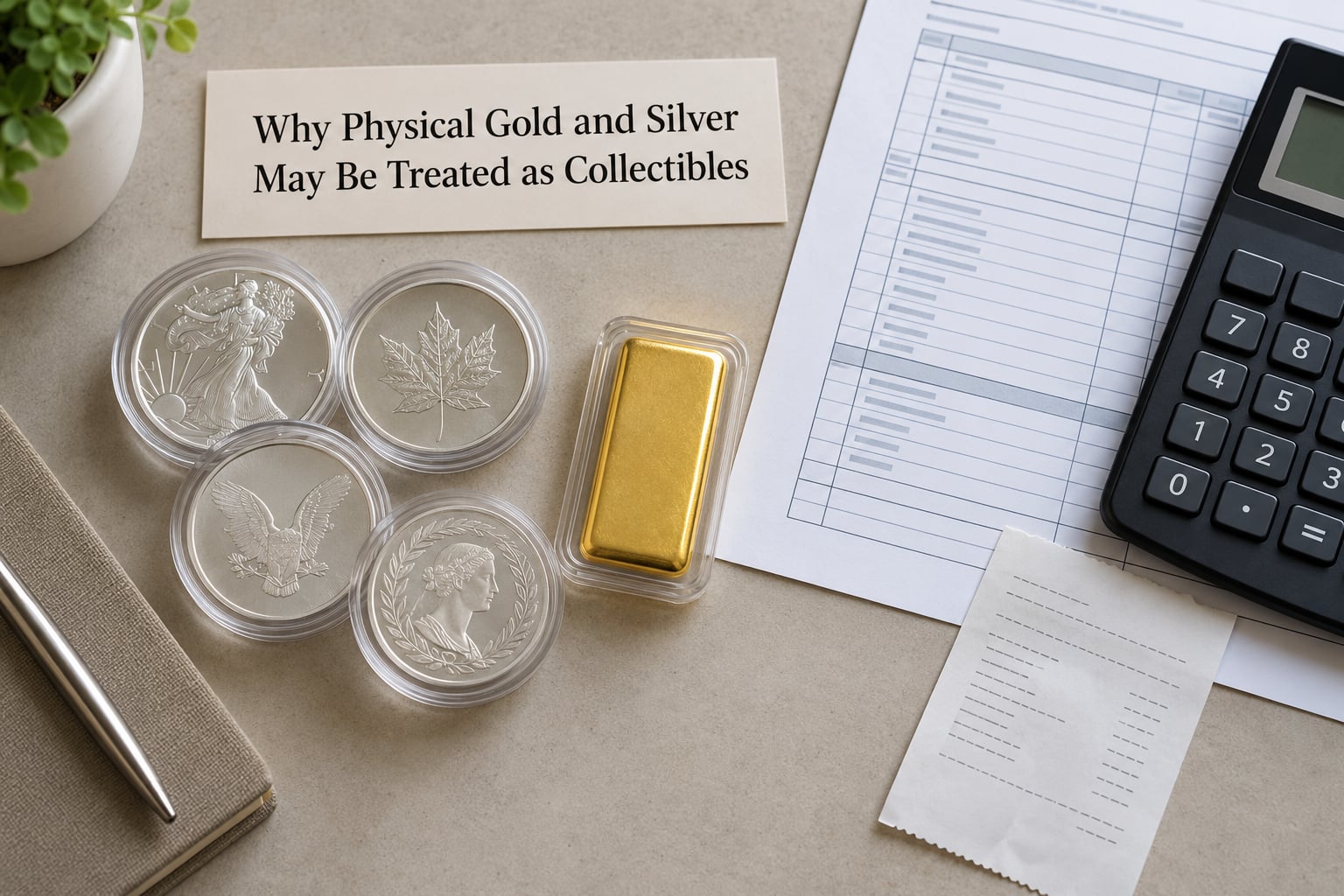
The reason metals sit in the 28% bucket is legislative, not financial. Congress carved collectibles out of the lower long-term rate structure when it created the category in the 1980s, reasoning that art, antiques and precious metals were not securities and were already exposed to a market risk that stocks were not.
Two things follow. First, the 28% is a ceiling, not a rate you pay. A single filer with a 40,000 USD long-term collectible gain in a year would actually pay a 15% federal rate on it, not 28%. Only gains that push taxable income far into the top brackets reach the maximum, and the true rate is whatever your bracket puts you in after the gain is stacked on your other income.
Second, the collectible label attaches to the metal, not to your intent. A silver round bought as a hedge and a rare-date coin bought for enjoyment are taxed the same way. The number of coins alone does not flip an item into numismatic collectible territory, either; for coins, the relevant test is whether they are of a type that ordinarily sells for more than the bullion value.
Add the 3.8% net investment income tax on top if your modified adjusted gross income exceeds the threshold, which for most filers is 200,000 USD, joint or 125,000 USD, single. That surtax applies to the gain on its own, inside the same brackets, and it applies whatever vehicle the metal sits in.
What Happens When You Sell Metals?
Four steps cover almost every metal sale, and you can do them in a few minutes once you have your paperwork. The order matters only in that each step feeds the next.
How to calculate the capital gain on a gold or silver sale
Step 1. Establish your cost basis. Total what you paid for the specific units being sold, including the dealer premium, commissions and state sales tax. If you have lost the invoice, use your best evidence: bank or card statements, dealer emails, an old appraisal. A reconstructed basis is acceptable, but write down how you arrived at it.
Step 2. Add up your proceeds. This is everything you received for the sale. Selling a coin for 1,500 USD after paying 100 USD in state sales tax gives you a basis of 1,100 USD, not 1,000 USD.
Step 3. Work out the gain or loss. Subtract basis from proceeds. A result above zero is a gain taxed at your rate; below zero is a capital loss you can use against other gains.
Step 4. Pick the rate from the holding period. One year or less means your ordinary income rate. More than one year means the 0%, 15% or 20% long-term table, except for collectibles, where the maximum is 28% instead. Then add the 3.8% surtax if your income clears that threshold.
A worked example you can copy
| Step | Figures | Result |
|---|---|---|
| Purchase: 30 one-ounce silver Eagles at 1,850 USD per coin | 1,850 USD x 30 = 55,500 USD | Purchase price 55,500 USD |
| State sales tax paid at 7% | 55,500 USD x 0.07 = 3,885 USD | Capitalised into basis 3,885 USD |
| Cost basis | 55,500 + 3,885 | 59,385 USD |
| Sale 18 months later at 2,400 USD per coin | 2,400 USD x 30 = 72,000 USD | Proceeds 72,000 USD |
| Gain | 72,000 – 59,385 | 12,615 USD |
| Long-term collectible gain at 15% | 12,615 USD x 0.15 | 1,892.25 USD federal |
| Same gain at the 28% maximum | 12,615 USD x 0.28 | 3,532.20 USD federal |
The gap between those last two rows is the single most misunderstood point in this whole subject. The 28% headline is not what most people pay. Your real rate depends on your total taxable income, and the right way to think about it is to add the gain to your other income and read off the bracket.
How the IRS finds out about a metal sale
This is the question that generates the most anxiety on the bullion forums, and the answer has three parts. Whether you sold for cash makes no difference to your obligation to report; it only changes who files paperwork for you.
- Your dealer or broker files Form 1099-B when gross proceeds from a sale of collectibles exceed 600 USD in nominal value. You get a copy showing proceeds, cost basis and whether the holding period was long or short.
- Cash sales are reported on Form 1099-MISC, box 3A for gross proceeds and box 3B for federal income tax withheld, again from 600 USD of nominal value upward. Note that 600 USD of nominal silver value is well under one ounce today, which is why almost every transaction of any size triggers a form.
- You report the sale yourself when no form arrives, or when a form is incomplete or wrong. Under-reporting a sale that a dealer reported is a mismatch the IRS systems will find, and under-reporting one that was never reported is still a problem if anything else connects it to your return.
Reporting runs through Form 8949, which lists each sale with its description, dates, proceeds, basis, adjustment and the long or short box. Totals flow to Schedule D on Form 1040, where collectible gains get their own line. The gain is reported in the tax year of the sale, not the year you bought. If a form reports basis as zero and you know the real figure, report your number and keep the evidence.
r/Silverbugs regulars are blunt about the cash question: on the threads about holding metal at home, the consensus advice is that the duty to report does not depend on how you were paid. The community view on r/tax, put more cleanly than most published summaries manage, is that tax on precious metals is at the 28% capital gains rate if held more than a year and at your ordinary rate if held less than a year. What the forms change is whether the IRS already has your number.
How Are Mining Stocks, ETFs, and Futures Different?
Ordinary securities, which includes mining company shares, do not receive collectible treatment. Their long-term gains are taxed at 0%, 15% or 20% by taxable income and filing status, so the maximum is 20% instead of 28%. That eight-point gap is why plenty of investors who want gold exposure hold the shares rather than the metal.
How capital gains tax works on metals held in different accounts
Precious metal ETFs usually sit in the collectible bucket. The structural reason is that most are grantor trusts holding physical bullion, so the trust itself takes collectible treatment and passes it through to shareholders. That is worth checking for any specific fund, because the structure is not universal across the category.
Futures are different again. Contracts traded on regulated futures exchanges and certain options fall under Section 1256, where 60% of the gain is treated as long-term and 40% as short-term no matter how long you held the position. The long-term portion still uses the collectible ceiling.
Inside a traditional IRA or 401(k), nothing is taxed while the metal sits in the account. Withdrawals are taxed as ordinary income at your current rate, not as a capital gain, which makes the deferral valuable when you are in a low tax bracket on withdrawal but expensive if you are not. Self-directed IRAs allow certain bullion and coins, generally meeting purity standards such as 99.5% for gold and 99.9% for silver, with specific approved issues, and the metal is usually held by a trustee. Plan for required minimum distributions starting at 73, because selling metal on schedule can create a large taxable event in a year you did not choose.
Can You Deduct Losses or Avoid Tax by Selling to Yourself?
You can offset gains with losses, but the rules on metal are unusual in one specific way: the wash sale rule does not apply to collectibles. Section 1091 lets you defer a loss on a stock by buying a similar stock within 30 days before or after. No such deferral exists for a coin, so a loss on metal is generally real and usable, though you have to follow through on the sale.
Capital losses from metal net against capital gains first. If losses exceed gains, up to 3,000 USD of the remainder can offset ordinary income each year, and the rest carries forward indefinitely until used. One long-coin collector told the forum that switching from numismatics to bullion mid-collection cost him a large deduction he could not use in the year it happened, and had to carry the balance forward. That is the classic trap.
Now the popular “tricks,” none of which work:
- Selling metal to yourself, a spouse, or a family member. Related-party sales are legitimate when the price is fair and the transaction is real, but they do not erase tax. The gain is still recognised by the seller, and the IRS has looked back at related-party sales made at a loss to generate a deduction and disallow it under the substance-over-form rule. A family member who reports a 30,000 USD loss on a gift of metal has created a problem, not a saving.
- Trading one metal for another. Swapping silver for gold with no cash is a taxable disposition. The silver you surrendered was sold for the fair market value of the gold you received, in a self-directed IRA the same rule applies. The r/Silverbugs threads on bar-for-bar trades come back to this every time: holders treat a metal-for-metal swap as a taxable event, and they are right.
- Gifting to an adult child. A gift tax return and reporting may be required depending on the value, and the child still gets a carryover basis, so nothing is escaped.
- Rolling a gain into a like-kind exchange. Section 1031 has been limited to real property since 2018, so gold into silver is not like-kind. The gain is deferred by nobody.
There is no shortcut here. The genuine strategies are unglamorous: hold past one year, use losses, keep state sales tax out of basis, and pick the vehicle that matches the rate you will face.
What Records Should You Keep?
Basis problems are the reason people get into trouble with metal, because the purchase tends to happen years before the sale and in cash. A simple folder per lot is enough.
- The purchase invoice with date, quantity, product description, unit price, total, and the dealer name. A phone photo of the receipt is fine, keep it somewhere that survives a phone replacement.
- Bank or card statements from the purchase date, which prove payment even when the invoice is gone.
- State sales tax paid on that purchase, itemised.
- Grading certificates for coins you had professionally authenticated, including the submission and return dates, plus any conservation cost. The invoice value of the service matters to basis if it improved the coin.
- Sale confirmation showing date, gross proceeds, the exact units sold, and any commission withheld.
- Storage and insurance records. Useful for your own records, and not for basis. Keeping them anyway costs nothing and helps if you ever need to argue the value of a coin you stored properly.
- A note on the holding period for each lot, since coins bought in a single order but sold across several dates need each date tracked.
One clarification that comes up more than any other: there is no federal limit on how much gold or silver you may legally keep in your home, and no requirement to register it or report the purchase. The reporting obligation is triggered by a sale, not by ownership, though a large movement of metal across state lines by commercial quantity is a separate matter under state law rather than tax law.
Frequently Asked Questions
Does capital gains tax apply to collectibles?
Yes. The IRS classifies gold, silver, platinum and palladium, and coins made from them, as collectibles. A gain on a sale held one year or less is short-term and taxed at your ordinary income rate, up to 37%. A gain held more than one year is long-term and taxed at a maximum of 28%, though most filers actually pay 15%. Holding the metal itself is not a taxable event; selling, trading or gifting it is.
How does the IRS know if I sell silver?
Three ways. Your dealer files Form 1099-B when a collectible sale exceeds 600 USD of gross proceeds in nominal value, and Form 1099-MISC for cash sales. If no form is issued, you report the transaction yourself on Form 8949 with the proceeds, your cost basis and the long or short box, then total it on Schedule D. Paying cash does not remove your obligation to report, and it only changes whether the IRS already has your number.
Is gold exempt from capital gains tax in the US?
No. There is no exemption for precious metals in federal law. Since sales occurring after August 19, 2023, a transaction with a fair market value of 2.5 troy ounces of gold or less, or 25 troy ounces of silver or less, falls outside the collectible definition and is taxed at the ordinary long-term rates. Coins of 1,000 USD or less per coin are also excluded. Anything larger is fully taxable, and 28% is the long-term ceiling.
Is there a simple trick for avoiding capital gains tax on silver?
No trick exists, and the ones circulating online are either illegal or counterproductive. The legitimate levers are holding more than one year, realising capital losses elsewhere to offset the gain, keeping state sales tax out of your basis, and choosing a vehicle taxed at lower rates. A like-kind exchange does not apply, since Section 1031 is limited to real property. Trading one metal for another is a taxable disposition at the fair value received.
Can I use a 1031 exchange or a self-directed IRA to defer the tax?
Like-kind exchanges under Section 1031 have been limited to real property since 2018, so gold into silver is not tax-deferred. A self-directed IRA is different: bullion and certain approved coins can be held inside one, and nothing is taxed while the metal stays in the account. Distributions are taxed as ordinary income rather than capital gain. Required minimum distributions starting at age 73 can force a sale in a year you did not plan.
What happens to cost basis and holding period when metals are inherited?
Metal received by inheritance usually gets a stepped-up basis set at the fair market value on the date of death, or the date it is received, and the holding period starts fresh on that date. A gift is different: the recipient uses the donor’s carryover basis and the holding period tacks, so the recipient’s clock starts where the donor’s stopped. Get a qualified appraisal for higher-value collections, and keep estate records and probate costs, which can add to basis.
Conclusion: Start With the Form of the Investment
The first thing to do is name the form of what you hold: physical bullion, a collectible coin, a metal ETF, a mining share, a futures contract, or metal inside an IRA. That one answer sets your maximum rate, your holding period rule and your reporting form. Then find the cost basis and the acquisition date for each lot, and run the four-step calculation before you sell, not after. When the numbers are large or the paperwork is thin, a CPA or enrolled agent can usually do more for you than any strategy in this article.