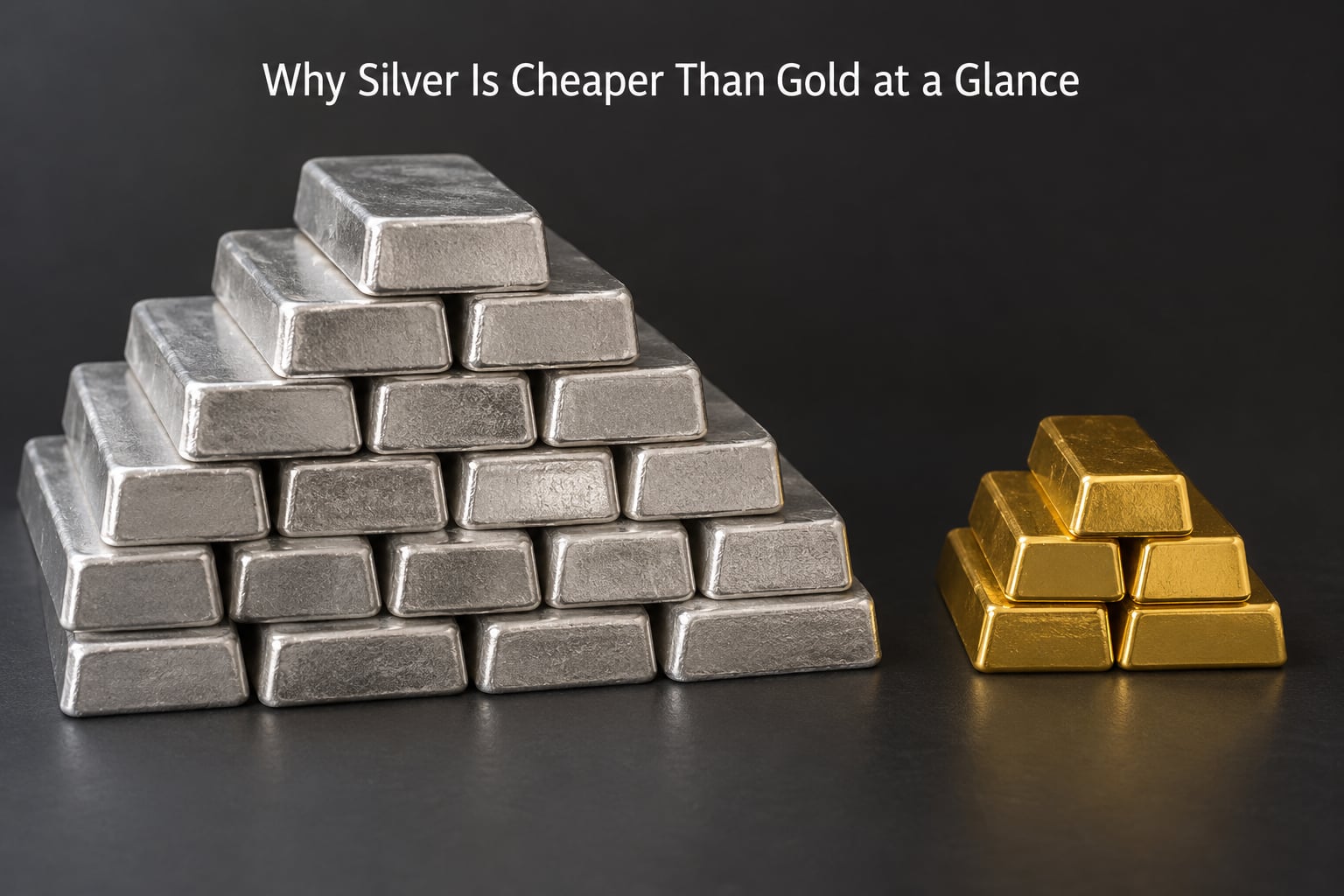
Silver trades well below gold for four connected reasons: it is roughly 19 times more common in the Earth’s crust, most of it is recovered as a by-product of copper, lead and zinc mining rather than mined for itself, more than half of its demand comes from industry, and it trades in a much smaller market than gold. Price follows what buyers compete hardest for, and silver has never had to compete with central banks for its metal.
That is the short version. Why silver is cheaper than gold comes down to supply, demand, market structure and monetary role, and this guide breaks the gap into the pieces that actually move it, from the gram of silver sitting in a solar panel to the vaults in Fort Knox, finishing with what the gold-to-silver ratio is really telling you.
Table of Contents
- Why Silver Is Cheaper Than Gold at a Glance
- Which metal is scarcer?
- Why Silver Is Cheaper Than Gold: Supply and Rarity
- Why is silver worth less per ounce?
- How does silver’s industrial demand affect its price?
- Why do investors value gold more than silver?
- How do liquidity and market size affect the gold-silver price ratio?
- Does silver’s lower price mean it is better value?
- Which Should You Choose?
- Frequently Asked Questions
- Is silver cheaper than gold because it is less valuable?
- Why is silver priced per ounce when gold is also priced per ounce?
- What determines the gold-to-silver price ratio?
- Can industrial demand make silver more valuable than gold?
- Should I buy silver simply because it is cheaper than gold?
- The Bottom Line
Why Silver Is Cheaper Than Gold at a Glance
| Factor | Gold | Silver |
|---|---|---|
| Price per troy ounce | The benchmark; many multiples of silver | A fraction of the gold price, tracked by the gold-to-silver ratio |
| Crustal abundance | Roughly 0.004 parts per million | Roughly 0.075 parts per million, about 19 times more |
| Mining character | Mostly primary gold mines chasing the metal itself | Roughly 28% comes from primary silver mines; most is a by-product |
| Primary demand | Investment, jewellery and central bank reserves | Industrial use exceeds half of total consumption |
| Investment character | Monetary metal and portfolio ballast | Hybrid metal with a large industrial component |
| Market size and liquidity | Deep global trading, tight bid-ask spreads, futures participation across many venues | Much smaller, thinner, wider spreads, more sensitivity to order flow |
| Common forms | Bars, coins, allocated accounts, ETFs and futures | Rounds, bars, coins, ETFs and futures |
Read that table and the answer becomes obvious. Gold is scarce, mainly self-mined, and overwhelmingly demanded as money and as wealth that does not rust or tarnish. Silver is more common, mostly a by-product, and demanded as money, as jewellery, and as a raw material.
The verdict: the price gap is not a market inefficiency or a pricing mistake. It is the sum of four differences — supply, demand, market structure and monetary role.
Which metal is scarcer?
Gold. In the outer crust of the Earth, gold averages about 0.004 parts per million while silver averages about 0.075 parts per million. Silver is roughly nineteen times more abundant than gold on that measure, and gold is also far more concentrated in deposits worth mining.
There is a wrinkle worth understanding, because it explains something people find confusing. Almost no silver is found as a pure silver vein. Silver shows up mixed with lead, zinc, copper and gold in ores, and it is separated during the processing of those base metals. So silver is geologically more common, yet recovering a clean ounce of it is not necessarily cheaper per unit of effort than recovering gold.
Why Silver Is Cheaper Than Gold: Supply and Rarity
This is why the supply side matters so much. When a metal is mined mainly as a by-product, its output is decided by decisions made for other reasons. A copper mine that happens to carry silver will produce silver whether or not silver is valuable. Producers cannot meaningfully slow that output to prop up the silver price, because the decision to expand the copper mine does not turn on the silver price at all.
Gold does not work that way. A gold mine is a gold mine, so gold supply responds to the gold price. When the gold price climbs, more gold projects get funded, and the eventual response arrives with a multi-year delay.
Annual production tells the same story. Global mine supply of gold runs in the low hundreds of millions of ounces a year. Silver is larger in comparison, and roughly seven-tenths of it arrives as a by-product of base-metal mining.
Abundance alone never sets a price. Two abundant metals can trade very differently depending on demand. But scarcity sets the ceiling on how cheap a metal can be relative to a far scarcer one, and silver has never had a chance to close that distance on supply alone.
Why is silver worth less per ounce?
Both metals are quoted per troy ounce, which is 31.1035 grams, or about 1.097 avoirdupois ounces. The unit is identical. The prices are not, and why silver is cheaper than gold is a supply-and-demand story, not a quirk of the unit that happens to measure it.
Converting the difference into everyday terms makes it easier to picture. Gold at any given price weighs the same as silver at the same quoted price, so the value of a gold coin that looks small on a scale is many multiples of the value of a silver coin of similar size. A troy ounce of gold carries roughly the same metal mass as a troy ounce of silver, yet the dollar value attached to that mass can be many times greater.
Per pound, per kilogram and per gram the gap persists in the same proportion, because the conversion factors are fixed. Only the denominator changes. That is why investors compare the two metals by weight but by ratio, never by expectation that a silver bar will one day match a gold bar ounce for ounce without a change in their relative value.
Consider it this way. Gold at a given quote is expensive because people bid aggressively for every gram available. Silver at its own quote is cheap for the same weight simply because fewer people bid for those grams. The unit does not create the difference, it just measures it.
One more mechanical point: silver has an industrial afterlife that gold does not. A silver contact that gets destroyed in a switch is gone from the investment market. That constant slow drain from the investor pool to the factory floor is part of why the monetary premium on gold stays wider.
How does silver’s industrial demand affect its price?
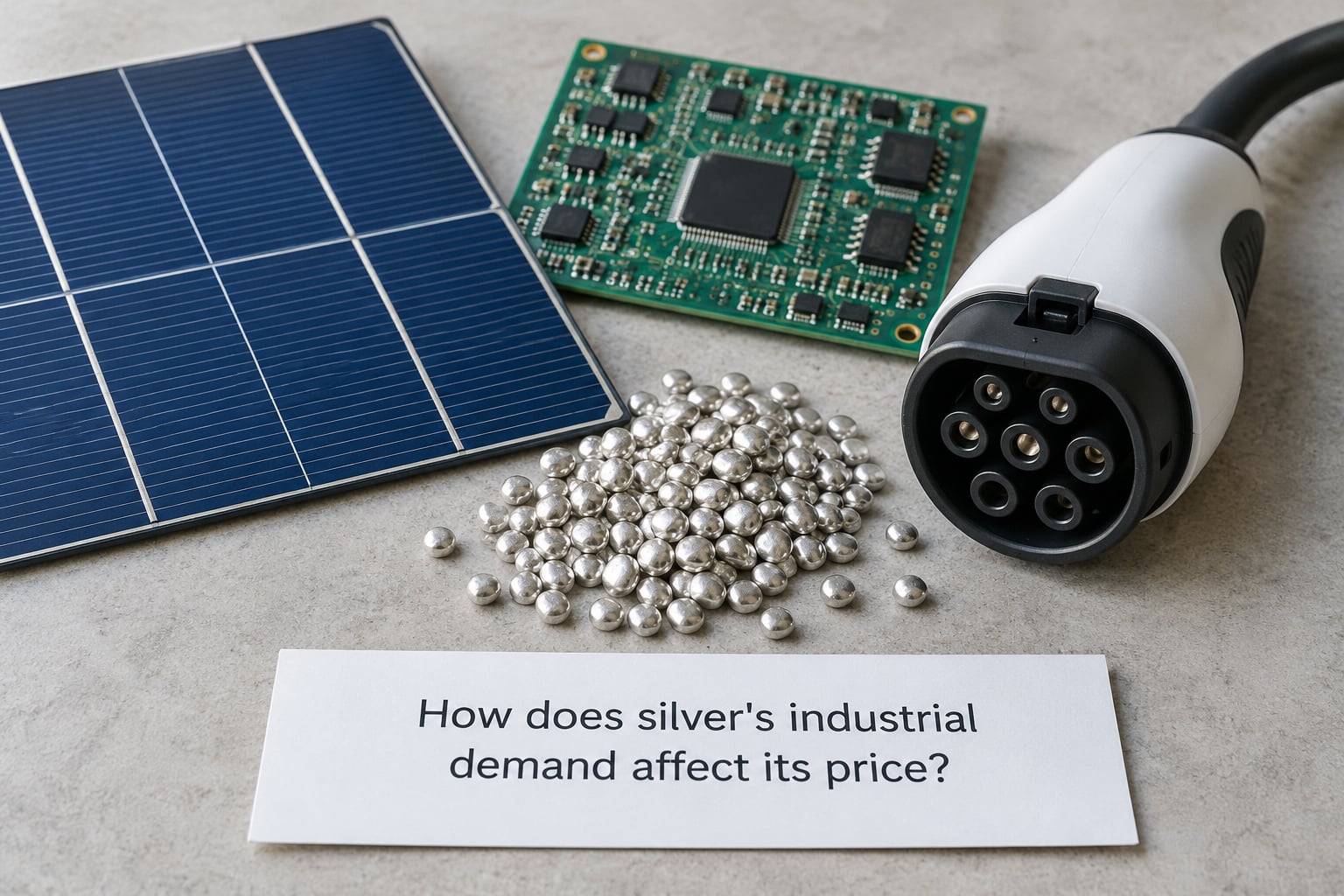
Silver is the most conductive metal there is. Nothing else carries electricity as well, and in electronics that matters more than price. Contact switches, solders, conductive inks and printed circuit patterns all rely on it, and so do solar cells, where a thin silver paste coats each wafer.
Industrial demand accounts for more than half of total silver consumption, which is the single biggest structural difference from gold. Gold has industrial uses too, but they are small enough that most of gold’s demand is about money, jewellery and reserves. For silver, the factory is the customer of record.
That cuts both ways, and it is the part most glossed-over summaries miss. Industrial demand gives silver a floor when investment demand is absent, because the metal is consumed whether or not anyone is buying coins. But it also caps the upside that investors assign to it. When demand rises, a fabricator can often substitute copper, aluminium or a cheaper silver paste mix before the price moves very far.
Demand drivers here are not speculative. Photovoltaic installations add steady tonnage, as does every electric vehicle, each power inverter and a growing pile of power electronics. Add grid equipment, data-centre hardware, vehicle electronics, medical devices, water treatment, mirrors and silver brazing, and the industrial picture broadens considerably. Recycling and recovered silver from industrial scrap and jewellery also returns a meaningful slice of supply each year, which the investor side of the market often ignores.
The result is a metal with two different jobs and one shared price. When investor demand is strong and the industrial cycle is calm, silver behaves like gold with extra steps. When the industrial cycle turns with the economy, silver carries that cycle straight into a portfolio that may not have been built for it.
Why do investors value gold more than silver?
History wrote that premium over several centuries. Gold became the monetary metal of the classical world, carried across the Roman Empire, re-adopted in post-medieval Europe, formalised in the gold standard, and retained after that standard collapsed in the nineteen-seventies. Silver has a long monetary record too, including the silver standard debates and bimetallism in the United States, but it lost that contest.
Central bank behaviour is the sharpest illustration. Major central banks hold gold as a reserve asset and report their holdings publicly. They do not hold silver in reserve in any meaningful quantity. Reserve demand is one of the steadiest sources of gold buying, and silver simply does not participate in it. Gold-to-silver ratio watchers often point out that when central bank buying is strong, the ratio tends to widen rather than narrow.
Cultural recognition matters more than most models admit. Gold has been the default expression of stored value for so long that it needs no explanation. A gift, an engagement ring, a wedding band, a savings bar, a sovereign balance sheet: all of them default to gold. Silver carries associations with industry, photography, electronics and jewellery, which is a fine reputation but not the same one.
Physical behaviour reinforces the difference. Silver tarnishes, is softer, is less dense so it takes more volume to hold the same value, and is more easily scratched. None of that is a big deal in a vault, but it matters for jewellery and for storage efficiency.
None of this means gold is risk-free or guaranteed to hold its value. What it means is that gold has more buyers who want it for monetary reasons, and those buyers tend to buy when other things go wrong. Do the arithmetic on a stable monetary premium, and you get most of the distance between the two quotes.
How do liquidity and market size affect the gold-silver price ratio?
The gold-to-silver ratio is simply how many ounces of silver equal one ounce of gold. Its long-run average sits near 47 to 1, and in recent years it has traded well above 100, meaning silver has looked unusually cheap against its own history.
Market size is the main reason the two quotes behave so differently day to day. Gold trades on a far larger volume across more venues, with tighter spreads and constant two-way liquidity. Silver trades a fraction of that volume. In a thinner market, the same order moves the price further, which shows up as volatility two to three times gold’s.
Futures and options participation amplifies the effect. Silver has open interest and options, so leveraged positions can pull silver to the move rather than sit inside its value range. In a squeeze narrative, a thin market moves fast in both directions, and silver’s smaller size means moves of that size are entirely ordinary.
Dealer availability tracks the same pattern. Larger dealers quote gold in near-continuous markets, while silver coins and smaller silver products carry higher premiums over spot and wider buyback spreads. On forums like r/Silverbugs and thesilverforum.com, people weigh gold for stability and silver for upside, and the recurring complaint is that silver underperforms during gold-led bull markets. That is the smaller, more industrial, more speculative market showing through.
The practical consequence for readers: silver quotes move more per dollar of flow, and the gap between what you pay and what a dealer pays you to sell is wider in percentage terms. Spreads eat returns quietly, and they eat them faster in silver than in gold.
Does silver’s lower price mean it is better value?
No, and the reasoning matters. A high ratio means silver is cheap relative to gold on a ratio basis, not that it is mispriced or that it must catch up. A ratio of 100 to 1 says nothing about where either metal goes next. It has been far higher and far lower across different eras.
Value and affordability are different questions. Silver is more affordable per ounce of metal. Whether that is value depends on what you are trying to own: monetary exposure, portfolio ballast, industrial leverage to electrification, or exposure to a small market that can move violently in either direction.
Costs also matter more in silver. Storing the same dollar value of silver takes noticeably more volume than gold, so vaulting runs roughly 50 percent more per dollar of metal. The dealer spread is wider in percentage terms. Physical silver is taxed as a collectible in the United States, which has pulled the long-term rate down from the ordinary capital-gains rate, currently 28 percent federally, and that hits returns over a long hold. In a metals IRA, only specific approved products qualify, and that limits your choices compared with gold.
The honest summary is this. Silver carries more risk per unit of money committed: higher volatility, wider spreads, higher storage cost, worse tax treatment, and a price that responds to the industrial cycle. In exchange, a smaller percentage move in the gold price produces a larger percentage move in silver, which cuts both directions.
Which Should You Choose?
Pick the metal that matches the job you want the money to do.
Gold suits someone who wants monetary exposure and portfolio ballast, who wants a metal with no major industrial cycle attached to it, and who wants the deepest liquidity and the tightest spreads when buying and selling. Gold is the better fit for the part of your portfolio meant to be boring.
Silver suits someone who wants precious-metal exposure at a lower dollar cost, who deliberately wants a position tied to solar, electronics, electric vehicles and grid build-out, and who can tolerate moves that would feel wrong in a gold allocation. Silver is also the metal most retail buyers reach for when the gold quote feels out of reach, which is exactly why it carries industrial and volatility exposure they may not have priced in.
Both suit someone building deliberate diversification. A common approach is a larger gold weighting with a smaller silver weighting, sized so that the more volatile metal cannot dominate portfolio-level swings. Plenty of long-horizon holders do the reverse and size silver off the gold ratio, buying when the ratio is unusually wide and trimming when it compresses.
On process rather than picking the winner. If you buy physical, government-minted coins are easier to resell than rounds, the two-way market matters more than the headline premium, and storage arrangements should be decided before the purchase. If you buy through funds, you accept counterparty risk in exchange for liquidity, and you pay an ongoing expense. Many buyers split purchases over time rather than committing on one day, which is what forum regulars describe as dollar-cost averaging and what most long-horizon buyers end up doing by habit.
None of this is personalised advice, and none of it comes with a return attached. Position size for the volatility you can actually live with, not for the outcome you hope for.
Frequently Asked Questions
Is silver cheaper than gold because it is less valuable?
Value and price are related but not identical. Silver is cheaper mainly because supply is more abundant and more elastic, because most of it arrives as a by-product of copper, lead and zinc mining, and because its largest source of demand is industrial rather than monetary. Gold is rarer, mostly mined as a primary metal, and demanded by central banks and investors as a reserve asset. Lower price per ounce reflects those differences, not a verdict on worth.
Why is silver priced per ounce when gold is also priced per ounce?
Both metals are quoted in troy ounces, which is 31.1035 grams, because precious metals have always been traded by weight. The shared unit just means the two quotes are directly comparable. It does not imply that one ounce of silver should be worth the same as one ounce of gold. When you convert to grams, pounds or kilograms, the ratio between the metals stays the same, since only the unit of measurement changes.
What determines the gold-to-silver price ratio?
The ratio is how many ounces of silver equal one ounce of gold. It moves with silver’s industrial cycle, investor flows, central bank gold buying, mine supply, and how thin the silver market is on the day. Its long-run average sits near 47 to 1, while recent years have seen it trade well above 100. A high ratio means silver is cheap relative to gold, not that it must catch up.
Can industrial demand make silver more valuable than gold?
In practice, extremely unlikely. Industrial demand gives silver a reliable floor and can trigger sharp rallies, as past surges in photovoltaic and electronics demand have shown. But that same demand caps the upside, because fabricators can substitute copper, aluminium or lower-silver mixes once prices rise. Central banks hold gold rather than silver, gold has a far deeper market, and no modern monetary authority treats silver as reserve metal.
Should I buy silver simply because it is cheaper than gold?
Cheaper per ounce is affordability, not value. Silver carries wider dealer spreads, roughly 50 percent more storage cost per dollar of metal, worse US collectibles tax treatment, and volatility commonly two to three times gold’s. Decide what you want the position to do first, then size it so the swings stay manageable, and check dealer premiums and storage arrangements before buying rather than after.
The Bottom Line
Silver sits below gold for four reasons that reinforce each other: it is about nineteen times more abundant in the crust, roughly seven-tenths of it is a by-product of base-metal mining, more than half of its demand is industrial, and it trades in a market far too small and thin to carry gold’s monetary premium.
Two figures tell you where things stand: the flow of silver into industry versus investment, and the gold-to-silver ratio. Watch both, size any position for silver’s wider swings, and treat affordability as a starting question rather than an answer.