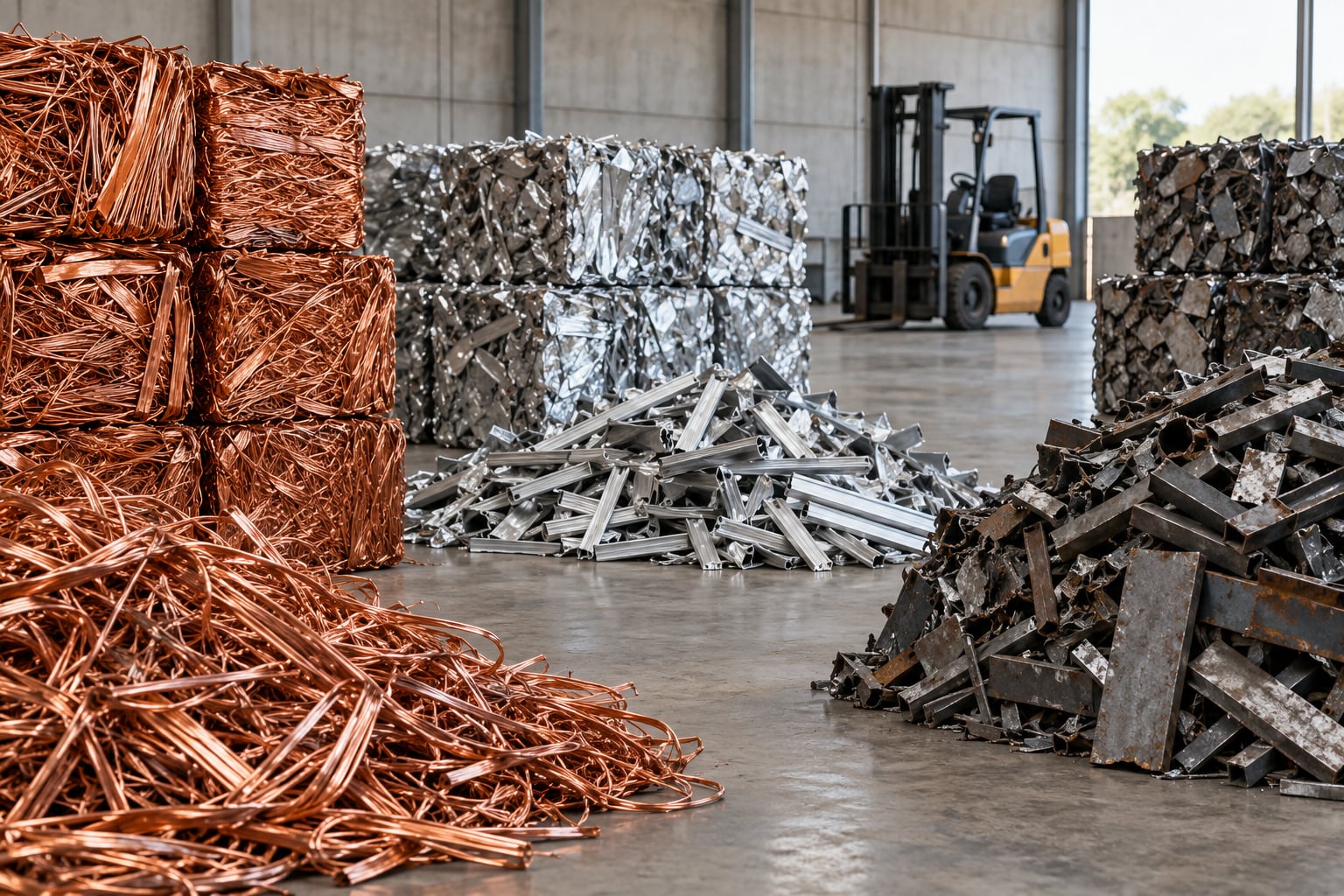
To be direct about how recycling affects metal prices: it adds recovered material to total supply, which limits how far prices can climb. Because more scrap gets collected when prices rise, recycled supply also softens collapses. Recycling dampens metal price volatility; it does not set the price.
That is the whole mechanism, and almost everything else is a detail about timing, grade and cost. The detail that surprises people is that high metal prices shrink the scrap supply they created: expensive metal gets repaired, refurbished and kept in service instead of thrown out, so the material that would have entered the scrap stream a decade later simply never appears.
The effect is uneven across metals and uneven across the cycle. In steel and aluminium, where recycled material is a genuine share of supply, scrap flows can move prices within weeks. In rare earths or battery metals, where collection rates remain tiny, recycling barely registers. Below is how the transmission works, where it breaks down, and what an investor can actually watch.
Table of Contents
- How Recycling Affects Metal Prices Through Scrap Supply
- How Recycling Influences Supply and Demand
- Scrap Metal Versus Newly Mined Metal
- Why Recycling Does Not Always Lower Prices
- How Recycling Varies by Metal
- The Timing of the Price Effect
- How Energy and Processing Costs Change the Equation
- What Investors Should Watch
- Frequently Asked Questions
- Does recycling always make metal prices go down?
- How quickly does recycled metal supply affect prices?
- Which metals are most sensitive to recycling?
- Why can metal prices rise when recycling activity is high?
- What does treatment charges mean for recycled metal supply?
- How can an investor tell whether scrap supply is tightening?
- What to Watch First
How Recycling Affects Metal Prices Through Scrap Supply
Recycled metal competes with mined metal in the same market. A tonne of copper cathode from a smelter fed with scrap is chemically identical to one made from concentrate, so both are priced against the same benchmark. When the recovered share of supply grows, the balance of supply and demand loosens and prices soften.
Five channels carry that effect through to a quoted price:
- Supply addition. Recovered units enter the market without any new mining, adding to availability in the short run.
- Substitution. Buyers switch from primary metal to scrap where grades allow, so demand for mined output falls even as total use holds.
- Cost-curve shift. Recycled units sit lower on the cost curve, so they set the marginal price whenever capacity allows them to clear.
- Procurement behaviour. Manufacturers with recycled-content targets bid scrap away from other industrial users, tightening the market for it.
- Volatility damping. Because scrap generation rises and falls with price, recycled supply arrives hardest at the peaks and thinnest at the troughs, flattening both ends.
Amplifiers and offsets sit on top of those channels, and confusing the two is the most common analytical error in this area.
| Effect on price | What amplifies it | What offsets or cancels it |
|---|---|---|
| Downward pressure | Rising collection rates, clean sorted grades, spare smelter capacity, generous scrap discounts to benchmark | Smelter bottlenecks, contamination penalties, weak end-use demand |
| Upward pressure | Mine disruptions, export restrictions on scrap, weak collections, stockpiling by holders | Fast scrap response, high-grade feedstock available locally |
| Dampened volatility | Long product lifetimes, high recovered share of supply | Low stock-to-flow ratios, few years between supply shocks |
| Almost no effect | Metals with negligible collection rates or no secondary smelting route | Minimal secondary supply share in the first place |
How Recycling Influences Supply and Demand
Plainly: more usable scrap means more total supply, which caps prices or lets producers cut back on primary output they do not need. If copper smelters can feed themselves from scrap, a portion of mined concentrate loses its buyer and mine supply growth matters less to the refined price.
The reverse also holds. When scrap is expensive to sort, contaminated with plastics or steel, or simply not collected, the recycled share shrinks and demand has to be met from mines. That is when the market behaves as if recycling does not exist.
Collection is the quiet bottleneck. Material only becomes feedstock once someone separates it from a demolished building, a shredded vehicle or an electronics stream. Where sorting capacity and regulatory compliance are tight, the practical volume of recycled metal is far below the theoretical volume of metal in use.
Scrap Metal Versus Newly Mined Metal
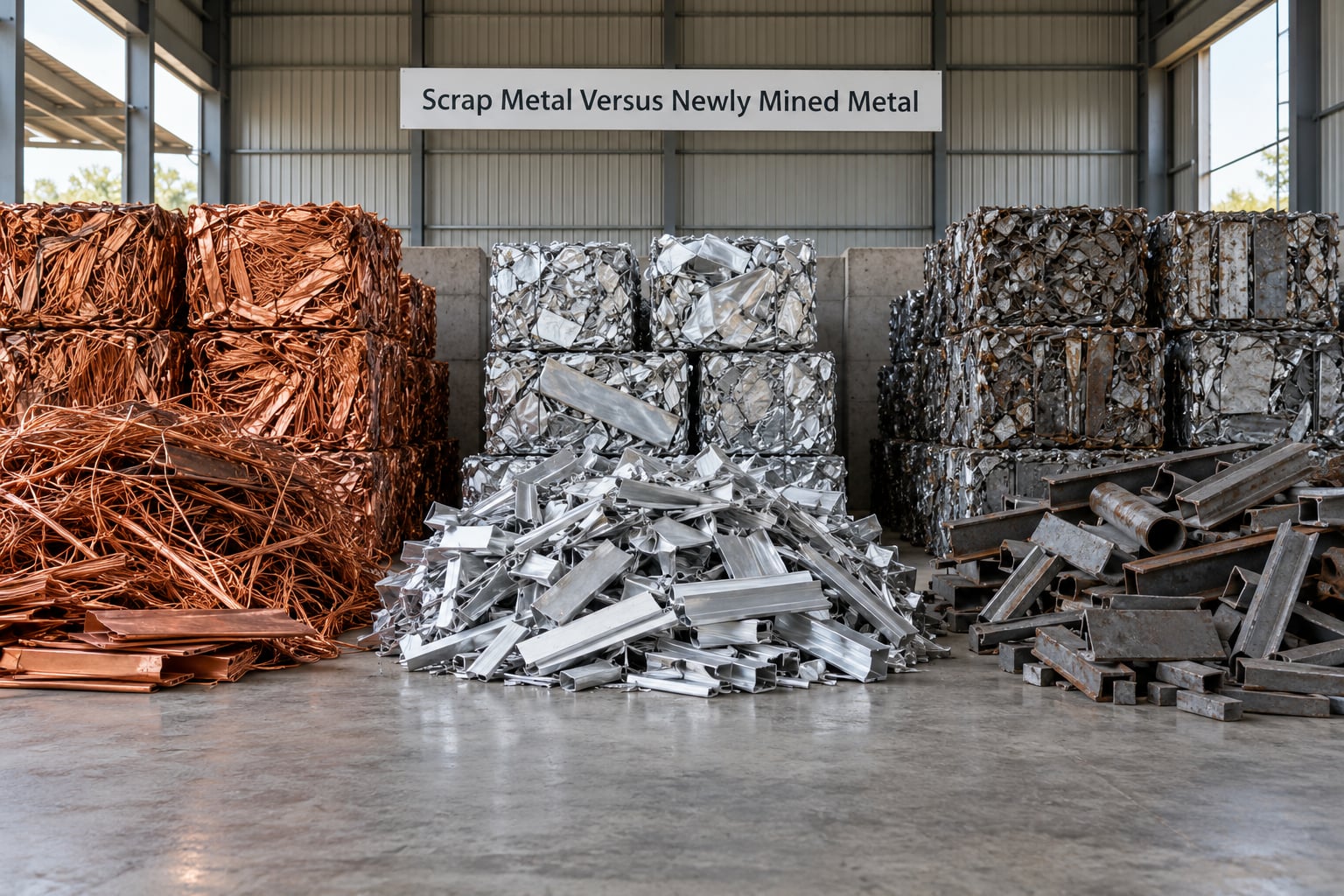
Recycled metal is a substitute for mined metal, not a perfect replacement. Grade is the dividing line: a clean, known alloy can go straight back into a smelter, while a mixed load needs shredding, magnetic separation, eddy-current separation and alloy identification before it becomes usable feedstock.
| Factor | Recycled (secondary) supply | Mined (primary) supply |
|---|---|---|
| Feedstock | End-of-life products, production drop, clean industrial scrap | Ore body, concentrate, cathode |
| Lead time | Days to months once collected | Years to over a decade for a greenfield mine |
| Energy use | Materially lower than primary for the same unit of metal | Baseline for all other supply |
| Volume response to price | Fairly responsive, with a lag tied to product lifetimes | Slow, constrained by permitting and ore grade |
| Grade reliability | Varies widely by stream and contamination | Consistent assay from the orebody |
| Geographic flexibility | Local, near where products are retired | Fixed to the deposit and infrastructure |
Energy is the reason recycled units usually sit low on the cost curve. Industry bodies have published savings of roughly 74% for secondary steel against the primary route, around 90% or more for aluminium, and up to about 85% for copper. Those figures come from industry associations rather than from a single neutral dataset, so treat them as order-of-magnitude guidance rather than precise accounting.
Lower energy is not the same as lower total cost, and the gap is where most of the practical friction sits. Recycling still requires collection, sorting, transport, melting, refining, slag and emissions handling, and it loses some metal to yield. It also carries compliance costs from tracking material provenance and legal exposure from accepting questionable feedstock.
Why Recycling Does Not Always Lower Prices
High recycling activity and rising prices coexist more often than most explanations admit. Six situations account for most of it.
Demand grows faster than collection. Electrification and construction booms pull refined metal demand up at a pace no collection network matches. Copper is the standard example: scrap flows have been strong and the price still moved higher.
Processing capacity is full. Refiners run on scrap, but they also run on concentrates and they cannot exceed throughput. Recycle traders during tight markets have described buying feedstock they could not immediately process. When capacity binds, availability of scrap stops translating into availability of metal.
Scrap generation is slow to respond. A tonne of copper in a building today may sit in service for forty years. The supply response to a price rise is spread over decades, so short cycles can run entirely on lagged material.
Material is withdrawn from circulation. Where metal is expensive, owners repair rather than replace, theft and informal export remove legitimate tonnage, and industrial users hold inventory instead of selling. All three shrink the scrap flow precisely when prices are rising.
Trade policy moves the metal, not the price. Export restrictions and tariffs on scrap change where metal is processed rather than how much exists. A refined-output region can tighten even while scrap piles grow elsewhere.
Grades and contamination bite. Mixed loads get penalised, sometimes heavily. A shift in the composition of the scrap stream can reduce usable supply even when collected tonnage rises.
Scrapyard commentary through 2026 reflects this split clearly: non-ferrous categories have shown far more dynamic pricing than ferrous ones, which is what a supply-and-processing bottleneck looks like in practice rather than a general rise in all scrap.
How Recycling Varies by Metal
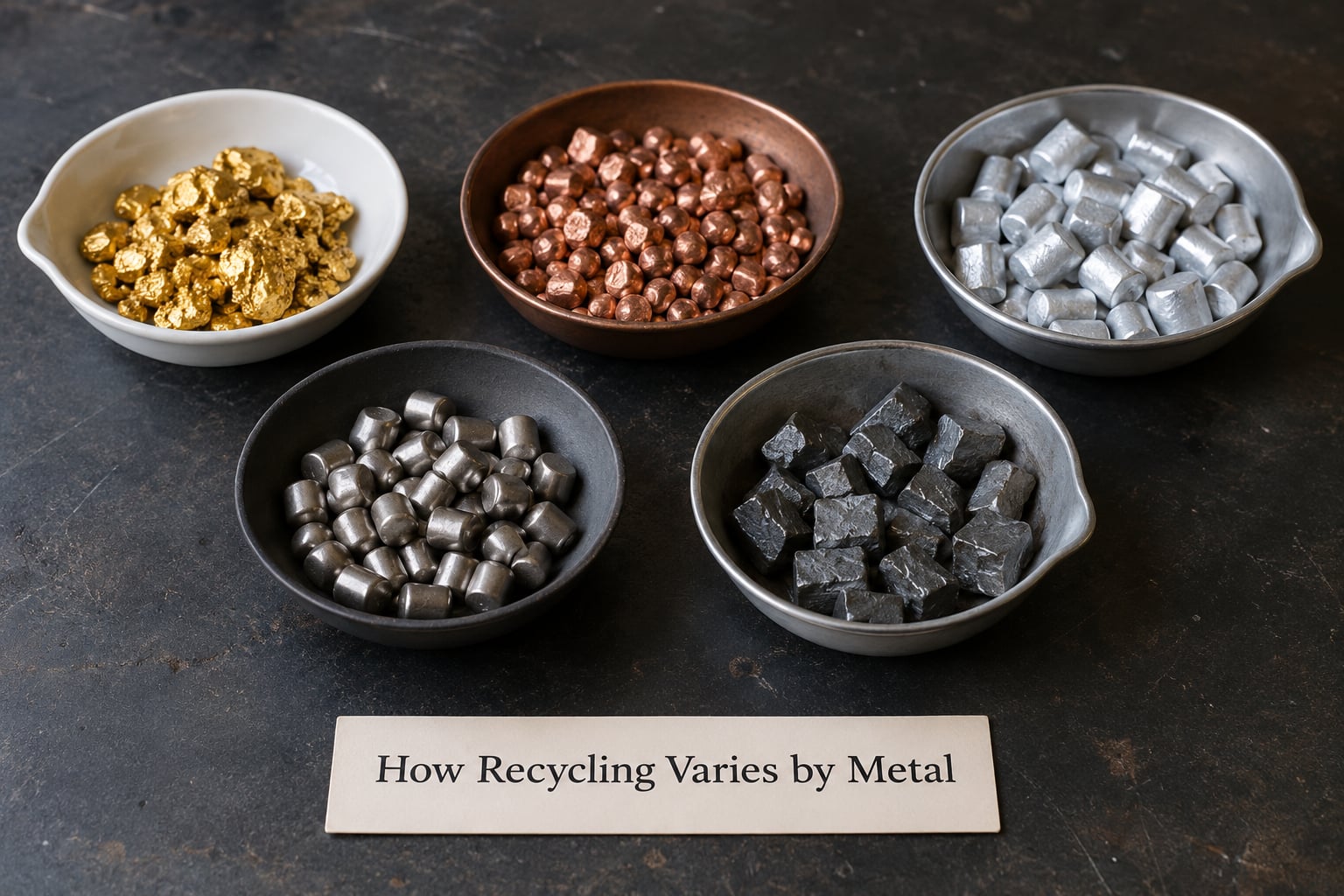
Secondary share of supply differs by an order of magnitude across metals, and that single number mostly determines how much recycling can move a price.
| Metal group | Secondary supply position | What moves recycled supply here |
|---|---|---|
| Steel | Largest single source of feed for many plants | Construction and demolition activity, vehicle scrapping, arc furnace economics |
| Aluminium | Major share of supply in regions with strong collection | Beverage can scrap, building profiles, scrap discounts to benchmark |
| Copper | Substantial and growing secondary share | Cable and motor scrap, grid spending, smelter scrap ratios |
| Nickel | Meaningful share from stainless and plating scrap | Stainless production, battery feedstock, refining capacity allocation |
| Precious metals | High-value supply drawn from jewellery, catalysts and bullion | Jewellery sales behaviour, autocatalyst collection, refining throughput |
| Rare earths | Collection rates reported near fractions of a percent | Magnet recycling economics, separation cost, regulatory push |
Steel and aluminium sit at one end because their economics work: the tonnage is large, the material is easy to identify by eye or magnet, and processing capacity is widespread. Precious metals sit at the other kind of end: tonnage is tiny but value per unit is enormous, so even a small collection rate matters to supply. Rare earths and several battery metals sit at the end where recycling is discussed far more than it is practised.
The Timing of the Price Effect
In the short run, recycled supply moves prices through what is already at the processor. Scrap in the yard today can change what a smelter buys next week, so spreads and benchmark premiums respond quickly. This is why scrap prices can swing far harder than the exchange price they track.
Across years, the effect is the opposite. New scrap only arrives when products built and sold today are retired, so the supply response to a price rise has a lag measured in product lifetimes, from a few years for electronics and batteries to decades for construction metal and grid cable.
Capacity fills the gap in the middle. Higher prices eventually bring dormant sorting and refining lines back online, new collection contracts and higher scrap discounts that pull material out of circulation. That expansion shows up as a ceiling forming under prices, and it arrives later than most buyers expect.
Then the loop reverses. Persistent high prices keep metal in service, encourage repair and displace virgin material with substitute materials, so scrap generation slows again. The supply that capped the rally is the same supply that disappears if prices stay high for long enough.
How Energy and Processing Costs Change the Equation
The relevant cost of recycled metal is not the cost of the scrap. It is the full delivered cost of a usable unit at the smelter gate, and several of those costs swing independently of the metal price.
- Collection and logistics. Pickup, transport and handling cost the same whether or not the load is contaminated, and they rise sharply in regions with thin coverage.
- Sorting and grade identification. X-ray fluorescence and alloy identification technology adds cost but recovers value by separating what would otherwise be downgraded.
- Contamination penalties. Plastics, oils and mixed ferrous content reduce the price a yard can realise, often by a wide margin.
- Energy and refining. Melting and electrorefining consume power, so power prices set the floor under secondary production costs even where the feedstock is free.
- Yield loss. Some metal leaves the process as dross, dust or slag, so scrap input exceeds recovered output.
- Environmental compliance. Emissions control and residue handling are fixed costs that penalise small and informal operators hardest.
- Opportunity cost. Scrap has other outlets: re-melt by end users, export, or direct reuse of whole products. The best price for a load is sometimes not the smelter.
Put together, these explain why scrap markets can diverge sharply by geography even when the benchmark is global. Collection and freight costs, power prices and local processing capacity all feed into the delivered number a regional buyer actually pays.
What Investors Should Watch
If you are modelling metal prices, recycled supply belongs in the model as a price-elastic variable that responds with a lag, not as a fixed share. These are the inputs worth tracking, roughly in order of usefulness:
- The spread between scrap and the primary benchmark. A widening discount signals surplus available feedstock; a narrowing discount signals scrap is scarce relative to refined demand.
- Smelter and refinery scrap ratios. The share of feed that is secondary is published by producers and shows whether secondary demand is actually absorbing material.
- Collection and export volumes. Scrap export data is a direct read on where secondary supply is moving and on trade-policy effects.
- Refined output and treatment charges. Treatment and refining charges reveal how tight processing capacity is. Rising charges say processors are competing for feedstock; falling charges say they are not.
- Inventories at exchanges and in bonded warehouses. Available inventory tells you how much buffer sits between a supply surprise and the benchmark price.
- Mine disruptions and end-use demand. Recycled supply modifies these, it does not replace them. Fabrication output and construction activity still set the demand side.
- Reported versus recovered-equivalent metal prices. Real all-in prices that account for recovery rates and treatment costs differ from headline benchmark quotes and are the more useful comparison.
Two structural notes for anyone tracking this. Theft and questionable-material compliance rules remove legitimate feedstock, so tighter provenance rules can tighten recycled supply for reasons that have nothing to do with demand. And the reported recycling rate for a metal is often measured on collected material rather than on metal in use, which is why reported figures and reality diverge so widely.
This is general market mechanics, not investment advice. These relationships vary by metal, region and period, historical rates do not predict future prices, and anyone acting on metals exposure should take their own advice and consider a licensed adviser.
Frequently Asked Questions
Does recycling always make metal prices go down?
No. Recycling limits how high prices can climb and softens collapses, because recovered metal adds supply and scrap generation rises when prices rise. But when demand grows faster than collection, processing capacity is full, or material is held in service instead of scrapped, prices can keep rising while recycling activity stays strong.
How quickly does recycled metal supply affect prices?
Material already at a processor can move prices within days to weeks, mostly through scrap discounts and treatment charges. New scrap generated from end-of-life products arrives far more slowly, on timelines set by product lifetimes, from a few years for electronics to decades for construction and grid metal. New processing capacity fills part of that gap, but on its own schedule.
Which metals are most sensitive to recycling?
Steel, aluminium and copper are the most sensitive, because their recycled share of supply is large, the material is easy to identify and process, and dedicated processing capacity already exists. Nickel and precious metals respond differently: nickel has a meaningful secondary share tied to stainless production, while precious metal recycling is small in tonnage but large in value per unit.
Why can metal prices rise when recycling activity is high?
Three reasons dominate. Demand may be growing faster than collection networks can supply scrap. Smelters and refiners may be at their throughput ceiling, so feedstock is available but cannot be converted into metal. And high prices keep products in service, suppress scrapping and pull material into inventory, shrinking future scrap generation rather than growing it.
What does treatment charges mean for recycled metal supply?
A treatment charge is the fee a processor charges for turning feedstock into refined metal. Rising charges signal that processors are competing for scarce scrap, which means secondary supply is being absorbed and recycled material is commanding a premium. Falling or negative charges indicate surplus feedstock. It is one of the cleanest weekly reads on the balance between scrap availability and processing demand.
How can an investor tell whether scrap supply is tightening?
Watch the scrap discount to the exchange benchmark, producer scrap ratios, and treatment charges together. A narrowing discount, rising scrap ratios and climbing treatment charges together usually mean recycled supply is tightening and the price ceiling is being rebuilt. If the discount widens while charges fall, scrap is plentiful and the cap on prices is holding further out.
What to Watch First
If you take one thing from this, take the distinction between recycled metal that already exists and recycled metal that has yet to be generated. Scrap in a yard today shapes prices this month. Scrap from products being built today shapes prices in decades.
Start where you are analysing a specific metal: check current scrap availability and processing economics against exchange inventories and end-use demand in that market. The scrap discount and treatment charges tell you first whether recycled supply is capping prices or whether it is nowhere near enough to matter yet. Understanding how recycling affects metal prices is a matter of watching that spread, not assuming recycling always pushes a price down.