
A gold vault is a high-security facility where physical gold bullion, bars and coins, is stored, verified and insured on behalf of people and institutions that do not want to keep it at home. To answer how a gold vault works in plain terms: you buy metal, the provider allocates a specific quantity of it to your name, secures it in an audited vault, and you later sell it or take physical delivery.
One caveat before we go further. “Gold vault” means at least three different things in search results, and only one of them is what most people asking this question are actually looking for. Once you can tell them apart, the rest of this guide is straightforward.
Table of Contents
- Gold Vault Basics
- What Is a Gold Vault and How Does It Work?
- How Gold Vault Storage Works
- How Gold Vaults Protect Stored Metal
- Allocated Versus Unallocated Gold Storage
- What It Costs to Store Gold in a Vault
- How gold vault accounts are taxed
- Who Uses Gold Vaults?
- What to Check Before Choosing a Gold Vault
- Frequently Asked Questions
- Are gold vaults safe?
- Where is the safest place to store your gold?
- Is it safe to store gold in a safe deposit box?
- Can I physically visit the vault to check my gold?
- How much gold can I legally own at home?
- What is the main downside of vaulted gold?
- Conclusion
Gold Vault Basics
A gold vault is any secure building or room built to hold large quantities of bullion. The rooms themselves do not differ much in design whether they belong to a central bank or a private dealer, but the way the metal is owned and accounted for differs enormously.
| Type of gold vault | Who uses it | How ownership works |
|---|---|---|
| Central bank or government vault | Central banks, governments, bullion banks holding official reserves | Assets sit on the institution’s balance sheet. No individual account, no serial numbers issued to you. |
| Private bullion depository vault | Individuals, dealers, funds, ETFs, jewellery chains, refineries | Specific bars are allocated and held under your name. You receive a statement or receipt with details. |
| Home safe or safe deposit box | Private holders keeping metal in their possession | You hold the metal directly. Security depends entirely on your own setup and insurance. |
Most of the noise in this topic comes from headlines about Fort Knox and the Bank of England. Those rooms are genuinely enormous, and that content is interesting, but a person asking what a gold vault is usually has retirement savings in mind, not national reserves.
What Is a Gold Vault and How Does It Work?
In the private-investor sense, a gold vault is a professional storage facility operated by a bullion dealer or depository. You buy gold through the provider, the provider records a specific weight of metal as belonging to your account, holds it in a high-security insured vault, and credits your account with the corresponding ounces. You can then sell that metal, move it to another vault, or request insured delivery to an approved address.
How Gold Vault Storage Works
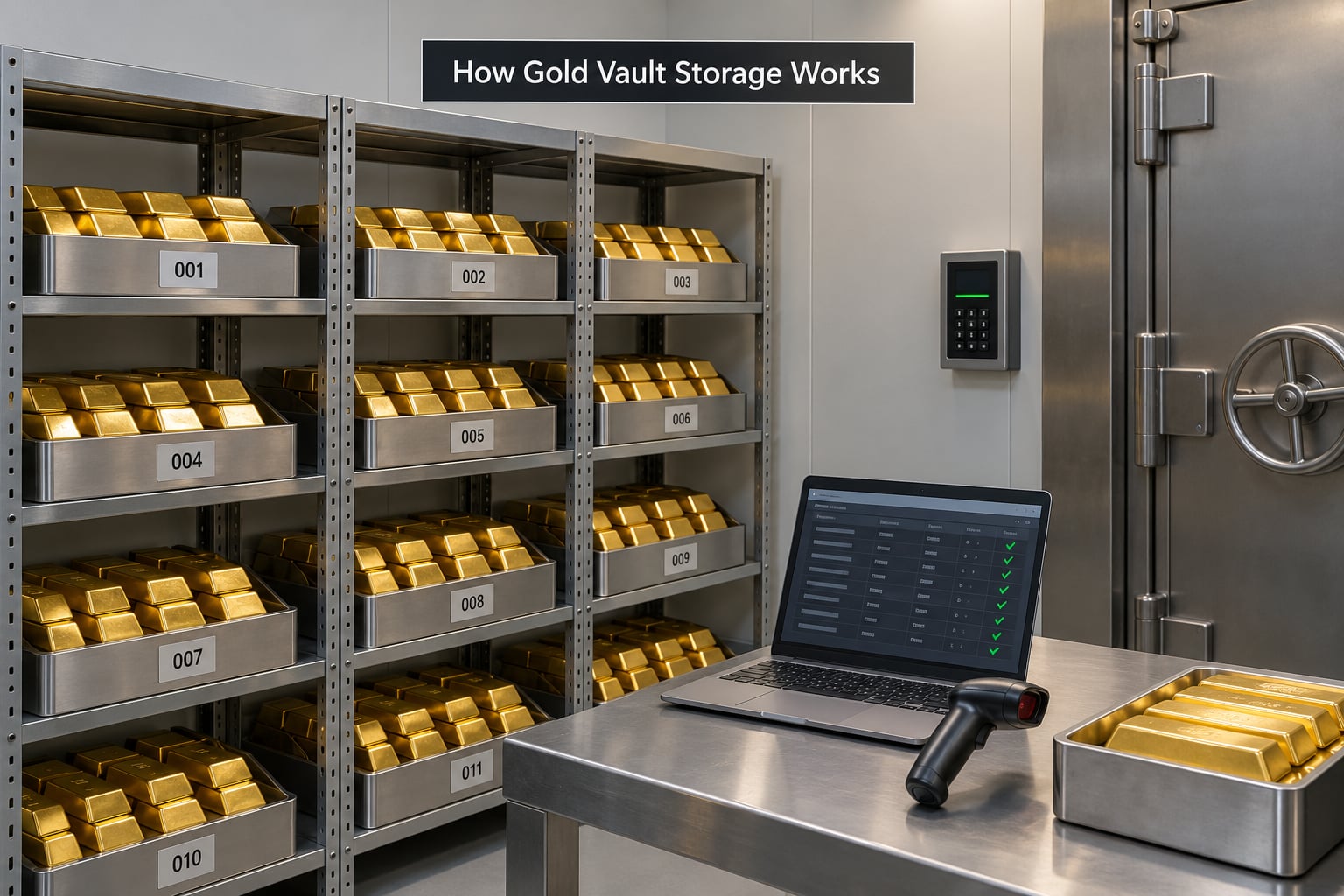
The mechanics are surprisingly plain once you strip away the marketing. Here is the full flow.
- Open an account and verify your identity. You provide personal and address details, pass anti-money-laundering checks, and sign the custody or storage agreement that defines your legal claim.
- Fund the account. Most providers take a bank transfer. A few accept card or wire, usually with a surcharge.
- Buy gold. You choose a bar weight or coin, typically from one gram up to a full kilo bar. The price you pay is the LBMA Gold Price plus a dealing spread.
- Metal gets allocated to your name. The provider pulls specific bars from its inventory, records their serial numbers against your account, and shows the allocation on your statement.
- The metal is insured and stored. Bars sit in numbered trays inside insured vaults. RFID or barcode tagging lets staff move and verify specific holdings without disturbing the rest.
- Sell, move, or withdraw. You sell back at the current price minus a spread, request a transfer between vault locations for a fee, or take insured delivery where permitted.
The important step is the fourth one. Allocation is what turns a claim on a company’s gold into a claim on specific metal, and it is the single concept most often glossed over in explanations of this topic.
How Gold Vaults Protect Stored Metal
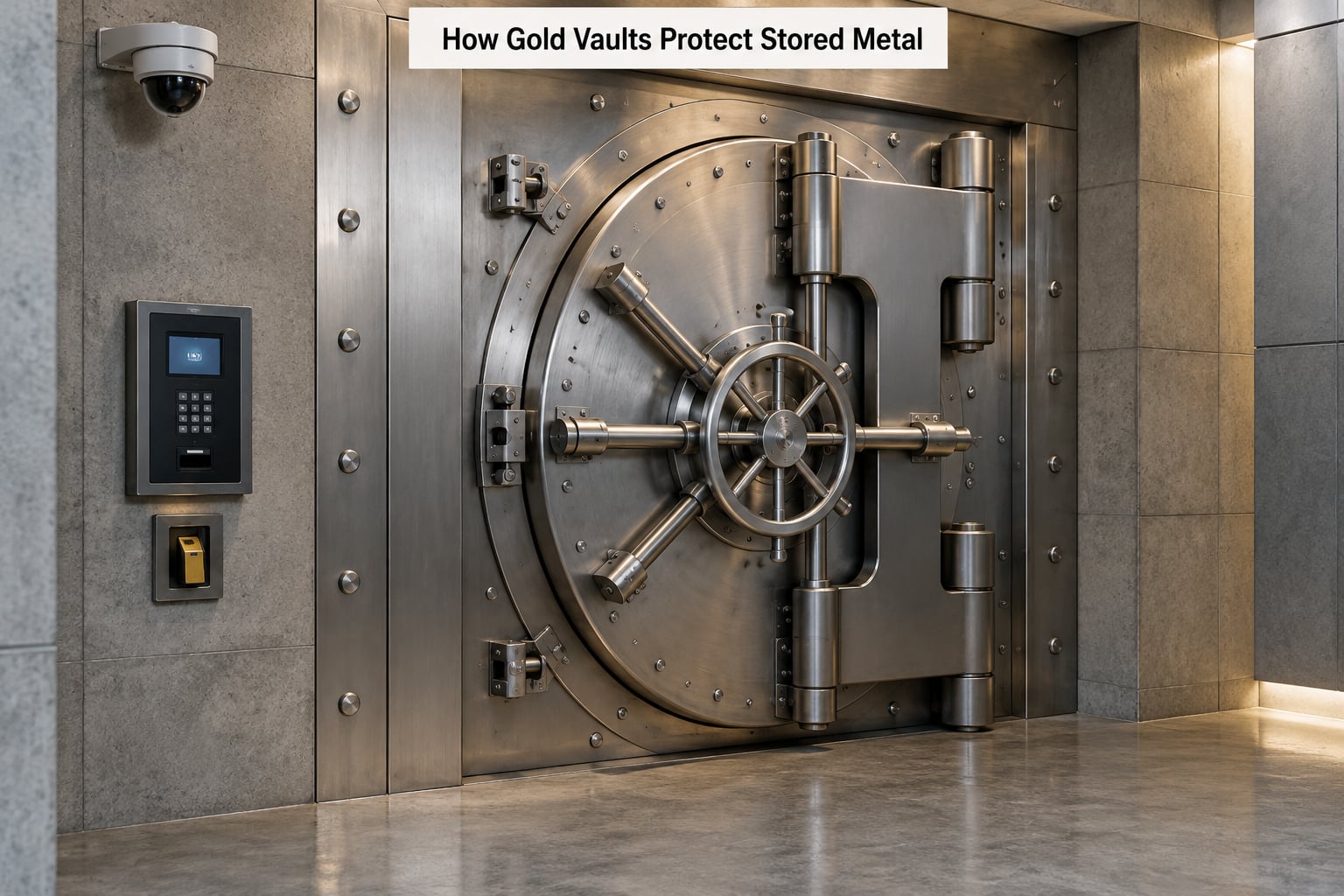
Physical security is layered, and the layers are the point. A serious facility sits behind a perimeter fence and guard rotation, passes through a mantrap, then through a steel vault door into a room with segregated coffer grids. Every coffer is individually sealed and inventoried, and access requires two or more authorised parties present.
Most vaults run a continuous video record of coffer access and review it when a tray is opened. Insurance sits on top of that, and reputable providers name their underwriter and publish the limits rather than leaving you to guess.
What a vault does not protect against is the counterparty itself. If a provider fails, whether the metal is returned to you depends on the legal segregation of the holdings and on your account agreement, not on how thick the door is. Segregated and allocated language in the contract is what matters here, and it is the first thing to look for when reading terms.
Users on r/Gold and r/Silverbugs return to this point constantly, and the sentiment is blunt: metal in a vault is only as good as the jurisdiction and the entity holding it. A clean chain of custody in a stable legal system is worth more than an impressive building in a shaky one.
Allocated Versus Unallocated Gold Storage
Allocated means specific metal is held for you and your name appears against it on the provider’s ledger. Unallocated means you hold a balance in pounds, dollars or ounces against the provider’s pooled metal, and the provider owes you the value, not a specific bar. It is a difference in legal title, and it decides what happens if the provider runs out of money.
Here is the concrete version. If a provider is completely insolvent and holds all customer metal unallocated, you are one of thousands of creditors in a queue, and recoveries can be a small fraction of your balance. If the metal is allocated, segregated in your name and legally segregated in the provider’s accounts, your claim is to specific bars that are not available to other creditors.
| Feature | Allocated | Unallocated |
|---|---|---|
| What you own | Specific bars or coins, with serial numbers on your statement | A balance owed to you by the provider |
| Risk if the provider fails | Claim to your specific metal, assuming holdings were properly segregated | Unsecured creditor claim, competing with all other customers |
| Costs | Storage or custody fees, usually charged on value | No storage fee, since you hold no specific metal |
| Silver or platinum | Sometimes offered, typically on different terms | Commonly offered as a pooled account |
| Physical delivery | Usually possible, subject to provider rules | Usually not |
Some providers offer a middle option, a pooled precious metals account held through a trust structure, where the metal is held on your behalf but not in your name. Treat that as a distinct category and read who the trustees are.
What It Costs to Store Gold in a Vault
There is no single number, because providers charge in different ways. The main cost components are storage or custody fees, insurance, dealing spreads on both the buy and the sell, delivery charges, minimum holding requirements, inactivity fees and account closure or withdrawal fees.
The important distinction is how the storage fee is calculated. Flat annual fees stay constant. Percentage-based fees rise when gold rises, so a position that cost the same to store in a flat market can cost far more after a strong run.
There is a second-order effect worth understanding. Where a provider charges fees in metal rather than cash, it sells a small amount of your holding to settle the bill. Your balance in dollars can look healthy while your balance in ounces quietly shrinks, which matters if your plan assumes you hold a fixed weight over time.
Run the arithmetic before committing. A position held in a vault with annual percentage fees always loses a share of its value to custody, and that share is permanent. Compare that against home storage, where you pay for a safe and an insurance rider once, then carry the home-security risk instead.
How gold vault accounts are taxed
Tax treatment varies by country, so treat this as general information rather than advice. In the United States, investment-grade gold is generally treated as a collectible, which means long-term capital gains are taxed at the higher collectibles rate rather than the usual long-term rate. Sales above ten thousand dollars in cash by a dealer trigger cash reporting under Form 8300, and reportable bullion sales are reported to the tax authorities on Form 1099-B.
The practical point for storage planning is that vaulting does not defer tax. You own the metal from the moment of allocation, and gains are realised when you sell or withdraw.
Who Uses Gold Vaults?
Individuals use them to hold a longer-term bullion position without the operational burden of a home safe. Dealers and refiners use them as working inventory, since a refinery storing finished bars nearby cuts transport and handling costs. Banks and bullion houses keep vaults for client metal under custody agreements.
Exchanges use secure storage to back delivery promises, so the metal exists before an obligation is settled. Governments use institutional vaults to hold official reserves, which is the sense most news coverage refers to.
Larger investment vehicles are also users. Physical-backed exchange traded funds hold bulk bars in professional vaults, which is why fund sponsors talk about vault fees rather than operating expenses.
What to Check Before Choosing a Gold Vault
Ask for the following in writing before you fund anything: confirmation that holdings are allocated to you and segregated from the provider’s own metal, the full schedule of fees including any minimum charge, who underwrites the insurance and at what limit, the serial numbers or a reference scheme for your holdings, the process if the provider becomes insolvent, and whether you can request an independent verification of your holdings.
Red flags are easy to spot once you know them. Unusually low storage fees paired with vague language about insurance, no willingness to state segregation in the agreement, a single vault location with no alternative, and a refusal to explain the insolvency process are all worth walking away from.
Forum contributors who have actually done this tend to split their holdings deliberately rather than concentrating in one venue, and they treat operational communication as a security feature in itself. A provider who answers a question in detail on day one is usually easier to deal with in a crisis than one who goes quiet.
A word on scope. This guide explains how gold vaulting works in general terms. It is not investment, tax or legal advice, and rules differ by country and state.
Frequently Asked Questions
Are gold vaults safe?
A reputable professional vault combines layered physical security, segregated coffer storage, continuous video records and insurance for the metal it holds. That protects well against theft and operational error. What it does not protect against is the provider itself failing, which is why segregation and allocated status in writing matter more than the building.
Where is the safest place to store your gold?
There is no single answer, and the honest comparison is between security and access. A professional vault gives you stronger physical security, insurance and oversight but no access in hand. A home safe gives you total control and immediate access with more risk on you. A safe deposit box sits in between, with bank opening hours and no deposit insurance on contents.
Is it safe to store gold in a safe deposit box?
It is reasonably safe for a modest position, with two real drawbacks. Contents are not insured by the deposit insurer the way the cash in the account is, so you need your own policy. Access is limited to bank hours, and access can be restricted if the bank itself faces problems. Many holders split a small amount across boxes rather than concentrating in one.
Can I physically visit the vault to check my gold?
It depends on the provider, and this is worth asking before you sign up. Some large vault operators run viewing rooms where account holders can inspect their holdings under supervision. Many retail-facing providers do not offer visits and instead rely on statements, serial-number records and third-party audits as proof. Ask directly, and treat the answer as part of your decision.
How much gold can I legally own at home?
There is no limit on owning gold at home in most Western countries, and no special licence or registration is required for bullion held privately. Reporting obligations attach to dealers making large cash sales, not to individuals keeping metal at home. Local rules on import, export and any duty or tax can differ, so check the position in your own country.
What is the main downside of vaulted gold?
The honest answer is cost and inconvenience. Storage fees compound every year, percentage-based fees rise when gold rises, and the metal generates no income while it sits. On top of that you cannot touch it, and selling spreads and delivery charges mean you recover less than the quoted price. Vaulting suits a position you intend to hold for years, not one you may need quickly.
Conclusion
A gold vault is simply secure, insured storage for physical bullion, and for most private investors it works through one mechanism: metal is allocated to your name, recorded, and held at an audited facility until you sell or collect it. The decision is less about the building than about the paperwork, since allocated and segregated status is what separates owning metal from owning a promise about metal.
Your first move is simple. Get the provider’s segregation policy, full fee schedule and insolvency terms in writing, then run the annual cost against what home storage plus insurance would cost you for the same position. Only then compare vaults.