Updated for October 2026. If you have ever wondered why there is no tellurium mine, this is the guide to start with.
Byproduct metals in mining are metals that come out of the ground as a side effect of mining something else. A copper mine, for instance, is built around copper, but the same ore body carries silver, tellurium, selenium, molybdenum and small amounts of gold. Those extra metals are recovered, sold and booked as revenue, yet nobody drilled a hole looking for them.
That single fact explains almost everything unusual about them as investments. Their supply cannot grow on its own, their prices move in ways that have nothing to do with their own end uses, and a company can quietly become a meaningful producer of a metal its name does not suggest.
The rest of this guide walks through where they come from, which ones matter, how the credits land in a cost model, and what to check before you build a thesis around them.
Table of Contents
- What Are Byproduct Metals in Mining?
- How Are Byproduct Metals Produced?
- Where byproduct metals get separated out
- Which Common Metals Are Mining Byproducts?
- Why Do Byproduct Metals Matter to Miners and Investors?
- How Do Byproduct Credits Affect a Mining Company’s Economics?
- A worked example, clearly hypothetical
- What Should Investors Check Before Valuing Byproduct Exposure?
- Byproduct Metals vs. Primary Metals: What’s the Difference?
- Frequently Asked Questions
- Is silver always a byproduct metal?
- Why are byproduct metals valuable to mining companies?
- Can a mining company choose which metal to call its primary product?
- Are byproduct metals reported the same way as the mineu0026rsquo;s main metal?
- Why do byproduct metal prices spike so hard?
- How do I read payable metal in a mining resource statement?
- What to Take Away
What Are Byproduct Metals in Mining?
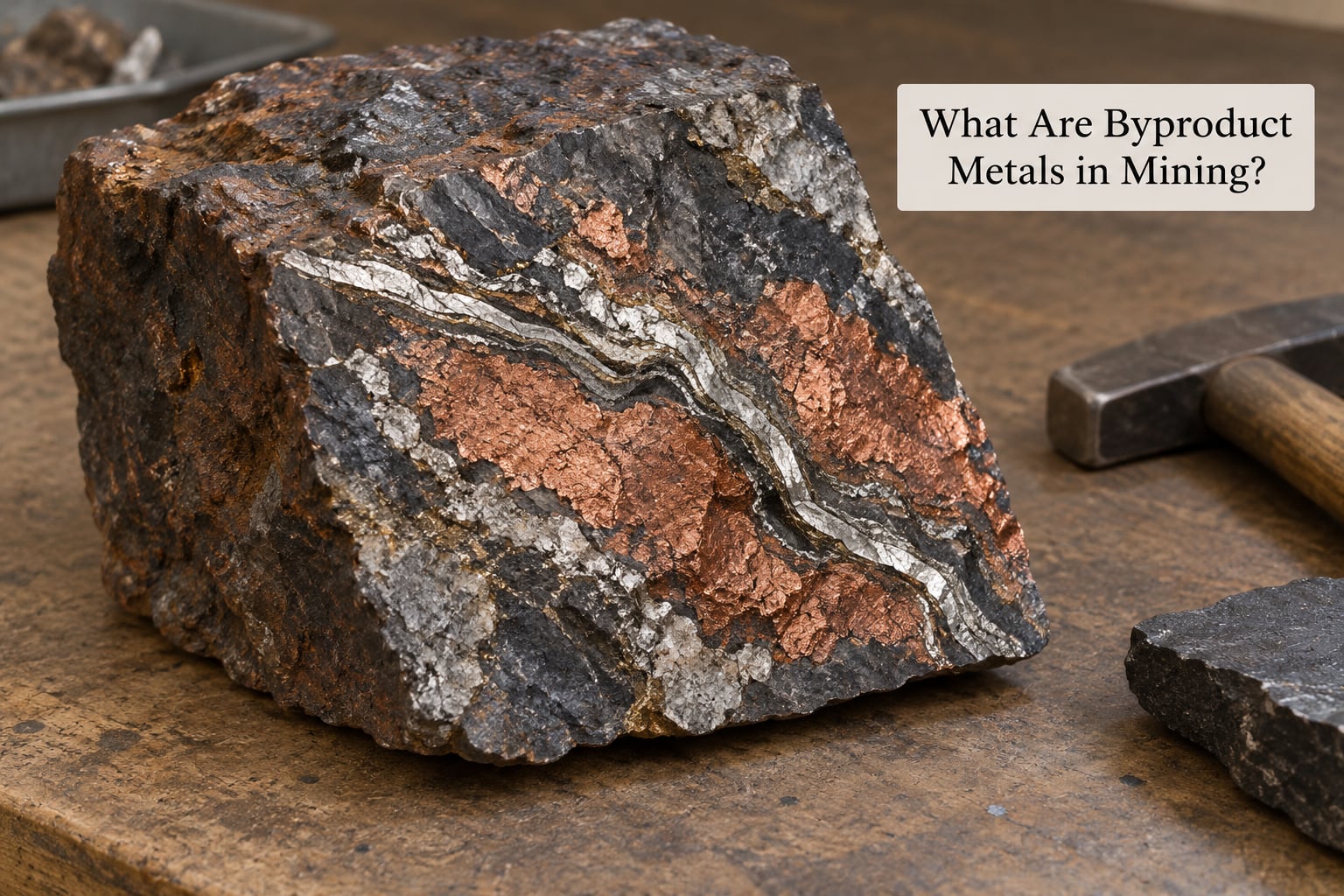
Byproduct metals are metals recovered incidentally alongside a mine’s primary target metal, present in the same ore body or process stream in small quantities, and sold as a secondary product. Their supply depends on how much of the host metal is mined, not on their own price, so most are never mined deliberately.
Geologists and economists have written about these under the label minor metals. The definition that has stuck in the literature comes from Hagelüken and Mesker (2010), who described minor metals as those with relatively low production or usage, which occur at low ore concentrations, are regarded as rare, or are not traded at the major public exchanges. That definition captures the awkwardness of the category: indium, tellurium, germanium and antimony are all real, traded and increasingly important, and none of them has a mine built around it.
The relationship is easiest to understand through one example. Take a large porphyry copper deposit. The company spends its capital on a pit, a mill and a flotation circuit designed to separate copper sulfide from waste rock. Gold, silver and selenium are not the targets of any of that equipment. They ride along because they are locked into the same crystals, or because they substitute for copper and silver inside those crystals, and the circuit that separates copper from waste happens to sweep them into the concentrate as well.
Sometimes the relationship is geological rather than incidental. Molybdenum often occurs with copper in porphyry systems because both precipitate from the same hydrothermal fluid. Cobalt sits in certain copper and nickel ores. Tellurium and selenium concentrate in the anodic slimes generated during copper electrolytic refining. In each case the association is a geochemical fact, which is exactly why the pairing is predictable rather than accidental.
Two practical consequences follow. First, you cannot treat the supply of a byproduct as a simple function of demand for that metal. If copper prices fall and a producer cuts output, tellurium output falls with it, and no new tellurium mine appears to fill the gap within the relevant timescale. Second, a mine that is a modest copper producer can end up ranking among the larger producers of a small metal, purely because that metal is locked into its ore.
How Are Byproduct Metals Produced?
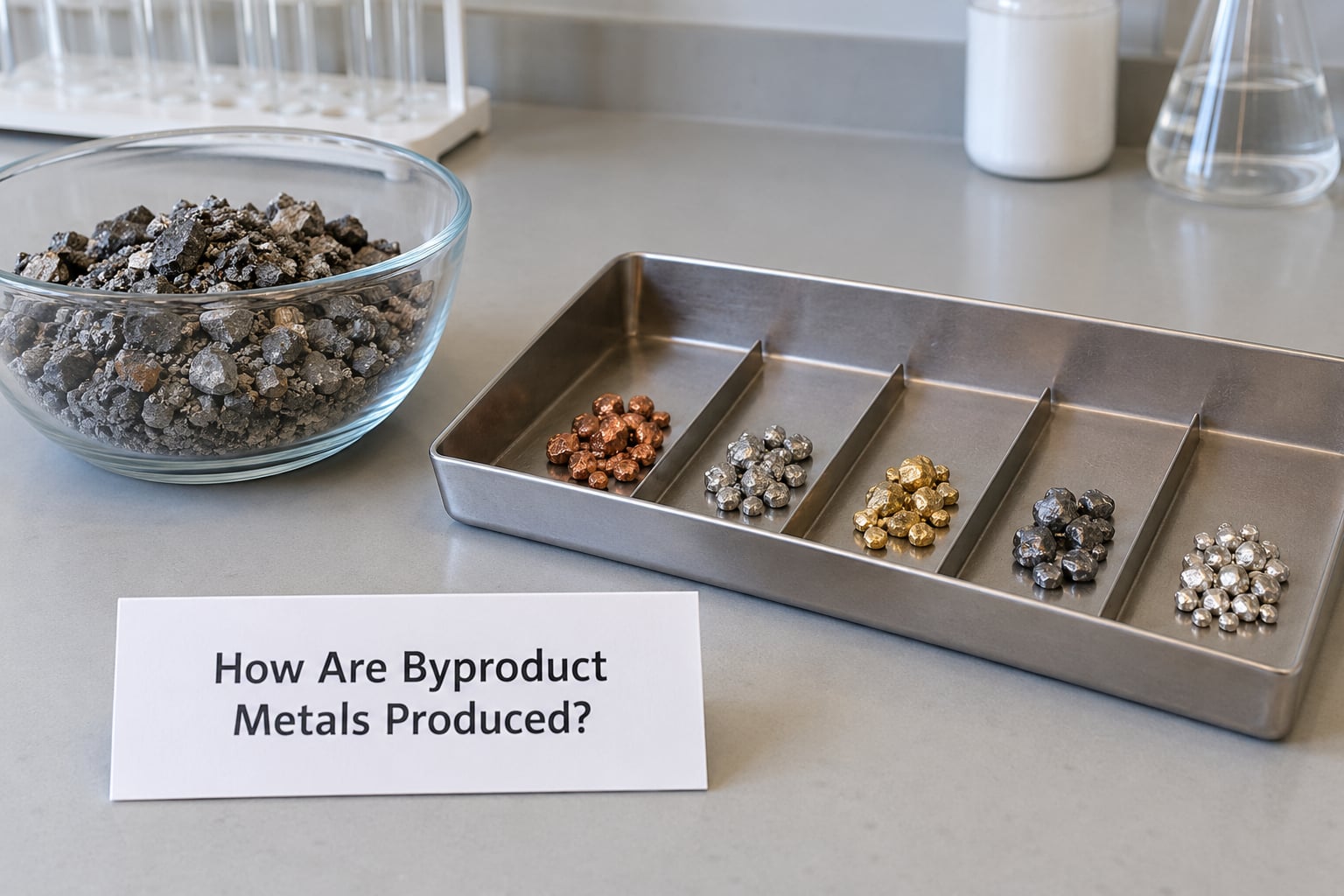
The production path runs through the ordinary mining sequence, with a few extra steps tacked on at the separation and refining stages. Byproduct metals enter as contained metal in the ore, follow the host metal through milling and flotation, and are only counted as revenue once they have been physically separated and turned into something a smelter will pay for.
| Stage | What happens | Why it matters for byproducts |
|---|---|---|
| Mining | Ore is extracted from the pit or underground workings by drilling, blasting and hauling. | The byproduct metal is present in the rock as contained metal. Nothing has been recovered yet. |
| Beneficiation | Crushing and milling reduce the ore to a fine size, and flotation separates valuable minerals from waste rock. | The byproduct minerals are not usually the target of the flotation chemistry, but they report to one of the concentrate streams anyway. |
| Concentrate transport | Copper concentrate is trucked, railed or shipped to a smelter, carrying its contained byproduct metal with it. | Concentrate sales carry payment terms. The buyer sets deductions, and the producer rarely sees the full value of the contained metal. |
| Smelting | The concentrate is roasted and melted, and the byproduct metals move into the matte, slag or flue dust. | Precious metals and selenium or tellurium concentrate further here, in anode slimes or refinery residues. |
| Refining | Copper is electro-refined, and anode slimes are processed separately for gold, silver, selenium and tellurium. | This is where much of the world’s byproduct gold and tellurium actually becomes saleable material. |
| Payable settlement | Quantities contained in the shipped material are compared against recovery, deductions and treatment terms. | Only payable metal generates revenue. This step is where an impressive headline number quietly shrinks. |
Three stages of that table deserve more attention than they usually get. Beneficiation is where recovery rates diverge sharply between metals: copper recovery might be well over 80 percent while a minor metal sitting in a less responsive mineral phase returns only a fraction of its contained amount. Smelting is where the association pays off, since the smelter is already handling the mass and the heat and byproducts fall out of the same chemistry. And the final settlement stage is where the accounting happens, which is the subject of the economics section below.
Where byproduct metals get separated out
Some operations install dedicated circuits for a specific byproduct, and then it is no longer purely incidental. A copper smelter that deliberately recovers selenium from anode slimes has made a commercial decision about a metal that still has no mine of its own. Hydrometallurgical and bioleach routes are also used where the byproduct is locked into a refractory phase that conventional flotation will not touch.
Researchers and producers increasingly look at old tailings and process residues for the same reason. Material that was once discarded still contains the metal, and the processing technology to pull it out has improved enough in some cases to make it economic. These routes do not change what the metal is, though. It remains a byproduct of somebody else’s operation, and its output still follows the host operation’s schedule rather than its own price signal.
Which Common Metals Are Mining Byproducts?
The table below pairs the byproduct metals that matter most with the operations that actually supply them. The important column is the second one: when you know the host metal, you know what a byproduct price move will and will not affect.
| Byproduct metal | Host metal or operation | Typical source | Principal end use |
|---|---|---|---|
| Silver | Copper, lead, zinc, gold | Copper and lead concentrate, plus gold refining | Electronics, solar cell paste, jewellery and silverware |
| Gold | Copper | Porphyry copper concentrate and copper anode slimes | Jewellery and investment bars |
| Tellurium | Copper | Copper anode slimes from electrolytic refining | Thin-film solar, cadmium telluride cells, thermoelectrics |
| Selenium | Copper | Copper anode slimes | Glass decolourising, metallurgy, agriculture and chemicals |
| Molybdenum | Copper | Porphyry copper deposits, sometimes recovered as its own product | Steel alloying, lubricants, catalysts |
| Cobalt | Copper, nickel | Certain copper and nickel ores, later in hydrometallurgical refining | Battery cathodes, superalloys, hard metals |
| Indium | Zinc | Zinc refinery residues | Indium tin oxide for displays and solar |
| Germanium | Zinc, coal | Zinc concentrates and coal ash | Fibre optics, infrared optics, solar cell substrates |
| Cadmium | Zinc | Zinc refinery residues | Batteries, coatings, pigments, reactor control rods |
| Bismuth | Lead, copper, tungsten | Lead and copper refining residues | Pharmaceuticals, low-melting alloys, electronics |
| Antimony | Gold | Some gold operations, and standalone deposits | Flame retardants, lead-acid batteries, solar glass |
| Rare earth elements | Various | Monazite, ion-adsorption clays, apatite | Magnets, catalysts, phosphors, wind turbine components |
Two entries in that table blur the category, and the blur is instructive. Molybdenum and antimony sometimes arrive as genuine co-products, where the operation could reasonably be described by either metal. Rare earth elements are usually a primary product from a dedicated operation. A byproduct label describes an economic relationship, not a fixed physical fact, which is why serious reporting always names the host operation rather than describing a metal in isolation.
Why Do Byproduct Metals Matter to Miners and Investors?
Byproduct revenue lowers the effective cost of producing the main metal. When a copper producer sells 20000 ounces of gold and 1.5 million ounces of silver along with its copper, the gold and silver revenue offsets part of the cash cost per pound of copper. Cost curves published without those credits make a mine look more expensive than it is.
Beyond the cost line, byproduct revenue adds a second and third price exposure that most people forget when screening a mining name. A copper producer can end up with meaningful sensitivity to gold, silver, tellurium or selenium, sometimes to several at once. Those are additional sources of volatility, and they can cut in both directions during a bad quarter for the host metal.
The third effect is project-level. When a deposit carries recoverable byproduct metal, the feasibility study may show lower capital intensity per unit of the primary metal, since part of the revenue comes without the extra mining cost. That can change a marginal project into a viable one, which matters for anyone tracking development pipelines rather than current output.
None of this is a free lunch, and the limits are worth stating plainly. Byproduct revenue is not costless production; the metal still has to be recovered, refined and paid for through treatment and refining charges. Recovery rates for minor metals are often lower and less predictable than for the host metal. And because output is fixed by the host operation’s mine plan, a producer cannot accelerate supply when a small metal’s price triples. Credit for byproducts flatters margins; it does not create resilience.
How Do Byproduct Credits Affect a Mining Company’s Economics?
The calculation runs in a fixed order, and each step shrinks the number before revenue appears. First comes contained metal: the quantity in the mined and processed material, before any recovery loss. Then recovered metal, which is contained metal multiplied by the recovery rate for that metal in that circuit. Then payable metal, which is recovered metal minus treatment and refining charges, moisture deductions, penalties for impurities and any transport or marketing costs the contract passes back to the mine.
Byproduct revenue is payable metal multiplied by the realized price for that metal, less any refining charge applied again at settlement. Revenue from the primary metal is computed the same way. Costs are then subtracted, and the result is the margin that funds capital, debt service and dividends.
A worked example, clearly hypothetical
Consider a hypothetical operation producing 100000 tonnes of contained copper in concentrate each year, with contained gold of 3000 ounces and contained silver of 400000 ounces. Assume recovery of 85 percent for copper, 55 percent for gold and 65 percent for silver, and simplified payable factors of 96.5 percent for copper, 90 percent for gold and 85 percent for silver. Applying those assumptions in order:
- Recovered copper: 96500 tonnes. Payable copper: roughly 93100 tonnes.
- Recovered gold: 1650 ounces. Payable gold: roughly 1485 ounces.
- Recovered silver: 260000 ounces. Payable silver: roughly 221000 ounces.
Now the sensitivity. If the assumed gold price rises by 100 currency units per ounce, this hypothetical operation picks up roughly 148500 in extra annual revenue, while a comparable percentage move in copper is worth several million. That asymmetry is the point: the headlining price of a byproduct matters less than the payable quantity and the credit terms in the concentrate contract.
The mirror image matters just as much. If the assumed silver price falls by one unit per ounce, the operation loses roughly 221000 of revenue. A mine whose margin is tight on the host metal can absorb that; a mine with generous byproduct credits can absorb a lot more. Both are the same fact seen from opposite ends.
This example is illustrative only. It uses invented figures to show the arithmetic, and it is not a forecast, a valuation or a recommendation for any company or commodity.
What Should Investors Check Before Valuing Byproduct Exposure?
Start with mineralogy and ask whether the byproduct metal is in a mineral phase the plant can actually recover. Many disappointing feasibility studies come from assuming a recovery rate for a minor metal that the flowsheet was never designed to deliver.
Then separate the three quantities that headlines mix together. Contained metal is what the rock holds. Recovered metal applies the recovery rate. Payable metal is what the contract actually pays for, after deductions. A report quoting a spectacular contained number and a thin payable number is telling you the smelter keeps the difference.
Next, read the commercial terms. Treatment and refining charges, penalty elements, quotational periods and whether the mine sells concentrate or refined metal all determine how much of the headline value reaches the income statement. A producer with a smelter keeps more of the byproduct value than one shipping raw concentrate.
After that, check what is actually being disclosed. Some companies publish byproduct payable metal by year, some publish only expected economic credits, and some mention nothing beyond their primary metal. A thesis that depends on tellurium or indium needs disclosure you can actually verify.
Finally, separate resource statements from production. A resource or reserve figure is an in-situ estimate with a confidence level attached, not metal recovered next year. Production history is what tells you whether the credit is real. And if you are looking at a joint venture, check the ownership interest and any streaming or royalty arrangements that capture a share of the byproduct before it reaches the company.
The habit that pays off is separating the three quantities first, because that is where a headline grade or resource number stops being useful on its own.
Byproduct Metals vs. Primary Metals: What’s the Difference?
Both are real, saleable metal, and neither is second-class. The difference is in purpose and control: the primary metal is the reason the operation exists, and the byproduct is a result of how that operation is run.
| Aspect | Primary metal | Byproduct metal |
|---|---|---|
| Purpose | The target the mine plan, capital and equipment are built around. | A recovered result of processing that same ore body for the primary metal. |
| Production control | Set by the operator through mine sequencing, stope plans and mill throughput. | Set by the host metal’s output, plus the route chosen for recovery. |
| Supply response to price | Operators can raise output, restart idle capacity or develop new deposits. | Almost no independent supply response in the short to medium term. |
| Cost treatment | Carries the bulk of mining and processing cost. | Adds revenue, often shown as a credit against effective unit cost. |
| Reporting | Usually a headline production figure with grade and recovery. | Frequently partial: payable quantities, estimated revenue or an expected credit. |
| Main risk | Grade, recovery, cost inflation and permitting. | Host-metal output, recovery uncertainty and contract deductions. |
The middle and co-product nuance belongs here too. A co-product is a metal produced in quantities that make it economically meaningful in its own right, so the operation is reported as a producer of two metals rather than one metal plus a credit. The distinction between byproduct and co-product is a reporting and accounting choice, and different companies handle the same ore body differently.
Frequently Asked Questions
Is silver always a byproduct metal?
No. Silver is a byproduct when it is recovered mainly as an associated metal while a mine is producing another primary commodity, such as copper, lead or zinc. It is a primary metal when the operation is designed around silver, which is the case at several dedicated silver mines in Mexico, Peru and Nevada. Some operations report silver as a co-product because the recovered quantity is large enough to shape the revenue. The classification depends on the mine plan and the reporting choice, not on the metal itself.
Why are byproduct metals valuable to mining companies?
Byproduct revenue offsets some mining and processing costs and adds exposure to prices the host operation would not otherwise carry. Credits can lower the effective unit cost of the primary metal, which moves a project along the cost curve and can turn a marginal operation into a viable one. They also add volatility, because a small metal priced per ounce can contribute a visible share of revenue in a quarter when the host metal is weak.
Can a mining company choose which metal to call its primary product?
Not arbitrarily. The classification reflects the operationu0026rsquo;s purpose, mine plan, production economics and the material the project was designed to recover. A deposit can contain several valuable metals at once, and a company may recover two of them in commercial quantities, which is usually reported as co-production. Reporting practice also varies, so two mines processing similar geology can present their output differently. Check the reported product mix rather than assuming a standard.
Are byproduct metals reported the same way as the mineu0026rsquo;s main metal?
Not always. Companies may disclose associated-metal production, payable quantities, estimated revenue or expected economic credits, and the level of detail varies widely between annual reports. A resource or reserve figure also does not describe recovered output: it is an in-situ estimate with a confidence level attached. For a byproduct that is a small share of revenue, disclosure can be limited to a single line in the reserves statement, which is why verification against primary sources matters.
Why do byproduct metal prices spike so hard?
Because supply barely responds to demand. Production is set by how much of the host metal is mined, and by the economics of a recovery route that may not be worth expanding quickly. When demand jumps for a thin market such as tellurium in thin-film solar or germanium in fibre optics, a small absolute change in demand absorbs a large share of available supply. Thin markets also amplify sentiment, so prices can fall back just as fast once alternative supply or substitution arrives.
How do I read payable metal in a mining resource statement?
Payable metal is the portion of recovered metal the buyer actually pays for, after treatment and refining charges, moisture deductions and impurity penalties. Contained metal is what the rock holds, recovered metal applies the metallurgical recovery rate, and payable metal is what remains after the commercial terms. A headline contained figure can be several times the payable figure, especially for minor metals in concentrate. Look for both numbers in the same table before drawing conclusions.
What to Take Away
Byproduct metals are not a niche curiosity. For several small metals, a large share of the world’s supply comes from mines built for something else entirely, and that is the single fact that explains their supply risk, their price behaviour and the credits sitting quietly inside a copper producer’s income statement.
If you take one practical step from this, make it the reading habit: contained, recovered, payable, in that order, every time you see a multi-metal production headline. Then check which host operation sits behind the small metal, because that host decides how much of it there will be.
Source note: terminology follows the minor-metals definition from Hagelüken and Mesker (2010), and supply figures should be checked against the USGS Mineral Commodity Summaries, which is the standard reference for metal supply data. This article is general education about a mining concept, not investment advice, and the worked example uses invented numbers to illustrate arithmetic only.