
Keeping investment records for taxes means saving the paperwork that proves what you bought, when you bought it, what you paid, and what you sold it for, then holding it for as long as the IRS could examine that return. Most people manage that with one folder, one spreadsheet, and about an hour a month. Everything below is US federal general information, not individualized tax advice.
The IRS generally has three years from your filing date to assess a return, six years if you understated income by 25 percent or more, and no limit at all if you never filed or fraud is involved. Because the clock starts when you file rather than when the trade happened, a January sale can sit in your files for a decade before it is safe to archive.
Last updated: October 2026. Tax thresholds, forms, and retirement rules change, so check current IRS guidance before you file.
Table of Contents
- What You Need to Keep Investment Records for Taxes
- Step-by-Step: The Record-Keeping System
- How to keep investment records for taxes: choose one system
- Create a master transaction log
- Record every purchase, sale, dividend, and distribution
- Track cost basis and adjustments
- Reconcile statements and correct mismatches
- Save supporting records and backups
- Create an annual tax summary
- Common Mistakes and Their Fixes
- Frequently Asked Questions
- How long should I keep investment records for taxes?
- Do I need to keep records if my broker provides tax forms?
- What investment records should I keep for tax purposes?
- Can I use a spreadsheet to track investment transactions?
- How do I calculate cost basis for investments?
- What should I do if my investment records do not match my tax statement?
- Conclusion
What You Need to Keep Investment Records for Taxes
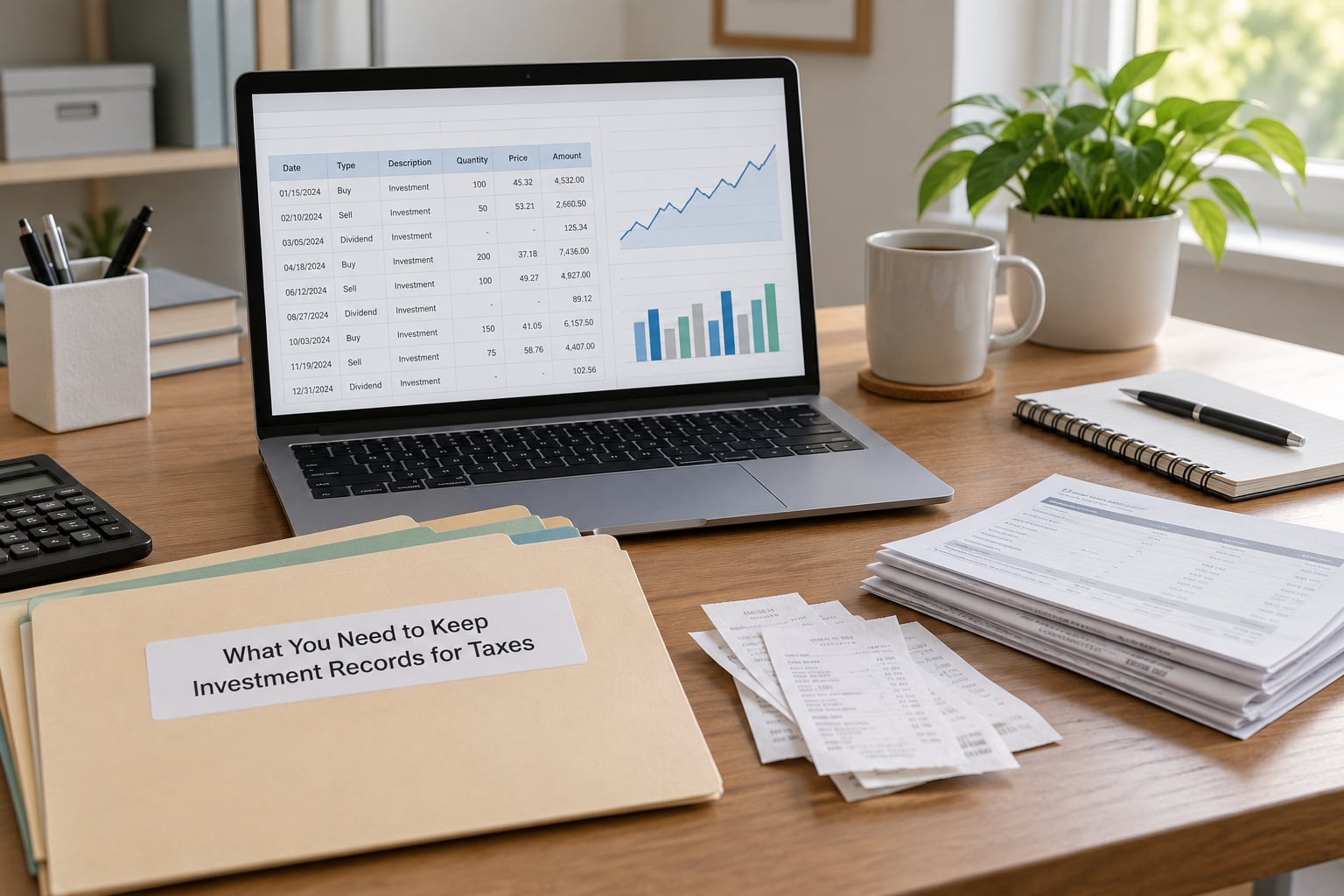
Six things, and nothing exotic: your account identifiers, the tax forms your broker sends, the statements that back them up, one storage destination, a naming convention, and a log that connects the two.
- Account identifiers. Custodian name, account number, account type (taxable, IRA, Roth IRA, 401(k)), and the last four digits only when you share files with a preparer. Write these once and reuse them.
- The tax forms themselves. Consolidated Form 1099-B, 1099-DIV, 1099-INT, 1099-R, and 1099-MISC, plus Form K-1 if you hold a partnership, LLC interest, or royalty arrangement.
- The statements behind the forms. Year-end consolidated statements, trade confirmations, and the custodian’s lot-level cost basis report.
- Retirement paperwork. Contribution confirmations, year-end plan statements, and any Form 8606 you need for nondeductible or inherited IRA contributions.
- One storage destination. A cloud folder, an encrypted external drive, or both. Pick it before you need it.
- A naming convention and a master log. These two turn a pile of PDFs into something you can actually search six years later.
Gather these before building anything. A record system that starts as one clean template beats a folder you assemble during the week your accountant calls.
Step-by-Step: The Record-Keeping System
How to keep investment records for taxes: choose one system
Pick one primary system and let everything feed it. Spreadsheets suit most individual investors, portfolio trackers suit people juggling several accounts, and accounting software suits anyone also running a business.
How to keep investment records for taxes without a tool nobody maintains: use a spreadsheet as the ledger of record and treat broker downloads as the evidence, or the reverse, but never let two systems both claim to be authoritative. The moment you reconcile a transaction from two places and they disagree, you have no idea which one to believe.
Whatever you choose, the system needs three parts working together:
- A folder structure sorted by tax year, then by account, then by document type.
- A master transaction log, one row per transaction, in a single format.
- A source-document reference in that log pointing to the exact PDF that proves the row.
A folder alone grows into a dumping ground. A spreadsheet alone loses its receipts. Together they check each other.
Create a master transaction log
The log is the spine of the whole setup. One row per transaction, with these columns, in this order:
- Date (settlement date, written the same way every time)
- Account and account type
- Security or asset name and identifier
- Transaction type: buy, sell, dividend, interest, reinvestment, transfer in, transfer out, split, merger, fee
- Quantity of shares or units of metal
- Price per share
- Commissions and fees
- Total amount
- Acquisition date and cost basis per share, on any purchase
- Holding period start date
- Realized gain or loss, on any sale
- Source document filename
- Notes, including anything you had to correct later
A worked example. On March 4 you buy 100 shares at 42.15 each and pay a 4.95 commission. Total cost is 4,219.95, so your basis per share is 42.20. That single row tells you later what you paid, when the holding period started, and which PDF proves it.
When you sell part of that position two years later, the log needs a second row: the sale date, proceeds, the basis you are matching against it, and the resulting gain or loss. Your Form 8949 is a printout of that arithmetic, so if the row is wrong the return is wrong.
Record every purchase, sale, dividend, and distribution
Enter every transaction the day it settles, using the same entry rules each time. Inconsistency is what makes a log unusable later, not volume.
Separate cash activity from non-cash activity. Dividends paid in cash and dividends reinvested are both taxable, but only one moves money. Interest paid into a sweep fund is income, and so is a return of capital, though the tax treatment differs.
Log internal transfers as separate rows on both sides. When you move shares from a taxable account into an IRA, the taxable side records the sale and its gain or loss, and the IRA side records the contribution. Recording only the destination hides a taxable event that your broker will happily report to the IRS.
Record Section 1256 contracts, including regulated futures and certain index options, on their own line. They are taxed at a 60/40 rate regardless of holding period, which surprises people who find an old statement and assume long-term treatment.
Track cost basis and adjustments
Cost basis is what you paid to acquire a position, plus commissions and fees, plus the basis of reinvested distributions. The custodian reports it on Form 1099-B, and your job is to verify it, never to overwrite the custodian’s official tax lot data.
Keep records for the events that change basis: reinvested dividends, return-of-capital distributions, stock splits, reverse splits, mergers, and spin-offs. Each one has its own documentation, and Form 8949 asks for descriptions in some cases. Save the notice or prospectus page that explains the terms.
Watch the wash sale rule under Section 1091. If you sell a position at a loss and buy a substantially identical one within 30 days before or after, the loss is deferred. The deferral is the part people miss: brokers report what happened inside your account, so a wash sale spanning two brokers or an IRA never shows up on any 1099.
Handle inherited assets separately. Basis generally resets to fair market value at the date of death, and you need the estate valuation, the death certificate date, and the account transfer paperwork to prove it. Without those documents the basis is often reported as zero or as your original purchase price, which produces a tax bill you did not expect.
Reconcile statements and correct mismatches
Spend fifteen minutes a month comparing your log against the monthly or quarterly statement. Your log is the system of record; the statement is the evidence you are testing it against.
Look for three things: transactions in the statement that never reached your log, rows in your log that never settled, and numbers that disagree on a trade that appears in both. Transfers between brokers, reinvested dividends, and merged positions cause most of these.
When you find a mismatch, correct the log, then add a dated note describing what changed and why. Restated 1099 forms are the common cause. If one arrives after you have filed, compare it against your filed return and decide with a preparer whether an amended return is worth the trouble.
Correct it the same week you find it. A three-year-old correction is the kind of problem that turns into a full afternoon of phone calls.
Save supporting records and backups
Use durable formats: PDF for statements and forms, CSV for transaction exports, and a plain spreadsheet for your log. Save each year’s folder as a frozen snapshot when the return goes out, then duplicate it to two other places.
Adopt a naming convention before you have fifty files. Date first, then custodian, then account type, then document:
2026-02-15_BrokerA_Taxable_1099-B.pdf
2026-03-04_BrokerA_Taxable_TradeConfirm_100shares.pdf
2026-03-31_BrokerA_Taxable_AnnualStatement.pdf
Follow the 3-2-1 approach: three copies, on two different kinds of media, with one copy somewhere you do not work from daily. A cloud folder plus a password manager document plus a yearly archive on an external drive is more than most people need, and it holds up for the ten-plus years these records can last.
Physical assets need their own paper trail. Bullion, coins, and collectibles come with dealer invoices, assay or grading certificates, and shipping documents. Take photographs of serials and packaging on the day of purchase and store them next to the invoice. Mining and royalty income brings Form K-1, which you keep with everything else for that entity and tax year.
Create an annual tax summary
Once a year, total what your log says and check it against your return. This is the step that makes handing records to a preparer take ten minutes instead of two hours.
Total realized gains and losses by the Form 8949 categories, then total short-term and long-term separately. Add up dividends, interest, and other investment income. Pull forward your capital loss carryforward balance. Note any withholding and any estimated payments you made.
Then compare your totals to what the brokers reported to the IRS. Where your numbers differ, you now have the documentation to explain why. Form 8949 and Schedule D instructions set out how sales are reported, and Publication 550 covers holding periods, basis, and wash sales in detail.
Save a final PDF of the summary with the year’s folder, and record the carryforward balance in the front row of the log for next January. That one number is the most commonly lost figure in self-directed investing.
Common Mistakes and Their Fixes
- Relying on screenshots. A screenshot of a transaction page can vanish with an app update. Fix: save the PDF confirmation the day you trade.
- Mixing tax lots in one row. Merging purchases from different dates destroys the acquisition date and holding period. Fix: one row per purchase event.
- Omitting fees. Commissions and margin interest belong in basis. Fix: add a fee column and fill it every time.
- Using different date formats. Mixing 03/04 with 2026-04-03 makes sorting a guess. Fix: pick ISO format and never deviate.
- Skipping backups. One cloud folder is one provider’s outage away from a bad week. Fix: 3-2-1, checked once a year.
- Treating an account summary as a tax basis report. A year-end statement shows what you held, not what the IRS will see. Fix: use the Form 1099-B summary plus your lot-level export.
- Assuming the broker’s data is complete. Cross-account wash sales and some corporate actions are not reported anywhere. Fix: your log is the only complete record.
If your records are already thin, recover what you can before filing. Brokers can usually reprint historical statements and provide lot-level detail for older positions, sometimes for a fee. Form 4506-T gives you a copy of a return you filed years ago, and an IRS account transcript proves what was filed when. Where basis is genuinely unrecoverable, a preparer can often work out a defensible method rather than leaving you guessing.
Ask a CPA or enrolled agent when records span inherited assets, an unrecoverable transfer-in basis, crypto or physical metals, multi-state issues, or a notice from the IRS. Bring the log, not a shoebox, and the conversation costs an hour instead of three.
Frequently Asked Questions
How long should I keep investment records for taxes?
Three years after you file is the federal floor for most supporting documents. Six years applies when you understated income by 25 percent or more, and there is no limit when a return was never filed or fraud is involved. In practice, hold trade records for six years past the sale and retirement records until every distribution is complete.
Do I need to keep records if my broker provides tax forms?
Yes. The form your broker sends is a report about you, not your file, and the IRS receives the same data directly. Errors show up regularly: wrong basis after a transfer, merged lots, missing reinvested dividends, or a restated form after you have already filed. Your own records are what let you spot those and correct them.
What investment records should I keep for tax purposes?
The core set is a consolidated Form 1099-B, 1099-DIV, and 1099-INT, your year-end account statements, trade confirmations for anything you sold, the custodian cost basis report, retirement forms such as 1099-R and 8606, and any Form K-1. Add dealer invoices for physical metals and a lot-level export if you trade options or futures.
Can I use a spreadsheet to track investment transactions?
Yes, and for most individual investors a spreadsheet is enough. One row per transaction, fixed columns, consistent dates, and a saved copy each year covers the whole job. Spreadsheets break down when data from several sources is merged without a shared format, so keep one master log rather than a separate file per broker.
How do I calculate cost basis for investments?
Cost basis is what you paid to acquire a position, plus commissions and fees, plus the basis of reinvested distributions. It changes after a return of capital and generally resets to fair market value when you inherit an asset. In a taxable account the custodian reports it on Form 1099-B, so compare their figure against your own log before filing.
What should I do if my investment records do not match my tax statement?
Compare line by line first: dates, shares, proceeds, and lot count. Transfers, reinvested dividends, and mergers cause most differences. Ask the custodian for the transaction-level detail behind the summary line, correct your log, and note the fix with a date. If a restatement arrives after filing, decide with a preparer whether an amended return makes sense.
Conclusion
Start this week rather than next tax season. Choose one system, build a master transaction log with the columns above, and save one recent statement as the template you will reuse for every account and every year.
That is the whole job. From there, the monthly reconciliation keeps the log honest, the annual summary keeps your carryforward balance and gains totals in one place, and the 3-2-1 backup keeps everything readable when a broker restates a form or the IRS sends a notice six years later. Anyone can learn how to keep investment records for taxes with an hour of setup and a habit of fifteen minutes a month.