To invest in timber and forestry, you buy exposure to forest land and the trees growing on it. You can do that five ways: buy a parcel of forest land directly, put money into a private timberland fund run by a timber investment management organization, buy shares in a publicly traded timberland REIT, buy a forestry ETF, or buy a single forestry company. Most people start with a public-market vehicle because it costs little and takes an afternoon to set up.
The catch is that the five routes are not interchangeable. One gives you control over a specific hillside and a thirty-year commitment. Another gives you a dividend cheque and no soil. Getting the match right matters more than picking the winner, because the honest long-run numbers on this asset class are modest and the differences in liquidity and tax treatment are large.
This guide walks through what you need to gather first, the step-by-step process for choosing and checking an opportunity, and the mistakes that show up most often. It is updated for 2026 and reflects US-market examples, though the mechanics in forestry, taxation and land tenure differ elsewhere.
Table of Contents
- What You Need Before You Invest in Timber and Forestry
- Step-by-Step: How to Invest in Timber and Forestry
- 1. Define your investment objective and time horizon
- 2. Choose how to invest in timber and forestry
- 3. Evaluate the underlying forestry assets
- 4. Analyze cash flow, valuation and fees
- 5. Check sustainability and regulatory risks
- 6. Diversify and monitor the position
- Common Mistakes in Timber and Forestry Investing
- Frequently Asked Questions
- Are timber and forestry investments suitable for long-term investors?
- How do timber REITs differ from owning timberland directly?
- What returns can investors expect from forestry assets?
- Are timber investments environmentally sustainable?
- How liquid are forestry investments compared with stocks?
- What due-diligence questions should I ask before investing?
- Start With a Focused Due-Diligence Checklist
What You Need Before You Invest in Timber and Forestry
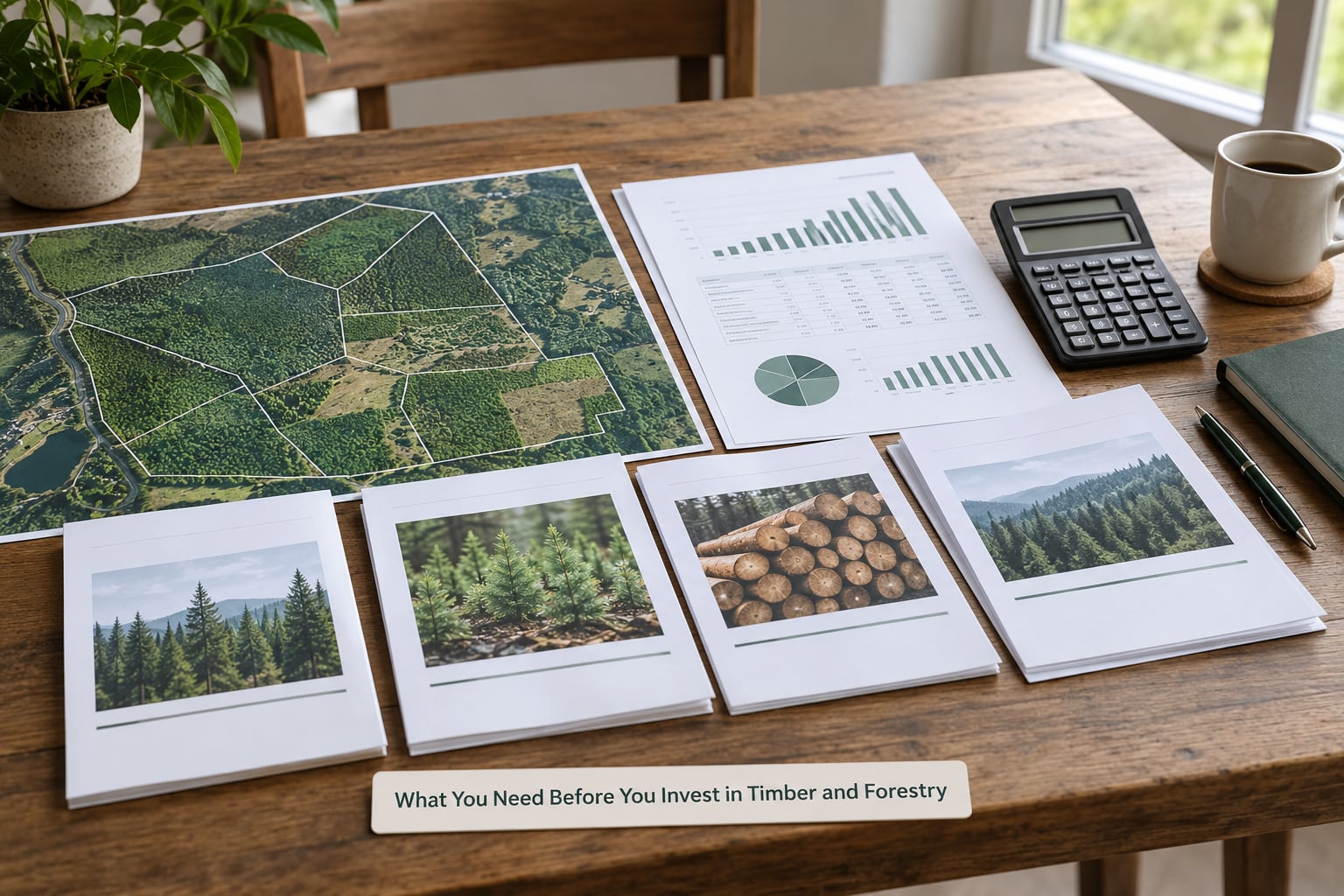
Gather the material first. Forestry deals reward slow reading, and a rushed decision usually means you accepted somebody else’s numbers.
- A clear list of what you own or plan to own. Direct forest land, a fund interest, REIT shares and ETF units have completely different risk profiles. Decide which one you are evaluating before you look at returns.
- Financial statements, not brochures. For a public company, the annual report and the REIT distribution statement. For a fund, audited statements, fees, lockup terms and redemption windows. For land, a cruise report, an appraisal and the property tax history.
- The name of a licensed forester. This is the professional you cannot skip. Bogleheads participants on a 2010 forum thread pointed beginners to their state department of forestry or natural resources first, noting that staff foresters will often visit property and advise at no charge.
- Your own numbers on your own timeline. An internal rate of return, a net present value, a payback period. Being able to run a discounted cash flow in a spreadsheet is the difference between reading a brochure and reading a balance sheet.
- Knowledge of the local tax rules. Timber income, depletion deductions, capital gains on the underlying land and estate treatment all differ by state and country. Get advice from a professional who works with timber, not a generalist.
- An honest view of liquidity. Deciding when you might need the money, before you commit. Forest land can take months or years to sell into the right hands.
- A sense of your own risk tolerance. Wildfire, insects, disease and lumber price cycles are all part of the asset class, not surprises bolted on afterwards.
Step-by-Step: How to Invest in Timber and Forestry
1. Define your investment objective and time horizon
Start by writing down what you want the money to do. Land appreciation over decades is a different goal from steady dividend income, and neither is the same as owning woodland for hunting and conservation. Most direct timberland owners hold for twenty to forty years because that matches the pace trees grow and mills need.
Near-term traders should stay away. Trees do not adjust to a rate decision the way a share price does, and a rotation cycle that is convenient for the forest can be badly timed for your mortgage.
2. Choose how to invest in timber and forestry
Compare the five routes on control, liquidity, effort and complexity. Here is how they differ at a glance.
| Route | Typical entry | Liquidity | Income profile | Main return driver |
|---|---|---|---|---|
| Direct forest land | Full purchase, closing and transaction costs | Very low, sale can take a long time | Harvest proceeds, leases, occasional carbon payments | Land appreciation plus timber harvest |
| Private timberland fund (TIMO-run) | Large minimums, lockups and fund fees | Low, redemption only on set windows | Distributions set by the manager | Harvest and land value across a portfolio |
| Timberland REIT | Share purchase through any broker | Daily, like any listed share | Dividend, with a REIT distribution requirement | Land and timber value plus dividends |
| Timber and forestry ETF | Share purchase through any broker | Daily | Dividends from the underlying companies | Equity price movement of forestry firms |
| Single forestry company | Share purchase through any broker | Daily | Dividend, company-dependent | One company’s mills, land and balance sheet |
Direct forest land is the most involved. You own the trees, the dirt, the roads and the bills. A forester writes a forest management plan, marks stands for thinning and harvest, and you sell logs to mills. You will also meet property tax, insurance, road maintenance, boundary disputes and neighbours who would like to hunt.
Private timberland funds are run by TIMOs. They buy, manage and eventually sell parcels on behalf of investors and take management fees plus a share of the returns. The minimums and lockups usually sit well beyond a retail account, so the practical question is whether you can qualify at all.
Timberland REITs are the easiest entry point. Three US names dominate the sector: Weyerhaeuser, which elected REIT status in 2010 and holds roughly 11 million acres in the US plus about 14 million acres under long-term Canadian licences; Rayonier, with about 2.8 million acres split roughly 69% US South, 17% Pacific Northwest and 14% New Zealand; and PotlatchDeltic, with about 1.9 million acres across Arkansas, Alabama, Louisiana, Idaho, Minnesota and Mississippi, plus sawmills, a plywood mill and a real estate development arm. Named here as research starting points, not recommendations.
Forestry ETFs buy a basket of listed forestry companies for you, which spreads company risk but adds a layer you cannot see through. On the lumber question people often ask: there is no widely available retail fund holding physical lumber. Lumber futures are traded through a futures broker with margin requirements, and most broad commodity funds hold only a tiny forestry weighting, so they are not a way to bet on lumber prices.
A single company puts you on one management team, one mill network and one geography. Concentrated, but you know exactly what you own.
3. Evaluate the underlying forestry assets
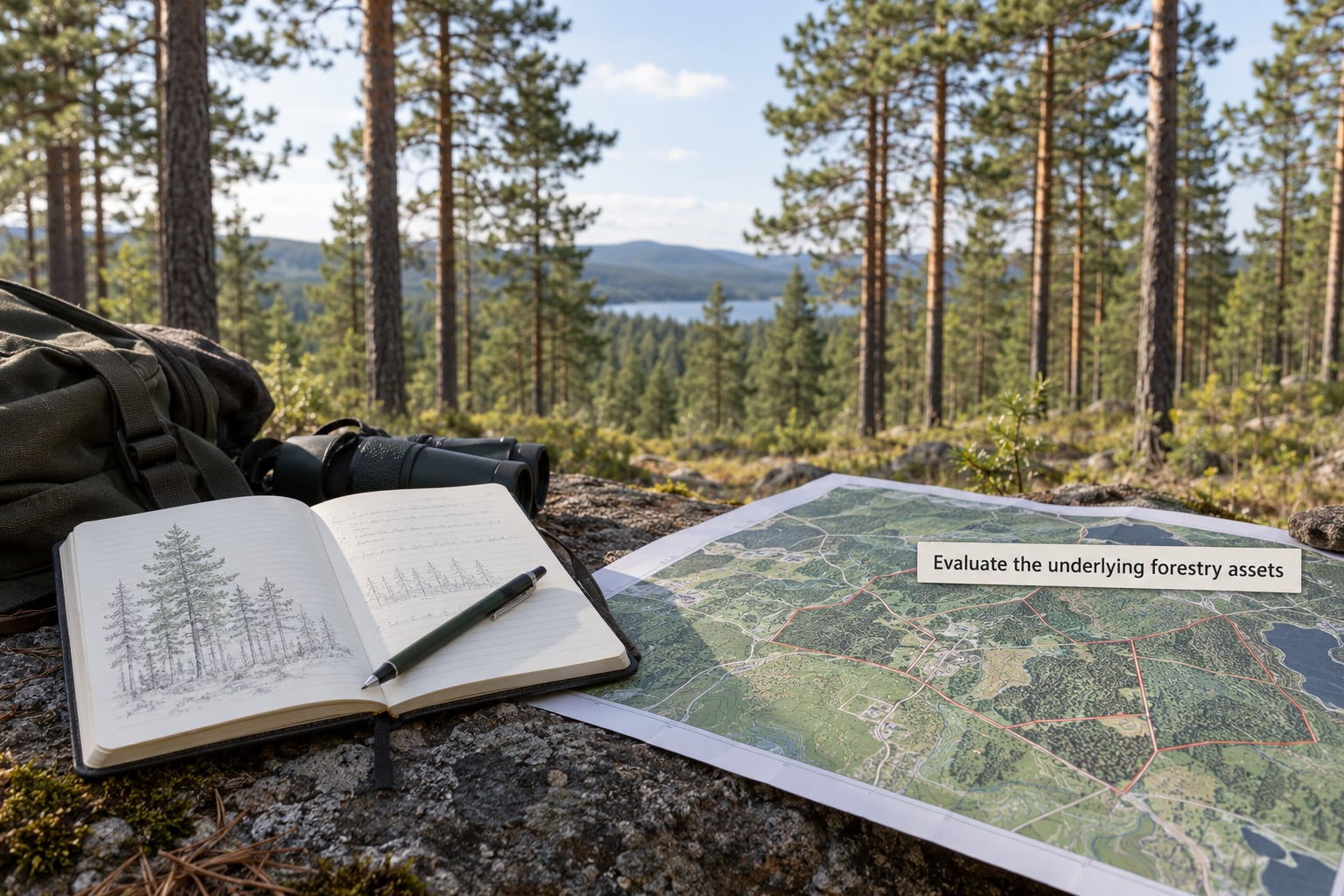
Whether you are buying land, a fund stake or shares in a landowner, the question underneath is the same: what is growing, where, and who manages it?
Location and access. Wood that cannot be trucked out cheaply is worth less. Distance to a mill and quality of year-round road access move appraised value more than many buyers expect. A parcel at the end of a seasonal mud road can look identical on a map and be worth materially less.
Species, age and quality. Loblolly and longleaf pine average roughly 8% biological growth per year in good conditions, according to a 2025 research primer on the sector. That figure varies enormously with site quality, soils, rainfall and management. A cruise report counts trees by species, diameter and height on a sample grid, which is how you know what is really standing there rather than what the listing claims.
Harvest cycle. Ask for the average harvest age and rotation length, and look at the thinning schedule. A forest harvested on a disciplined rotation produces a steadier cash flow than one that relies on a single big cut a generation away.
Soils, water and silviculture. Check drainage, site index and whether the plan calls for replanting after harvest. Mississippi State University Extension cites landowners earning roughly a 7-10% real rate of return by replanting pine seedlings after harvest, which is a concrete argument for following the silvicultural plan rather than letting a stand mature past its economic point.
Tenure and encumbrances. Confirm you get clear title, mineral rights, water rights and any easements for power lines or pipelines. Hunting and recreational leases can add income and create obligations, so read them.
4. Analyze cash flow, valuation and fees
Work through the numbers rather than the headline. A yield that looks generous can be an accounting artefact, and a fee you cannot see may be doing most of the damage.
Start with what the investment actually distributes, then divide by what you put in, to get the cash-on-cash return. For direct land, the honest calculation is a discounted cash flow: forecast harvest proceeds, replanting and management costs, road upkeep, taxes and land sale, discount at a rate that reflects forestry risk, then check whether the net present value is positive and the internal rate of return beats what you could get elsewhere.
On stumpage specifically, the calculation runs through volume and quality rather than acreage. Estimate merchantable volume in board feet from the cruise report, apply a local stumpage price net of logging and hauling costs, subtract the discount for hauling distance and road access, and scale by the share of the parcel you intend to harvest in a given year. This is the same arithmetic behind the questions people ask about what loggers pay per acre or what an acre of pine is worth: the answer is a volume times a price, not a fixed number per acre.
Then look at what you are paying in fees. Fund management fees and carried interest, REIT expense ratios, ETF expense ratios, brokerage costs and appraisal fees all come out of the same return. Private funds usually add a lockup of several years, which is the single most important term on the page for anyone who might need cash.
Understand valuation method too. Appraised value per acre is a modelling exercise resting on assumptions about growth, harvest and discount rate. Ask what discount rate was used and whether the appraiser or the fund manager built the model.
5. Check sustainability and regulatory risks
Certification schemes carry real weight in this sector. The Forest Stewardship Council and the Sustainable Forestry Initiative both set standards for responsible harvesting and replanting, and an owner may be contractually required to hold one. Replanting after harvest is the baseline expectation, and thinning improves both timber value and habitat in many stands.
Also weigh the criticisms honestly. Forestry has been criticised for clearcut harvest reducing biodiversity, for effects on habitat and stream buffers, and for unresolved questions about land rights in several regions. Where a manager claims sustainability, ask for the certification number, the harvest plan and the replanting record rather than accepting the label.
On carbon, be clear-eyed. Trees absorb carbon as they grow, and the fastest-growing stands absorb the most, which conveniently overlaps with the most profitable window to harvest. Carbon project revenue depends on a verified methodology, a registry and a buyer, and it should be treated as a possible addition rather than dependable income.
Then check the physical and legal risks. Wildfire in dry years, bark beetle and other pest outbreaks, disease, drought stress, water access, harvest permits, buffer rules, land-use restrictions and zoning near a growing suburb all change the value of a parcel. Check the fire history for the county before you fall in love with a specific stand of trees.
6. Diversify and monitor the position
Set a limit before you buy. Forestry exposure is genuinely different from equities and bonds, which is the point of owning it, but concentration in one region, one species or one harvest window is a different kind of risk entirely. Institutional allocators typically size timberland as a small slice of a portfolio, not the core of it.
Once you hold it, watch a short list: distributions per unit, timber and lumber prices, harvest activity in the company’s filings, debt levels and interest expense, dividend coverage, and any regulatory or fire news in the relevant counties. For direct land, the annual cruise report and the property tax bill are your dashboard. Re-run your own model annually with actual harvest data, because appraisals drift.
Common Mistakes in Timber and Forestry Investing
Treating a high yield as a safe one. A distribution that looks like a yield may partly be a return of capital, and the payout ratio tells you how much of it came from operations. Check the REIT distribution requirement, which is what makes REIT payouts predictable but also why the underlying companies have little room to smooth out a bad year.
Buying without an exit plan. Ask who would buy this land in ten years and at what cost. Roads, title, mineral rights and access conditions drive resale value as much as tree quality does.
Ignoring liquidity. A fund with a five-year lockup is not a near-term store of value, whatever the marketing says. Direct timberland can be slower still.
Concentrating in one region or one species. Single-company exposure and single-watershed exposure can both turn one bad fire season or one mill closure into a large loss.
Counting carbon credits as guaranteed income. Project revenue depends on verification, registries and buyers. Model it at zero and treat it as upside.
Accepting management claims without records. Ask for the certification, the harvest schedule, the replanting history and the appraiser’s discount rate. If the answers are vague, so is the opportunity.
Frequently Asked Questions
Are timber and forestry investments suitable for long-term investors?
Generally yes, because the asset itself works on a long clock. Trees need decades to reach harvest age, and a forest management plan only makes sense over a full rotation. The same feature makes these investments a poor fit for short-term goals. Expect your money to be tied up for years, with dividends or distributions as the only income along the way, and decide whether that fits your plan before you buy anything.
How do timber REITs differ from owning timberland directly?
A timberland REIT owns forests on behalf of shareholders and you own a share of the company. You get daily liquidity, a dividend and no management chores. Direct ownership gives you control over which stands get harvested and when, plus hunting leases, mineral rights and development optionality, but also property tax, road upkeep, insurance and a sale that can take a long time. The REIT structure pays you for land you will never see.
What returns can investors expect from forestry assets?
Treat single-digit annual total returns as the realistic planning range rather than the exception. A 2025 research primer on the sector put the five-year total return of the global timber and forestry ETF near 5%, noted that the three US timber REITs roughly broke even over twenty years after dividends, and gave an average Timber REIT yield of 2-3%. Direct landowners can do better with active management, and MS State Extension cites roughly a 7-10% real rate of return for replanting pine after harvest. Past results do not predict future ones.
Are timber investments environmentally sustainable?
It depends entirely on the forest and the manager. Certification schemes such as the Forest Stewardship Council and the Sustainable Forestry Initiative set standards for harvest, replanting and habitat protection, and responsible operators hold them. The criticism is real too, and covers clearcut harvest, biodiversity loss, stream buffer protection and land rights disputes in some regions. Verify the certificate and review the actual harvest plan rather than relying on a general claim of sustainability.
How liquid are forestry investments compared with stocks?
Very much less. Timberland REITs, forestry ETFs and forestry company shares trade daily like any other listed security, so selling takes seconds. Private timberland funds usually lock investors in for several years with redemption only at set windows. Direct forest land is slower still, since a sale involves finding a buyer, due diligence, title work and sometimes a negotiated closing over months. Size the position so the illiquid part is money you will not need soon.
What due-diligence questions should I ask before investing?
Ask who manages the land and what they have harvested over the past decade. Request the cruise report, the forest management plan, the average harvest age, the replanting record, road and access conditions, mineral and water rights, easements, the property tax history, the certification number and the appraiser’s discount rate. For funds and funds of funds, add fees, lockup terms, redemption windows and past performance net of all costs. A licensed forester can walk you through the land documents.
Start With a Focused Due-Diligence Checklist
If you take four actions, you will be ahead of most retail buyers in this asset class. Write down your objective and the earliest date you might need the money, because that single sentence rules out most of the options immediately. Pick one route and one region rather than a scattered set of forestry holdings, which keeps your first learning curve affordable. Then run one asset through the full check: cruise report, management plan, road access, title and easements, fees and lockups, and the appraiser’s assumptions, with a licensed forester reading it with you. Finally, ask for the current financial and risk information in writing and give the structure a full business cycle before you commit real money.
Forestry rewards patience, and the vehicles that are easiest to buy are the ones most likely to disappoint if you expected more than a steady, diversified income. Know which one you are holding and why, then let the trees do their part of the work.
Disclaimer: this article is general information, not investment, tax or legal advice. Returns figures cited are historical, sourced to the publications and dates noted, measured in US dollars, and do not predict future results. Rules on timber income, depletion, capital gains and foreign ownership of land vary by country and state. Securities named are research starting points and are not recommendations. Consider a licensed forester and a tax professional before acting.