To hold silver in an IRA you use a self-directed account with a custodian that permits precious metals, and the metal itself sits with an IRS-approved depository or vault in the name of the account. You tell the custodian what to buy, a dealer delivers the silver straight to that vault, and you never take the metal home while it stays inside the IRA. Getting there takes six steps, and most of the surprises come from eligibility rules and fees rather than the buying itself.
Below is what I wish someone had laid out for me before I started: the documents to gather, the account types worth comparing, the questions that expose a weak custodian, and what actually happens when you sell. Rules and limits change, so confirm the current figures with the IRS and a qualified tax professional before you move money.
Last reviewed in 2026. This is educational information, not tax or investment advice.
Table of Contents
- What You Need
- Identification and account documents
- A funding source you can name
- A custodian that allows the investment
- A dealer who will ship to the depository
- A shortlist of eligible silver
- Records to keep
- Step-by-Step: How to Hold Silver in an IRA
- Step 1: Choose an IRA that fits your withdrawal needs
- Step 2: Select a custodian that lets you hold silver in an IRA
- Step 3: Confirm that the investment is IRA-eligible
- Step 4: Fund the IRA and purchase silver
- Step 5: Store or manage the holding and review it regularly
- Step 6: Know the exit before you enter
- Common mistakes
- Frequently Asked Questions
- Can you buy silver with IRA money?
- Can I store silver in my IRA at home?
- Are silver ETFs allowed in an IRA?
- What fineness does silver need to be IRA eligible?
- How do I roll over a 401(k) into a silver IRA?
- What happens when I sell silver in my IRA?
- Conclusion
What You Need
You do not need much to begin. You need identification, a funding source, a custodian that permits the investment you actually want, and a clear idea of which silver you are buying. Gathering those four things before you open anything saves the expensive mistakes later.
Identification and account documents
Every custodian will ask for a government photo ID, your Social Security number, date of birth and address, and a signature on the account agreement. Having those scanned in one folder shortens the opening process from weeks to days.
A funding source you can name
Traditional and Roth IRAs generally need compensation or self-employment income to open with new money. If you have no earned income this year, your realistic options are a direct transfer from another IRA, a 401(k) rollover, or moving a 401(k) into a solo 401(k). Retirement savers on r/BestGoldIRACompanies ask this question constantly, because rolling over an old 401(k) is the most common way people fund a metals account.
A custodian that allows the investment
Not every IRA custodian holds bullion. Ask before you open: do you permit physical silver, do you charge a one-time setup fee, what is the annual account fee, and is storage billed separately. Get the answers in writing before you sign.
A dealer who will ship to the depository
Your dealer has to be willing to fill the order in the name of your IRA and deliver to the custodian’s chosen vault. Most reputable bullion dealers do this routinely, but some retail sellers will not, which alone rules them out.
A shortlist of eligible silver
Decide whether you want coins, bars or a fund before you talk to anyone. That choice determines your premium, your storage cost, and how easily you can sell later.
Records to keep
Order confirmations, trade confirmations, valuation statements and fee invoices. Silver held in an IRA produces no 1099-B, so the custodian’s statements are your only cost-basis trail. Keep them for years.
Step-by-Step: How to Hold Silver in an IRA
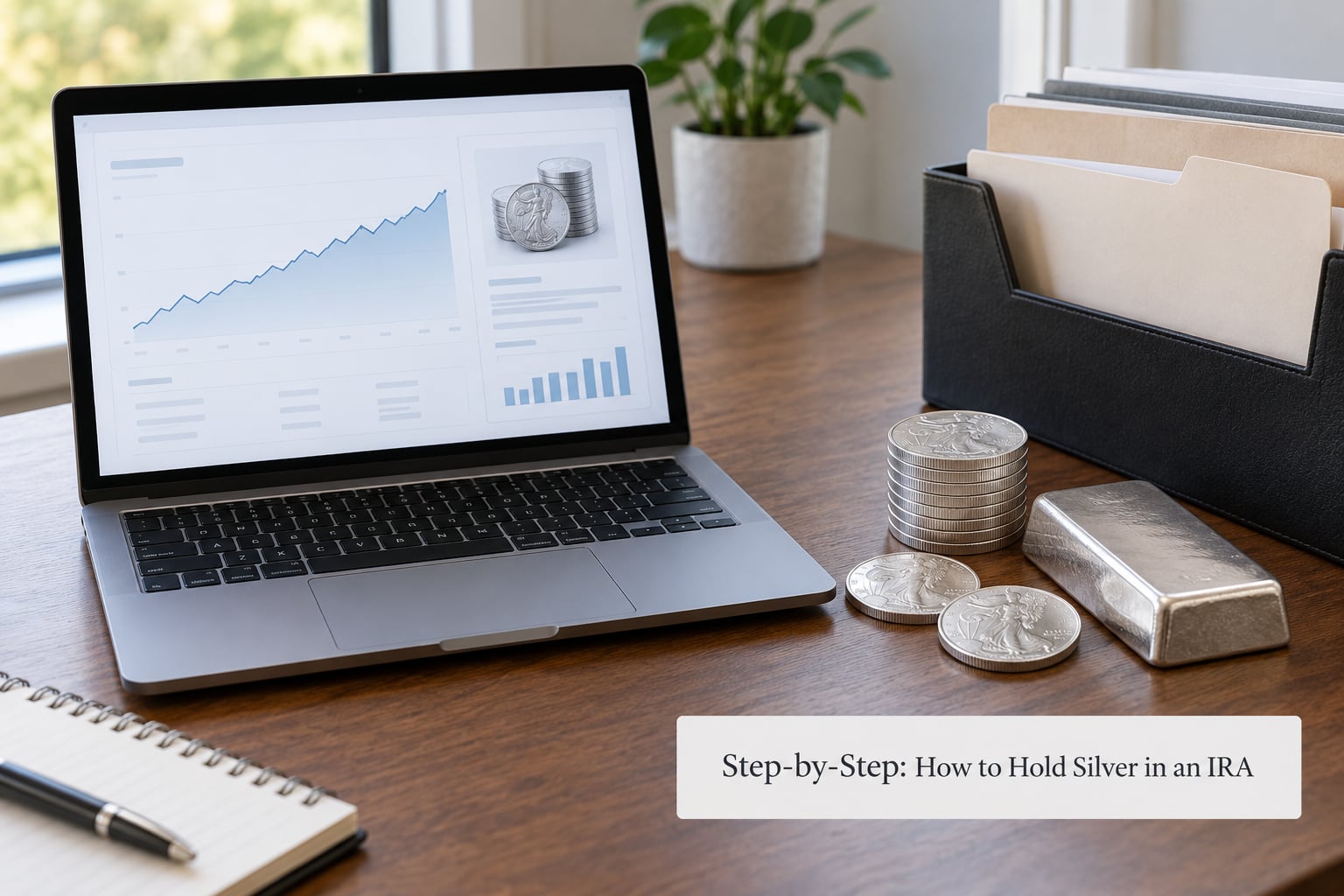
Here is how to hold silver in an IRA in plain order: choose the account type, pick a metals-permitting custodian, confirm the specific silver qualifies, fund the account, place the purchase in the IRA’s name so the dealer delivers to the depository, then manage and eventually sell the position. Six steps, and step three is where most accounts go sideways.
Before any of it, one comparison worth making. Metals IRAs, silver funds inside a normal brokerage IRA, and silver you own outright are three very different products.
| Factor | Physical silver in a metals IRA | Silver ETF in a normal IRA | Silver you own outright |
|---|---|---|---|
| Custody | IRS-approved depository or vault | Fund share record | Your home or your own vault |
| Possession | None while inside the account | None | Yours |
| Annual fees | Account fee plus storage, itemized | Expense ratio only | Home insurance or vault rental |
| Entry cost | Dealer premium over spot | Brokerage commission | Dealer premium over spot |
| Tax treatment | Tax-deferred or tax-free depending on account type | Same as any IRA holding | Capital gains when sold |
| Liquidity | Sell to a dealer, funds arrive in days | Sell any market hour | Sell to a dealer, same as above |
| Best for | People who want tax deferral on metal | Low-cost silver exposure, small tickets | Investors who want possession |
The honest read: the IRA wrapper buys you tax deferral and removes income taxes on a rollover, and it costs you possession plus two annual fees. The fund route gives up almost nothing on tax treatment and costs a fraction as much, which is why it deserves a fair hearing before you sign anything.
Step 1: Choose an IRA that fits your withdrawal needs
A Traditional IRA gives you a deduction now and taxes the metal at your ordinary income rate when you withdraw. A Roth IRA is funded with after-tax money and, after the rules are met, qualified withdrawals are tax-free. That difference matters a lot for an asset like silver that produces no income along the way.
A SEP IRA is funded by an employer or self-employed owner, and a solo 401(k) gives self-employed people control over investment choices plus a larger contribution ceiling. Both can hold metals through a self-directed provider. Check the current IRS contribution limits and income thresholds for the year before you transfer anything, because the numbers are indexed and change.
One caution for anyone already holding gold or silver personally: moving metal you own into an IRA is an in-kind contribution, and most custodians will only accept it with prior written permission. Ask first. Buying new metal in the account’s name is the smooth path.
Step 2: Select a custodian that lets you hold silver in an IRA
This is where people lose money, and it has almost nothing to do with silver prices. Here is the vetting list I would run through with any provider:
- A written fee schedule showing the annual account fee, the storage fee, and any one-time setup fee as separate line items.
- No asset-based or “management” fee quietly deducted from your balance.
- A custodian that does not also run its own metals sales operation. Separation means the custodian has no incentive to push you into a purchase.
- Clear insurance terms, including who holds the policy and what it covers.
- A stated process for selling, liquidating, and transferring out, in writing rather than a sales promise.
- No pressure to roll over a 401(k) on the spot. A reputable provider is fine with you taking a week.
Owners on retirement forums describe a typical first-year running cost of roughly 80 to 100 dollars in account fees plus about 100 dollars in storage, so somewhere in the 180 to 200 dollar range annually before any premium on the metal itself. A single setup fee in the region of 50 dollars is common. Get your provider’s real numbers in writing, because the recurring complaint on these forums is not the fee level, it is discovering fees after the fact.
Step 3: Confirm that the investment is IRA-eligible
The tax code generally bars collectibles in an IRA, and precious metals qualify through a specific exception with two conditions attached. The metal must be in your IRA, and it must be held by an approved trustee or depository rather than your house.
On fineness, silver bullion must be at least .999 fine. Bars, rounds and generic bullion coins that meet the standard qualify. A small set of coins is named directly in the code and qualifies at a lower fineness, including the American Silver Eagle, American Gold Eagle, Canadian Maple Leaf, Australian Kangaroo, Austrian Philharmonic and Mexican Libertad, among others. If a dealer claims a proof or numismatic coin is IRA-eligible, that is a red flag worth walking away from.
Ask a custodian or dealer these five questions in writing: Is this specific product eligible for IRA purchase? What fineness is it? Where will it be stored, and is that storage segregated? Who has title to the metal while it is in storage? And what is the documented exit process? A dealer who will not answer the eligibility question plainly is selling you something else.
Step 4: Fund the IRA and purchase silver
You have three funding routes. A direct trustee-to-trustee transfer from an existing IRA moves money without triggering income. A 401(k) rollover puts money in the account and can be taxable if it is a 60-day cash rollover rather than a direct transfer. A new contribution from earned income goes through a bank transfer like any other IRA.
Once funded, you instruct the custodian in writing, the custodian places the order with the dealer, and the dealer delivers the metal directly to the depository in the name of your IRA. Funds under $10,000 in a custodian account are invested at your direction, though many providers place smaller amounts in a default fund until you act, so check your statement.
Verify the silver arrived. You should receive a confirmation from the depository or a statement showing ounces and purity held, not just a shipping notice.
Step 5: Store or manage the holding and review it regularly
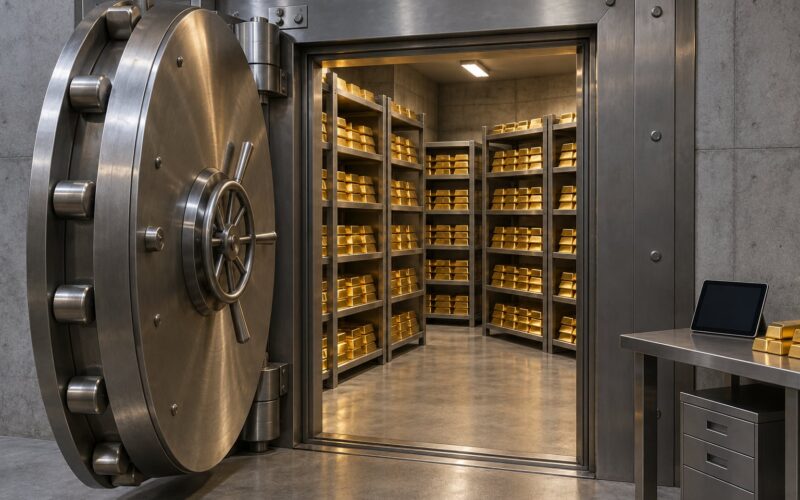
Storage comes in two main flavors. A cash depository account holds metal on a pooled or unallocated basis, and you hold a claim on a quantity rather than on specific pieces. Allocated storage means specific serially numbered coins or bars are set aside as yours. Ask which model you are paying for; the answer changes what happens if the depository has a problem.
Accounts run on annual fees and periodic valuations, and your custodian normally reports the metal in troy ounces. Review once a year that the ounces still match what you bought, the fee schedule has not changed, and the position still fits the role you gave it. Silver produces no yield, so its case rests on diversification and price, and those arguments get weaker when the position grows to a large share of your retirement savings.
Step 6: Know the exit before you enter
Nobody explains this part well, so ask for it in writing at the start. To leave, you instruct a sale, the custodian sells to a dealer, and the cash goes back into the IRA. Your account then carries cash until you take a distribution or transfer out.
Distribution rules come from the IRS and depend on your age and account type. A Traditional IRA requires a minimum distribution in most cases once you reach a certain age, and the taxable amount is based on the silver’s value at distribution, which is exactly the moment prices tend to spike. A Roth requires no minimum distribution to the original owner. You can also move the account to another IRA custodian by direct trustee-to-trustee transfer, and metal generally cannot simply be handed to you while it is inside the account. Take metal physically only after it is distributed out, where your income situation will have a lot to say about the tax.
Common mistakes
Buying collectible coins. Proof and numismatic sets routinely sell at large multiples of melt value and usually fail the IRA collectibles bar. Fix: buy .999 fine bullion or a named exception coin, and check the eligibility question before the order, not after.
Threads on r/BestGoldIRACompanies circle one theme: nobody explains what happens when you sell, and the storage and account fees are why a metals IRA was not worth it for some owners. Fix: get the rollover illustration with dollar figures, and compare it against simply opening a self-directed IRA at a lower-fee provider.
Ignoring storage and insurance in the math. A metals IRA can carry a few hundred dollars a year before a single ounce is bought. Fix: divide the annual fees by the value of the holding. On a small position, the cost of carry can eat a meaningful share of any gain.
Storing bullion at home and calling it an IRA. Household metal is not IRA property. Fix: keep IRA metal at the depository your custodian uses.
Assuming the whole category is safe. It is a legitimate structure, but the rollovers industry has a persistent marketing problem. Fix: check disclosures, fee schedules, and whether anyone is pushing you to act today.
None of this depends on a silver price forecast, and that is deliberate. Volatility cuts both ways, so the case for metal in a retirement account rests on diversification and tax structure, not on a target for the ounce.
Frequently Asked Questions
Can you buy silver with IRA money?
Yes, if your custodian permits precious metals. You instruct the custodian, a dealer buys the silver you selected, and the dealer delivers it to the IRS-approved depository in the account’s name. The metal must be at least .999 fine or a named exception coin such as the American Silver Eagle, and it must stay in the depository to keep the account compliant.
Can I store silver in my IRA at home?
No. IRA rules require precious metals to be held by an approved trustee or depository for as long as they stay in the account. Home storage breaks that requirement, and the metal can become a taxable distribution. If you want silver in your possession, buy it separately outside the IRA and keep the account holding something else.
Are silver ETFs allowed in an IRA?
Yes. Silver exchange-traded funds hold metal themselves and are permitted inside a Traditional or Roth IRA at any major brokerage, so no self-directed custodian is needed. The trade-off is an expense ratio instead of account and storage fees, no possession, and a fund share that trades like a stock. Many investors start here before deciding whether physical metal adds enough to justify the extra costs.
What fineness does silver need to be IRA eligible?
Silver bullion must be at least .999 fine to qualify. A limited set of coins named in the tax code qualifies at lower fineness, including the American Silver Eagle, Canadian Maple Leaf, Australian Kangaroo, Austrian Philharmonic and Mexican Libertad. Proof and numismatic coins generally do not qualify, no matter what a seller calls them, and they usually carry premiums far above metal value.
How do I roll over a 401(k) into a silver IRA?
Compare providers first, then ask for a rollover illustration showing every dollar amount involved. Choose a self-directed IRA custodian that allows bullion, open the account, and start a direct trustee-to-trustee transfer so the money moves straight from your plan without you touching it. A 60-day cash rollover into your own account can trigger taxes, so the direct transfer is the cleaner route.
What happens when I sell silver in my IRA?
You instruct a sale, the custodian sells the metal to a dealer, and the proceeds land back in the IRA as cash. Any tax depends on the account type: a Traditional IRA is taxed as ordinary income at distribution based on the metal’s value that day, while a qualified Roth distribution is tax-free. Required minimum distribution rules from the IRS can also apply, so plan the sale around your distribution schedule.
Conclusion
Start with two things: decide which IRA type fits your withdrawal plan, then ask two or three metals-permitting custodians for their written fee schedule and their written exit process. Compare those answers against buying a silver fund inside a brokerage IRA, which is cheaper and simpler. When the numbers point to a metals account, buy eligible silver in the IRA’s name, have the dealer deliver to the depository, and review the position once a year.
Rules, limits and tax treatment change, and silver prices move hard in both directions. Confirm the current IRS figures and your personal situation with a qualified tax or investment professional before you fund the account.