
Here is how a precious metals IRA works: it is a self-directed Individual Retirement Account that holds IRS-approved physical gold, silver, platinum, and palladium bullion, with the metal stored by an approved depository rather than in your house. You open it with a metals-capable custodian, fund it with cash or a rollover, buy bullion from a dealer, and the custodian tracks and values the holdings for you every year.
That is the whole mechanism. The rest of this guide covers what you can actually hold, how the purchase and storage process runs, what it costs, and which tax rules trip people up. Written as a walkthrough, not a recommendation, because the account structure is what matters before you fund anything.
Table of Contents
- What Is a Precious Metals IRA?
- Which Metals Can You Hold in a Precious Metals IRA?
- How a Precious Metals IRA Works Step by Step
- What Happens After You Fund a Precious Metals IRA?
- How Storage and Custody Work
- What Fees and Costs Should You Expect?
- How Taxes and Retirement Rules Affect the Account
- Precious Metals IRA vs. Regular Brokerage Account
- What to Check Before Opening an Account
- Frequently Asked Questions
- Do I own the gold in a precious metals IRA?
- Can I roll over my 401(k) into a precious metals IRA?
- Can I store my precious metals IRA gold at home?
- Can I take physical possession of the metal when I retire?
- What is the minimum needed to open a precious metals IRA?
- How are precious metals IRAs taxed and reported?
- Conclusion: Start With the Account Structure
What Is a Precious Metals IRA?
A precious metals IRA is a retirement account that holds physical bullion rather than stocks, bonds, or mutual funds. It is a self-directed IRA, which means you choose what the account holds instead of picking from a custodian’s investment menu. The same tax treatment applies as a traditional or Roth IRA, so the metal sits inside the account framework rather than in a taxable brokerage account.
The rules come straight from tax code. Section 408(m) added precious metals as a permitted asset class and Section 408(m)(3) defines exactly what counts. In practice a custodian is still required, and that custodian has to accept metals as an investment. Most conventional custodians do not.
Who uses one? People near or in retirement who want a small slice of a tangible asset inside a tax wrapper, and people rolling over an old 401(k) or traditional IRA balance who want that money held in something other than the usual funds. What it is not: a brokerage account, a way to collect rare coins as a hobby, or a place to keep personal jewelry and coin collections.
Which Metals Can You Hold in a Precious Metals IRA?
Only four metals qualify, and each one has a minimum purity you have to meet.
| Metal | Minimum fineness | Common qualifying form |
|---|---|---|
| Gold | 99.5% | Bullion coins and bars, no collectible value |
| Silver | 99.9% | Bullion coins and bars, no collectible value |
| Platinum | 99.5% | Bullion coins and bars, no collectible value |
| Palladium | 99.5% | Bullion coins and bars, no collectible value |
Two conditions apply to everything you buy. The item must meet the purity standard, and it must be a finished product produced by a recognized refiner rather than a privately minted round. Bars typically need to be hallmarked with weight, fineness, and a refiner mark, and recognized refiners are generally those on the approved exchange lists.
You will see American Gold Eagle, American Silver Eagle, Canadian Maple Leaf, and Austrian Philharmonic coins cited constantly, mostly because their weights are standard and the market for them is liquid. American Eagle coins also carry legal tender status, which is why they qualify even though the gold inside them is 91.67% pure. A provision allows up to 10% of the account to hold gold at less than the stated fineness, and a legally tender coin is treated differently from a private-mint round.
What does not qualify: numismatic or collectible coins, anything whose value depends on rarity or condition, privately minted rounds, jewelry, silverware, and any metal you already own. That last one matters more than people expect, because most accounts will not accept an in-kind contribution of personal bullion, so the money that funds the first purchase usually has to come from cash or a retirement account.
How a Precious Metals IRA Works Step by Step
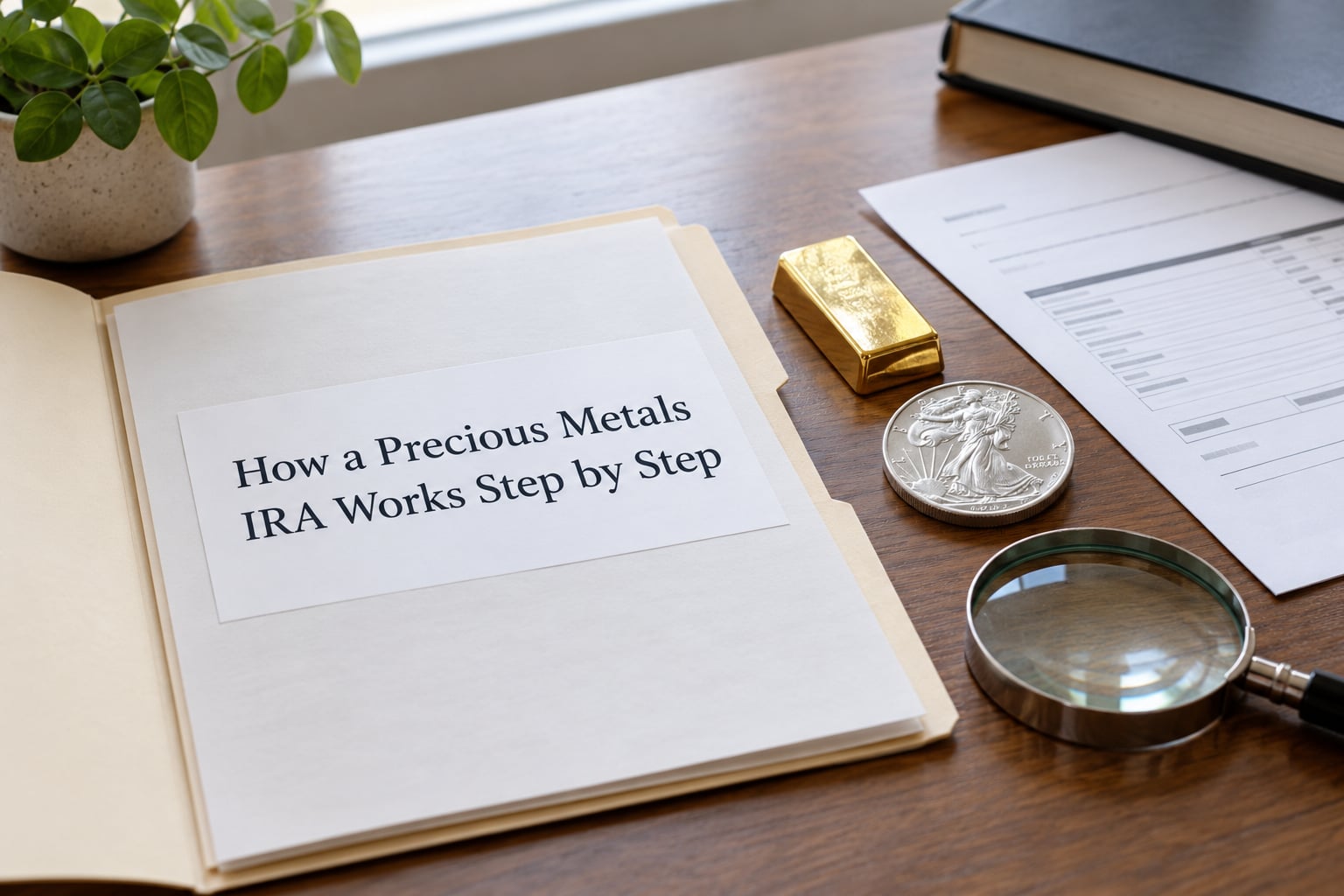
Six steps take you from nothing to metal sitting in a depository. The order matters, because the custodian has to exist before the money moves.
- Choose a custodian that accepts precious metals. Not every custodian does, and this is the first filter. Look for one that names its depository, publishes a fee schedule, and handles bullion orders directly.
- Open the account. Standard paperwork, an application, identity verification, and beneficiary designations, much like any other IRA.
- Fund the account. With a contribution from your bank account, a transfer from another IRA, or a direct rollover from a 401(k) or 403(b). A direct trustee-to-trustee rollover avoids the 60-day rule entirely.
- Select the metal and the product. You choose the type of metal, the form, and the amount, working from live pricing with the dealer or through the custodian’s ordering platform.
- Place the order and pay. The order typically goes from the custodian to the dealer, with payment from the IRA rather than your pocket.
- Delivery to the depository. The dealer sends the insured, sealed bullion directly to the depository in your account’s name. The custodian confirms receipt and adds it to your holdings.
After that, the account behaves like any other retirement account. You receive statements, the metal is valued as of December 31 each year for reporting, and you direct buys and sells through the custodian as the account grows.
What Happens After You Fund a Precious Metals IRA?
Once the money lands, the sequence runs from the custodian to the depository in a fixed order. The custodian credits the account and holds the cash until you tell it what to buy, then a direction-of-investment form or online order moves the instruction to the dealer.
The dealer settles the purchase and arranges insured transport to the depository, so the metal never travels to your house. The depository logs the item, assigns it to your account, and reports back to the custodian, which sends you a statement showing what you hold, the ounces, and the value. At year end the custodian values every holding at December 31 prices, and that figure is what appears on your tax reporting.
How Storage and Custody Work
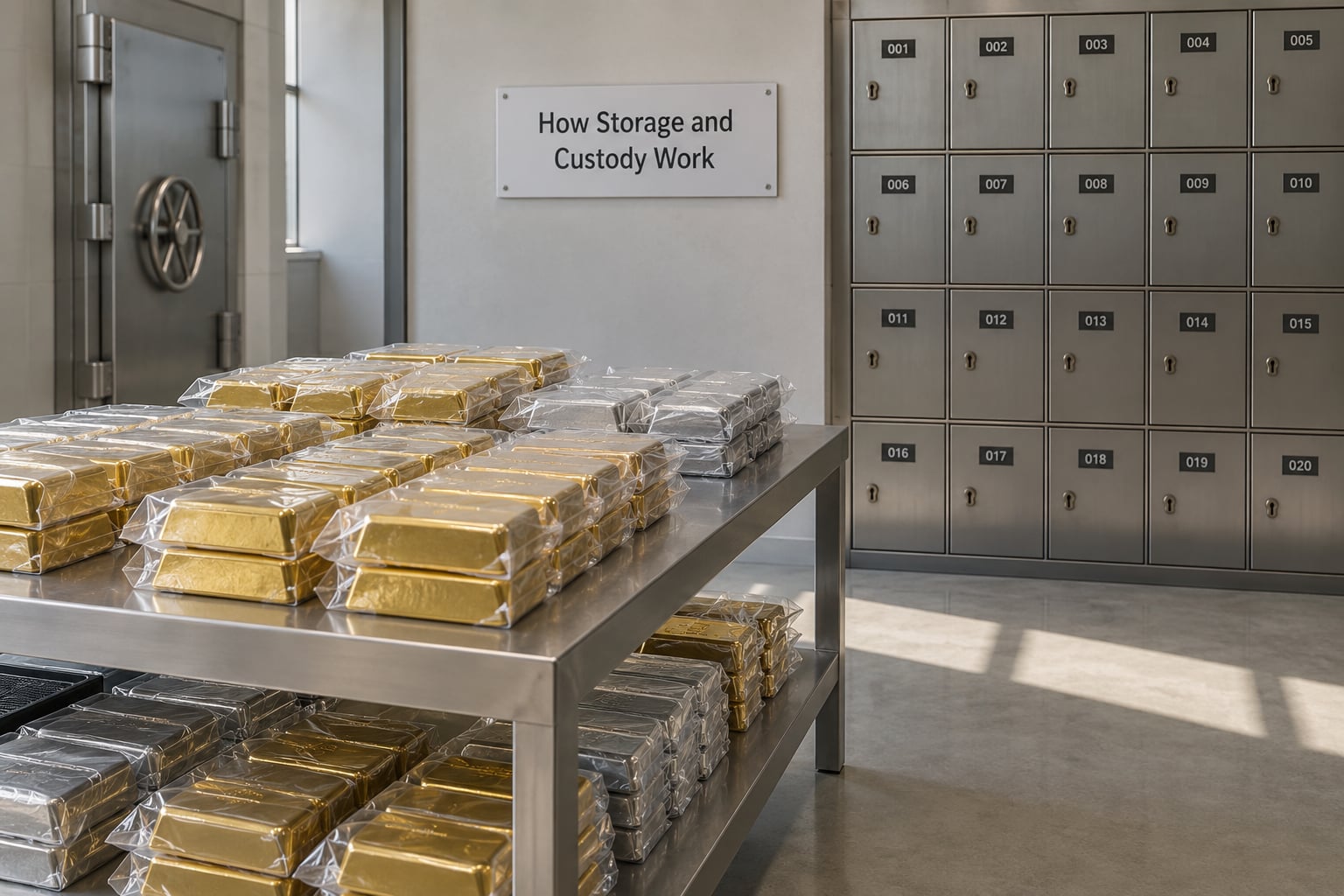
Retirement assets cannot sit in your own possession, and that is the single rule people misread most. The custodian or an approved depository holds the metal, and the account holder does not take physical delivery while the assets are in the IRA.
Storage itself comes in two forms, and the difference is what you get if the depository ever has a problem.
| Storage type | What it means | Trade-off |
|---|---|---|
| Allocated (segregated) | Your specific coins and bars are held and identified separately in your name | Higher annual cost, clearer identification if you ever take in-kind delivery |
| Commingled | Your holding is recorded as a share of a larger pool of identical bullion | Lower annual cost, you hold a claim on an undifferentiated pool rather than specific items |
Most depositories carry insurance and hold the metal in a segregated vault, but coverage varies, and precious metals are often capped as one category. Ask the custodian what the policy covers, what the limit is, and who pays if a claim is denied.
Home storage is where the rules get interesting. A plain safe in your basement is not a depository, and taking IRA metal home is generally treated as a distribution. Plenty of accounts end up with account holders quietly holding the wrong thing, so treat any company advertising at-home gold storage as something to walk away from. The legitimate exceptions involve specific transfer-of-ownership rules after death, which are narrow and fact-dependent.
What Fees and Costs Should You Expect?
Fees come in layers, and each one quietly reduces how much metal you end up owning. Providers price them differently, so the honest way to compare two firms is to add up every line on a written schedule.
- Account opening or setup fees. Some custodians charge a one-time fee, others do not. One-time costs are the least annoying part of the bill.
- Annual administration or maintenance. A recurring account fee, billed whether or not you buy anything. This is the number worth comparing first.
- Storage. Billed per year based on the value of the metal, and it changes with the metal price. Allocated storage sits above commingled.
- Insurance. Sometimes included in the storage rate, sometimes billed separately, and always subject to a category limit.
- Dealer markup and spread. The dealer buys metal above the spot price and sells below the price it will pay you back. On some products the gap between those two numbers runs well above what a bullion buyer expects, and it is the biggest line item in the whole structure.
- Shipping, handling, and transaction charges. Insured transport to the depository, wire fees on funding, and per-order administrative fees.
The point worth holding onto: every fee is a percentage of the value you put in, and the buy-sell spread is a cost you only discover when you sell. Ask any provider to show you, in writing, the price they would pay for a round ounce today compared with the price they charge to sell it to you. A company that will not show that number is telling you something.
How Taxes and Retirement Rules Affect the Account
The tax treatment depends on which kind of retirement account you opened, and the contribution you started with mostly decides that.
| Account type | Contributions | Withdrawals in retirement | Conversion |
|---|---|---|---|
| Traditional | Deductible, subject to annual limits | Ordinary income taxed, no capital gains on distributions | Possible, counts as a distribution in the year converted |
| Roth | Not deductible, subject to annual limits and income rules | Tax-free qualified distributions after the required period | Allowed, but the conversion year is taxed |
| SEP | Deductible, employer or self-employed funded | Ordinary income taxed, no capital gains on distributions | Possible under the same general rules |
A few mechanics catch people out. Required minimum distributions have to be taken once you reach the applicable age, and when you hold physical metal, the distribution is generally made in kind: the custodian ships metal to you and you take it to an approved dealer, who pays you for it. The trade triggers a taxable distribution in that year.
There is a specific reason to use the wrapper at all. Physical precious metal held in a taxable account can be subject to the collectibles rate of capital gains treatment, which is higher than the long-term rate that applies to most other assets. Holding the metal inside the IRA can avoid that. It is also a change in character, not a free lunch: you convert a capital asset into a retirement asset, and the account’s own rules take over.
Rollovers and transfers behave differently, and the difference matters. A direct rollover goes trustee to trustee and never touches your bank account. An indirect rollover does, which starts a 60-day clock and requires the whole amount to be re-entered by the due date, with withholding if it is not. When in doubt, the direct route is the one with fewer ways to go wrong.
Self-directed accounts also carry compliance obligations. The prohibited transaction rules still apply, and you cannot buy metal from yourself, a family member, or an entity you control, and you cannot run a personal business out of the account. Strangers online describe handing their account to a relative as a workaround; that is the kind of thing that ends an account. Value your own holdings for Form 5498 reporting, and expect Form 1099-R for distributions.
Rules change and the details vary by account and by individual. Treat this as a map of the structure, and run your specific situation past a qualified tax professional before you act on it.
Precious Metals IRA vs. Regular Brokerage Account
The main difference is tax treatment and who holds the asset. A brokerage account is fully taxable, you own the holding outright, and you can convert it to cash whenever you want. A precious metals IRA defers or avoids tax on that treatment, but the custodian holds the metal and the account has contribution limits, distribution rules, and required minimum distributions that a brokerage account does not.
| Factor | Precious metals IRA | Taxable brokerage account |
|---|---|---|
| Tax on the asset | Tax-deferred, and may avoid collectibles-rate capital gains | Capital gains apply, potentially at the collectibles rate |
| Contribution limits | Annual limits and eligibility rules apply | No limit |
| Access to the money | Only through a distribution, with income tax and possible penalties | Anytime, at your cost basis |
| Who holds the metal | The custodian or depository, never you while it is in the account | You |
| Eligible assets | Four IRS-approved metals in qualifying form | Anything, including collectibles and personal metals |
Which one fits depends on what you already own. If you have metals in a taxable account and are sitting on a large unrealized gain, the IRA wrapper can change how that gain is treated. If you want unlimited access and you already hold the metal, the taxable account is simpler. Neither is better in the abstract.
What to Check Before Opening an Account
Before you fund anything, run a company through this list. It takes twenty minutes and it filters out most of the problems people report.
- Full fee schedule in writing. Setup, annual, storage, insurance, shipping, wire, and transaction fees, plus the rate each increases.
- Dealer pricing, both ways. What they charge to sell you metal, and what they pay to buy it back. The gap between the two is your real exit cost.
- Named depository and insurance details. Which vault, what coverage, what the limits are.
- Account documents before you sign. Custodial agreement, fee disclosure, and the buyback policy.
- Withdrawal process. What happens when you take a distribution, who delivers the metal, and how the trade is taxed.
- Complaint history and business length. Check the Better Business Bureau and independent reviews. Reviews written for a company are worth less than none.
- Sales process. A provider that pushes hard, wants a decision today, or discourages you from reading the fee schedule is telling you something too.
- Your tax questions. Especially if this involves a rollover, an inheritance, or a conversion.
Forum threads on gold investing come back to the same two complaints: markups that run far higher than expected, and buyback prices that disappoint. Both are visible in step two of that list, before you commit a dollar.
Frequently Asked Questions
Do I own the gold in a precious metals IRA?
Economically you do, but the custodian holds it in the account’s name on your behalf and a depository holds the physical metal. That is what keeps the account in compliance with the rules that require retirement assets to be managed by a custodian. You direct what the account buys and when it sells, and you receive statements showing your holdings. Taking the metal into your own hands while it is still in the IRA is generally treated as a taxable distribution.
Can I roll over my 401(k) into a precious metals IRA?
Yes, most 401(k) and 403(b) balances can be rolled into an eligible retirement account, provided the receiving custodian accepts precious metals. Ask for a direct trustee-to-trustee rollover rather than having the money go to you first. An indirect rollover starts a 60-day clock, requires the full amount to be redeposited by the due date, and can trigger withholding if you miss it. Check whether your plan permits the rollover and whether any employer restrictions apply.
Can I store my precious metals IRA gold at home?
Generally no. Retirement assets must be held by a custodian or an approved depository, and a home safe is neither. Taking IRA metal home is usually treated as a distribution, which is taxable in the year it happens and can carry a penalty if you are under the applicable age. The exceptions after a death are narrow and fact-dependent, and they go through the custodian rather than around it. A company advertising home delivery of IRA gold is describing something that conflicts with the rules.
Can I take physical possession of the metal when I retire?
Yes, and required minimum distributions often work that way. When the account has to make a distribution, the custodian can transfer the metal to you or ship it to an approved dealer who buys it and pays you. Either way the fair market value of the metal is a taxable distribution that year, so the tax hit comes before you touch the metal. Ask your custodian in advance exactly how in-kind distributions are processed and how long the process takes.
What is the minimum needed to open a precious metals IRA?
There is no regulatory minimum for the metal purchase, but the practical threshold is the point where fixed fees stop being a large share of the account. Set-up and annual fees are flat, so a small account pays a much higher percentage in costs than a larger one. Some custodians also impose their own account minimums or minimum first purchase, and those vary. Get the fee schedule first, then work out what size account keeps the flat costs to a reasonable percentage.
How are precious metals IRAs taxed and reported?
The custodian values your holdings as of December 31 each year and reports the account on Form 5498. Qualified distributions arrive on a Form 1099-R. Distributions from a traditional or SEP account are taxed as ordinary income, while qualified Roth distributions can be tax-free. Physical metal can be subject to the higher collectibles rate of capital gains when held outside a retirement account, which is one reason people use the wrapper. Form 5498 is for your records and for the annual contribution limit.
Conclusion: Start With the Account Structure
A precious metals IRA works by putting physical bullion inside a self-directed retirement account: a metals-capable custodian opens it, you fund it with cash or a rollover, the dealer buys IRS-approved metal and delivers it to the depository, and the custodian values the holdings at year end. Everything else is detail hanging off that chain.
So the first move is comparison, not funding. Get the fee schedule, the depository and insurance details, and the buy and sell prices in writing from at least two providers, and take your specific tax questions to someone qualified before you move any money.