WTI and Brent are the two crude oil benchmarks that price most of the world’s oil trade. West Texas Intermediate is a light, sweet American grade delivered at Cushing, Oklahoma and traded on NYMEX. Brent is a slightly heavier North Sea grade shipped by tanker and priced on ICE, and roughly two-thirds of global crude contracts reference it. The two differ in origin, quality and market reach, and that gap shows up as the WTI-Brent spread.
Here is what is WTI vs Brent crude in plain terms: what each benchmark actually is, how their specs line up, why Brent usually costs more, what moves the spread, and which one fits your purpose.
Table of Contents
- What Is WTI vs Brent Crude? at a Glance
- What Is WTI?
- Why Cushing, Oklahoma matters so much
- Who uses the WTI price
- What Is Brent Crude?
- Where does Brent crude come from?
- Why is the oil price called Brent crude?
- Brent the benchmark versus the Brent complex
- How Do WTI and Brent Differ?
- Production location and supply base
- Quality: API gravity and sulfur
- Delivery and contract specifications
- WTI Midland versus WTI Cushing
- Which One Usually Has the Higher Price?
- What Factors Cause the WTI-Brent Spread to Change?
- Which Crude Oil Benchmark Should Investors Choose?
- How to get exposure
- Frequently Asked Questions
- Is Brent crude always more expensive than WTI?
- What does it mean when the Brent-WTI spread widens?
- Should I invest in WTI or Brent crude?
- Does WTI or Brent better represent global oil prices?
- Are crude oil futures and crude oil ETFs the same thing?
- Why do WTI and Brent prices sometimes move differently?
- Key Takeaways
What Is WTI vs Brent Crude? at a Glance
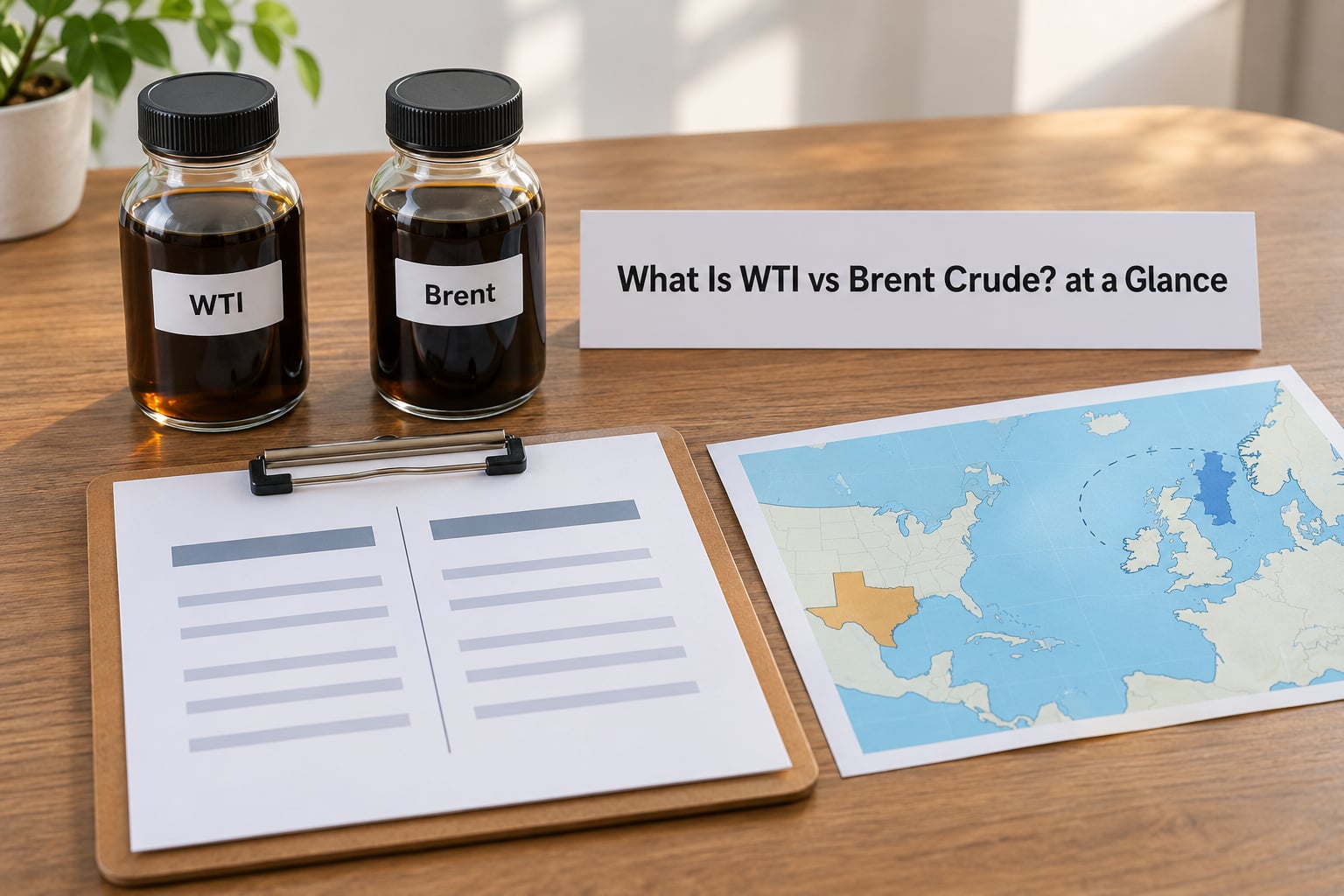
The short version: they are the same liquid molecule priced in two different places. Everything that separates them comes down to where the barrel is, how it reaches a buyer, and how sweet it is.
| Attribute | WTI | Brent |
|---|---|---|
| Full name | West Texas Intermediate | Brent crude, the North Sea benchmark |
| Type of crude | Light, sweet | Light, sweet, slightly heavier and higher in sulfur |
| Where it comes from | U.S. onshore fields, led by the Permian Basin | The North Sea between the UK and Norway, plus a global supply base |
| Delivery point | Cushing, Oklahoma, a landlocked pipeline hub | Waterborne loading at North Sea terminals |
| Exchange | NYMEX, part of CME Group | ICE Futures Europe |
| API gravity | About 39.6 | About 38 |
| Sulfur content | About 0.24 percent | About 0.37 percent |
| Market reach | Primarily the United States | International pricing for most crude trade |
| Typical price relationship | Often trades a few dollars below Brent | Often trades at a premium to WTI |
Cushing holds roughly 90 million barrels of storage, and that single fact explains more about WTI’s price behaviour than anything else. When barrels pile up there, they are effectively trapped, because the only way out is a pipeline, a rail capacity or a seaport.
What Is WTI?
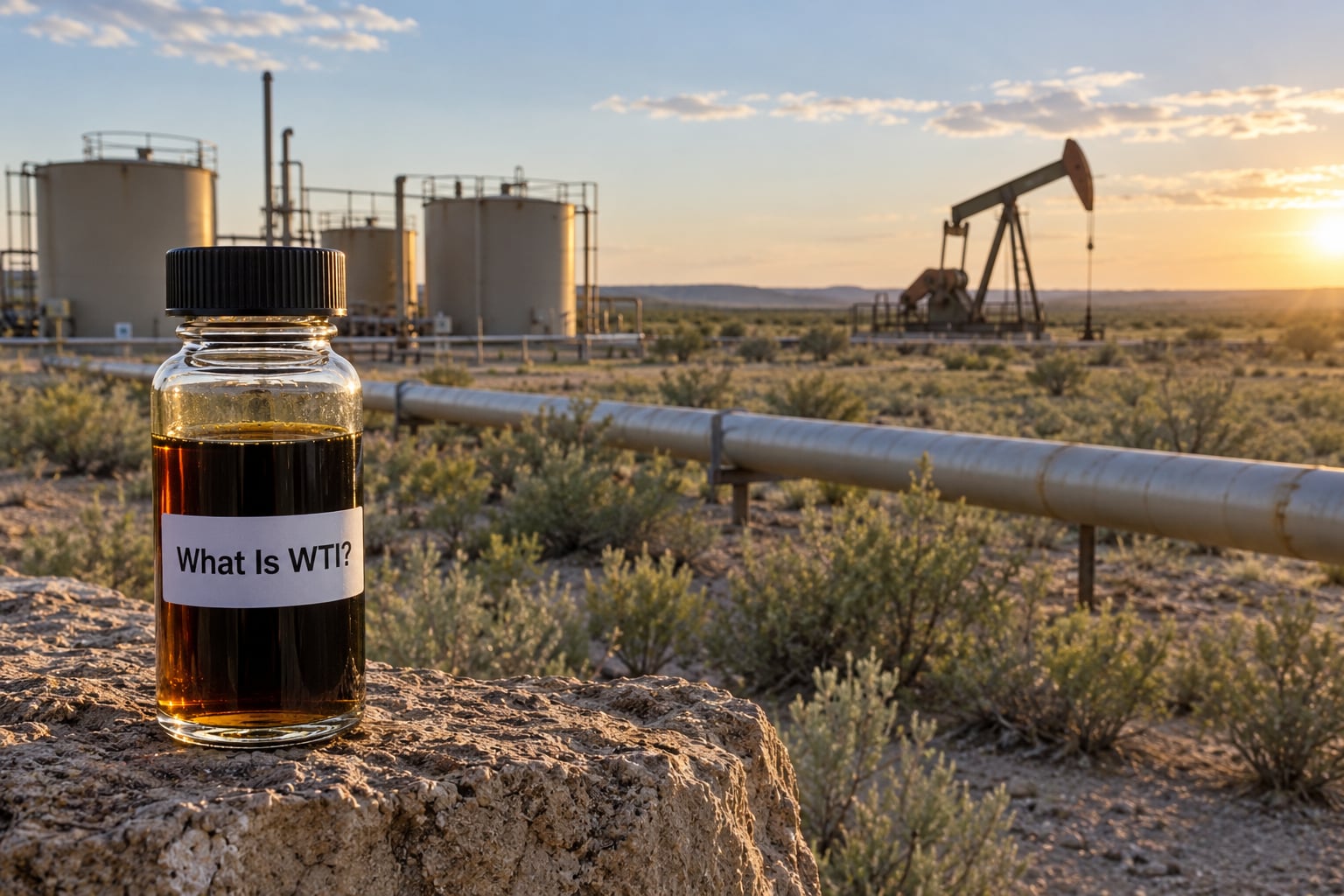
WTI stands for West Texas Intermediate. It is the dominant crude oil benchmark for the United States, and the name comes from where the oil is graded: West Texas, with “intermediate” describing its density between light gasoline-range crude and heavy residual fuel oil.
One correction worth making early, because it confuses newcomers: WTI is not a single oil or a single oilfield. It is a grade specification, a quality definition. Any barrel meeting that spec can be delivered against the contract, which means the U.S. supply base that prices against it is broad and constantly shifting.
Why Cushing, Oklahoma matters so much
The NYMEX light sweet crude contract settles against barrels delivered in Cushing, and that hub is landlocked in the middle of Oklahoma. Producers in Texas, New Mexico, North Dakota and Colorado have to move their output by pipeline or truck before anything can be delivered against the benchmark.
When pipeline space is plentiful, barrels flow out and prices track the global market closely. When capacity is tight, barrels back up at Cushing and WTI can trade well below where the seaborne market is clearing, even though the two grades are chemically similar.
Who uses the WTI price
American producers hedge their revenue against it, U.S. refiners buy against it, and because American gasoline prices ultimately track what domestic crude costs, it is the benchmark most retail investors in the US actually feel.
What Is Brent Crude?
Brent crude is the North Sea light sweet crude benchmark, priced on ICE Futures Europe. It is the international reference oil, and the Brent futures contract is the most heavily traded crude oil futures contract in the world.
Where does Brent crude come from?
It takes its name from a field in the North Sea between the UK and Norway, and the oil is graded against the Brent Blend specification. Brent is often described as a single oil, and that is slightly wrong. The physical oil moving through North Sea fields is only part of the story.
Why is the oil price called Brent crude?
Because the North Sea blend produced the earliest large-scale, consistent supply of a light sweet grade outside the United States, and traders needed one agreed number to reference. The name stuck, and the Dated Brent assessment published by S&P Global Platts now prices cargoes loading in roughly 10 to 60 day windows, which makes it the reference for international cargo deals long after the original field’s output became a small part of the total.
Brent the benchmark versus the Brent complex
When people say Brent prices, they can mean three different things: the front-month Brent futures contract on ICE, the Dated Brent physical assessment, or the wider Brent complex that includes spreads and dated cargoes. Traders usually mean the futures contract. Physical traders usually mean Dated Brent. They track each other closely but are not identical, which is why spread quotes sometimes look confusing at the margin.
How Do WTI and Brent Differ?
Production location and supply base
WTI prices U.S. onshore crude, overwhelmingly from shale and tight oil formations such as the Permian, the Bakken and Eagle Ford. That supply is price-sensitive and responds quickly to producer budgets. Brent prices a much wider global supply base that includes North Sea fields, Atlantic basin production, Middle Eastern barrels and Russian grades priced under their own arrangements, so it carries more of the world’s geopolitical risk.
Quality: API gravity and sulfur
API gravity measures density relative to water; higher numbers mean lighter crude. WTI sits around 39.6 and Brent around 38. Sulfur tells you how much desulfurization a refinery needs: WTI runs about 0.24 percent and Brent about 0.37 percent. Both fall under the “light sweet” category, which is why either one is a strong feed for a gasoline-focused refinery. Brent’s edge over WTI on quality is small but real, and quality differentials are one part of why the two prices are not identical.
Delivery and contract specifications
Both contracts cover 1,000 barrels and trade on electronic platforms nearly around the clock. WTI trades on CME Globex during U.S. hours with a settlement tied to physical delivery at Cushing. Brent trades on ICE Futures Europe, and its delivery mechanism is tied to a Norwegian crude cargo program, which makes it a waterborne, seaborne benchmark.
Trading hours matter more than beginners expect. U.S. crude futures follow U.S. session liquidity, so WTI moves most when American traders are active. Brent follows a European-centered schedule but catches the Asian session’s oil demand, and because Asian buyers refine Middle Eastern grades against Dubai and Oman, Brent picks up news that never touches Cushing.
WTI Midland versus WTI Cushing
This one confuses even experienced traders. WTI Midland is priced at Midland, Texas, closer to where the oil is actually produced, before it moves toward the Gulf Coast. WTI Cushing reflects barrels at the Oklahoma hub. The two are usually close, but they diverge when pipelines from the Permian are constrained. In 2023, S&P Global Platts added WTI Midland barrels to the Dated Brent assessment process, which tightened the link between U.S. inland production and international pricing.
Which One Usually Has the Higher Price?
Brent usually trades above WTI. In broad strokes the spread sits in the range of a few dollars per barrel in normal markets, and it has historically moved from roughly twenty-eight dollars below Brent to about twenty-seven dollars above it. A normal band is somewhere between minus five and plus ten dollars.
The reason for the usual premium is transport and geography. A barrel priced at a North Sea loading point can be loaded onto a tanker and delivered almost anywhere in the world with no landlocked bottleneck in the way. A Cushing barrel has to leave the hub overland first. That difference is worth a few dollars a barrel in most markets.
What the spread is not is a quality discount. WTI is the lighter and sweeter of the two, so if anything the crude-quality gap works the other way. The premium is overwhelmingly about location, export capacity and regional supply and demand balance.
A common claim on trading forums is that the relationship has permanently flipped, with WTI now permanently above Brent. Posters in communities like r/Commodities push back on that: the arbitrage channel has stayed open and wide since the U.S. export ban was lifted, and a market with that much available arbitrage does not sit at a permanent extreme. Read the spread as a live flow story rather than a structural switch.
April 2020 is the reminder of how far it can go. Storage at Cushing filled faster than it could be emptied, and WTI’s front-month contract settled below zero on April 20, 2020. No one was being paid to take a barrel. Brent fell hard that month too, but it stayed positive, which is the whole landlocked-versus-seaborne problem compressed into a few days.
What Factors Cause the WTI-Brent Spread to Change?
Here are the drivers that actually move it, roughly in order of how often they matter.
- U.S. shale production growth. More Permian and Eagle Ford output competing for the same pipeline space pushes WTI down relative to Brent.
- Pipeline capacity and outages. Every added permian-to-Gulf line after 2019 narrowed the discount; every freeze or maintenance event widens it again.
- Cushing inventories. Rising stocks mean barrels are accumulating faster than they can leave, and that is the single most direct cause of a wider WTI discount.
- U.S. export policy. The 1975 to 2015 crude export ban kept U.S. oil boxed in and produced the extreme dislocation of 2011, when the spread pushed past twenty-five dollars. Its repeal in 2015 opened the arbitrage that holds the spread tighter today.
- North Sea and OPEC+ supply. OPEC+ production decisions and North Sea maintenance move Brent far more than they move WTI.
- Geopolitical risk. Sanctions, conflict and shipping disruptions in the Middle East, Russia or West Africa land on Brent first, because Brent prices the globally traded barrel.
- Refinery demand and maintenance. Spring and autumn turnaround windows cut runs and crude buying, usually in one region at a time, which can pull a single benchmark down against the other.
- U.S. driving season and European heating demand. Summer gasoline demand supports WTI; winter heating demand supports Brent. The seasonal patterns do not line up, which keeps a slow wobble in the spread through the year.
- The U.S. dollar. Both benchmarks are priced in dollars, so a stronger dollar tends to weigh on crude broadly, and the two do not always feel it equally.
- Strategic Petroleum Reserve releases. Announced SPR sales or purchases move barrels and can briefly shift the regional balance.
Here is the weekly routine traders actually use. The EIA publishes its Weekly Petroleum Status Report on Wednesday mornings at 10:30 a.m. Eastern, and the Cushing stockpile figure in that release is the number that tends to move WTI against Brent the fastest. Baker Hughes publishes its rig count on Friday, which gives a slow-moving read on whether U.S. drilling is set to add supply in three to six months. After that, OPEC+ announcements and refinery turnaround schedules fill in the rest.
Forum traders are honest about one limitation here: the spread is a flow story, not a chart pattern. Levels stick around because flows support them, and when the flows change the level changes fast.
Which Crude Oil Benchmark Should Investors Choose?
The answer depends on what the exposure is for, not on which one is better oil.
- Direct exposure to U.S. shale and domestic fuel prices. Choose WTI. If your concern is what Americans pay at the pump or whether Permian producers keep growing, WTI is the cleaner read.
- Global supply risk and inflation hedging. Choose Brent. Brent prices the seaborne barrel, so shipping disruptions, sanctions and OPEC+ policy reach it directly, and it tracks the global oil macro picture more faithfully.
- Trading the difference between them. Use both, as a spread. Widen or narrow the spread rather than taking a view on the oil price itself.
- Following U.S. consumer fuel costs. Watch WTI. U.S. refinery configurations lean on domestic and Canadian grades, so WTI is the closer proxy for the pump.
- Hedging a refiner or an airline. Most refiners worldwide buy against Brent, so Brent is the hedge that matches the exposure, even for a company based in the U.S.
How to get exposure
Ranked from simplest to most involved:
- Commodity ETFs. USO tracks WTI futures and BNO tracks Brent futures. They are easy to buy, but both hold futures, so when the curve is in contango, rolling costs quietly eat returns. That drag is the reason a futures ETF can underperform the spot price over a long stretch.
- Energy equities. Integrated majors and shale producers respond to both benchmarks, but differently. Refining-heavy companies lean toward crack spreads and toward Brent, since that is where their crude is priced internationally.
- CFDs and other leveraged contracts. Convenient and small-ticket, but the broker’s spread and financing costs are wider and less transparent than a futures spread. Retail forums repeatedly complain about this, and it is the most common complaint I saw about broker oil products.
- Futures, properly sized. The most direct route and the most demanding. One contract covers 1,000 barrels, so the notional exposure is large relative to most retail accounts. Leverage here is the whole risk.
Whatever route you pick, oil moves on weather, war headlines and inventory prints. A general note: nothing here is investment advice, positions can lose money quickly, and no spread level tells you where the next one will print.
Frequently Asked Questions
Is Brent crude always more expensive than WTI?
No. Brent usually trades above WTI, but the relationship reverses in stressed markets. In April 2020 the front-month WTI contract settled below zero while Brent stayed positive, and over two decades the spread has flipped from about twenty-eight dollars below Brent to roughly twenty-seven dollars above it. Treat Brent’s premium as the normal state, not a rule.
What does it mean when the Brent-WTI spread widens?
It means WTI has fallen further below Brent, or Brent has risen further above WTI. A widening spread usually points to U.S. supply building faster than it can leave, most often through Cushing inventories, pipeline capacity limits, or production growth outrunning export demand. A narrowing spread points the other way, typically toward stronger U.S. exports or weaker U.S. output.
Should I invest in WTI or Brent crude?
Pick the benchmark that matches your exposure. WTI is the better read on U.S. shale, domestic fuel prices and Cushing inventories. Brent is the better read on global supply risk, seaborne trade and OPEC+ policy, and it is what most refiners worldwide price against. Choose an instrument to match too: ETFs are simple, equities add company risk, and futures or CFDs add leverage and roll cost.
Does WTI or Brent better represent global oil prices?
Brent. Roughly two-thirds of the world’s crude oil contracts are priced off Brent, and it reflects a global supply base including North Sea, Atlantic and Middle Eastern barrels. WTI is narrower in reach, covering mainly U.S. onshore production, so it can diverge sharply from the seaborne market when inland logistics get constrained.
Are crude oil futures and crude oil ETFs the same thing?
No. A futures contract on NYMEX or ICE is a standardized agreement that expires, which is why professional traders roll positions forward and pay or receive the difference. An ETF holds a basket of those futures and rolls on your behalf. That convenience costs money when the curve is in contango, because the roll sells cheaper expiring contracts and buys dearer ones.
Why do WTI and Brent prices sometimes move differently?
Because they price different barrels in different places. WTI settles against barrels at Cushing, a landlocked hub where storage capacity of roughly 90 million barrels can trap supply, while Brent settles against seaborne cargoes that can reach any market. Supply growth, pipeline constraints, OPEC+ decisions, refinery maintenance and regional demand all hit the two benchmarks at different times and different sizes.
Key Takeaways
WTI and Brent price the same oil from two different parts of the world. WTI is the U.S. benchmark, settled at the landlocked Cushing hub and priced on NYMEX. Brent is the international benchmark, shipped by tanker from the North Sea and priced on ICE, with roughly two-thirds of global crude contracts referencing it.
Brent normally trades a few dollars above WTI because of geography and transport, not because WTI is worse oil. It is actually the lighter, sweeter grade.
If you are still working out what is WTI vs Brent crude for your own situation, start with three things. Watch the WTI-Brent spread for regional dislocation, watch Cushing inventories on the EIA’s Wednesday release for the direct cause of most moves, and match your instrument to your purpose: WTI for U.S. exposure, Brent for global supply risk, a spread pair if your view is on the difference itself.
Figures here are benchmark specifications and historical ranges rather than live prices, and both benchmarks change daily. Nothing in this guide is investment advice.
Last updated: October 2026