
The eurozone debt crisis was a sovereign debt and banking crisis that ran from 2009 to 2018, in which Greece, Ireland, Portugal and Cyprus could no longer refinance government debt or rescue their national banks without emergency loans from the European Commission, the European Central Bank and the International Monetary Fund — the institutions nicknamed the Troika. Every loan came with conditions: deep spending cuts, tax rises and labour-market reforms. Greece never left the euro, and it never had its debt cancelled outright. What happened instead was a nine-year sequence of bailouts, restructurings, capital controls and an eventual exit from the programmes in 2018.
Here is how the eurozone debt crisis unfolded, phase by phase, with the dates and figures that most accounts leave out.
Table of Contents
- Key takeaways
- What Started the Eurozone Debt Crisis?
- Why a shared currency removed the usual escape routes
- The 2008 shock, unreliable Greek figures and the doom loop
- The argument nobody could settle
- How the Eurozone Debt Crisis Unfolded: Key Timeline
- The three Greek bailout programmes
- Why Did Greece’s Debt Become a Eurozone Problem?
- Where the bailout money actually went
- The July 2015 referendum and the third programme
- What would Grexit have cost?
- How Did the Crisis Spread Across the Eurozone?
- Four countries, four different transmission channels
- The five programmes at a glance
- What Did the ECB and European Leaders Do?
- A plain-English glossary of the terms that fill the coverage
- What Were the Main Market Effects?
- Why Did Some Countries Recover Faster Than Others?
- What Lessons Did the Crisis Leave for Investors?
- Frequently Asked Questions
- What caused the eurozone debt crisis?
- When did the eurozone debt crisis begin and end?
- Did the eurozone debt crisis cause a recession?
- How did the ECB respond to the eurozone debt crisis?
- Which countries were most affected by the crisis?
- What is the difference between a sovereign bailout and a default?
- What to Take Away
Key takeaways
- The euro’s design was the root cause: one interest rate and no exchange rate for economies moving in opposite directions.
- Greek statistics were unreliable for years, and the 2009 deficit was revised from roughly 6-8% of GDP to 12.7%.
- Three Greek programmes followed — €110bn in 2010, €130bn in 2012 and up to €86bn in 2015.
- Banks holding government bonds made each country’s fiscal problem a banking problem, and the two fed on each other.
- The final settlement reached in 2018 ended the programmes; Greece has stayed in the euro.
What Started the Eurozone Debt Crisis?
The eurozone debt crisis started with a design problem, not a spending spree. Nineteen countries shared one currency and one central bank interest rate, but they did not share one economy, one tax system or one budget. When a member ran into trouble, the two normal fixes a country normally reaches for — devaluing its currency or letting its central bank print money — simply did not exist.
Why a shared currency removed the usual escape routes
A country with its own currency can devalue, which makes exports cheaper and imported energy more expensive, and the growth that follows pulls the debt-to-GDP ratio down. It can also ask its central bank to buy its bonds, effectively financing itself at whatever rate it chooses. Inside the euro area, a member could do neither. Greece could not devalue the drachma because there was no drachma. It could not print money because the ECB sets one rate for all nineteen members.
What it could do was ask other governments and the IMF for a loan. That is the part people find hard to accept: losing your currency printer is fine until you owe more than you can raise, and then the absence of a currency becomes the reason a bailout is needed.
The 2008 shock, unreliable Greek figures and the doom loop
The immediate trigger was the global financial crisis of 2008, which hit southern European economies through their banks and their access to wholesale funding. Greece had also been running structural budget deficits for years and funding them with debt, while understating the scale through accounting that moved costs off the books.
In October 2009, Greece’s newly appointed government revealed that its 2009 deficit was 12.7% of GDP rather than the 6-8% previously reported. Markets repriced Greek bonds immediately. Greek ten-year yields went from a few percentage points to double digits within months, and spreads over German bonds blew out to more than 1,000 basis points at the peak.
Then came the feedback loop that made everything worse. Greek banks held Greek government bonds. When those bonds lost most of their value, the banks took losses, which weakened the banks, which led to the government to bail out the banks with more debt, which raised the government’s debt further. The euro area had no fiscal union and no way to transfer spending between members, so each country was pushed to fix its own banking system with its own shrinking budget.
The argument nobody could settle
The deepest problem was political. Northern members wanted loans repaid and conditionality enforced. Southern members argued that a monetary union implies a degree of shared risk, and that German banks had earned generous spreads lending to Greek, Irish and Portuguese borrowers for a decade before insisting those borrowers absorb the losses alone. Germans also had the constitutional problem that a bailout is a transfer between eurozone citizens, and their court had ruled in 2010 that parliamentary approval was required for Greece.
That argument never resolved cleanly. It just got managed, again and again, with new institutions and new rules.
How the Eurozone Debt Crisis Unfolded: Key Timeline
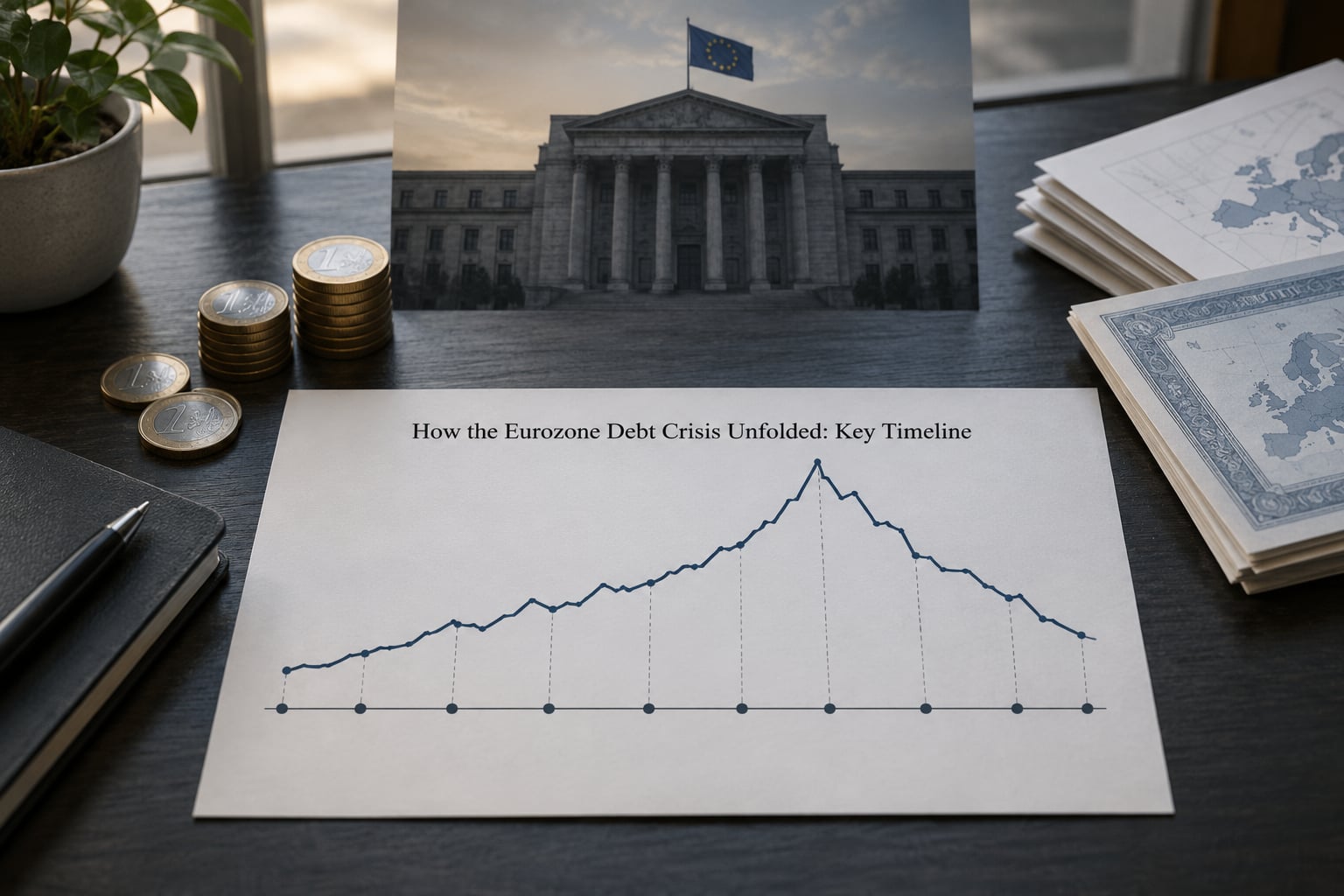
The eurozone debt crisis unfolded in six stages: the shock and cover-up through 2009, the first Greek bailout and Irish rescue in 2010, the contagion year of 2011, the 2012 restructuring, the 2015 standoff and Grexit vote, and the slow resolution from 2016 to 2018. The table below lists the dated milestones that separate them.
| Date | Milestone | Why it mattered |
|---|---|---|
| October 2009 | Greek 2009 deficit revised to 12.7% of GDP | Credibility collapsed; Greek bond yields surged |
| 2 May 2010 | First Greek bailout of €110bn agreed | First test of joint eurozone lending |
| May 2010 | Greek capital controls imposed, first euro-area restrictions | Precedent for limiting domestic withdrawals |
| June 2010 | European Financial Stability Facility (EFSF) created | Permanent euro area rescue fund |
| 29 November 2010 | Ireland banking rescue of €67.5bn | Showed the crisis could reach a core EU state |
| May 2011 | Portugal bailout | Third country to use the Troika |
| February 2012 | Second Greek bailout of €130bn agreed | Restructuring became the agreed route |
| March 2012 | Private Sector Involvement (PSI) bond swap, 53.5% nominal write-down | The only true debt cancellation of the crisis |
| March 2012 | European Stability Mechanism (ESM) established | Replaced the temporary EFSF |
| June 2012 | Cyprus rescue agreed | Included a bank depositor haircut |
| August 2012 | Draghi’s “whatever it takes” pledge and OMT announcement | Central bank backstop for sovereign bonds |
| 5 July 2015 | Greek referendum rejects bailout terms, 61% to 39% | Directly against the Troika’s own advice |
| 13 July 2015 | Third Greek bailout of up to €86bn agreed | Greek banks reopened after a three-week shutdown |
| August 2015 | Greek sovereign default; Greece missed an IMF payment | First euro-area member to default |
| 20 August 2018 | Greek bailout programmes declared ended | Close of the crisis era |
The three Greek bailout programmes
Greece went through three separate Troika programmes, and mixing up their sizes is the most common error in accounts of the crisis. They were loans, not gifts, and only the 2012 restructuring actually cancelled debt.
| Year | Size | What it covered | Debt cancelled? |
|---|---|---|---|
| 2010 | €110bn | Deficit financing and bank recapitalisation | No |
| 2012 | €130bn | Second loan plus the PSI bond swap | Yes — 53.5% nominal write-down |
| 2015 | Up to €86bn | Third programme with ESM as main lender | No |
Add the contribution from the International Monetary Fund, drawn under its facilities, and the total committed to Greece exceeded €250bn. Around 78% of Greek debt is now held by public institutions rather than private creditors, which is a very different country from the one that walked into the crisis.
Why Did Greece’s Debt Become a Eurozone Problem?
Greece’s debt became a eurozone problem because Greek banks were exposed to Greek government bonds, Greek banks depended on wholesale funding from the rest of the euro area, and every step toward a disorderly default risked pulling those banks down. A country that had struggled alone in 2009 could not struggle alone in 2011, because its banking system sat inside a borderless one.
The trigger for the first escalation was the October 2009 revision of the deficit figure. The consequences followed a familiar chain: Greek government bonds fell, Greek bank balance sheets deteriorated, the ECB had to supply emergency liquidity to those banks, and the cost of that support was added to Greek public debt.
Where the bailout money actually went
Here is the point that surveys rarely explain clearly. Across the programmes, only roughly 10% of the funds disbursed financed Greek budget deficits — the day-to-day gap between what the state spent and what it collected. More than 80% went to refinancing private creditors: repaying bondholders, redeeming maturing paper and letting banks repay what they owed each other.
That distinction changes how you read the whole episode. A bailout can sound like foreign governments handing money to a country, when in practice it is mostly a group of banks and bondholders agreeing to be paid later instead of taking a loss now. It is why critics called it a bank rescue dressed as a country rescue, and why supporters answered that the alternative was a disorderly default that would have hit those same banks harder.
The July 2015 referendum and the third programme
The crisis reached its sharpest political point in the summer of 2015, when Prime Minister Alexis Tsipras called a referendum on the Troika’s terms after concluding negotiations. The deal would have offered Greece debt relief in exchange for reforms. Voters were told to vote no, and they did, 61% to 39% — against the explicit advice of the European Commission, the ECB and the IMF.
The market treated it as a decision to leave the euro. Greek bank shares collapsed, withdrawals emptied current accounts, and the ECB capped Greek banks’ access to its liquidity facility. That squeeze produced political capitulation within days: a third programme of up to €86bn in August 2015, with the ESM as the main lender. Greece missed an IMF repayment in August 2015 and defaulted on its own bonds, the first euro area member to do so.
Greece stayed in the euro. Every headline that said otherwise was wrong, and the misconception persists in comments sections to this day.
What would Grexit have cost?
Before 2015 ended in a deal, banks circulated exit scenarios. Nomura modelled a roughly 60% devaluation of the drachma on re-entry, BNP Paribas warned of 40-50% inflation and a debt-to-GDP ratio above 200%, and UBS warned of hyperinflation. Greece’s central bank balances in TARGET2, the ECB’s settlement system, would have been a heavy claim on the remaining members. Those numbers explain why leaving was never a clean option: the cost of the exit would have landed on Greek savers and on other euro members at the same time.
How Did the Crisis Spread Across the Eurozone?
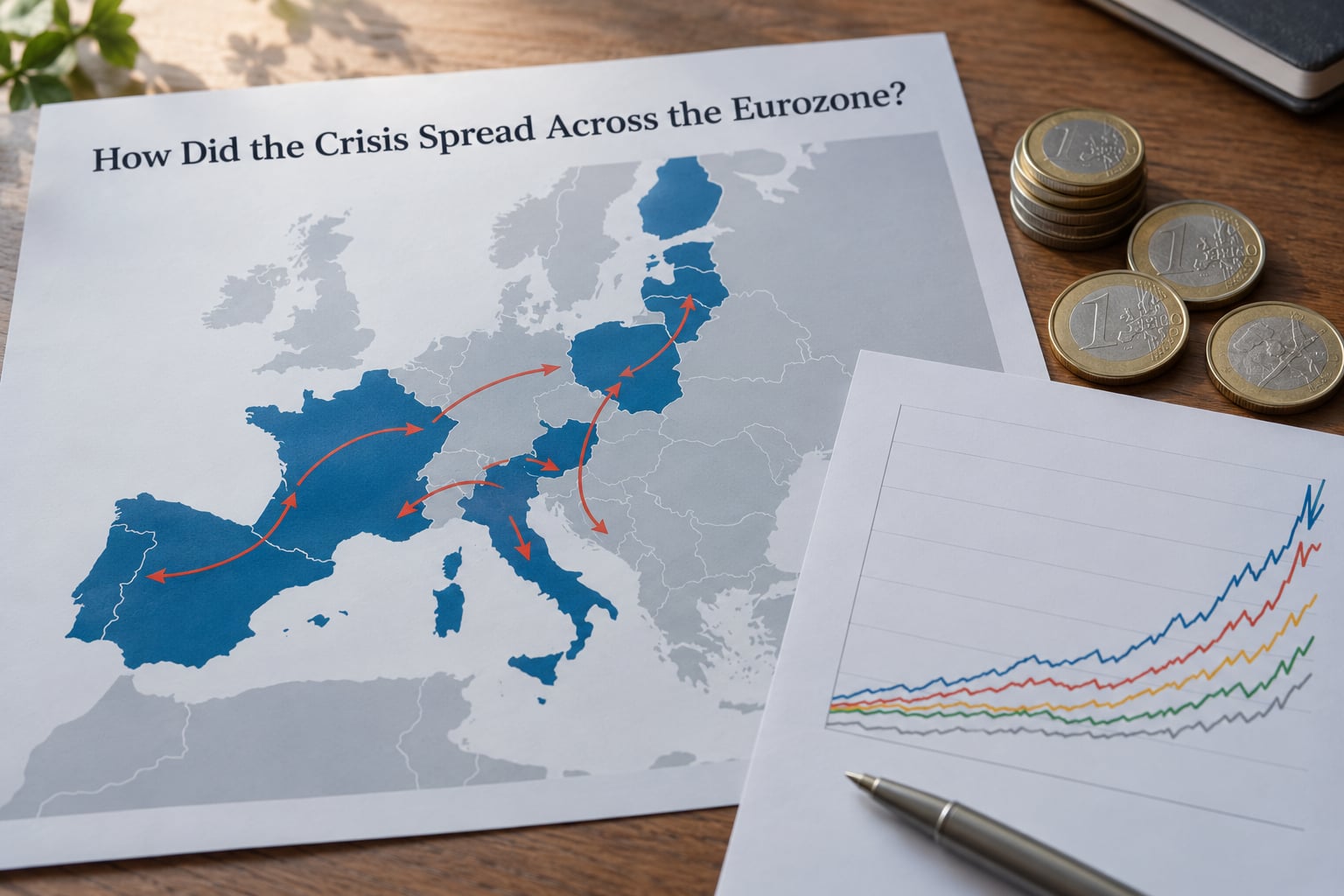
The crisis spread through three channels: bond markets repricing risk, banks holding each other’s sovereign paper, and deposits moving between countries. It reached far beyond Greece, and it hit some countries through their budgets and others through their banks.
Four countries, four different transmission channels
Ireland had a property-driven banking crisis rather than a fiscal one. A property boom left its banks with bad loans, and the government guaranteed bank liabilities in September 2008, converting a banking failure into a sovereign one. The €67.5bn rescue agreed on 29 November 2010 focused on bank recapitalisation and disposal, and Ireland repaid its programme early in 2013-14.
Portugal was closer to the Greek pattern. Years of structural deficits and low growth left the banks fragile and the budget stretched, and the May 2011 programme attached a firm deadline for returning to market funding. Portugal exited its programme in 2014 and repaid early in 2017.
Spain never took a sovereign programme. Its property bubble left the banks carrying an estimated €190bn of bad real-estate loans, and the government used a domestic bank recapitalisation scheme backed by European funds to deal with them. It was the largest bailout in the world by some measures, but it never became a Troika programme because the sovereign itself stayed solvent. Investors drew the lesson that it made, and Spain was also one of the first countries where spreads narrowed well before Greece.
Cyprus was small but instructive. Its banks held Greek and Russian exposure far larger than the country’s own economy could support, and the June 2012 rescue included a large write-down of depositor balances above the insured limit. It is the clearest case of a country being rescued because of what its banks held rather than what its government spent.
The five programmes at a glance
| Country | Date | Programme size | Type |
|---|---|---|---|
| Greece | 2010, 2012, 2015 | €110bn, €130bn, up to €86bn | Sovereign and banking |
| Ireland | November 2010 | €67.5bn | Banking |
| Portugal | May 2011 | About €78bn across programmes | Sovereign and banking |
| Spain | 2012 | Up to €100bn, via domestic scheme | Banking only |
| Cyprus | March 2013 | About €10bn for the banking sector | Banking |
Italy deserves a note. Its debt was the largest in absolute terms in the euro area, and its bond spreads widened sharply in late 2011 as markets tested whether Rome would join the programme queue. It never did. That difference still shapes the spreads investors watch today.
What Did the ECB and European Leaders Do?
The policy response ran in three tracks: lending to governments, lending to banks, and building permanent institutions so the next crisis would not need improvisation. The European Commission and the member states handled the loans; the ECB handled liquidity and, from 2012, the bond market backstop.
In 2010 the EFSF was created as a temporary fund. In 2012 it was replaced by the European Stability Mechanism, a permanent institution with its own legal basis and a sovereign credit rating. Fiscal rules were tightened twice, in 2011 and again in 2013, with national budgets placed under tighter EU surveillance and automatic penalties attached.
The ECB moved first through Emergency Liquidity Assistance to individual banks, and then, in August 2012, Mario Draghi’s pledge to do “whatever it takes” for the euro, backed by the Outright Monetary Transactions (OMT) programme. OMT gave the central bank the option to buy distressed sovereign bonds, capped at 70% of a country’s issuance, strictly for the purpose of restoring market access rather than for financing governments.
That single sentence changed the arithmetic of the crisis. Markets had been pricing the possibility of a euro-area break-up; a central bank willing to act as backstop of last resort priced that risk down sharply. The political project that came out of the crisis — the European Banking Union, built on a single resolution mechanism and a shared bank fund — aimed at removing exactly the loop that caused the contagion in the first place.
A plain-English glossary of the terms that fill the coverage
Troika — the European Commission, the ECB and the IMF, which together provided euro area emergency lending and set the conditions.
EFSF and ESM — the temporary euro area rescue fund created in 2010 and the permanent replacement from 2012.
Debt-to-GDP ratio — government debt divided by the size of the economy. It can rise because debt grows or because the economy shrinks.
Primary surplus — a budget surplus excluding interest payments, which is the measure used to judge whether debt is on a sustainable path.
CDS spread — the price of insuring a bond against default, a faster market read on risk than the yield itself.
OMT — Outright Monetary Transactions, the ECB’s 2012 programme to buy distressed sovereign bonds.
ELA — Emergency Liquidity Assistance, central bank loans to individual banks, a signal of stress.
PSI — Private Sector Involvement, the 2012 bond swap in which private holders accepted a 53.5% nominal write-down.
Haircut — the write-down or loss imposed on a creditor.
TARGET2 — the ECB’s settlement system for cross-border payments, which holds central bank balances that shift when capital moves between members.
Grexit — the scenario of Greece leaving the euro, heavily priced before 2015 and never realised.
What Were the Main Market Effects?
The main market effect was a repricing of risk inside the euro area. In 2010, Greek ten-year yields traded around 17-18% and spreads over German bonds exceeded 1,000 basis points; by 2018 the same bonds yielded a fraction of that, and peripheral spreads compressed to levels last seen before 2008.
Three things drove that. The backstop from Draghi and OMT reduced the perceived chance of a break-up. Greece’s bank recapitalisation and its removal from the euro area’s stock of credit risk in 2015 cut the weight of the worst holdings. And the ECB’s very low policy rates pushed investors toward higher-yielding bonds everywhere, including the ones that had been treated as unbuyable.
Banks took the direct hit. Greek banks were recapitalised more than once, Irish banks shrank dramatically and Cyprus lost depositors. The core-periphery transfer ran alongside it: by the end of 2011 German institutions had reported net gains of more than €9bn from Greek exposure, largely because hedging meant many had insured the credit risk and then recovered the profit when the payments arrived.
Growth was the cost centre. Greece’s unemployment peaked around 27.9%, with youth unemployment above 60% at points, and purchasing power fell by roughly 40% across the adjustment. That is the austerity paradox in one line: when spending cuts shrink GDP, the debt-to-GDP ratio can rise even as deficits fall, which is why Greece ended the decade with a lower deficit and a higher debt ratio than when it began.
Why Did Some Countries Recover Faster Than Others?
Countries recovered at different speeds mainly because they entered the crisis in different condition, not because their rescue programmes were designed differently. The starting position explained more than the programme design.
Ireland and Portugal recovered faster because their problems were mainly banking problems with a clear remedy — bad loans written down, banks recapitalised, credit restored. Greece had a different mix: a heavily indebted sovereign, a weak tax base, a large public sector and a debt stock that had to be cut by a quarter before markets would return.
Spain recovered fastest of all, because its banks were fixed through a domestic scheme while its sovereign kept borrowing — no Troika conditionality, no austerity at the scale Greece faced, and continued access to bond markets. Italy, which stayed outside the programmes throughout, benefited from the same backstop.
What slowed recovery was the debt burden itself. When nominal GDP falls, the ratio of debt to GDP rises even if the debt never grows, and Greece’s debt was reduced through a restructuring and a euro of nominal decline at the same time. Growth, not austerity, was what closed the gap in the end, and Greek growth only turned sustainably positive after the third programme settled and the oil price fell.
What Lessons Did the Crisis Leave for Investors?
The crisis left a few lessons that are still visible in euro area bond markets today, and they are worth stating plainly rather than dressing up as a moral story about fiscal discipline.
Check the funding structure before the fundamentals. A country with a high debt-to-GDP ratio and credible markets can roll its debt. Greece became acute when market access closed. Debt maturity, domestic investor base and current-account balance told you more about crisis timing than any deficit projection.
Watch the doom loop, not just the budget. The difference between Spain and Greece was not fiscal discipline. It was whether the domestic banking system held the sovereign’s paper. That relationship is the single most useful lens for reading any sovereign market.
Distinguish political promises from enforceable policy. The euro area’s response came late, in stages, and only became decisive once the ECB committed capital behind it. Markets did not price the politics correctly in 2010 and again in 2015. Backstops that are real get priced; backstops that are speeches do not.
Treat currency unions as risk structures. A single currency removes both the devaluation lever and the lender-of-last-resort lever for individual members. Investors in euro area credit are implicitly making a bet on political solidarity that no contract enforces.
Banking risk does not sit next to sovereign risk; it sits inside it. The programmes in Greece, Ireland, Spain and Cyprus were mostly bank rescues financed through sovereign debt. Portfolio diversification that holds a country’s government bonds and its domestic banks is far more concentrated than it looks.
A repeat would look different in one important way. The architecture is different: a permanent stability fund, a banking union, a fiscal rule with automatic penalties, a central bank that has already said it will backstop sovereign bonds, and a defence instrument currently outside the EU budget. The structural weaknesses that produced the crisis — no common fiscal capacity, no transfer union, divergent competitiveness inside one currency — are largely untouched.
Frequently Asked Questions
What caused the eurozone debt crisis?
Three causes combined. The euro area had one interest rate and no exchange rate for economies moving in different directions, so a weak member could not devalue or print money. Greek public debt and unreported deficits grew for a decade. Then the 2008 financial crisis pushed banks in several countries into trouble, and because those banks held their own government’s bonds, each fiscal problem became a banking problem.
When did the eurozone debt crisis begin and end?
Most analysts date it from October 2009, when Greece’s 2009 deficit was revised to 12.7% of GDP and Greek bond yields jumped, through to 20 August 2018, when the Greek programmes were declared ended. If you need a sharper starting point, use late 2009; for the end, 2018 is the widely accepted date.
Did the eurozone debt crisis cause a recession?
Yes, in several countries, and it deepened an existing downturn. Greece entered recession in 2009, its economy contracted by roughly a quarter over the following years, and unemployment peaked near 27.9%. Ireland, Portugal and Spain also went into sustained contraction, with Spain recording a double-digit cumulative fall in output between 2009 and 2013.
How did the ECB respond to the eurozone debt crisis?
The ECB supplied Emergency Liquidity Assistance to stressed banks, and from 2012 it offered to buy distressed sovereign bonds under the Outright Monetary Transactions programme after Mario Draghi’s pledge to do whatever it takes. That backstop was what compressed peripheral spreads, and it later underpinned the European Banking Union and the European Stability Mechanism.
Which countries were most affected by the crisis?
Greece was worst hit on almost every measure: highest debt burden, deepest recession, largest programme. Ireland and Portugal followed on recession depth, Spain on unemployment and banking losses, and Cyprus on the scale of its depositor losses. Italy was never in a programme but its debt remains the largest in the euro area in absolute terms, while Greece has the highest ratio of debt to GDP.
What is the difference between a sovereign bailout and a default?
A bailout is an agreed loan that keeps a country paying, usually on conditions. A default is a missed or refused payment. Greece had both, in that order: the 2010, 2012 and 2015 programmes kept payments flowing, and after the July 2015 referendum Greece missed an IMF repayment and stopped coupon payments on its own bonds, becoming the first euro area member to default.
What to Take Away
If you analyse a future sovereign debt crisis, start in the same order the euro area did, and in the same order every serious framework does. Find the funding problem first: who owes what, to whom, and when does it mature. Then trace the contagion channels — banks holding sovereign paper, deposits leaving, and members with common political exposure. Only then judge the policy response, and judge it on whether it is enforceable rather than merely promised.
Apply that to Greece in 2009 and the crisis follows almost mechanically: opaque figures, a funding market that closes, a banking sector that cannot be separated from the sovereign, and a political response that arrives late. Everything that followed — the three programmes, the referendum, the 2018 exit — was downstream of those four facts.
This article is general information about a historical event. It is not investment advice, and readers should consult a qualified financial adviser before making any decision about euro area bonds or currency exposure.