
The Federal Reserve and the European Central Bank both steer a short-term rate to hold inflation near 2%, but they are built differently and read different economies. The Fed runs a dual mandate with a rate corridor and a US-only labour market; the ECB runs a price-stability mandate for one currency shared by around twenty national economies. That is the core of how ecb policy differs from the fed.
Here is the short version, in seven lines, before we go into the detail:
- Mandate: the Fed targets maximum employment alongside price stability. The ECB’s primary mandate is price stability alone.
- Inflation measure: the Fed targets 2% on the PCE price index. The ECB targets 2% on the euro-area HICP, measured symmetrically.
- Rate instrument: the Fed moves a federal funds target range and pays interest on reserves. The ECB moves a three-tier corridor where the deposit facility rate acts as the effective policy rate.
- Decision body: twelve voting seats at the FOMC in Washington against fifteen national central bank governors who sit on the ECB Governing Council alongside six Executive Board members.
- Balance sheet: the Fed began shrinking its holdings in the years after the pandemic. The ECB ran large pandemic programmes and, for several years, stopped reinvesting.
- Bank supervision: the Fed supervises US banks itself. The ECB sets policy but leaves supervision to national regulators.
- Economic spread: one currency across roughly twenty economies with very different growth, wages and energy exposure, which slows the ECB’s reaction function.
One thing to set straight early, because it trips people up: the ECB does not set interest rates country by country. It sets one euro-area policy rate that applies to Greece, Germany, France, Spain and Finland alike. There is no national monetary policy left inside the euro.
Numbers move. The rate levels quoted in older articles on this topic are usually stale, and the research behind this piece found exactly that problem across competing pages. So this article sticks to frameworks, instruments and mechanisms that do not expire, and points you to the two official sites for the live figures: ecb.europa.eu and federalreserve.gov.
Table of Contents
- How ECB Policy Differs from the Fed at a Glance
- What mandates and economic priorities shape each central bank?
- The Fed’s dual mandate pulls in two directions at once
- The ECB has one primary job and a much wider map
- Why one currency over twenty economies changes the reaction function
- Is the ECB based on the Fed?
- How do interest-rate decisions and policy paths differ?
- A target range against a three-tier corridor
- Different reaction functions, not different convictions
- Guidance is a policy instrument at both, but spoken in different registers
- What tools does each institution use beyond interest rates?
- The Fed’s toolkit
- The ECB’s toolkit
- What counts as normal policy and what does not
- How does the ECB differ from the Fed on QE and the balance sheet?
- What the Fed buys
- What the ECB buys
- Why exit is harder for the ECB
- How do exchange rates, commodities, and financial markets react?
- Which policy matters more for a particular investor?
- How do investors compare the next Fed and ECB moves?
- Which Should You Choose?
- Frequently Asked Questions
- What is the main difference between the ECB and the Federal Reserve?
- Are the ECB and Fed independent central banks in the same way?
- What happens when ECB policy differs from Fed policy?
- How does the ECB approach quantitative easing compared with the Fed?
- Which central bank has more influence on gold and commodity prices?
- Can the ECB and Federal Reserve raise or lower interest rates at the same time?
- Conclusion: Start With the Policy Function
How ECB Policy Differs from the Fed at a Glance
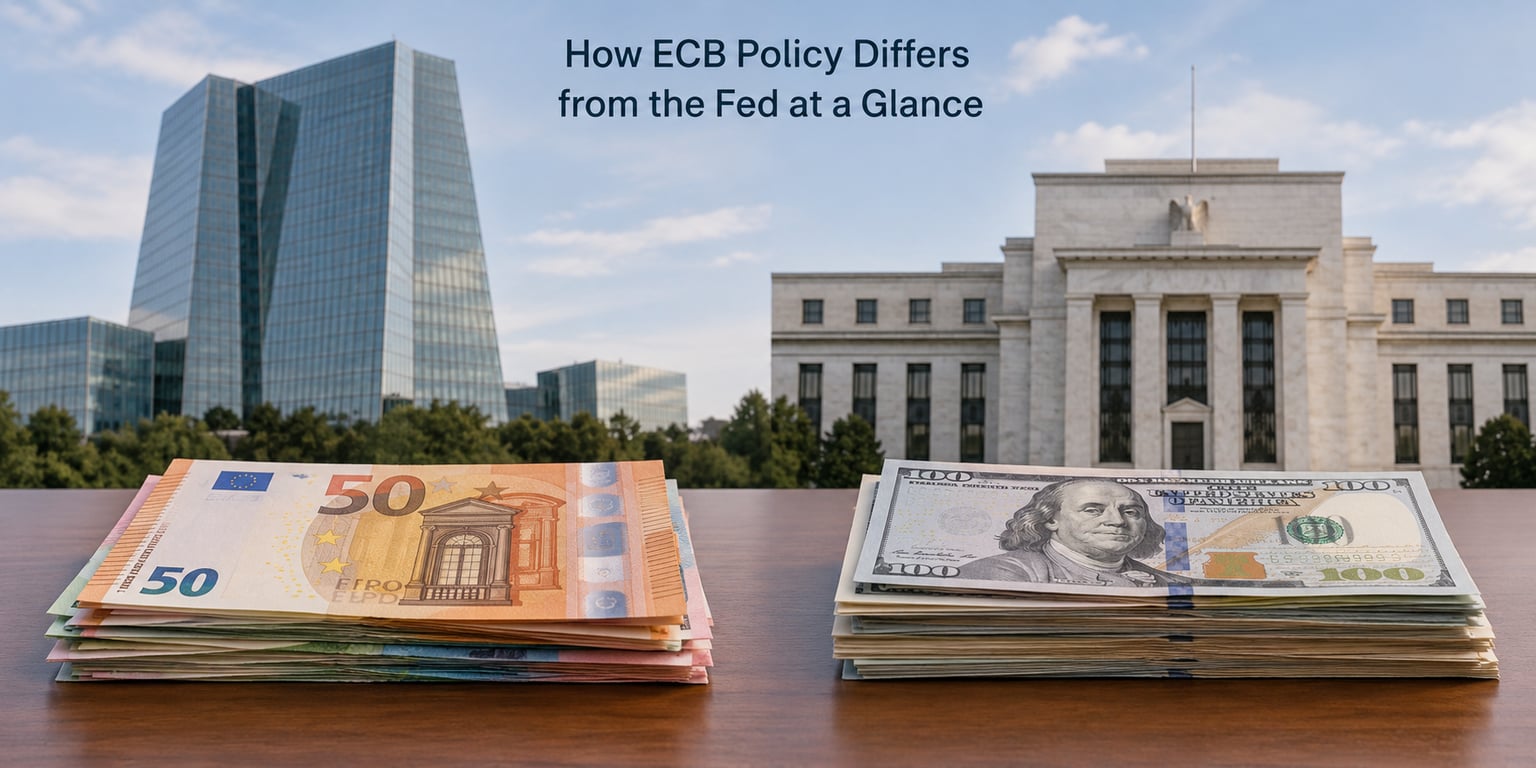
Both institutions are independent, inflation-targeting central banks with a 2% goal, and outside a crisis they do the same three things: raise a policy rate when inflation runs hot, cut it when the economy sags, and manage a balance sheet in between. Everything below that summary line is where the differences sit.
| Criterion | European Central Bank | Federal Reserve |
|---|---|---|
| Primary mandate | Price stability over the medium term; financial stability as a secondary objective | Maximum employment and stable prices |
| Inflation target | 2% HICP, interpreted symmetrically | 2% on the PCE price index, over time |
| Key policy instrument | Deposit facility rate inside a three-tier corridor | Federal funds target range, plus interest on reserve balances |
| Corridor design | Main refinancing rate above, deposit rate below, marginal lending rate above both | Target range with discount window above and interest on reserves below |
| Decision body | Governing Council, 26 members, 21 voting | Federal Open Market Committee, 12 voting seats |
| Who votes | Executive Board (6) plus national central bank governors (15) | 7 Board governors plus the New York Fed president |
| Meeting cadence | Eight scheduled Governing Council monetary policy meetings a year | Eight scheduled FOMC meetings a year |
| Balance sheet tool | APP, PEPP and PSPP asset purchase programmes, reinvestment decisions | SOMA holdings in Treasuries and agency mortgage-backed securities |
| Bank supervision | Handled by national authorities under the Single Supervisory Mechanism | Fed directly supervises large banks and the systemically important firms |
| Lender of last resort | National central banks hold national mandates; no single euro-area backstop | A single federal backstop across the country |
| Communication style | Press conference and staff macro projections after every decision | Statement, dot plot and Summary of Economic Projections four times a year, press conference every decision |
| Fiscal backdrop | Separate national budgets under shared rules | One federal budget, one sovereign |
Read that table row by row and the pattern is clear: the Fed is a country-wide central bank with a single sovereign and a single supervisor, while the ECB is a supranational institution running monetary policy across a union of sovereigns. That design choice propagates into every other difference below.
What mandates and economic priorities shape each central bank?
The Fed’s dual mandate pulls in two directions at once
The Federal Reserve Act commits the Fed to maximum employment in the economy, stable prices, moderate long-term interest rates, and stability of the financial system. The first two goals often point opposite ways, which is why every FOMC meeting is a two-sided argument.
When unemployment is falling and inflation is running above target, the employment argument pushes toward cutting. When inflation expectations look loose, the price argument pushes toward holding or raising. Chair Jerome Powell has spent much of the recent cycle insisting that the labour market is no longer a source of significant inflationary pressure, which in practice means employment data inform the Fed but rarely drive it on their own.
The ECB has one primary job and a much wider map
The ECB’s mandate is price stability, with the supporting objective of maintaining financial stability. Its secondary mandate is to support the growth of the economy, and that word “support” matters: the ECB is not directed to raise growth to a level or a date the way national governments are.
It also works with a target defined on the euro-area HICP, the Harmonised Index of Consumer Prices, measured symmetrically. Symmetric means a fall below 2% is treated with the same seriousness as a rise above it, and the Bank of Japan is the only other major central bank using that framing.
The Fed, by contrast, watches the PCE price index, which excludes some volatile housing components and weights spending differently. Core measures sit alongside headline ones at both banks, but the reference points differ enough that “inflation looks similar” is often an illusion when you compare a euro-area core HICP print with a US core PCE print directly.
Why one currency over twenty economies changes the reaction function
The euro area spans economies with per-capita output, unemployment histories and energy exposure that differ enormously. Germany runs a large manufacturing and export economy with strong wage discipline; Spain and Greece carry higher structural unemployment; Italy and France face distinct fiscal and banking structures; several member states are far more exposed to imported energy shocks than the United States is.
One rate has to serve all of them. Tightening enough to squeeze an overheating labour market in one member state risks choking a weak demand environment in another, and there is no national central bank left to offset it by cutting rates locally. That single fact slows the ECB’s reaction function more than any other feature of its design.
Other structural factors point the same way: shallower securitisation markets, less flexible labour markets in parts of the union, wider fiscal dispersion between members, and a monetary transmission channel that has historically run more weakly from bank rates to corporate borrowing costs.
Is the ECB based on the Fed?
No, and the history runs the opposite direction from most readers’ instinct. The ECB was created in the late 1990s with the European Monetary Institute drawing heavily on lessons from the Bundesbank and other continental European institutions, at a time when several members of what became the G7 still operated fixed exchange rates or tightly managed currencies.
What the ECB borrowed from the US model was independence from national governments, published forecasts, and forward guidance as a policy instrument. Those are shared traditions of central banking, not institutional lineage. Reading the ECB as a subordinate or a copy of the Fed misreads the setup, which matters because it predicts nothing about where each bank goes next.
How do interest-rate decisions and policy paths differ?
A target range against a three-tier corridor
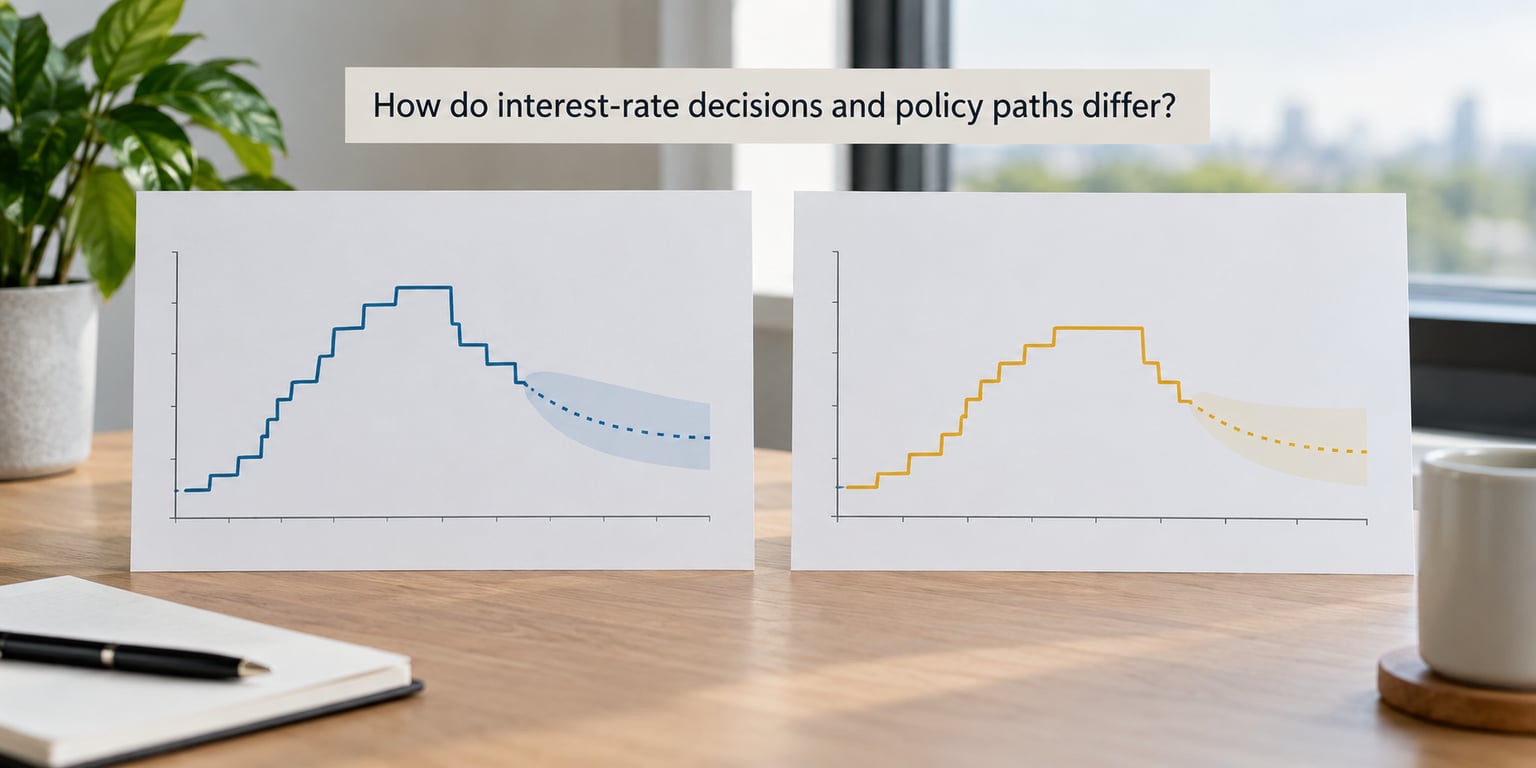
The Fed announces a target range for the federal funds rate and works to keep the effective rate inside it, using interest paid on reserve balances as the main implementation tool. Banks that hold more reserves than they need bid the rate up in the market, so the reserve rate is what actually anchors overnight borrowing.
The ECB runs a corridor with three rungs. The deposit facility rate sits at the bottom, the main refinancing operations rate sits above it, and the marginal lending facility rate sits above both as a backstop. Because banks have no reason to borrow overnight at a rate higher than the rate they earn on overnight deposits, the deposit facility rate functions as the ECB’s effective policy rate. Comparing “the ECB rate” with “the Fed rate” without knowing which instrument you are looking at is the single most common error readers make.
Different reaction functions, not different convictions
The Fed decides meeting by meeting against a dual mandate and publishes a Summary of Economic Projections, including the median dot plot and the longer-run neutral rate estimate, four times a year. The ECB publishes staff macro projections after every monetary policy meeting, split into baseline and adverse scenarios, and publishes them without a formal dot plot of committee members’ paths.
Both banks can tighten or ease. The path diverges because the data diverge. When the Fed faces a labour market that has already normalised and an inflation rate that has plateaued, the case for holding is different from the case facing an economy where domestic price pressure is still broadening into services and wages.
Here is how ecb policy differs from the fed in practice: identical-looking inflation prints, different inflation composition, different wage dynamics, and different degrees of economic slack produce different reaction functions, which produce different rate paths even when both banks are nominally heading the same way.
Guidance is a policy instrument at both, but spoken in different registers
Neither bank has a formal “promise”. Forward guidance shapes expectations about the path of short rates, which is part of why long-term yields can fall even when the policy rate rises. The ECB has leaned heavily on explicit language about the conditions under which rates would stay higher or lower for longer. The Fed has alternated between a similar conditional language and a deliberate vagueness that lets it move quickly when data turns.
Communication format also differs. Chair Powell’s press conference after every FOMC decision has become the market-moving fixture. ECB President Christine Lagarde holds a press conference after every Governing Council monetary policy meeting, and the projection rounds that accompany it are treated as a meaningful signal in their own right.
What tools does each institution use beyond interest rates?
Beyond the headline rate, each bank runs standing facilities that define the edges of its corridor and a set of emergency tools that normally sit dormant. These matter to market functioning even when they are not being used, because their existence sets a backstop for funding markets.
The Fed’s toolkit
Standing facilities include the discount window, which offers short-term liquidity to eligible depository institutions, and the repo framework for short-term funding. During stress the Fed has used broad asset purchases, facilities for money market funds and corporate credit, dollar swap lines with foreign central banks, and emergency deposit facilities for banks and money market funds. Those emergency programmes were built for specific crises and are treated as standing backstops rather than routine tools.
The ECB’s toolkit
The ECB has its own set of standing credit facilities at the Eurosystem level and its national central banks run theirs. Beyond that it built targeted lending programmes with national banks through the Asset Purchase Programme, including pandemic and post-pandemic refinancing operations, and it acquired corporate and government bonds under the corporate sector purchase programme and the public sector purchase programme. Transmission through banks is stronger in the euro area, so targeted lending has carried more weight there than in the United States.
What counts as normal policy and what does not
The pandemic pushed both balance sheets to historic size through purchases that included, in the Fed’s case, mortgage-backed securities to support market functioning. Both banks have since shrunk or stopped reinvesting. The durable distinction is that the ECB kept a corporate bond holdings portfolio as a structural feature while the Fed’s holdings rolled back toward a smaller, more conventional mix.
Emergency lending programmes are different again. They are designed to be usable without stigma, and both banks have said they can deploy them quickly when conditions warrant. Their existence changes behaviour at the margin even when they are idle.
How does the ECB differ from the Fed on QE and the balance sheet?
Quantitative easing is the clearest place where the two institutions reveal different philosophies, because the Fed tends to describe its purchases in terms of the size of its holdings while the ECB has described them in terms of what they are intended to do for the economy.
What the Fed buys
The Fed’s purchases, run through its System Open Market Account, focused on US Treasury securities and agency mortgage-backed securities. Buying mortgage-backed securities supported the housing-related transmission channel, where rate changes reach household borrowing costs. In recent years the Fed has described the process as reducing the size of its balance sheet, and has repeatedly updated the pace of that reduction in public statements.
What the ECB buys
The ECB’s holdings are split across several programmes, and the split is the point. The asset purchase programme covered euro-area government bonds. PEPP, launched during the pandemic, held both government and corporate bonds across member states with a reinvestment rule that later expired. The public sector purchase programme continues to hold government bonds for liquidity and market-functioning purposes, and the corporate sector purchase programme holds corporate bonds.
Because the ECB never published an explicit share cap for a large part of the pandemic holdings, each country’s bond weight grew roughly in line with its borrowing over the programme. That gives the portfolio a distribution unlike anything the Fed holds, and it raises exit questions that a single sovereign’s central bank does not face.
Why exit is harder for the ECB
Running down a balance sheet held by one country means deciding which securities to let mature. Doing it across a union raises a separate concern: sales or non-reinvestment could tighten financial conditions unevenly across member states with different debt levels and market structures, and the ECB cannot print in one country while holding in another to compensate.
There is a transmission difference too. The Fed’s holdings are US Treasuries and agency MBS, assets with deep, liquid markets where the central bank is a large but not dominant participant. The ECB’s government bond holdings are proportionally more concentrated in the markets of individual member states, which is why questions about scarcity and market liquidity keep appearing in the Eurosystem’s own analysis.
How do exchange rates, commodities, and financial markets react?
Markets read the two sets of decisions through overlapping channels, so the same policy move can pull an asset in two directions. The table below separates the direct effect from the expectation effect, which is where most of the confusion in commentary comes from.
| Asset | Direct effect | Expectation effect |
|---|---|---|
| Euro versus US dollar | Rate differentials pull the higher-rate currency toward support | Forward rate expectations often move before any actual decision |
| Bund yields versus Treasury yields | Front-end yields follow the respective policy rate | Term premium and fiscal supply push the long end independently |
| Euro Stoxx 50 versus S&P 500 | Rate-sensitive sectors react fastest to policy surprises | Relative earnings expectations can outweigh the rate signal |
| Gold | Real yields and the dollar are the main drivers | A policy pivot is often priced in before the announcement |
The euro and dollar case is the one retail readers ask about most. If one central bank is more hawkish than the other, the interest-rate gap tends to support the higher-rate currency, but only if markets are not already positioned for the difference. Futures and overnight-indexed swap pricing tend to move well ahead of the announcement, so the exchange rate reaction on the day is often smaller than the change in expectations.
For bonds, the front end is the clean read. Long-dated yields carry term premium, inflation expectations and fiscal supply on top of policy, which is why two central banks with near-identical short rates can produce very different ten-year yields. A widening or compressing Bund-versus-Treasury gap tells you something about growth expectations and fiscal supply as much as about policy.
Gold and industrial metals are usually downstream of real rates and the dollar rather than of either decision on its own. Gold tends to have a lower and slightly negative correlation with real yields and a weak positive correlation with the dollar, so a divergence that lifts US real yields while the dollar firms tends to weigh on it. Industrial metals track the growth expectations embedded in both, which is why a demand shock in one region can move copper without either bank acting.
One more angle worth naming: bank net interest income. A flatter or steeper curve changes what deposit and lending margins look like, and the structural differences in deposit concentration and loan duration between US and European banks mean the same rate move produces different earnings profiles on the two sides of the Atlantic.
Which policy matters more for a particular investor?
The Fed is the relevant authority for US Treasuries, US mortgage rates, US credit cards, US equities and anything denominated in dollars. The ECB is the relevant authority for euro-area sovereign bonds, euro-area lending rates and euro-denominated assets. Most global portfolios hold both, which is exactly why divergence rather than convergence is the thing to track.
For a portfolio held in dollars with European holdings inside it, the euro leg introduces both a currency decision and a rate decision, and they do not always point the same way. European rates falling while the currency weakens is a perfectly normal combination, and reading only one of the two leads to the wrong conclusion.
Precious metals and commodity producers are usually more sensitive to the joint move in US real yields and the dollar than to euro-area rates, though gold does respond to European demand and to risk sentiment in Europe. Commodity producers listed in one market and operating in the other sit between the two policy regimes.
For readers watching inflation or growth rather than holding assets, the divergence itself is the signal. A widening gap tells you the two economies are being diagnosed differently, which matters more than the absolute level of either rate.
How do investors compare the next Fed and ECB moves?
Comparing the two paths means reading two data streams and two communication styles side by side, and knowing which releases carry weight at each bank. The framework below is what I come back to.
- Inflation on both sides: euro-area HICP headline and core from Eurostat, US CPI and core PCE from the Bureau of Labor Statistics. Compare like with like where you can.
- Labour market data: euro-area unemployment and negotiated wages, US payrolls, unemployment rate and wage growth. The Fed weights employment in its mandate, so US labour data carry more weight in the FOMC reaction function.
- Services inflation: the component both banks watch most for evidence of persistence.
- Growth and survey data: PMIs, retail sales and industrial production give a faster read than quarterly GDP.
- Credit conditions: lending surveys, money-market spreads and corporate issuance indicate how much policy is reaching the real economy.
- Statements, projections and speeches: the ECB’s projection rounds after each meeting and the Fed’s quarterly Summary of Economic Projections are the two documents worth reading in full.
- Market pricing: overnight-indexed swaps and rate futures for each bank show what is already discounted, which is the gap that determines the reaction on the day.
- Balance-sheet announcements: reinvestment decisions and any change in purchase or runoff plans arrive separately from rate decisions and move long-end yields on their own.
Two practical habits help here. First, note the date next to any rate figure you write down, including in your own notes, because a comparison built on an undated number is worthless. Second, keep structural differences separate from cyclical divergence, since the first is permanent framework and the second reverses.
The official calendars are published on the ECB and Federal Reserve websites and are worth bookmarking rather than tracking through news headlines, which tend to lead with the drama rather than the change in expected path.
Which Should You Choose?
Neither, because a central bank is not an investment. What you actually choose is which policy outlook drives a decision you are already considering. The right frame is exposure: which currency and which assets does this money sit in, and which of the two policy regimes governs them.
If the decision concerns euro-area duration, euro-area lenders or euro-denominated assets, the ECB path matters more. If it concerns US Treasuries, US mortgage lending, US credit costs or dollar exposure, the Fed path matters more. If it concerns gold, commodity producers or a globally diversified equity book, both matter, along with the differential between them.
Two mistakes are worth naming because they recur. The first is treating a divergence as automatically bullish or bearish for one side. A widening gap usually reflects different domestic conditions rather than one bank being right and the other wrong. The second is reacting to the policy decision itself when the market had already moved on expectations.
The honest summary is that the ECB tends to move later and by smaller cumulative amounts because it is governing one currency across around twenty national economies, while the Fed has more room to move on a single national mandate. Neither of those statements tells you where either bank goes next, and neither is a forecast.
This is general information about how two central banks operate. It is not individual financial advice, and no returns are promised or implied. Rules, targets and rate levels change; check the official sources for current figures and consider your own circumstances.
Frequently Asked Questions
What is the main difference between the ECB and the Federal Reserve?
The Fed serves one country with a dual mandate covering maximum employment and price stability, and it runs a federal funds target range. The ECB serves a union of countries with a single currency, and its primary mandate is price stability under a 2% HICP target reached through its deposit facility rate. Mandate scope, rate instrument, governance and supervision all differ as a result.
Are the ECB and Fed independent central banks in the same way?
Both operate independently of national governments, but the institutions around them differ. The Fed’s twelve voting seats sit inside a single national legal framework with one sovereign and one supervisor. ECB Governing Council members include fifteen national central bank governors, and bank supervision in the euro area is handled by national authorities rather than by the ECB itself.
What happens when ECB policy differs from Fed policy?
Interest-rate differentials tend to support the currency of the higher-rate central bank, though much of that move is usually priced in ahead of the decision. Sovereign yields at the front end follow their own policy rate, while long ends also reflect term premium and fiscal supply. Equity sector performance can diverge, and currencies of the two economies move on different growth expectations.
How does the ECB approach quantitative easing compared with the Fed?
The ECB split its holdings across government bond programmes, a pandemic programme and corporate bond programmes, and it generally described purchases by their intended effect rather than by a size cap. The Fed concentrated on Treasuries and agency mortgage-backed securities and has more often described the process as shrinking its holdings. The Fed can run down one balance sheet; the ECB cannot let individual member states adjust independently.
Which central bank has more influence on gold and commodity prices?
The Fed generally has more influence, because gold responds most closely to US real yields and the dollar, and US data releases move both. The ECB still matters through euro-area demand, industrial metals and the euro itself. During stress periods, however, dollar liquidity and US facility announcements can dominate moves in gold and industrial commodities far more than anything decided in Frankfurt.
Can the ECB and Federal Reserve raise or lower interest rates at the same time?
Yes. Neither bank follows the other, and both can tighten or ease in the same direction at the same time, at different speeds, or in opposite directions entirely. Their meeting calendars are set independently and their reaction functions differ, so coincident moves are common but synchronised ones are not guaranteed. Each institution publishes its own calendar, projections and statements.
Conclusion: Start With the Policy Function
Knowing how ecb policy differs from the fed comes down to four checks: which mandate applies, which rate instrument moves, which balance sheet sits behind it, and which economy the data describes. Once you can name those four for any given asset, a policy headline stops being confusing and becomes a signal you can size.
Start with the currency and asset exposure you actually hold, read the two official statements rather than the summaries, and track expectations alongside decisions. Then watch inflation, employment, growth and market pricing as one picture, not as four separate stories.