
US government debt is bought mainly by four groups: American investors and institutions such as mutual funds, banks, pensions, insurers and state and local governments; the Federal Reserve; foreign governments, central banks and private investors abroad; and the US government itself, through trust funds like Social Security. No single buyer controls the market, and the mix shifts every year.
That short answer hides a lot of nuance, so here is the longer version. When federal spending outruns tax revenue, the Treasury fills the gap by auctioning Treasury bills, notes and bonds. Whoever bids wins the securities, and then those securities change hands constantly in the secondary market. That is why the buyer at auction and the owner a decade later are often two very different parties.
I spend a lot of time on this data, and the single most common mistake I see is mixing up the numbers. A headline about the national debt is a gross total. The question “who buys US government debt” is usually about a narrower slice: debt held by the public. Get that distinction right and most of the confusion disappears.
Table of Contents
- Who Buys US Government Debt?
- What Is US Government Debt?
- Which Buyers Are the Largest?
- Major holder categories at a glance
- Why do countries such as Belgium and Luxembourg rank so high?
- Why Do Foreign Governments and Central Banks Buy It?
- What happens if a foreign buyer sells?
- Why Do the Federal Reserve, Banks, and Funds Buy It?
- The Federal Reserve
- Banks and credit unions
- Mutual funds, ETFs and hedge funds
- What About Households, Pension Funds, and Insurers?
- How Does Buyer Demand Affect Treasury Yields?
- What Should Investors Take From This?
- Frequently Asked Questions
- Does the US government buy its own debt?
- Which foreign countries hold the most US government debt?
- If the Federal Reserve buys Treasuries, does the government ever have to repay the Fed?
- Do US taxpayers personally own the national debt?
- Can one large buyer force the government to raise taxes or change its budget?
- Why do Treasury yields fall when investors buy more bonds?
- Conclusion
Who Buys US Government Debt?

The buyer map, in plain categories:
- US households — directly, through savings bonds, or indirectly by holding money market funds, Treasury bills and bond funds inside a brokerage or retirement account.
- Mutual funds and ETFs — the largest single domestic category by far, because bond funds hold Treasuries as their core holdings.
- Banks and credit unions — for liquidity reserves, collateral and interest-rate management.
- Pension funds, insurers and endowments — matching long-dated liabilities with long-dated government bonds.
- State and local governments — holding bond proceeds in Treasuries until they are spent on roads, schools and payroll.
- Hedge funds, proprietary trading firms and private investors — buying for relative value, financing trades or balance-sheet reasons.
- The Federal Reserve — an unusual buyer, because it buys in the open market to steer monetary policy rather than for profit.
- Foreign governments and central banks — for reserve assets, collateral and day-to-day liquidity.
- Foreign private investors — banks, funds, insurers and sovereign wealth funds outside the United States.
- The US government itself — Social Security and other trust funds invest payroll tax receipts in special-purpose, non-marketable Treasuries.
One more label to be careful with. Most of these people buy nominal Treasuries issued by the Department of the Treasury. Some buy agency debt, which is issued by entities such as Fannie Mae or Freddie Mac and carries an implicit federal guarantee but is not the same instrument. And “total federal debt” in the news is a separate concept again. Readers who treat agency debt and intragovernmental holdings as interchangeable with marketable Treasuries end up with percentages that make no sense.
What Is US Government Debt?
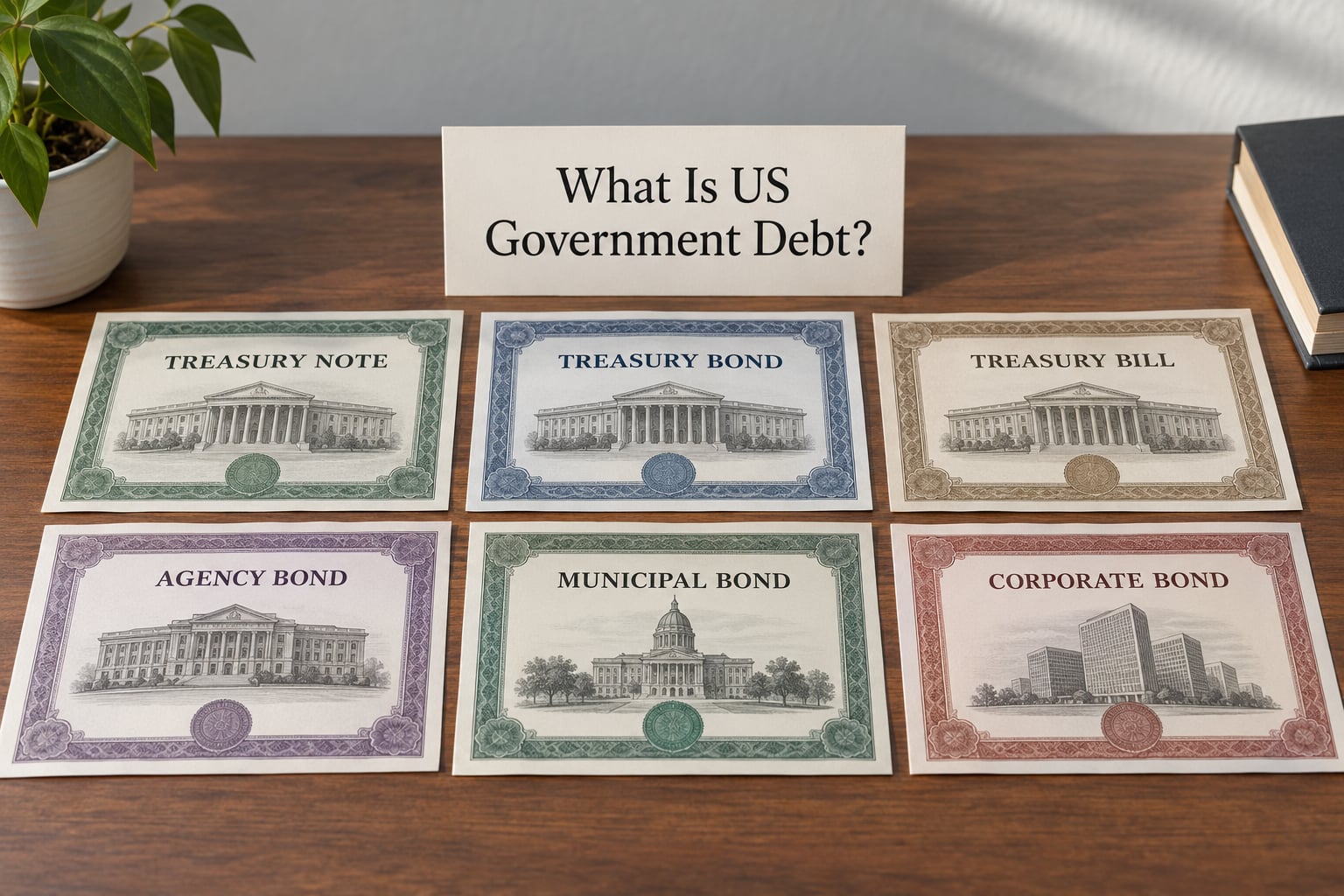
US government debt means obligations issued by the federal government, and the Treasury is the only department that issues them on the government’s behalf. The main securities are bills of one year or less, notes of two to ten years, bonds of twenty or thirty years, inflation-protected notes called TIPS, and floating-rate notes.
Several things get lumped in that are not the same thing:
- Agency debt — issued by government-sponsored enterprises, not by the Treasury.
- Municipal bonds — issued by states, cities and counties, not the federal government.
- Corporate bonds — private credit with no government backing.
- Federal Reserve liabilities — reserves and currency in circulation, which are not Treasury securities at all.
- Non-marketable special-purpose Treasuries — issued to federal trust funds and never traded on an exchange.
The word that matters most is gross. The gross federal debt total includes intragovernmental holdings, the money federal trust funds owe to themselves. At year-end 2023 that split was roughly 27.3 trillion dollars publicly held and 7.0 trillion dollars intragovernmental. Neither number tells you who the ultimate economic owner is, because ownership in the secondary market is something you generally have to infer rather than observe.
Which Buyers Are the Largest?
Foreign investors hold about 9.25 trillion dollars of US Treasuries, roughly 28.9 percent of debt held by the public, according to Treasury International Capital data as of July 2026. That share has fallen a long way from about 49 percent in 2008, when the balance sheet crisis pushed foreign buying to a peak. Japan is the largest single foreign holder at around 1.10 trillion dollars, and five countries together account for roughly 39 percent of all foreign-held Treasuries.
Major holder categories at a glance
| Holder category | Where it sits | Typical reason for buying |
|---|---|---|
| Mutual funds and ETFs | Domestic, marketable | Fund mandate, index exposure, collateral |
| Federal Reserve | Domestic, marketable | Monetary policy operations |
| Depository institutions | Domestic, marketable | Liquidity and asset-liability management |
| Pension funds and insurers | Domestic, marketable | Liability matching |
| State and local governments | Domestic, marketable | Short-term cash management |
| Households and savings bonds | Domestic, marketable | Savings, interest, retirement income |
| Foreign official institutions | Foreign, marketable | Reserves and collateral |
| Foreign private investors | Foreign, marketable | Relative value and diversification |
| Federal trust funds | Intragovernmental | Parking payroll tax receipts |
Read the categories with care. Official statistics use several different words. Held means the holder appears in the records. Managed means an institution manages the position for clients. Beneficially owned means the person who actually bears the price risk and collects the income, and that is rarely visible.
Why do countries such as Belgium and Luxembourg rank so high?
Because those rankings record where a security sits in a custody chain, not where the money came from. Belgium and Luxembourg host clearing and settlement operations, including through Euroclear, and the United Kingdom does the same through its own custody hubs. The Cayman Islands show up for a related reason, since a large share of the hedge fund industry is registered there. Actual beneficial owners frequently live somewhere else entirely.
The practical effect: any comparison of country rankings should be treated as approximate. Treasury notes that recorded data understate foreign private holdings, including hedge fund positions booked offshore, by an estimated 1.4 trillion dollars.
Why Do Foreign Governments and Central Banks Buy It?
Reserve managers buy Treasuries for reasons that have almost nothing to do with chasing yield. In rough order of importance:
- Liquidity and size. The market can absorb enormous transactions without moving the price much, which matters when a central bank needs to adjust reserves quickly.
- Collateral. Treasuries are the standard asset posted as collateral around the world, including in repo and swap lines.
- Benchmark status. Yields on Treasuries set reference rates for mortgages, corporate bonds and derivatives worldwide.
- Currency. The bonds pay in dollars, so a foreign buyer with dollar liabilities is not taking on foreign exchange risk.
- Sanctions exposure. Assets outside the United States can face restrictions in a crisis, and that risk is real even when it stays low most of the time.
- Domestic plumbing. Many central banks hold dollars to keep their own currency markets and banking systems functioning, regardless of what they think of US politics.
Central banks in Japan and Europe buy for these reasons, and the same logic applies to sovereign wealth funds. It is fair to say a foreign buyer cares about its own return, but it is not fair to describe any single government as controlling how the United States finances itself.
What happens if a foreign buyer sells?
Yields would likely rise, since selling pushes prices down. But nothing breaks. Treasuries trade in enormous volume every day, foreign buyers hold a minority of the marketable stock, and the United States still issues paper into a market several times deep enough to absorb a large sale without any trouble. In practice, a gradual shift in foreign buying shows up first as a slow drift in auction demand and bid-to-cover ratios rather than as a crisis.
The China question comes up constantly here. China’s recorded holdings have drifted down over the past decade, but recorded holdings depend on custody arrangements, and researchers have argued for years that some Chinese positions sit with third-country custodians. Both things can be true at once: the visible number fell and the underlying ownership is less certain than the number suggests.
Why Do the Federal Reserve, Banks, and Funds Buy It?
The Federal Reserve
The Fed is the largest single holder of Treasury securities on this list, and it got there through policy rather than ordinary deficit financing. During the 2008 crisis and the years after, quantitative easing involved large-scale purchases intended to lower longer-term borrowing costs and support the economy. Those holdings stayed on the balance sheet, and a balance sheet shrink in the form of runoff reduced them.
This is the part people on forums like r/AskEconomics usually get right: those bonds were not bought to fund a deficit. They were bought to change the price of money in the system. The interest the Fed receives on them now goes back to the Treasury, and maturing securities are treated like any other bond in the market, with proceeds rolled into new issuance.
Banks and credit unions
Banks hold Treasuries because they are liquid, they can be pledged, and they carry relatively little credit risk on a regulatory balance sheet. They also let a bank shorten or lengthen duration without taking much risk of default. A bank that expects rates to rise can add duration cheaply, for example.
Mutual funds, ETFs and hedge funds
Index products have to hold what their benchmark holds, which mechanically makes them steady buyers of Treasuries whenever new issuance expands the benchmark. Money market funds hold bills for their cash-management mandate. Hedge funds care about relative value: the spread between a Treasury and a corporate bond, or between one point on the curve and another. None of these buyers needs a view on the US economy to be a buyer.
| Buyer type | Main motive | Key risk they carry |
|---|---|---|
| Federal Reserve | Policy targets and market function | Losses if held to par fall |
| Banks | Liquidity and collateral | Rate moves against duration |
| Money market funds | Cash management | Reinvestment at lower rates |
| Pension funds | Matching long liabilities | Spending more than returns |
| Insurers | Duration matching | Spread widening on other credit |
| Foreign central banks | Reserves and collateral | Currency and political shifts |
| Hedge funds | Relative value and leverage in the trade | Position risk and funding costs |
What About Households, Pension Funds, and Insurers?
Pension funds are the clearest example of liability matching. A retirement plan promising benefits thirty years out wants assets that pay predictably over thirty years, and long Treasuries fit that promise more closely than equities or corporate bonds. Insurance companies run the same logic against claims they may have to settle years later.
Endowments and foundations buy for the opposite reason, balancing a spending-heavy present against a long investment horizon. State and local governments mostly do something simpler: they collect bond money today and spend it over the following year or two, so they park it in bills until the bills are drawn down.
Households mostly own Treasuries without ever choosing to. A money market fund holding bills, a bond fund tracking an index, or a brokerage sweep account is all indirect exposure. And savings bonds remain the rare instrument where an individual holds a direct government obligation, though they are not marketable in the same way as an auctioned security.
How Does Buyer Demand Affect Treasury Yields?
Here is the issuance chain, because this is where the verb in the question gets answered. The Treasury announces a bill, note or bond auction with a size and a settlement date. Primary dealers — a small group of banks with a direct relationship with the Treasury — bid competitively and take down large shares. From there the securities trade freely, and any investor anywhere can end up holding one.
That is why auction demand and final ownership are different questions. Primary dealers often buy at issuance and sell within days to pension funds, foreign reserve managers, banks and funds. When people ask whether buying Treasuries funds the deficit, the answer is that the purchase funds it only at the auction; everything afterward is one investor selling to another.
Demand affects yields through price. A bond pays a fixed coupon and returns principal at maturity, so buyers bid the price up when they want more exposure and the yield down as a result. Three steps, no more: more buyers, higher price, lower yield.
What complicates the picture is that demand is only one input. Maturity matters. A heavy calendar of long-dated issuance can push long yields higher even with strong demand, because buyers demand compensation for the duration. Inflation expectations and Federal Reserve policy expectations move the whole curve. Dealer balance-sheet capacity changes how much they can absorb in a session.
So the honest version is: strong foreign demand tends to help at the auction window and at the short end. It does not automatically drag long-term yields down, because the long end responds to issuance plans, term premium and inflation expectations far more than to any single buyer’s purchases.
What Should Investors Take From This?
The useful takeaway is not that some hidden group is pulling strings. It is that the buyer mix is broad, it changes over time, and the foreign share has already fallen from about half of publicly held debt in 2008 to under a third. When a headline blames a single country, check which category the figure belongs to first.
If you want to keep an eye on this yourself, here is a short list worth checking each month:
- Auction results — the bid-to-cover ratio, the tail, and how new long-dated issuance is received.
- The yield curve — especially the spread between two-year and ten-year yields.
- Federal Reserve policy — reinvestment decisions, balance sheet size and the direction of rates.
- Inflation expectations — the market’s view here is one of the biggest drivers of long yields.
- TIC releases — published with about a two-month lag, so label every figure with its release month.
- Issuance plans — the mix of bills against coupons tells you where the pressure lands.
- The maturity profile — more debt rolling over soon means more refinancing in a shorter window.
- Debt ceiling fights — extraordinary measures can shrink the bill supply for a period and distort the data that follows.
Treat all of this as background reading rather than a signal to act. Rules, rates and auction mechanics change, and nothing here is a recommendation for your own portfolio. If you hold T-bills or a bond fund, you are part of this buyer base, which is a reasonably comfortable place to sit.
Frequently Asked Questions
Does the US government buy its own debt?
Partly. Federal trust funds, and Social Security is the biggest example, invest payroll tax receipts in special-purpose non-marketable Treasuries. That money is intragovernmental debt: the government owes itself, and these securities are never auctioned or traded on a market. The same trust funds buy Treasuries again when they mature. It is an accounting arrangement for parked revenue, not a way of financing the deficit.
Which foreign countries hold the most US government debt?
Japan ranks first at around 1.10 trillion dollars of Treasuries as of the July 2026 TIC data, followed by the United Kingdom and China. Five countries hold roughly 39 percent of all foreign-held Treasuries. Treat the rankings as approximate: they record where securities sit in a custody chain, and Belgium, Luxembourg and the Cayman Islands rank highly because of clearing hubs and fund registration rather than the origin of the money.
If the Federal Reserve buys Treasuries, does the government ever have to repay the Fed?
Yes, in the ordinary way. The Fed holds Treasury securities on its own balance sheet, and when they mature the Treasury repays principal and interest, with the interest going to the Fed. The Fed then typically remits that income to the Treasury. Nothing about the arrangement is a gift or a cancellation: the securities remain debt obligations, and the Fed holds no claim on the government beyond what a private holder would have.
Do US taxpayers personally own the national debt?
No. The gross federal debt total is money the federal government owes, held by other governments, banks, funds, pension plans, insurers and households rather than by individual taxpayers. If you hold a bond fund, a money market fund or savings bonds, you own a slice of it indirectly. If you paid income tax, you contributed to revenue that helped pay the interest on it, but the obligation runs to the holders of the securities, not to the public as a collective.
Can one large buyer force the government to raise taxes or change its budget?
No single holder controls that. Taxing and spending are set by Congress through legislation, and the budget process does not consult bondholders. Foreign central banks hold a minority of marketable Treasuries, and even a large sale would move prices rather than hand anyone a policy lever. Federal policy responds to inflation, employment and financial stability. Large holders do influence the price the government pays to borrow, which is a different kind of influence entirely.
Why do Treasury yields fall when investors buy more bonds?
A Treasury security promises a fixed coupon and the return of principal at a set date. Once those payments are fixed, the only variable is the price you pay. Buyers competing for a limited supply bid the price up, and a higher price means a smaller yield relative to the fixed payments. That relationship works in reverse too: heavy selling pushes prices down and yields up, which is why yields often read as a signal about how much demand the market has.
Conclusion
US government debt is bought by American funds, banks, pensions, insurers and households; by the Federal Reserve; by foreign central banks and private investors; and by federal trust funds that hold their own receipts. Start by pinning down which question you actually mean: who holds Treasury securities today, who shows up at a given auction, or how large the Fed’s portfolio is. Then compare the same holder category across the same period, and check which release the figure came from. The buyer list changes enough from year to year that a number without a date is not worth much.