
The COMEX delivery process is the standardised way an expiring gold, silver, platinum or copper futures contract is closed out with the underlying metal instead of cash. After First Notice Day, the short seller tenders a Delivery Notice, the clearinghouse matches it to a long buyer, and ownership passes through a warehouse warrant for metal sitting in an approved vault. Last reviewed for 2026.
Most people who hear “COMEX gold delivery” picture bars being carted out of a vault in Manhattan. That is the rarest part of the process. What usually happens is a piece of paperwork changing hands.
That distinction matters, because delivery headlines get read as proof that metal is leaving the exchange. Usually they are not. Once you can separate the two, the rest of the mechanics fall into place quickly.
Table of Contents
- How the COMEX Delivery Process Works at a Glance
- What Is COMEX and Why Does Delivery Matter?
- Which COMEX Contracts Can Be Delivered?
- What Happens During the Delivery Month?
- How the delivery process runs day by day
- How Do Warehouse Receipts Transfer Ownership?
- What Happens on Settlement Day?
- What Are the Main Risks and Costs?
- What Does COMEX Delivery Mean for Investors?
- How to read the daily delivery intentions and warehouse stocks reports
- What the curve tells you
- Questions to ask before trading a deliverable contract
- Frequently Asked Questions
- Can individual investors deliver COMEX futures?
- Is every COMEX contract settled with physical delivery?
- What is a COMEX warehouse receipt?
- When does a COMEX futures contract stop trading?
- What happens if nobody takes delivery of a COMEX contract?
- Why do most futures traders avoid physical delivery?
- Conclusion
How the COMEX Delivery Process Works at a Glance
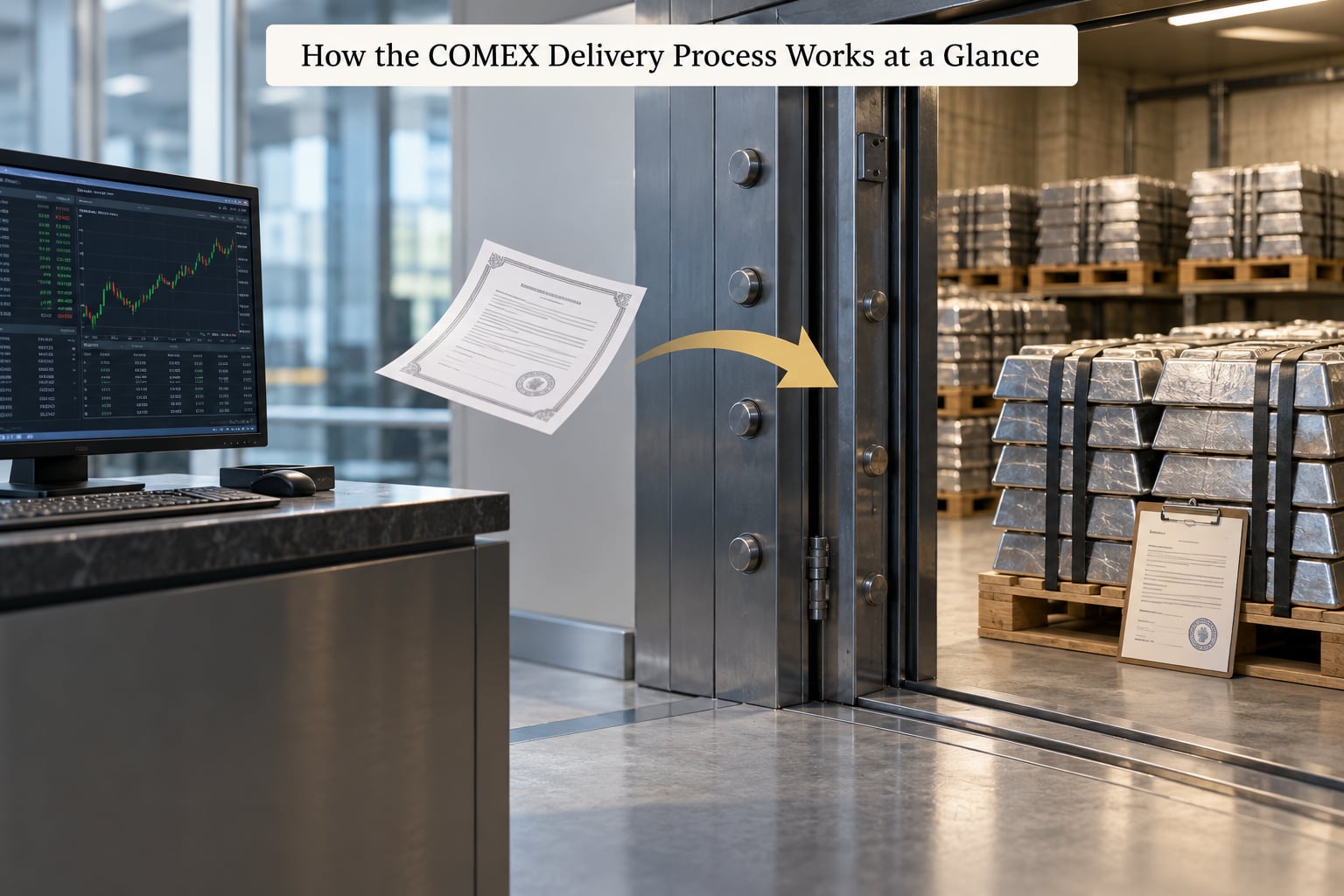
In plain terms, the short initiates by tendering, the clearinghouse assigns longs to shorts, the buyer pays the settlement price plus costs, and a warrant naming the new owner is issued. The metal itself normally stays where it is.
| Stage | What happens | Who acts |
|---|---|---|
| Rolling | Position is closed out and reopened in a later contract month | Nearly every trader |
| First Notice Day | Delivery window opens; shorts may begin tendering | Short |
| Delivery Notice | Short tells its clearing member it intends to deliver | Short |
| Assignment | Clearinghouse pairs that short with a long, pro rata | Clearinghouse |
| Warrant issuance | Warehouse warrant is cancelled against the old holder and reissued to the new one | Depository |
| Payment | Long pays the settlement price plus delivery-related costs | Long |
| Load-out | Optional separate step where the owner physically removes the metal | New owner |
| Last Trading Day | Remaining open interest is closed and the contract expires | Clearinghouse |
Note that only two things happen on this list without anyone choosing them: assignment, and the final expiry. Everything else is a decision by one party or the other.
What Is COMEX and Why Does Delivery Matter?
COMEX is the commodity division of CME Group, historically based in New York and now sharing CME Group’s electronic trading system with the rest of the complex. It lists contracts on metals, energy and agricultural products, and it is where the world’s most actively traded gold futures contract lives.
The exchange itself does not own metal, does not run the vaults and does not hand you a bar. What it does is write the rules: which refiners qualify, which storage facilities are approved, what a deliverable bar must look like, and how title to it is proven. The clearinghouse guarantees the contract by standing between buyer and seller.
Delivery is what keeps futures honest. Because a contract can always be closed by taking the physical thing, arbitrageurs can buy metal cheap and sell futures rich, or the reverse, and that trading pushes the futures price back toward the spot price. Without a real deliverable product, the futures price could drift away from reality indefinitely.
Many commodity contracts have no physical metal behind them at all and settle purely in cash, using an average or index price on the expiry date. Understanding which contracts those are is one of the first things a new futures trader should check.
Which COMEX Contracts Can Be Delivered?
Only some COMEX products are deliverable, and even among those, the terms differ by metal. The contract month matters too: a contract becomes the spot month when the delivery month begins, and only then does its delivery process run.
| Contract | Contract unit | Typical form | Fineness standard |
|---|---|---|---|
| Gold (GC) | 100 troy ounces | 100 troy oz bar or 1 kg bar | Minimum 995 parts per thousand |
| Silver (SI) | 5,000 troy ounces | 1,000 oz, 15 kg or 60 kg bars | Minimum 999 parts per thousand |
| Platinum (PL) | 50 troy ounces | 50 or 100 troy oz bar | Minimum 950 parts per thousand |
| Palladium (PA) | 100 troy ounces | 100 troy oz bar | Minimum 950 parts per thousand |
| Copper (HG) | 25,000 pounds | Copper cathode | Grade A cathode |
Gold bars are the ones people picture, and they carry the strictest branding. A deliverable gold bar must have been refined by a refiner on the approved list, bear the refiner’s mark and a unique serial number, and come with an assay certificate. The bars are weighed and their serial numbers recorded when they are registered into the system.
Storage has to happen somewhere the exchange approves, at a listed depository. Metal held there and warrant-registered is called registered metal. Metal that meets the brand and grade standard but sits outside an approved vault is eligible metal, and it can still be delivered, though the paperwork and price adjustments differ.
Contract rules do get revised, including notice dates, position limits and approved brand lists, so treat any table like this as a description rather than a rulebook.
What Happens During the Delivery Month?
This is the sequence most guides skip. Here is how the COMEX delivery process works once a contract enters its delivery month, step by step.
How the delivery process runs day by day
- Positions roll or close. Most traders exit before the delivery month starts, often weeks earlier, so the contract they never intend to deliver simply expires quietly.
- First Notice Day arrives. This is the day the delivery window opens. For most metals it falls on the business day immediately before the Last Trading Day, which is generally the third-to-last business day of the contract month.
- The short tenders. A seller holding to expiry submits a Delivery Notice through its clearing member, stating it will deliver against its short position.
- The clearinghouse assigns. CME Clearing pairs that short with a long. Where a clearing member’s customers hold more long delivery interest than the member’s shorts can cover, assignment is made pro rata against that member’s aggregate position.
- The warrant moves. The depository cancels the existing warrant and issues a new one in the name of the buyer. Title to the metal changes here.
- The buyer pays. The assigned long settles at the contract’s settlement price for the delivery period, plus or minus whatever quality and location adjustments apply to the warrant.
- The contract expires. Any remaining open interest is closed on the Last Trading Day, and the contract month drops off the board.
None of this means the bar travels. Load-out is a separate step that the new owner may never take, or may take months later, paying the warehouse to release the metal and arranging its own transport and insurance.
If more delivery demand than registered supply shows up, the exchange does not simply fail. The short may be required to source metal from outside the approved system, at its own cost and at whatever price it can negotiate, and the sale carries a discount to reflect that handicap.
How Do Warehouse Receipts Transfer Ownership?
A warehouse warrant, also called a warehouse receipt, is the document that proves who owns a specific quantity of a specific serial-numbered bar sitting in an approved vault. Gold gets one warrant per 100 troy ounce bar. The warrant is what the buyer actually receives on delivery day.
Registered warrants can only be issued against metal that is in an approved facility, has been weighed and assayed to the standard, and whose brand and serial number are recorded. Eligible warrants cover metal that meets the brand and grade standard but sits outside approved storage, which is why they often carry a price adjustment.
The key distinction, and the one most often stated wrong, is this: delivery transfers a warrant, and the metal usually stays in the vault. Load-out is optional and separate.
| Warrant transfer | Physical load-out |
|---|---|
| Automatic part of settlement | Optional, requested separately |
| Title changes hands | Metal physically leaves the vault |
| Happens during the delivery window | Happens whenever the owner arranges it |
| Cheap: mostly fees and paper | Costs storage release, transport, insurance, assay |
| Routine, happens constantly | Rare relative to warrant transfers |
There is a second difference worth knowing. An owner who wants to exit after taking delivery does not have to move metal at all. They can leave the warrant in place and sell it, or go short the same contract against it, which is a cash-and-carry position rather than a physical withdrawal.
It also explains why vault-stock numbers are not the same thing as net withdrawals. Restocking, internal movements between facilities and warrant cancellations are not all published, so a drop in reported metal is not proof that metal left the system.
What Happens on Settlement Day?
After the Last Trading Day, the clearinghouse closes the contract out. Positions that were delivered have already changed hands through warrants. Positions that were closed in the market have simply been offset through the clearing process, with gains and losses settled daily against margin rather than at expiry.
The clearing sequence generally runs like this:
- Open interest is confirmed after the final trading session.
- Each clearing member’s net position to be delivered is established and the corresponding cash obligation is calculated at the delivery settlement price.
- The member’s customers are told which of their positions were assigned. Most are surprised, which is the point.
- Warrants are issued or cancelled through the depository and the payment obligation is invoiced.
- If a member fails to meet its obligation, the clearinghouse closes out the position using the guaranty fund and the default waterfall, then pursues the member.
Cash-settled contracts skip steps three to five entirely. The final price is averaged or sampled over a settlement window, and the difference between that price and the contract price is paid in cash. The contract is closed, and nothing physical ever existed.
This is why the settlement price is set separately from the last traded price. Exchange rules define how it is determined, and it is that figure, not the final quote on the screen, that drives delivery payments.
What Are the Main Risks and Costs?
Standing for delivery is the least glamorous and most expensive way to hold a futures position. The costs start with margin and do not stop there.
Full payment requirement. To hold a contract into delivery rather than rolling or closing it, you post essentially the entire contract value as performance bond, not the modest initial margin used during trading. On a gold contract that is five figures per contract at typical prices.
Storage and insurance. The depository charges to hold registered metal, and those charges sit with the warrant owner. Rates vary by facility and metal and change over time.
Delivery and handling fees. Fees attach to the transaction itself, including assay and re-weighing, warrant issuance, and the movement of metal between facilities.
Transport and handling. If you do load out, you arrange and pay for insured transport from a secure facility to wherever you want it.
Quality and documentation risk. If a bar fails an assay, carries a mark the rules do not accept, or its paperwork does not reconcile, the receiving side can reject it. Disputes here are slow and expensive.
Margin and liquidity risk. Even before delivery, holding a leveraged position means daily mark-to-market calls on fluctuating margin. A futures position can be closed out by a margin call long before delivery day arrives.
Operational risk. Being assigned obligations you did not plan for, with deadlines measured in hours, is how a profitable speculation turns into an expensive logistics problem.
What Does COMEX Delivery Mean for Investors?
For most investors reading this, the honest answer is that delivery is something to understand rather than something to do. Knowing the mechanics is what lets you read a price move correctly instead of misreading paperwork as metal leaving a vault.
How to read the daily delivery intentions and warehouse stocks reports
CME publishes daily reports on stocks and on delivery intentions for the metals, and most people misread them. A few habits make them legible.
- Separate the stock columns. Registered warrants represent metal in approved vaults that can back delivery. Eligible metal sits outside them. Only the registered figure is immediately usable against delivery demand.
- Read intentions as intentions, not deliveries. The intentions report shows what longs say they intend to take. It is an early signal, not a tally of what happened.
- Track changes over days, not a single print. One day’s stock move means little. A sustained build or drawdown against open interest into the delivery month says something real.
- Compare with open interest in the spot month. Open interest far above deliverable registered stock in the expiring contract is the combination that gets people talking about tight delivery.
- Remember what is missing. These reports do not tell you who holds warrants, whether metal is being restocked, or whether a fund has quietly changed its position.
What the curve tells you
When a nearby contract trades above the next one out, the curve is in backwardation, which usually reflects genuine pressure on near-term availability. Contango, the more common state, reflects storage costs exceeding what holders earn by holding metal. A curve that ignores cost of carry invites cash-and-carry arbitrage, and that arbitrage is what pulls prices back together.
Questions to ask before trading a deliverable contract
- Is this contract physically deliverable or cash-settled?
- What are the First Notice Day and Last Trading Day dates for this specific month?
- What is the full payment requirement to hold into delivery?
- What fees apply at my clearing member if I am assigned?
- Would I roll, close, or deliver, and do I know before the notice date?
There is also a route that avoids the futures delivery machinery entirely. An exchange for physical, or EFP, is a bilateral transaction where metal and a futures position are settled together. It is the tool large buyers use when they want specific metal rather than a warrant for whatever bar happens to be in the vault.
Frequently Asked Questions
Can individual investors deliver COMEX futures?
Technically yes, if your broker and clearing member handle deliverable contracts, but practically it rarely makes sense. Taking delivery means posting the full contract value rather than normal margin, then paying storage, insurance and handling fees on metal you may not be able to sell easily. Most retail traders roll or close the contract before First Notice Day instead.
Is every COMEX contract settled with physical delivery?
No. COMEX lists both deliverable and cash-settled products, and the distinction is contract-specific rather than exchange-wide. A cash-settled contract uses an average or index price over a defined window and pays the difference in cash, with no metal, warrant or vault involved at any point. Always check the contract specification before assuming which type you are trading.
What is a COMEX warehouse receipt?
A warehouse receipt, also called a warrant, is the document that proves who owns a specific quantity of a serial-numbered bar of metal held in an approved vault. It is issued against registered metal that has been weighed, assayed and recorded. On delivery day the existing warrant is cancelled and a new one is issued to the buyer, which is how ownership changes without the bar moving.
When does a COMEX futures contract stop trading?
The Last Trading Day is generally the third-to-last business day of the contract month for most COMEX metals, and First Notice Day is the business day immediately before it. Exact dates are published per contract and can be adjusted for holidays, so check the exchange specification for the specific month rather than assuming a calendar date.
What happens if nobody takes delivery of a COMEX contract?
If no longs tender, no delivery occurs and the contract simply expires after its Last Trading Day. If the reverse happens, where more longs want delivery than the shorts can supply from registered vaults, the short must source metal from outside the approved system at its own cost, usually at a discount to the contract price. Trading continues regardless, because open interest is offset through the clearing process.
Why do most futures traders avoid physical delivery?
The economics rarely work for a small trader. Holding to delivery requires the full contract value as performance bond, plus storage, insurance and handling fees that accrue every month. The metal may also be awkward to sell without further refining or transport. Almost everyone rolls into a later contract or closes the position before First Notice Day instead, which is why reported deliveries reflect paperwork far more than metal movement.
Conclusion
The COMEX delivery process is a paper-and-vault system more than a logistics one. A short tenders on or after First Notice Day, the clearinghouse assigns longs pro rata, warrants are reissued in the buyer’s name, and the buyer pays the settlement price plus costs. The metal stays put unless someone separately requests a load-out.
Your first practical step is small: pull up the specification sheet for the exact contract and month you trade, and check four things. Whether it is deliverable or cash-settled, the First Notice Day and Last Trading Day dates, the full payment requirement, and the fees your broker charges if you are assigned. Everything else in this guide follows from those four lines.