
A carry trade borrows in a low-interest-rate currency and buys a higher-yielding one, so the rate difference pays you while the position stays open. That is the core of how carry trades work in currency markets. The catch is that the income is slow and small, and a move in the exchange rate can erase years of it in days.
Most people meet the phrase in a headline about a market sell-off rather than in a trading manual. By the end of this guide you should be able to explain where the return comes from, how it is actually paid to you, and exactly what has to go wrong for a carry position to bleed out.
This is educational content about market structure, not investment advice. Rates, tax treatment and access rules differ by country and by provider, and nothing here is a recommendation to take a position.
Table of Contents
- Key takeaways
- What Is a Currency Carry Trade?
- How Carry Trades Work in Currency Markets
- Borrow, Convert, Invest, and Close: How Carry Trades Work Step by Step
- How Are Carry Trade Returns Calculated?
- Why Do Investors Use Carry Trades?
- Why the yen funds so much of the world
- Interest rate parity and the forward premium puzzle
- Diversification and tactical positioning
- What Determines Whether a Carry Trade Is Profitable?
- Why Do Carry Trades Lose Money?
- What happened in the summer of 2024
- How a Classic Currency Example Works
- How Do Traders Manage Carry Trade Risk?
- Early warning signs that a carry unwind is starting
- Frequently Asked Questions
- Are currency carry trades risk-free?
- Does the highest interest rate always produce the best carry trade?
- Can a retail investor use a currency carry trade?
- Why are Japanese yen carry trades so widely discussed?
- What happens to carry trades when central banks change interest rates?
- Conclusion
Key takeaways
- You short the low-yield funding currency and buy the higher-yield target currency.
- Your return has exactly two components: the interest rate differential, and any exchange-rate movement.
- Daily carry is roughly [(long rate − short rate) ÷ 360] × notional, credited or debited as rollover every day at 5pm New York time.
- Interest is credited on the full position notional, not only on the margin you posted.
- The trade pays a small certain amount in exchange for an open-ended loss if the target currency falls sharply.
- Break-even is simple arithmetic: a 4% differential means the target currency can fall about 4% before a full year of carry is gone.
What Is a Currency Carry Trade?
A carry trade is any position where the rate you pay is lower than the rate you earn, so the spread between them lands in your account while you hold it. In currency markets that almost always means borrowing in a low-yield currency and buying a higher-yield one, and the difference between the two is called the carry.
Two currencies do the work, and naming them is most of the vocabulary you need:
| Term | What it means |
|---|---|
| Funding currency | The low-yield currency you borrow and sell short. You pay interest on it for as long as the position is open. |
| Target currency | The high-yield currency you buy and hold. You receive interest on it while it sits in the position. |
| Positive carry | The rate you receive exceeds the rate you pay, so every night the position owes you a small amount. |
| Negative carry | The rate you pay exceeds the rate you receive, so the position costs you money to hold. Some brokers also add a markup on this leg. |
| Rollover, or swap | The overnight interest credit or debit itself, quoted in pips or points and applied at the daily rollover. |
| Carry trade unwind | Positions being closed, often at once, usually because the funding currency has strengthened sharply. |
What separates a carry trade from ordinary currency speculation is the source of the profit. If you buy a currency purely because you think it will rise, every unit of profit has to come from the price. If you buy it because the interest rate is higher, you earn something even while the price sits still, which is the whole appeal and the whole danger.
There is a third category worth knowing about, and it catches out a lot of beginners. Buying a US-listed share or an overseas fund with money you already hold in euros is an implicit carry trade: you are long the dollar by default, and you earn or lose the rate difference whether or not you named it. You asked a question about this on r/interactivebrokers, and it is the single most common confusion in the space.
How Carry Trades Work in Currency Markets
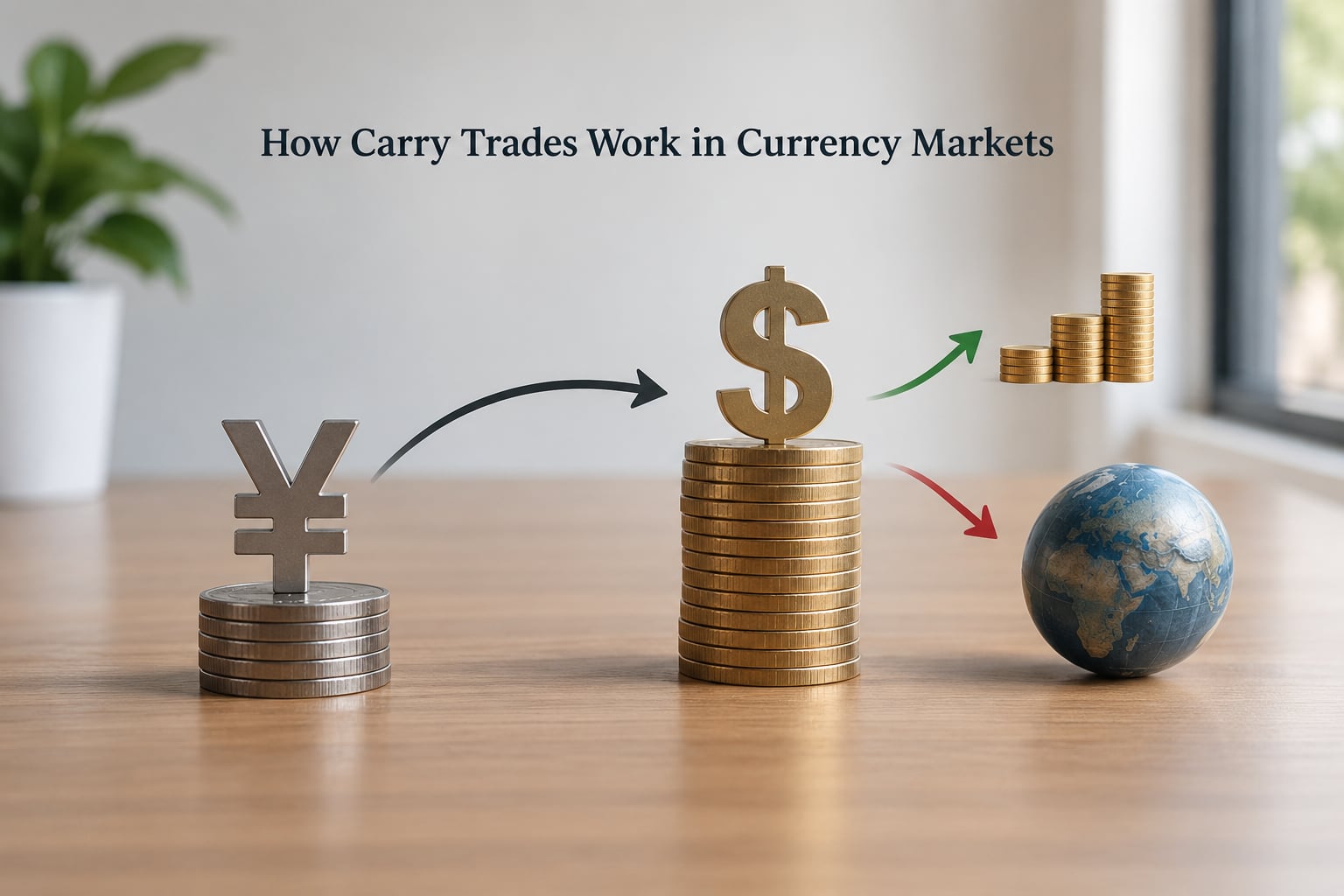
The flow of money is what makes the strategy work, and it is short. You borrow the cheap currency, you sell it, you use the proceeds to buy the expensive currency, and you sit on the position. The interest you pay on the borrowing and the interest you earn on the holding are both live at the same time, and only their difference is your profit.
There are two ways to hold it. At retail level it is almost always a spot position through a broker, where the interest difference appears in your account as rollover credits. Institutions do the same thing with outright forwards, borrowing in the low-yield currency and lending the proceeds forward in the high-yield currency, which locks the rate difference in advance but also locks the exchange rate, converting the strategy from an income stream into a fixed forward-arbitrage result.
That distinction matters more than most explanations admit. The spot version gives you floating carry and floating currency risk. The forward version gives you a known rate difference but removes the currency exposure entirely, which is why it is a hedging tool as much as a return strategy.
Borrow, Convert, Invest, and Close: How Carry Trades Work Step by Step
- Pick the funding currency. Usually the cheapest credible currency available to you, which in recent years has meant the Japanese yen, the Swiss franc or, for many readers, simply their own domestic currency.
- Pick the target currency. A currency whose central bank pays materially more. The gap between the two policy rates is your headline return before any currency movement.
- Borrow and convert. In practice you sell the funding currency and buy the target currency, usually with leverage, so the position size is many times your deposit.
- Hold and collect, then close. Each rollover credits or debits the interest difference. At the end you sell the target currency, repay the borrowing plus interest in the funding currency, and settle. If you used a forward instead, the principal and interest are exchanged at maturity as one fixed amount.
The important point to hold on to is that interest income does not guarantee an overall profit. The carry is a smaller, steadier component sitting on top of a much larger currency exposure. When the target currency falls further than the carry accumulated, the total result is negative no matter how many days you were paid.
How Are Carry Trade Returns Calculated?
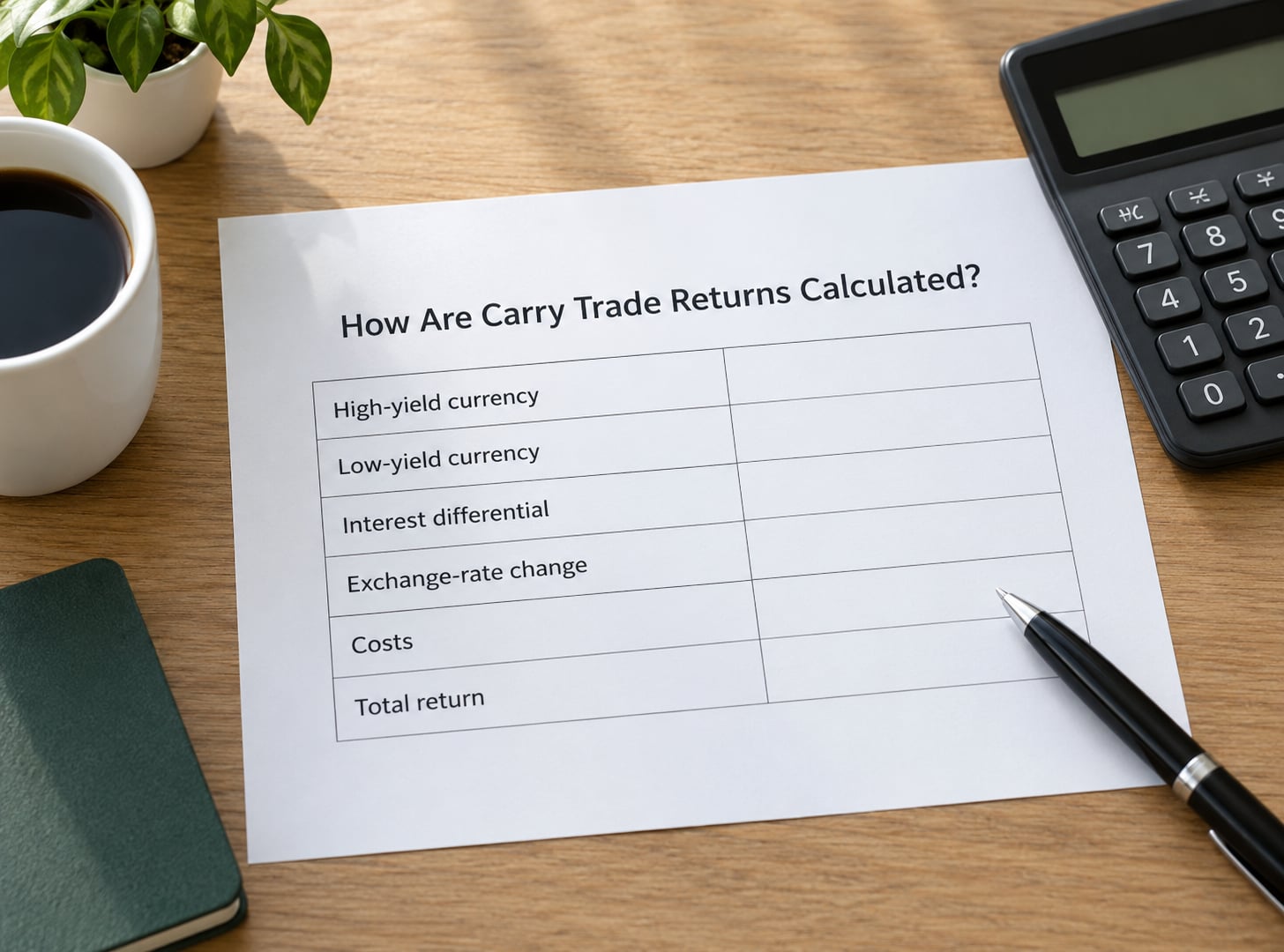
The arithmetic is not complicated, and you can run it yourself in thirty seconds. Take the rate you earn, subtract the rate you pay, divide by the number of days in the broker’s year convention, and multiply by the size of the position.
Brokers normally quote a daily rollover using a 360-day year, so the common form is [(long interest rate − short interest rate) ÷ 360] × notional value. On a 100,000 position, the numbers look like this:
| Rate differential | Annual carry on 100,000 | Daily carry on 100,000 |
|---|---|---|
| 1.00% | 1,000 | 2.78 |
| 2.00% | 2,000 | 5.56 |
| 3.00% | 3,000 | 8.33 |
| 4.00% | 4,000 | 11.11 |
| 6.00% | 6,000 | 16.67 |
| 10.00% | 10,000 | 27.78 |
Three practical details sit on top of that table. First, the credit applies to the full notional of your position, not to the margin you deposited, which is why a leveraged carry position pays far more than the same trade unleveraged. Second, the differential is set by central bank policy rates, but what you receive depends on the interbank money market rate your broker actually uses, which can sit below the headline policy rate.
Third, the table shows a simple annual rate. Quoted differentials are not compounded, and once you factor compounding in the effective return on a multi-year hold is slightly higher than the nominal figure. Against that, the costs that do not appear in the table at all are the ones that matter at the margin: the spread you cross on entry and exit, the broker’s markup on the rollover rate, and in some jurisdictions withholding tax on interest received.
Why Do Investors Use Carry Trades?
There are four reasons, and they are not equally sensible.
Why the yen funds so much of the world
Japan has the largest pool of savings on earth relative to the size of its economy, a currency that has spent decades in or near zero interest territory, and a central bank that owns an unusually large share of its own government debt. Households in Japan have historically pushed that money outward into foreign bonds and equities, buying the foreign currency to do it. When you read about that flow it is usually called Mrs. Watanabe, or the kimono trader, after the caricature that used to appear in Japanese newspapers.
The result is a global funding currency sitting in the middle of nearly every carry book. When Japanese investors are comfortable, leverage flows outward and risk assets rise. When policy in Tokyo tightens and Japanese money goes home, the same plumbing runs in reverse and hits markets everywhere at once.
Interest rate parity and the forward premium puzzle
If you could lock in the rate difference with no risk at all, nobody would take currency risk. That is the whole content of interest rate parity, and the reason carry is not free money: the forward market is supposed to price out the differential so that hedged and unhedged returns match.
It nearly does, but not quite. Forward points for high-yield currencies typically show a discount smaller than the interest differential, and the gap is called the forward premium puzzle. In plain terms, investors who take unhedged currency risk earn a small extra return for doing so. Academics have argued for decades about whether that is compensation for risk, a leftover of balance-sheet costs that make real hedging expensive to deliver, or a symptom of global imbalances. For a beginner, the useful takeaway is simpler: the differential survives because hedging it is not perfectly free.
Diversification and tactical positioning
Carry income behaves differently from most bond coupons because the currency that generates it sits on the opposite side of the trade from the asset. That makes it a partial natural hedge, and it is why some funds use a currency overlay on an equity portfolio rather than a directional view. Others are simply buying yield where very little is on offer at home. Both are rational, and both fail at the same moment.
Low volatility is what makes carry look attractive. When implied volatility is low and the target currency drifts sideways, the income arrives cleanly and the strategy prints a long, boring series of winning months. Users describe this on r/Forex as the condition under which carry feels reliable, and it is also exactly the condition that encourages everyone to pile in.
What Determines Whether a Carry Trade Is Profitable?
One number does most of the work: how far the target currency can fall before the accumulated carry is gone. That figure is roughly the rate differential itself, and it is easier to reason about in pips than in percentages.
| Rate differential | Approximate breakeven depreciation | In pips, from a 100.00 starting rate |
|---|---|---|
| 2.00% | 2.0% | 200 pips |
| 4.00% | 4.0% | 400 pips |
| 6.00% | 6.0% | 600 pips |
| 10.00% | 10.0% | 1,000 pips |
That table is the reason carry feels safe and is not. A 4% differential sounds generous until you notice that major currency pairs routinely travel several hundred pips inside a single quarter for reasons that have nothing to do with interest rates.
Beyond the differential, four things decide the outcome. The first is financing: margin interest on the borrowed leg, charged daily, sits directly against the carry and can flip a thin spread negative. The second is the exchange rate, which is the only component capable of producing a loss large enough to matter. The third is leverage, which multiplies both. The fourth is transaction cost, paid twice on entry and exit, plus the broker’s rollover markup, which some providers widen considerably on the less liquid currency pairs.
A simplified calculation like this is a sizing tool, not a forecast. It says nothing about which direction the currency will move or how fast, and it is deliberately blind to the fact that positions are usually closed well before the theoretical breakeven.
Why Do Carry Trades Lose Money?
The failure mode has a shape. The funding currency rallies, the target currency falls by more than the carry accumulated, and a position that was quietly paying you every day starts paying you the other way instead, at a rate scaled by your leverage.
Roughly five things drive it. The obvious one is an adverse exchange-rate move. The second is a rate change: if the central bank of the target currency cuts, or the funding central bank raises, the differential you entered on shrinks or inverts while you are still holding. The third is a change in risk sentiment, which hurts carry twice over because the currency moves against you while the assets you were funding also fall. The fourth is funding or liquidity stress, when margins are raised, spreads widen and traders are forced to close. The fifth is concentration, which turns any of the above into a portfolio event rather than a small loss.
What happened in the summer of 2024
This is the cleanest recent illustration. In late July 2024 the Bank of Japan lifted its short-term policy rate from around minus 0.10% to 0.25%, its first move in roughly seventeen years. That single decision made the most popular funding currency in the world materially more expensive to borrow.
Positions built on borrowed yen started closing. The yen appreciated sharply, the dollar against yen falling from the area of 161 in mid-July to around 141 in early August, a decline of roughly 12% in a matter of weeks. Australian and New Zealand currencies fell even harder against the yen because they are classic carry targets with high sensitivity to risk appetite. Japanese equity indices recorded their worst single-day drops in decades in the first week of August 2024, and volatility indices jumped across the board.
What the episode demonstrated is the ordering of the cascade. Borrowed money stops being available, positions are sold, the currencies used as targets fall, the assets those positions financed fall with them, credit spreads widen in emerging markets and high-yield debt, and leveraged holders with collateral calls are liquidated into a market that is already thin. Nobody needed a fundamental reason for the last two steps.
How a Classic Currency Example Works
Here is a fictional version, using round numbers so the mechanism is easy to see. Suppose a currency pair trades at 100.00 and the target currency pays 4.00% more than the funding currency, a differential that real pairs have carried for long stretches.
You short the funding currency and buy 100,000 units of the target currency. At roughly four percent, the position earns about 4,000 a year and about 11 a day, on the full 100,000 of notional. If the rate does not move at all, you finish the year with the carry and nothing else, less costs.
Now the adverse case. The target currency falls from 100.00 to 90.00. On 100,000 units that is a loss of 10,000 in the quote currency. Ten months of carry brings in roughly 3,300 of that back, leaving a net loss near 6,700 from a position that had been paying you every single day.
The favourable case is the mirror image and is worth understanding too. If the target currency rises from 100.00 to 108.00 over the same year, the gain is about 8,000, the carry adds roughly 4,000, and the total is 12,000. Note the asymmetry: the upside compounds with the carry, the downside can absorb years of it in a single quarter.
None of these figures include the spread, the broker’s rollover markup, margin financing costs or tax on the interest received. Those are exactly the items that decide whether a thin differential survives contact with a real account.
How Do Traders Manage Carry Trade Risk?
Nobody manages this risk well by predicting currencies. The controls that work are structural, and they are mostly about survival rather than return.
- Size for the tail, not the average. Ask what a full unwind would cost you and make sure the answer is survivable. Experienced users size carry as an income sleeve, small relative to the main book, for exactly this reason.
- Spread across pairs. A basket of several carry positions reduces the damage when one funding currency moves against you, since the others usually still pay.
- Define the exit before entry. A level at which you close, or a rule such as closing if the funding currency’s central bank turns hawkish, decided in advance and written down.
- Hedge the funding leg. Buying calls on the funding currency caps the cost of a squeeze. It costs money upfront, which is why it is used by funds and skipped by most retail accounts.
- Check liquidity and your counterparty. Exotic pairs price wider, roll over at worse rates and exit more slowly. Your position can be right and still take days to get out.
- Watch the central bank calendar. Rate decisions are scheduled, announced and anticipated. The risk is concentrated into hours.
These are general risk controls rather than a plan for any individual account, and none of them guarantees protection. A gap through your stop level can still fill at a much worse price than you set.
Early warning signs that a carry unwind is starting
Unwinds do not appear from nowhere, and the warning signs are public before they are obvious in price:
- Implied volatility rising, especially in short-dated contracts, while spot rates have not yet moved much.
- Funding costs spiking in leveraged markets, which tells you the same trade is getting more expensive elsewhere too.
- Central bank communication shifting, particularly language about normalising policy or about exchange-rate stability.
- Cross-currency funding spreads moving sharply, which shows global dollar and yen funding conditions tightening at the same time.
- Target currencies outperforming their funding currencies in the risk-on direction for months, which means carry positions have quietly built up.
None of these are sell signals on their own. Together they are the reason experienced carry traders spend more time reading the funding side of the market than the target side.
Frequently Asked Questions
Are currency carry trades risk-free?
No. Carry trades collect a small, fairly predictable interest income and accept an open-ended loss if the exchange rate moves against them. The differential typically tells you how much depreciation the position can absorb before a year of income is erased, which is often only a few hundred pips on a major pair. Leverage magnifies both the income and the loss. Treat carry as a position with a defined tail risk rather than as savings.
Does the highest interest rate always produce the best carry trade?
No, and the highest rate is often the warning sign. Very high differentials usually belong to currencies with inflation problems, capital controls or political risk, so the exchange rate is more volatile and more likely to fall sharply. A smaller differential on a stable currency can produce a better risk-adjusted outcome. Comparing policy rates is only step one; the currency’s volatility and the credibility of its central bank matter just as much.
Can a retail investor use a currency carry trade?
Yes, in most jurisdictions you can run one through a standard margin account by selling the low-yield currency and buying the high-yield one, and the interest difference is credited or debited as rollover. The practical differences from the institutional version are the broker’s rollover markup, less favourable rates, wider spreads on exotic pairs and the tax treatment of interest income, which varies considerably by country. Check your own jurisdiction before assuming anything.
Why are Japanese yen carry trades so widely discussed?
Because the yen is the most common funding currency in the world. Japan’s large savings surplus, historically low policy rates and a central bank that owns an unusually large share of domestic debt all push yen money outward into foreign assets. When Japanese policy turns and that money comes home, positions funded in yen close together, which is why yen carry trades are regularly linked to sharp global drawdowns across equities, credit, emerging markets and crypto.
What happens to carry trades when central banks change interest rates?
It depends on which central bank moves. A cut by the target currency’s central bank shrinks or inverts the differential you entered on, so income falls while you still hold. A hike by the funding currency’s central bank does the same thing and can also cause the funding currency itself to rally, which is the damaging combination. Positions are often closed before the rate decision rather than after it, which is why the damage tends to arrive ahead of the announcement.
Conclusion
How carry trades work in currency markets is a short answer wrapped in a long tail. You sell the cheap currency, buy the expensive one, and collect the rate difference as rollover while the position is open. That income is real, it is paid on your full notional, and it arrives whether or not the pair moves.
What makes it a real investment decision rather than free money is the other side of the same trade. The differential tells you roughly how many pips of adverse movement the position can absorb before a year of income is gone, and on major pairs that figure is surprisingly small compared with what currency markets do in an ordinary quarter. Every carry book is funded by cheap borrowed money, which means every carry book is vulnerable to the moment that funding gets expensive.
So the first thing to do before anything else is arithmetic rather than a position: pick two currencies, write down the current rate difference, convert that into a pip distance at the pair’s present rate, then add the spread, the rollover markup and any financing cost. If the number of pips that would wipe out the income is smaller than the pair’s normal weekly range, you have understood the strategy better than most of the commentary you have read on it.
This article is educational and describes how a market mechanism works. It is not investment advice, and returns from carry positions are neither predictable nor guaranteed.