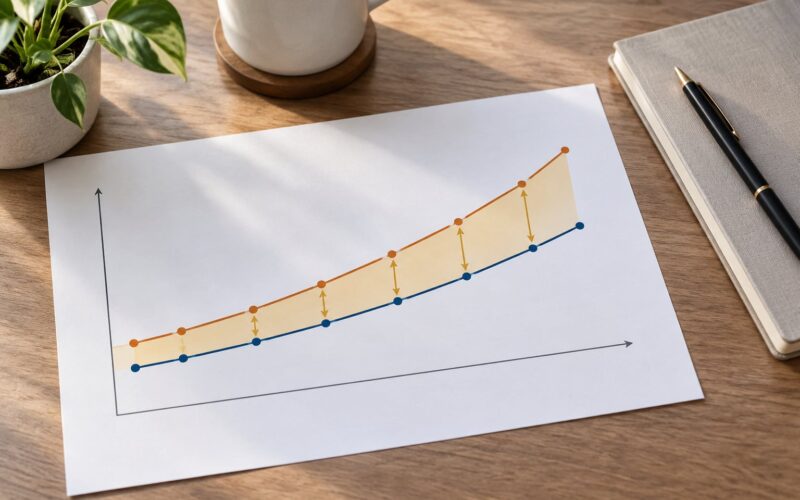
A currency peg is a policy that fixes the value of one currency against another currency, against a basket of currencies, or against a commodity such as gold, instead of letting it float. A central bank or government declares the rate and then buys or sells its own currency in the foreign exchange market to hold it near that level.
In plain English: someone decides the exchange rate, and then spends money to stop the market deciding it. If you want the short version of what is a currency peg in one line, that is it.
It matters to ordinary investors because a peg changes where the risk sits. When a currency is fixed, the day-to-day volatility in your currency position largely disappears, but so does the central bank’s ability to set interest rates or fight inflation on its own terms. You have swapped one kind of risk for another, and it is not always obvious which one is bigger.
Below is a walk through the mechanics, the arguments for and against, the named examples still in force today, and a checklist you can run against any pegged currency before you commit money to it.
Table of Contents
- What Is a Currency Peg?
- How a Currency Peg Is Set and Maintained
- Foreign exchange intervention
- Interest rate policy
- Capital controls
- Choice of anchor
- Hard Currency Pegs vs. Managed and Floating Exchange Rates
- Why Governments Use Currency Pegs
- Trade predictability
- An inflation anchor
- Cheaper foreign borrowing
- Lower currency volatility for investors
- Control as the real goal
- How a Currency Peg Is Maintained in Practice
- Step 1: the link rate is set
- Step 2: the currency drifts to the weak side
- Step 3: the currency drifts to the strong side
- Step 4: the arithmetic runs out
- The Costs and Risks of a Currency Peg
- What Currency Pegs Mean for Investors
- How to Tell Whether a Currency Peg Is Sustainable
- Examples of Currency Pegs Around the World
- Currency boards and retired pegs
- Managed arrangements
- Pegs that broke
- How a stablecoin peg differs
- Frequently Asked Questions
- Is the US dollar a pegged currency?
- Can you give me an example of a currency peg?
- What are the drawbacks of a pegged currency?
- What happens when a currency peg breaks?
- What is the difference between a fixed exchange rate and a pegged exchange rate?
- How does pegging to the US dollar affect interest rates?
- Key Takeaways
What Is a Currency Peg?
A currency peg is an exchange rate regime in which the exchange rate is held at, or very close to, a fixed value set by policy rather than by supply and demand alone. The authority doing the fixing might be a central bank, a government finance ministry, or a currency board that issues domestic currency only against foreign reserves.
Three things can serve as the anchor. The most common is a single currency, usually the US dollar. Less common anchors include a basket of major currencies, most often the International Monetary Fund’s special drawing rights, and a physical commodity such as gold.
The contrast with a floating exchange rate is the easiest way to see what a peg does. Under a float, the price of your currency is set continuously by the foreign exchange market, the way the price of any tradable good is set. Under a peg, the market still trades every day, but it trades around a number that has already been decided.
Take the Hong Kong dollar, which has traded inside a narrow band against the US dollar since the early 1980s. A US investor who buys Hong Kong dollars for a holiday knows roughly what the cost of a Hong Kong hotel room will be in their home currency months later, because the rate cannot wander far. That predictability is the entire product.
One word of caution before going further, because it trips up a lot of readers. A hard peg and a hard currency are not the same thing. A hard peg means an exchange rate that cannot move. A hard currency means a currency that is freely convertible and widely held, which is a description of money, not of a rate.
How a Currency Peg Is Set and Maintained
A peg is maintained with four tools, used in combination rather than in sequence.
Foreign exchange intervention
This is the core mechanism. If the currency drifts weaker than the peg allows, the central bank buys its own currency using its foreign exchange reserves, which pushes the rate back up. If the currency drifts stronger, the bank sells its own currency and takes in more foreign currency, pushing the rate back down. The reserves are the ammunition, and the amount of ammunition is the whole story when a peg is under stress.
Interest rate policy
Rates are the expensive lever. A central bank that wants to discourage currency flight can raise rates sharply, which makes holding its debt attractive and raises the cost of speculative borrowing against the currency. That works right up until the point where the damage to domestic demand is worse than the pressure on the currency.
Capital controls
Many pegs come with restrictions on moving money in and out, on paying dividends abroad, or on holding foreign currency deposits. These are rarely advertised as part of the deal, but they are part of it. A peg that relies on controls is a peg where the government has decided the market is not to be trusted with the full picture.
Choice of anchor
The anchor is chosen for a reason. Almost every surviving hard peg anchors to the US dollar, because the dollar is the currency most counterparties hold and most trade is invoiced in, and because the United States is the ultimate source of the reserves needed to defend it. Pegging to a smaller economy’s currency just moves the problem.
Hard Currency Pegs vs. Managed and Floating Exchange Rates
Not all pegs are equal. The International Monetary Fund sorts countries into de facto exchange rate arrangements, and the categories differ mainly on how much room the rate has to move.
| Regime | How much the rate can move | Reserve backing | Can the country run its own interest rate policy? | Example |
|---|---|---|---|---|
| Hard peg | Not at all, or within a very narrow band | Full, often formalised through a currency board | Largely no | Bermudian dollar, Panama balboa |
| Pegged within a band | A fixed band, such as a few percent either side of a central rate | Heavy, with official intervention at each end of the band | Constrained | Hong Kong dollar, Danish krone |
| Crawling peg | The central rate is moved down or up on a published schedule | Used mainly to manage the pace of adjustment | Partly preserved | Several emerging economies with inflation above target |
| Managed float | The market sets the rate, with the central bank intervening to limit extreme moves | Partial | Mostly yes | Chinese yuan |
| Free float | Whatever the market says | Used for emergencies, not routine management | Yes | US dollar, euro, yen |
So what is the difference between a fixed exchange rate and a pegged exchange rate? In everyday use they are the same idea, because a fixed rate that is never defended is just an announcement. The useful distinction is between a rate the central bank commits to defend and a rate it merely leans on.
One quick definition worth keeping: a soft peg is a rate the central bank nudges rather than fixes. It will intervene to smooth big moves but will not stand in front of a determined attack. That is why a managed float can look stable for years and then move 20 percent in a week when the pressure exceeds what the reserves can absorb.
Why Governments Use Currency Pegs
The list of motives is shorter than people expect. Governments peg because the alternative is worse for something they care about.
Trade predictability
An exporter quoting a price in a floating currency carries risk nobody wants in a factory gate price. A fixed rate turns that into a known number. For an economy whose main export is a commodity priced in dollars, a dollar peg means local revenue rises and falls with the commodity, not with the currency.
An inflation anchor
A peg imports the anchor country’s inflation problem, or at least its discipline. A currency board arrangement that only issues notes when it holds equivalent foreign reserves makes the money supply mechanically dependent on the reserves, which is a structural commitment against money creation. It is a blunt tool, and it works better than a promise.
Cheaper foreign borrowing
A credible peg lets a country issue debt at a spread over the anchor rate instead of a risk premium. For a small economy that would otherwise pay several percentage points more, the saving is large and easy to count. This is the single most common financial benefit cited by small pegging economies.
Lower currency volatility for investors
Stable money attracts foreign direct investment, because a factory is easier to plan for than a currency. Reduced volatility also narrows the hedging costs that any foreign investor has to pay to hold local assets.
Control as the real goal
Some pegs exist mainly to slow capital flight or to keep a government that dislikes the exchange rate from being overwhelmed by it. That is an honest reason even if it is not a healthy one, and it is worth asking which of these motives applies before trusting a peg to do anything else.
How a Currency Peg Is Maintained in Practice
The abstract mechanism only makes sense with numbers attached, so here is how it works in the case readers hear about most, the Hong Kong dollar.
Step 1: the link rate is set
The Hong Kong Monetary Authority, through its currency board, commits to buying US dollars from licensed banks at 7.75 Hong Kong dollars and selling US dollars at 7.85. That band is the peg. Anything between those two numbers is the currency trading freely, and the two edges are the points where the official system steps in.
Step 2: the currency drifts to the weak side
Suppose importers and investors start selling Hong Kong dollars, and the rate moves to the weak end of the band at 7.85. At that price the HKMA and the note-issuing banks step in and buy Hong Kong dollars. Banks hand over US dollars and receive newly issued Hong Kong currency, backed one for one. Reserves rise, the supply of Hong Kong dollars falls, and the rate moves back into the band.
Step 3: the currency drifts to the strong side
Now suppose the opposite. At 7.75, the system sells Hong Kong dollars and buys US dollars, adding to reserves. That side of the operation only functions while the currency is worth more than the anchor, which is precisely why it is the side that runs out first in a downturn.
Step 4: the arithmetic runs out
Every purchase of local currency against dollars reduces the reserve pile. If pressure persists long enough, reserves fall below the amount needed to honour the commitment. At that point the authority has three options, all bad: keep defending at a rate the market no longer believes, raise rates until the economy breaks, or move the peg. It almost always moves the peg.
The band works because everyone believes the reserves are there. Speculators do not need to outsmart the central bank, only to move in the same direction at the same time, which pushes the rate to the edge, triggers intervention, and shrinks the pile.
The Costs and Risks of a Currency Peg
Every benefit above has a matching bill, and the bills arrive on a schedule that can be measured.
Reserve exhaustion is the first and most common one. Defending a rate consumes foreign currency that can only be rebuilt by exporting goods or attracting capital, both of which take quarters, while pressure on the currency arrives in days. When reserves fall short, the result is a devaluation, which is a default on the peg rather than a modest adjustment to it.
Lost monetary autonomy runs alongside it. A country pegged to the dollar has imported US interest rate policy whether it wanted to or not. When the Federal Reserve tightens to fight its own inflation, the pegging central bank has to raise local rates too, even if its own economy is slowing and its own inflation is falling. Local borrowers pay for a decision made in Washington.
Imported inflation is the reverse version of the same coin. Pegged at a rate that is stronger than the country’s productivity supports, the currency makes imports cheap and exports expensive, and the resulting imported inflation is harder to control than inflation generated at home.
Capital controls are usually the hidden cost. Restricting withdrawals, dividend payments or foreign purchases stabilises the rate in the short term and pushes costs into the banking system and the black market. Investors who discover them late tend to find them expensive.
Economists call the underlying tension the impossible trinity: a country cannot simultaneously have a fixed exchange rate, free movement of capital, and its own independent monetary policy. It gets two of the three. A peg plus open capital markets means giving up monetary independence. A peg plus monetary independence means controlling capital. Knowing which one your currency has chosen tells you most of what you need to know about its flexibility.
What Currency Pegs Mean for Investors
Translation into portfolio terms, this is where the article earns its keep.
Currency risk falls, but it does not vanish. A pegged currency has less day-to-day volatility, and the risk that remains is concentrated and binary. You are not being paid much to carry it, and when it pays out you are usually devalued by 30 or 40 percent in a week, which more than eats the years of small gains that preceded it. Position size for the tail, not for the calm.
Rates move with the anchor. A pegged currency’s interest rates will track the anchor’s over time, so you cannot hold that currency for yield without also taking a directional view on the anchor’s central bank. If you want the local rate, you are making a bet on Fed policy whether you intended one or not.
Gold and commodity prices get distorted in a specific, useful way. Because the local currency is fixed, the domestic price of gold moves almost exactly opposite to the local currency per dollar, and inside the band it barely moves at all. If a central bank is buying gold to rebuild reserves after defending a peg, that demand is a real and recurring source of support for the metal, and a common reason reserves and gold holdings move together.
Diversification gets weaker than it looks. Holding a pegged currency alongside the anchor currency is closer to holding one currency twice than it is to holding two, especially for anyone with US dollar liabilities. Contributors building a portfolio that includes a dollar, a pegged currency and a floating currency have real diversification against one and thin diversification against the other two.
Corporate exposure is often missed. Large multinationals quote and earn in a mix of currencies, and a pegged local revenue line can be more stable than the reported figures suggest, or less, depending on which way the peg eventually goes. A devaluation is a large earnings event for any company with net assets or debt denominated in the local currency.
How to Tell Whether a Currency Peg Is Sustainable
Run these checks in order. They are cheap, they are public, and they work.
- Reserve cover against short-term foreign debt. Compare reserve holdings with the amount of foreign currency debt falling due within a year. Cover below that level means the peg is dependent on capital inflows continuing.
- The trend in reserves, not the level. A large number that has been falling for four quarters tells you more than a healthy number that has stopped rising. Peers watching the weekly reserve data have noticed this before you did.
- The inflation gap. Domestic inflation persistently above the anchor country’s inflation means real purchasing power is eroding, and the peg is slowly pricing itself out of competitiveness.
- The interest rate differential and where it goes. If defending the peg requires rates several points above the anchor, the bill is being paid by domestic borrowers. Ask how long the economy can absorb that.
- The current account. A persistent deficit must be financed by capital inflows. If the inflows are portfolio money, they reverse fast.
- The fiscal position. Defending a peg with public money rather than a central bank with reserves runs out of room sooner, and the market tends to price that in early.
- Controls and credibility. New restrictions on capital flows are a signal that the authority is running out of other options. Conversely, a government that has kept the same rate for years through a crisis has earned some credibility, and that record is worth real weight.
The fastest tells are usually reserves falling and new controls appearing. Those two together have preceded almost every peg break in the last four decades.
Examples of Currency Pegs Around the World
Here is a dated snapshot of the arrangements most often asked about. Rates are approximate and current as of 2026; pegs do change, and it is worth re-checking against the IMF’s published exchange rate arrangements before you rely on any figure.
| Currency | Anchor | Rate or band | Type | In force since |
|---|---|---|---|---|
| Hong Kong dollar | US dollar | 7.75 to 7.85 | Pegged within a band, currency board | 1983 |
| UAE dirham | US dollar | 3.6725 | Hard peg | 1997 |
| Saudi riyal | US dollar | 3.75 | Hard peg | 1986 |
| Qatari riyal | US dollar | 3.64 | Hard peg | 2001 |
| Panamanian balboa | US dollar | 1 to 1 | Hard peg, dollar substitute | 1904 |
| Bermudian dollar | US dollar | 1 to 1 | Currency board | 1972 |
| Danish krone | Euro | Central rate 7.46038, band plus or minus 2.25 percent | Pegged within a band | 1999 |
| Brunei dollar | Singapore dollar | 1 to 1 | Hard peg | 1967 |
| Nepalese rupee | Indian rupee | At par | Hard peg | 1993 |
| Bhutanese ngultrum | Indian rupee | At par | Hard peg | 1988 |
| Kiribati, Nauru and Tuvalu dollars | Special drawing rights basket | Basket of major currencies | Basket peg | Varies by country |
Currency boards and retired pegs
Currency boards are the strictest version of the idea, where domestic notes are only issued against foreign reserves and the currency has no independent monetary policy at all. Estonia ran one from 1992 to 2010 and Lithuania from 1994 to 2014, both at a fixed rate to the Deutsche Mark and later the euro. Bulgaria’s lev ran on a board anchored to the Deutsche Mark and then the euro, an arrangement the IMF’s classifications show ending in the last decade. Currency boards survive far longer than ordinary pegs, because there is no monetary policy left to get wrong.
Managed arrangements
The Chinese yuan is the most watched example. It was tightly tied to the dollar in the mid-2000s and has been managed more loosely since, with the central bank guiding the rate rather than defending a fixed number. The Danish krone shows the opposite: a free-floating currency with a formal central rate against the euro, kept inside a narrow band for decades by the central bank’s willingness to intervene. The Swiss franc had a ceiling against the euro from 2011 that was removed in 2015 once the pressure receded, which is a reminder that ceilings get withdrawn.
Pegs that broke
Argentina’s convertibility plan, in force from 1991, held the peso at one US dollar until 2001, then unravelled through a default and a devaluation to several pesos per dollar. The Thai baht was devalued and floated in July 1997, and the rate roughly doubled within days. On Black Wednesday in September 1992, the Bank of England pulled sterling out of the European Exchange Rate Mechanism rather than raise rates into a recession, and sterling fell sharply before the mechanism was rebuilt without the pound at the top.
How a stablecoin peg differs
Readers often assume the word pegged means crypto. It usually does not. A stablecoin such as a dollar token holds its value through reserves and redemption rather than through a central bank defending a rate. It has no interest rate policy to surrender, no currency board, and no discretion. A de-peg event there is usually a redemption or solvency problem, not a currency crisis, and the mechanism that ends it is arbitrage rather than intervention.
Frequently Asked Questions
Is the US dollar a pegged currency?
No. The US dollar floats. Since 1971 the United States has made no commitment to convert dollars into gold or any other currency at a set rate, and the Federal Reserve does not defend a target exchange rate. Foreign central banks hold dollar reserves, but that is them choosing to, not the US promising to. The dollar is the anchor for many pegs precisely because it is not itself pegged.
Can you give me an example of a currency peg?
The Hong Kong dollar is the clearest one. Since 1983 it has been linked to the US dollar inside a band of 7.75 to 7.85, enforced by the Hong Kong Monetary Authority through a currency board that issues local currency only against US dollar reserves at fixed rates. Other examples include the UAE dirham at about 3.67 and the Saudi riyal at 3.75, both held at fixed rates to the dollar.
What are the drawbacks of a pegged currency?
A peg costs monetary policy independence. Rates must broadly follow the anchor country, so a pegged central bank may raise rates into a domestic slowdown simply because the anchor is tightening. Other costs: reserves are spent defending the rate and eventually run down, imports become cheap and inflation gets imported, capital controls are often needed, and a break means a sharp devaluation rather than a gradual adjustment.
What happens when a currency peg breaks?
The peg moves in one step rather than gradually. The authority either widens the band, sets a new rate, or floats the currency, and the currency immediately trades well below the old fixed rate. Reserves become insufficient to defend the old level, so markets reprice to what the currency is worth without official support. Bonds, equities and bank balance sheets in that country are repriced at the same moment.
What is the difference between a fixed exchange rate and a pegged exchange rate?
They describe the same thing in everyday use: a rate set by policy rather than by the market. The distinction worth keeping is between a fixed rate that is actively defended with reserves and interest rates, and a rate that is merely described as fixed. In practice the peg is the defence, the fixed rate is the number, and a rate with no defence behind it is only an announcement.
How does pegging to the US dollar affect interest rates?
It drags them along. To keep the rate near the peg, the local central bank has to set its policy rate close to the Federal Reserve’s, or capital will move to whichever side offers more. That means a small pegging economy may raise rates because Washington is tightening, even when its own inflation is falling and its economy is slowing. Investors in local debt end up making a bet on US policy.
Key Takeaways
A peg trades monetary independence for exchange rate stability. That is the whole trade, and everything else follows from it.
When you assess any currency peg, check four things first: whether reserves still cover short-term foreign obligations, whether the authority has a record of keeping the same rate through a crisis, whether its policy is consistent with the anchor’s, and how much the defence is costing the domestic economy. Miss any one of those and the answer changes.
And to restate the definition one final time, since it is the question that brought you here: a currency peg is a policy that fixes a currency’s value against another currency, a basket, or a commodity such as gold, and then spends reserves, interest rates and sometimes capital controls to hold it there.