The US dollar is strong when one dollar buys more foreign currency and more foreign goods than it used to, and weak when it buys less. What makes the US dollar strong or weak comes down to one balance: demand for US assets, exports and Treasuries against the supply of dollars Americans create buying foreign goods, investing abroad or borrowing overseas.
Interest rates, inflation, growth, trade flows, risk appetite and fiscal credibility all lean on that balance, and they rarely lean the same way at once. One concrete reference point for scale: a Market Minute note from RSM US put the dollar’s 2025 loss at roughly 9.5% through December 17, with about 10.7% of that decline coming in the first half of the year.
The framing matters more than the headline. A strong dollar is not automatically good news and a weak one is not automatically bad news. Which is true depends on who you are and what you own, and by the end of this guide you will have a checklist to judge it yourself.
Table of Contents
- Dollar Fundamentals: What Makes the US Dollar Strong or Weak?
- What Makes the US Dollar Strong or Weak in Practice?
- How Do Interest Rates and the Federal Reserve Affect the Dollar?
- Does US Economic Growth Strengthen or Weaken the Dollar?
- How Do Inflation, Deficits, and Trade Balances Matter?
- Why Does the Dollar Often Rise During Market Turmoil?
- How Can Investors Tell Whether the Dollar Is Really Getting Stronger?
- What Common Misreadings Lead to Bad Currency Forecasts?
- Frequently Asked Questions
- What currently makes the US dollar stronger or weaker?
- Does higher interest rates always make the dollar stronger?
- Why is the dollar called a safe-haven currency?
- Can the DXY show whether the dollar is weak?
- What does a strong US dollar mean for commodities and emerging markets?
- What Should Investors Watch First?
Dollar Fundamentals: What Makes the US Dollar Strong or Weak?
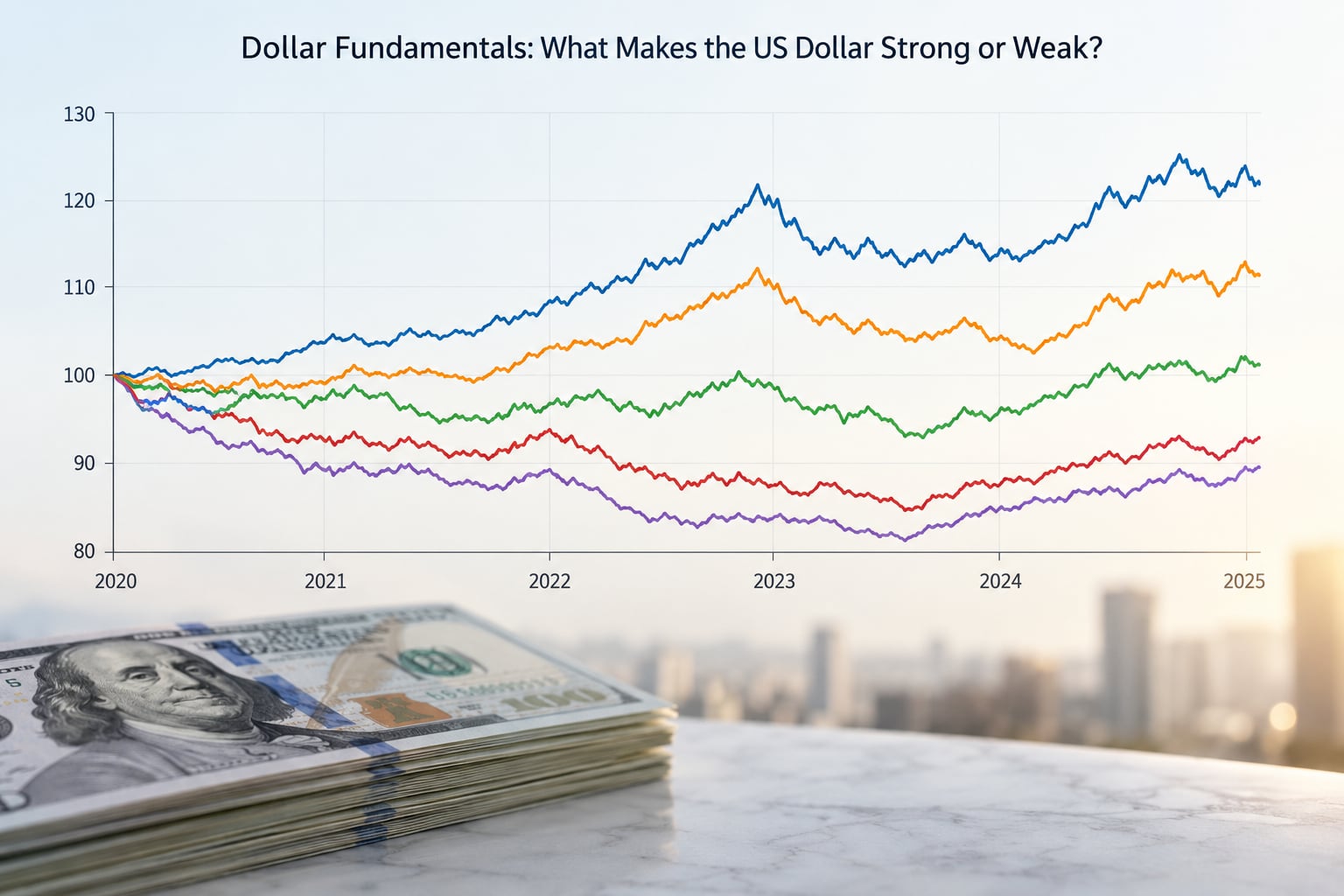
Dollar strength is a price, not a judgement. The dollar floats against other currencies, and that float is set by how many dollars people want to hold at a given price. When foreigners rush to buy US assets and Americans are content to keep their savings at home, the dollar appreciates.
Two different things get called dollar strength, and confusing them is the most common source of bad currency forecasts.
The first is exchange-rate strength. A dollar trading at 100 units against a basket, or at 1.08 euros, simply buys more than it did last year. That is the measure most headlines and the DXY use. The second is domestic purchasing power: what a dollar buys inside the United States. A dollar can lose value at home through inflation while gaining value against foreign currencies at the same time, and that has happened more than once in recent decades.
There is also the pairing question. The dollar can fall against the euro and the yuan while rising against the yen, and a headline built on one pair tells you nothing about the currency as a whole. The Federal Reserve’s trade-weighted indexes in the H.10 release exist precisely because bilateral rates are too narrow to describe the dollar. For most serious work, use both: the DXY for day-to-day market talk, the broad index for the bigger picture.
What Makes the US Dollar Strong or Weak in Practice?
The working framework has six parts, and here is the useful part: they routinely disagree. A country can have high rates and low growth, or a fat current-account deficit and a booming currency, because currency markets trade expected future returns rather than last quarter’s data.
| Driver | Pushes the dollar up | Pushes the dollar down |
|---|---|---|
| Interest rates | Rising policy rate, higher real yields, a steeper expected rate path | Rate cuts, falling yields, slower expected tightening |
| Inflation | US inflation running below trading partners, credible Fed tightening | US inflation above peers, loose policy, inflation scares |
| Growth | Faster relative growth pulling capital into US assets and equities | Slowdown, recession risk, earnings downgrades |
| External balance | Foreigners buying Treasuries and US assets faster than Americans spend abroad | A widening trade and current account deficit, capital leaving |
| Risk sentiment | Crisis demand for dollar liquidity, flight to safety | Global risk-on, investors chasing yield abroad |
| Policy credibility | Fiscal restraint, debt sustainability, stable institutions | Rising debt, political disruption, tariff and trade shocks |
Read that table row by row and you can usually explain most dollar moves after the fact. The work is in the weighting: which force is dominant this quarter, and is it getting stronger or fading.
How Do Interest Rates and the Federal Reserve Affect the Dollar?
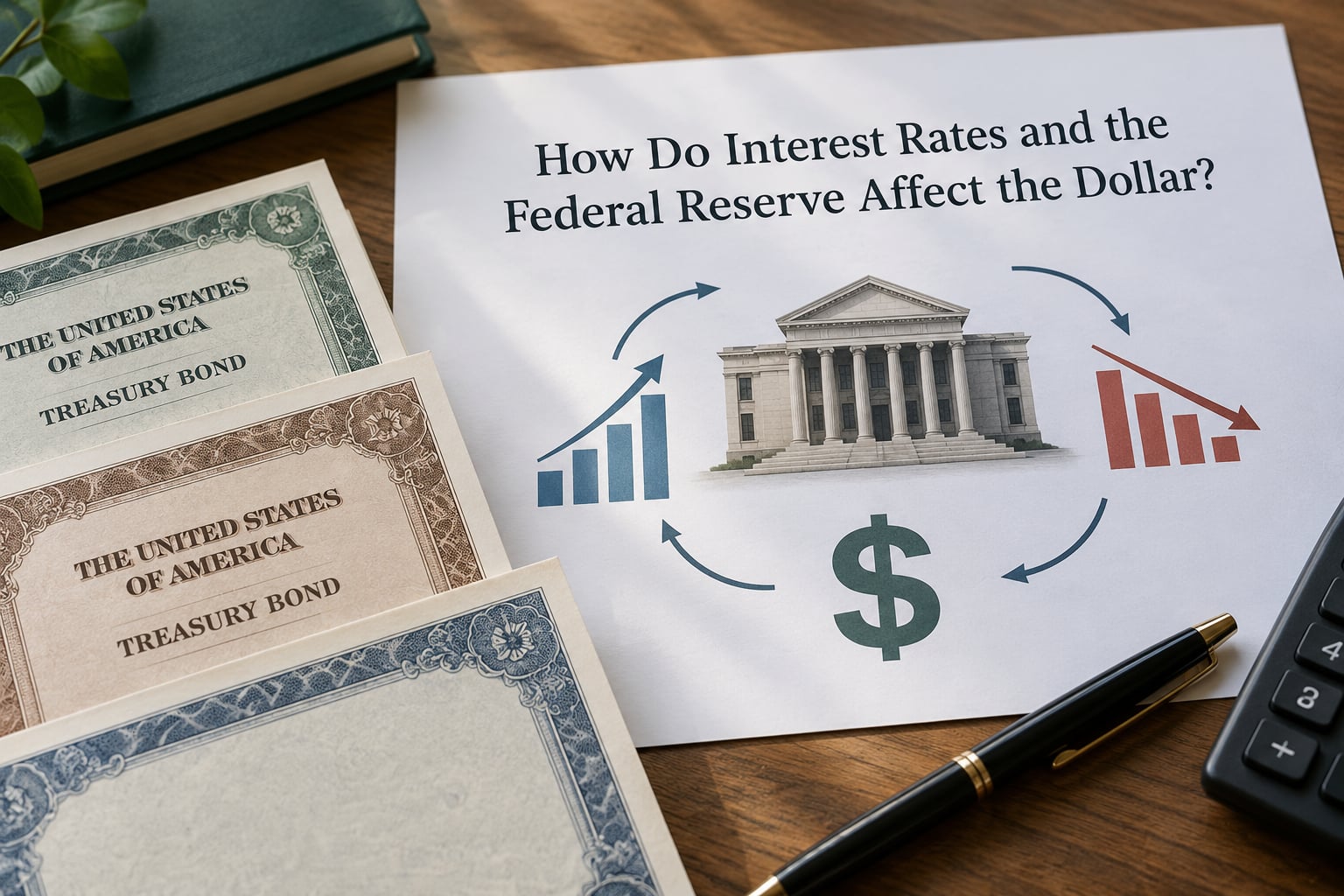
Rates drive the dollar more than any other single force, because US assets are the world’s biggest liquid store of value and the yield is the price of holding them. When US real yields rise relative to those in Europe or Japan, holding dollars pays more, and capital follows.
The part people get wrong is that markets trade expected rates, not the current federal funds rate. Two hikes that were fully priced in move markets less than one surprise cut. That is why Fed communication can swing the dollar more than the decision itself, and why hawkish or dovish forward guidance gets its own reputation.
| Setup | What it looks like | Typical dollar reaction |
|---|---|---|
| Bullish | Hikes priced, US growth holding up, 2-year yield rising, carry attractive | Dollar firm, especially against low-yield currencies |
| Neutral | Rate path fully discounted, no data surprises | Range trading on expectations and headlines |
| Bearish | Cuts priced, slowing growth, long yields falling on growth fears | Dollar soft, unless risk-off forces safe-haven buying |
Balance-sheet policy works through the same channel. Quantitative easing removes duration from the market and drags long yields down; quantitative tightening does the reverse. Both change what investors can earn by holding dollar assets, and both reach the exchange rate indirectly.
Then there is the carry trade, which is worth understanding because it is how a lot of dollar moves get amplified. Borrow cheaply in a low-yield currency, convert into dollars, park the money in US Treasuries, and pocket the spread. It is stable as long as rates hold and volatility stays low. When the Federal Reserve surprises markets and volatility jumps, those positions get unwound fast, and the forced selling is a large part of why the dollar can move several percent in weeks. The yen-funded version of this trade unwound sharply in the summer of 2024 after the Bank of Japan began raising rates, and dollar pairs such as the yen and the peso fell hard in days.
One practical number to keep in mind: analysts have flagged the 10-year Treasury yield above 5% as a level that tends to attract foreign buyers back into US debt. Whether that pull outweighs the growth-scare effect of high yields is exactly the tension markets argue about.
Does US Economic Growth Strengthen or Weaken the Dollar?
Strong growth usually helps the dollar, but not always, and the reason is that every part of growth pulls in a different direction. Higher US growth raises expected corporate profits, which pulls money into US equities. It also lifts Treasury yields, which pulls money into US bonds. Both effects support the currency.
Counter-pressure comes from the import side. When Americans are richer, they buy more foreign goods, which means selling more dollars to buy euros and yen. Strong domestic growth also tends to raise inflation and expected policy rates, and that cuts both ways: higher expected rates support the dollar, while higher inflation damages it.
This is why fast US growth with widening deficits has produced different outcomes in different decades. The net effect depends on whether the growth is pulling capital in faster than it is pushing capital out.
How Do Inflation, Deficits, and Trade Balances Matter?
Inflation erodes purchasing power, and currency markets price that erosion against inflation elsewhere. If US consumer prices rise 2% while prices in Japan barely move, the dollar loses value over time relative to the yen no matter what the Fed does, and that is the purchasing power parity argument in its simplest form. In practice, parity is a slow force measured in years. Interest rates and risk sentiment routinely move the dollar much faster, which is why a high-inflation country can still hold a strong currency for years.
Deficits work through credibility rather than arithmetic. Large budget and current-account deficits raise the total stock of US debt that has to be refinanced, and at some point investors start asking whether the supply of that debt is going to outrun demand. That worry shows up in the yield spread on long bonds and in the price of currency-hedging costs, not usually in a headline.
The trade balance itself is often misunderstood, and the accounting is worth stating plainly. The United States runs a trade or current account deficit only because capital is flowing the other way. Foreigners buying US Treasuries, US equities and US property is the mirror image of Americans buying Japanese cars and German machinery. A deficit is the price of the capital inflow, not a separate cause of currency weakness.
So a large deficit does not automatically sink the dollar. What weakens it is when the inflow slows relative to the outflow, or when investors start doubting that the inflow will continue on the same terms.
Why Does the Dollar Often Rise During Market Turmoil?
Because in a crisis, dollar liquidity is the one thing everyone can find. Global banks and funds hold dollars to settle contracts, fund margin calls and manage positions across time zones, and those obligations grow exactly when volatility rises. That forced, mechanical demand is why the dollar has repeatedly rallied during episodes of stress, from 2008 through the 2020 pandemic shock.
Deep markets reinforce it. US government debt is the most liquid safe asset on earth, and a currency that everyone can borrow and sell in size at any hour attracts crisis flows that smaller reserve currencies cannot.
The important caveat: crisis strength tends to fade. Once volatility normalises, hedging costs drop and the mechanical dollar demand unwinds, so a safe-haven rally is often a poor guide to where the currency sits a year later. Persistent weakness shows up differently, in slow erosion across many pairs rather than in one dramatic crisis rally.
How Can Investors Tell Whether the Dollar Is Really Getting Stronger?
Start with the index, then check what it is made of. The DXY is the number most people mean when they say the dollar index, and it is built from six currencies: the euro at roughly 57.6% of the basket, the yen at 13.6%, the pound at 11.9%, the Canadian dollar at 9.1%, the Swedish krona at 4.2% and the Swiss franc at 3.6%. Nearly 60% euro weight means a strong euro can hold the DXY down while the dollar rises against everything else. That is the flaw analysts pick at most often.
Three habits make the picture clearer. First, look at a broad trade-weighted measure alongside the DXY, using the Federal Reserve H.10 series or the same data on FRED. Second, look at several pairs at once rather than EUR/USD alone; yen and peso moves often tell a different story from euro moves. Third, separate nominal from real. The nominal exchange rate moves around freely, while the inflation-adjusted rate is the one that tracks purchasing power and eventually mean-reverts.
You can also check breadth. A genuinely strong dollar rises against developed and emerging currencies alike, and lifts emerging market equities at the same time, because dollar-denominated debt gets cheaper for borrowers. A dollar that only rises against the euro is a currency pair story, not a dollar story.
What Common Misreadings Lead to Bad Currency Forecasts?
Single-factor thinking. Rates explain a great deal, but the dollar fell through 2025 in large part on policy and fiscal credibility, not on rate differentials alone. Anyone forecasting from one variable will get the direction roughly right and the timing badly wrong.
Treating one pair as the dollar. A falling EUR/USD print is not evidence of broad dollar weakness when USD/JPY and USD/MXN are rising. Check breadth before drawing conclusions.
Reading correlation as cause. The dollar and Treasury yields have moved together for decades, and retail investors on forums have noticed that the relationship breaking down in recent years. When a correlation frays, the old rule stops being a signal.
Believing forecasts. Analyst currency calls have a poor long-run hit rate for reasons that are structural, not a conspiracy. Positions are large and crowded, so the consensus call is often the crowded trade.
Assuming the safe-haven label is permanent. Reserve status is durable but not guaranteed. Central banks trimming Treasury holdings and growing gold reserves are usually diversification within a dollar-based system, not the end of it. Trading on the stronger version of that claim is how people talk themselves into a sharp loss.
Frequently Asked Questions
What currently makes the US dollar stronger or weaker?
Dollar strength tracks the gap between demand for US assets and the supply of dollars in the market. Right now the main swing factors are the path of Federal Reserve rates and real yields, how US growth compares with Europe and Japan, the gap between US and foreign inflation, and how much capital foreign investors keep flowing into Treasuries and US equities. Risk sentiment decides which of those dominates week to week.
Does higher interest rates always make the dollar stronger?
No, not always. Higher rates usually support the dollar by raising the return on dollar assets, but markets trade expected rates, not the current federal funds rate. If a hike is already priced in, the dollar often does nothing. If higher yields come from a growth scare rather than healthy demand, investors sell off risk assets and can sell dollars too. The 2025 decline happened despite rate expectations of that kind precisely because other forces were stronger.
Why is the dollar called a safe-haven currency?
Because US government debt is the deepest, most liquid market in the world and dollars are the settlement currency for global trade and finance. In a shock, institutions need dollars to meet margin calls, settle contracts and hold the least risky asset available, so demand rises for mechanical reasons. That strength is reliable during the crisis itself but usually fades once volatility normalises and hedging demand unwinds.
Can the DXY show whether the dollar is weak?
Only partly. The DXY is built from six currencies and the euro carries roughly 57.6% of the weight, so the index can fall while the dollar rises against the yen, the peso or a broad group of emerging currencies. Use it as a market temperature gauge, then confirm with a Federal Reserve trade-weighted index from the H.10 series and with several individual pairs before concluding the dollar is genuinely weaker.
What does a strong US dollar mean for commodities and emerging markets?
Most commodities trade in dollars, so a rising dollar tends to cap dollar prices by making them dearer for buyers paying other currencies. That pressures on producers, though a weak dollar reduces their local currency cost base and makes new supply more viable. For emerging markets, dollar strength usually helps: it lowers the cost of servicing dollar-denominated debt and tends to support EM equity returns, unless the strength is severe enough to signal global risk-off.
What Should Investors Watch First?
If you track five things, you will know more about the dollar than most forecasts tell you. Start with real yields, because the gap between US inflation-adjusted yields and those abroad is the cleanest expression of what holders of dollar assets are actually being paid. Then watch the two-year Treasury yield, which moves with Fed rate expectations and rarely lies about what markets think is coming next.
Third, compare relative growth and inflation, using the same release calendar for the US and its main trading partners, because currency markets price differences rather than absolutes. Fourth, follow the flows: the Treasury TIC data on foreign holdings of Treasuries and the BEA current account figures show whether foreign appetite for US assets is holding up. Fifth, check breadth in the dollar itself, comparing the DXY with a broad trade-weighted index and with a handful of pairs including the yen, the peso and EM currencies.
| Group | Strong dollar | Weak dollar |
|---|---|---|
| US exporters and manufacturers | Harder, cheaper goods for foreign buyers | Back to competitive pricing abroad |
| US importers and consumers | Cheaper foreign goods and travel | Costlier imports, more import inflation |
| Gold and commodity holders | Headwind, as dollar prices cap commodity quotes | Tailwind to dollar commodity prices |
| Emerging market investors | Easier dollar debt service, supportive for EM assets | Debt burden rises, EM capital outflows |
| Foreign buyers of Treasuries | Translation losses on dollar bonds | Translation gains for non-US holders |
| Travel and tourism | US trips cheaper abroad, foreign trips dearer for visitors | Reverse of the above |
What makes the US dollar strong or weak is a question about the price of a currency, not about the health of a country. Rates usually set the direction, expectations do the timing, and credibility decides how long a move lasts.
Watch real yields first, check the flows, and resist treating a single pair or a single forecast as a verdict. A strong dollar is not automatically good news, a weak dollar is not automatically bad news, and the table above is usually a better guide to your own portfolio than either headline.