Refinery margins are the gap between what a refiner sells a gallon of fuel for at the wholesale level and what the crude oil behind it cost. When that gap widens, pump prices tend to rise or hold steady even while crude falls. That is the whole mechanism behind how refinery margins affect gas prices, and it is why a barrel of oil dropping ten dollars a barrel does not necessarily hand you ten dollars a gallon at the station.
Most people only watch the crude number on the news ticker, and they assume pump prices follow it directly. They do not, because crude is just one of four moving parts, and the refining step is the one that moves independently of it. This guide walks through what a refinery margin actually is, how it reaches you at the pump, why it sometimes rises and sometimes gets squeezed, and where you can read the data yourself.
Table of Contents
- Key takeaways
- How Refinery Margins Affect Gas Prices
- What Is a Refinery Margin?
- Crack Spreads: The Main Refining Margin Measure
- Why Higher Refinery Margins Can Push Gas Prices Up
- Why Refinery Margins Do Not Always Lead Gas Prices
- Why pump prices fall slower than crude
- The retail ratchet most drivers notice
- What Can Change Refinery Margins?
- Why Refinery Margins Vary by Region and Grade
- How Investors Can Monitor Refinery Margins
- How refinery margins affect gas prices week to week
- Frequently Asked Questions
- Are refinery margins the same thing as gas prices?
- Why are gasoline prices falling when crack spreads are rising?
- Do refiners make more money when gasoline prices are high?
- Which crack spread is most useful for investors?
- How quickly do refinery margins affect gas stations?
- Conclusion: Start With the Wholesale Product Market
Key takeaways
- A refinery margin is the difference between a product’s wholesale price and the crude cost of making it, measured in dollars per barrel.
- Refining accounts for roughly a fifth of the retail price of gasoline, so a wide margin can add real cents per gallon.
- Margins widen when spare refining capacity shrinks: high utilization, unplanned outages, maintenance season, or a regional product shortage.
- Margins are set at the wholesale level, then pass to the pump with a delay that is usually faster on the way up than on the way down.
- Crude falling does not guarantee cheaper gas, because a widening margin can offset the entire crude decline.
How Refinery Margins Affect Gas Prices
A refinery buys crude oil and turns it into gasoline, diesel and jet fuel. It sells those fuels to wholesalers at prices set by the market, not by the refiner. Whatever is left over after paying for the crude, the energy, the labor and the maintenance is the refinery margin, and that margin is embedded in every gallon that leaves the terminal.
So the causal chain is short: fewer idle refineries means less available product, product prices rise faster than crude costs, the crack spread widens, and the extra money flows into the wholesale price your gas station pays. The station then adds its own costs on top.
Keep three things separate in your head. First, the crude cost, which is a global benchmark price. Second, the refining margin, which is a spread between two wholesale markets. Third, the retail price, which adds freight, blending, station costs, credit card fees and taxes. Confusion between those three is what makes gasoline pricing feel broken.
What Is a Refinery Margin?
Two terms get used loosely in news coverage. The gross refinery margin is the simple difference between what you sell a barrel of product for and what a barrel of crude cost. The net or realized margin is what a refiner actually keeps after the costs of running the plant: energy, catalyst, maintenance, labor, transport and shrink.
A barrel of crude does not come out as one product. A typical refinery separates it by fractional distillation into gasoline, jet fuel, diesel, and a heavy residue, then cracks some of the heavier fractions again. A barrel yields something like 20 to 24 gallons of gasoline, around 10 gallons of diesel and jet fuel, and petroleum coke as a by-product. Every gallon sold is priced off its own market, and each market can be tight or loose independently.
What the margin does not include is the last mile. Distribution, retail station operations and taxes sit between the wholesale market and your pump, and none of them are refining. That distinction matters because a wide crack spread does not mean the station operator is pocketing a fortune.
| Component | Typical share of retail price | What moves it |
|---|---|---|
| Crude oil cost | Roughly half, in the 45 to 65 percent range | The global crude benchmark and regional basis |
| Refining cost and margin | Roughly a fifth, in the 10 to 25 percent range | Utilization rates, outages, crack spreads, regional product balance |
| Taxes | Often 10 to 20 percent, state by state | Federal, state and local excise rates; blending taxes |
| Distribution and marketing | Roughly 5 to 12 percent | Freight, terminal costs, station overhead, credit card fees |
Read that table as bands rather than fixed percentages. In a very tight product market the refining row can push toward the top of its range while the crude row shrinks as a share, even if the crude price itself has not moved.
Crack Spreads: The Main Refining Margin Measure
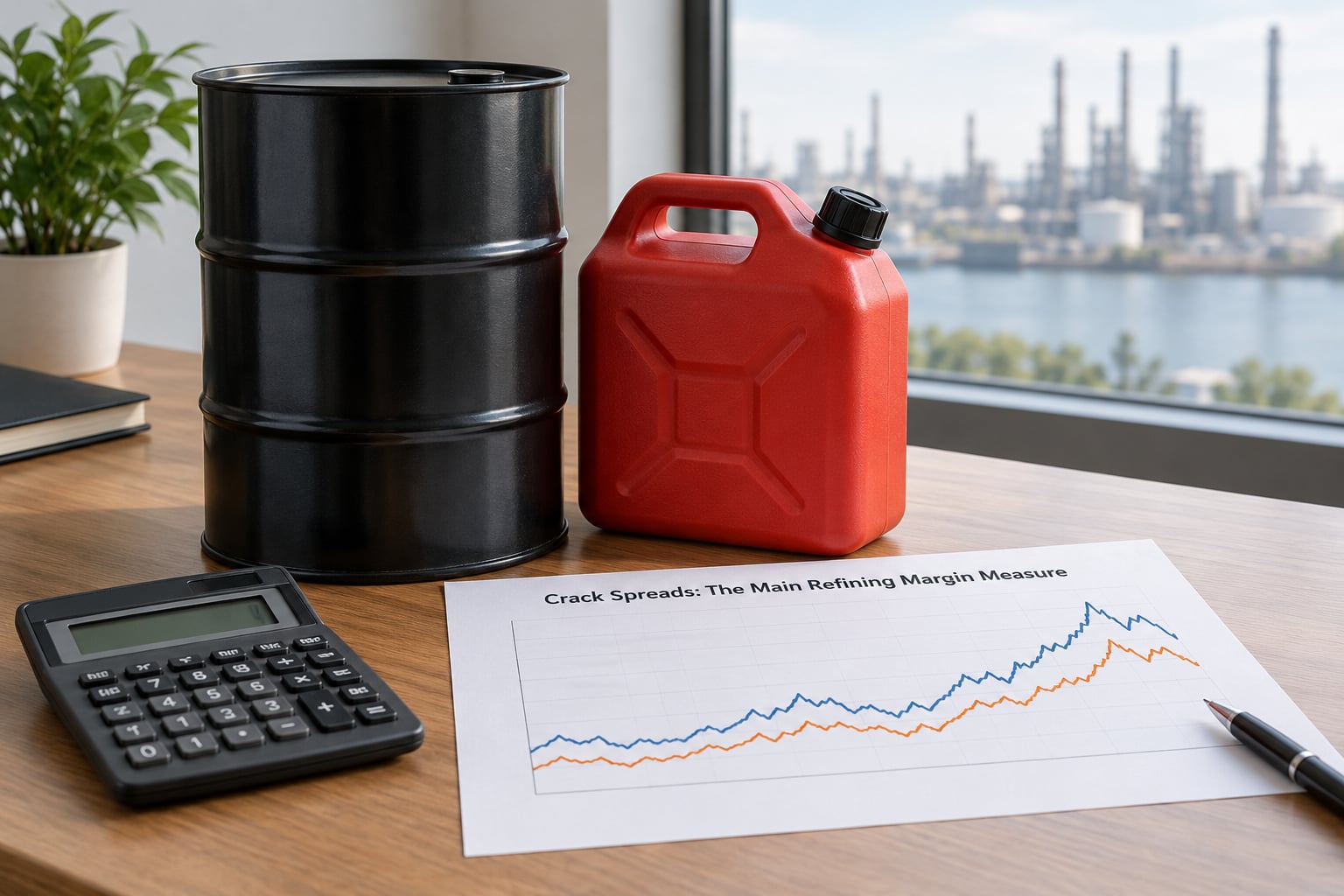
A crack spread is the difference between the wholesale price of a refined product and the price of the crude used to make it, measured in dollars per barrel. It is the standard proxy for a refinery margin, because it isolates the value of refining from the cost of the feedstock.
The gasoline crack spread is wholesale gasoline minus crude. The distillate crack does the same for diesel and jet fuel, and it often runs at a different level than the gasoline crack. Refiners watch both, plus the 3-2-1 crack spread, the industry benchmark that takes two barrels of gasoline and one barrel of distillate against three barrels of crude.
A quick worked example makes the translation to the pump obvious. Say crude is at 70 dollars a barrel and wholesale gasoline is trading at 2.20 dollars a gallon. A barrel holds about 42 gallons, so the wholesale gasoline price is about 92 dollars a barrel, and the crack is roughly 22 dollars a barrel. Spread that over 42 gallons and refining contributes about 53 cents of the gallon you buy, before taxes and station costs. That is the number the market refers to when it says refining margins are high.
| Spread | What it compares | What makes it widen |
|---|---|---|
| Gasoline crack | Wholesale gasoline versus crude, dollars per barrel | Strong driving-season demand, gasoline outages, low gasoline inventories |
| Distillate or ULSD crack | Wholesale diesel and jet fuel versus crude | Tight middle distillate supply, heavy turnaround season, freight and export pull |
| Jet fuel crack | Wholesale jet fuel versus crude | Aviation demand, seasonal jet fuel production limits at many refineries |
| 3-2-1 crack spread | Two barrels of gasoline plus one of distillate against three of crude | The overall state of refining profitability |
Diesel regularly carries a higher crack than gasoline, which is why truck owners notice a divergence that most drivers never see. Distillate competes with jet fuel and with export buyers at the same time, and plenty of refineries are configured to make less of it than gasoline demand would suggest.
Why Higher Refinery Margins Can Push Gas Prices Up
Margins widen for one of two reasons: product is scarce, or crude is cheap. Scarcity is the more durable driver, and it usually comes down to spare capacity. When most refineries are already running near their practical limit, every extra barrel of demand has to be met by turning a barrel some other way or by importing.
That is the supply response. A refinery can sell into a tight market at whatever the market clears at, and there is no price at which a driver politely declines to buy gasoline. The refiner does not set the price, but the refiner decides how much product exists, and that decision sets the ceiling.
Demand shocks do the same thing from the other side. A hot summer with heavy road travel, an economy running strong enough that commercial fuel use stays high, or an export wave that pulls barrels out of the domestic market will all tighten supply against demand and push the crack wider.
Margin strength is also a self-correcting sort of signal. Once cracks are wide enough to justify running every unit hard and importing product, the supply side responds and the crack usually compresses again. Wide margins are uncomfortable precisely because they invite the supply that ends them.
Why Refinery Margins Do Not Always Lead Gas Prices
The link between a widening crack and a higher pump price is real but noisy, and retail prices carry enough of their own momentum to break the one-to-one relationship in both directions. Understanding why is the difference between reading the market and guessing at it.
Why pump prices fall slower than crude
Wholesale product prices lead retail prices, but retail does not track them instantaneously. Stations buy fuel on their own schedule, often weekly or on a fixed delivery contract, so they are working off a purchase price that has already moved. When crude falls in the spot market, the lower cost reaches stations in steps as deliveries are placed.
Competition smooths this further. If two stations sit within a mile of each other, the one charging more loses customers fast, so retailers tend to hold price rather than chase a wholesale dip that all their competitors are also seeing coming. The result is the pattern drivers report constantly: prices climb quickly when crude rises, then sit flat for weeks after crude falls.
The retail ratchet most drivers notice
Retail station margins are thin, often a few cents per gallon, and thin margins create asymmetry. A station that holds its price while the replacement cost of its fuel rises is losing money on every gallon it sells. Losing money quickly, then waiting weeks to recover, is a business model nobody wants, so price rises pass through on the first replacement cycle.
When wholesale costs fall, the same station is not losing money, and there is no urgency to give the savings back. Competition caps how high the price can go, but it does not force it down on any particular day. That asymmetry, not greed, is most of the reason falls feel slower than rises.
There are also plenty of moving parts that have nothing to do with refining. Taxes are fixed per gallon and do not budge when crude moves. Freight rates, terminal fees, blending requirements for summer-grade gasoline and card fees all add noise. And in a market with plenty of stations, retail competition can compress the local margin to almost nothing, which is the opposite of what a wide crack spread implies.
What Can Change Refinery Margins?
Margins move because of demand, because of supply, and because of policy and quality constraints. Here is how the common drivers usually play out.
| Driver | Likely margin effect | Possible retail price effect |
|---|---|---|
| Strong gasoline demand | Gasoline crack widens | Pump prices rise, mostly in gasoline-heavy regions |
| Refinery utilization near the practical limit | Margins widen across products | Broad pump price increases |
| Unplanned refinery outage | Local supply shortfall, crack widens | Sharp regional increases within a few days |
| Spring turnaround maintenance | Temporary capacity reduction, cracks widen | Seasonal upward drift that fades as units return |
| Product inventories drawn down | Less buffer against supply shocks, margins widen | Higher and more volatile pump prices |
| Product imports and exports | Imports compress cracks, exports widen them | Regional relief or regional tightening |
| Pipeline and shipping constraints | Product cannot reach the shortage area, local crack widens | Large price gaps between regions |
| Crude quality mismatch | Refinery cannot run the cheap crude as designed, margins squeezed | Higher costs in the region running that crude slate |
| Weather and hurricanes | Production or logistics disrupted, margins widen | Rapid regional increases and later givebacks |
| Policy, tax changes and release decisions | Margin effect is indirect | Direct effect on the tax portion of the pump price |
Why Refinery Margins Vary by Region and Grade
A gallon of gasoline is not the same physical product everywhere, and that is a large part of the price variation people notice. California and other areas with tight fuel specifications need a different blend, and small refiners producing that specification are rare, so the local crack spread stays higher. The taxes differ too, sometimes by more than a dollar a gallon between neighboring states.
Geography adds another layer. The Gulf Coast has the largest concentration of refining capacity and the easiest access to export terminals, so wholesale prices there sit close to the crude benchmark. The East Coast depends on product arriving by pipeline, tanker or, for shipping between US ports, vessels flying the Jones Act flag, which limits how quickly supply can respond. When that capacity is full, the regional crack widens even when the national picture looks fine.
Grade matters as much as location. Regular gasoline, premium, diesel and jet fuel compete in separate markets with separate supply balances. Premium depends partly on octane availability, which is capped by what refineries can blend. Diesel depends on middle distillate output, which competes with jet fuel and with export demand. When one of those markets tightens, its crack widens independently of everything else, and the answer to why diesel costs more than gasoline is usually sitting in the distillate crack.
How Investors Can Monitor Refinery Margins
You do not need a terminal to do this. Every input is public, and most of it is free. Here is the routine I would use.
How refinery margins affect gas prices week to week
First, watch the two wholesale product prices rather than the crude price. If you follow only crude, you will be surprised by a rise in pump prices caused by the product side. Comparing the two tells you which part of the barrel is driving the move, and that distinction explains most of what otherwise looks contradictory.
Second, get the crack spread you care about. For a gasoline reader that is the gasoline crack; for anyone with diesel exposure it is the distillate crack. Compare it against its own history rather than against another spread, because the two have drifted apart from each other over time.
Third, pull the weekly utilization and throughput data from the US Energy Information Administration. High utilization with rising product supplied is a different signal from high utilization with falling output, and the release lands every Wednesday.
Fourth, track outages and turnarounds. Planned maintenance is seasonal and largely predictable. Unplanned outages are not, and they hit regional prices within days, which is why a hurricane on the Gulf Coast can move pump prices in states that never lost production.
Fifth, check inventories. A large build signals that supply is ahead of demand and tends to compress margins. A draw does the opposite.
Sixth, and last, read refiner earnings. A quarterly filing reports the realized refining margin per barrel the company actually captured, which is a different number from the headline crack spread and usually lower. Comparing the two tells you how much of the spread the refiner kept and how much went to freight, taxes and other costs.
Treat all of this as market structure rather than a prediction. Margins are a measure of tension in a market, and tension resolves one way or another. Reading the data tells you which market is tight and how tight; it does not tell you when it will loosen.
Frequently Asked Questions
Are refinery margins the same thing as gas prices?
No. A refinery margin is a spread between two wholesale prices: what a refined product sells for at the terminal versus what the crude behind it cost, measured in dollars per barrel. Gas price is what a driver pays at the pump, which adds freight, blending, station costs, retailer margin and taxes on top. One is a price, the other is the difference between prices.
Why are gasoline prices falling when crack spreads are rising?
It happens because the crack spread and the crude cost can move in opposite directions at the same time. If crude drops sharply while the crack widens by a similar amount, the wholesale gasoline price can land in roughly the same place, so the pump price barely changes. Local competition, taxes and a slow replacement cycle can stretch that flat period into weeks.
Do refiners make more money when gasoline prices are high?
Not always. A high pump price usually reflects a high crude cost, and the refiner’s margin is the gap between the two. What makes a refiner money is a wide crack spread while crude is moderate or soft, not a high retail price on its own. A refinery running full tilt with a narrow spread earns less per barrel than one running hard with a wide spread.
Which crack spread is most useful for investors?
The one that matches what you are exposed to. Gasoline drivers and gasoline producers should follow the gasoline crack, while trucking, shipping and diesel refiners should follow the distillate crack, which often runs at a different level. The 3-2-1 crack is useful as an overall read on refining profitability but can hide a divergence between the two product markets.
How quickly do refinery margins affect gas stations?
Faster than most people expect on the way up. Stations often buy on weekly or fixed delivery schedules, so a wholesale move shows up within days in what they pay for the next load, and competitive pressure to stay current pushes it through quickly. On the way down it is slower, because a station holding its price is losing a little money rather than a lot, and there is no rush.
Conclusion: Start With the Wholesale Product Market
If you take one idea from this guide, make it the crack spread. It is the cleanest measure of what refining is adding to the price of fuel, and it explains the cases that frustrate people most, including a crude price that falls while pump prices hold firm.
Start there, then add the context: compare the crack against crude rather than looking at either alone, check utilization and inventories, watch planned and unplanned outages, and remember that regional constraints and product grades set their own local prices. Read this as market structure rather than a forecast, and it will keep you ahead of the headline most of the time.