The IMF holds about 90.5 million fine troy ounces of gold, roughly 2,814 metric tonnes, and how the IMF holds gold comes down to three things: title to the metal, custody by member-country depositories, and a fixed historical accounting price of SDR 35 per ounce. None of the bars sit in a vault the Fund operates, and none of that metal is valued at the gold price on its balance sheet.
The gap between those two numbers is the single biggest source of confusion on this topic. The Fund carries the gold at an old acquisition cost that works out to a little over 4.5 billion US dollars in total. Marked to a gold price near 4,000 US dollars an ounce, the same pile is worth north of 350 billion US dollars. Both figures are correct. They measure different things.
This guide covers the custody arrangement, the accounting rule, the three times the Fund has actually sold gold, and what the whole thing means if you are watching bullion prices.
Table of Contents
- What Does the IMF Do With Gold?
- Why IMF gold is listed as a non-usable resource
- How the IMF Holds Gold
- Where the bars physically sit
- What SDR means and why gold is priced in it
- IMF gold by the numbers
- What Is the Difference Between IMF Gold and Country Reserves?
- Why Does the IMF Hold Gold?
- How the holdings were built
- An endowment rather than a trading position
- How Are the IMF’s Gold Holdings Reported?
- What the published figures can and cannot tell you
- Can the IMF Sell or Lend Its Gold?
- The three disposal episodes
- How an IMF gold sale actually works
- What Does IMF Gold Holding Mean for Investors?
- Bull case and bear case on an IMF sale
- How to check the numbers yourself
- IMF Gold Holdings: Key Facts and Caveats
- Frequently Asked Questions
- How much gold does the IMF hold?
- Where does the IMF store its gold?
- Who physically holds IMF gold?
- How does the IMF value its gold?
- Can the IMF sell or lend its gold again?
- Is IMF gold counted as usable liquidity?
- Conclusion
What Does the IMF Do With Gold?
The IMF treats gold as an asset on its own balance sheet and a potential source of income. It does not use gold to make loans, and members cannot withdraw it.
When a country joins the IMF, it pays a quota subscription. Part of that payment goes into the Fund’s General Resources Account in the member’s own currency, and part buys SDRs, the Fund’s unit of account. Gold sits outside that machinery entirely. A member that wants the currency portion of its quota back can draw it. The gold cannot be drawn.
That is why the IMF’s own financial tables separate gold from everything else. In its liquidity position tables, gold appears under a heading for what the Fund calls non-usable resources. It is excluded from usable resources, from the precautionary balance, and from forward commitment capacity, which is the Fund’s measure of how much it could newly lend.
Why IMF gold is listed as a non-usable resource
Usable resources are things the IMF can deploy quickly in a balance of payments crisis: quota currencies, SDRs, and undrawn credit lines. Gold is none of those. Turning it into crisis funding would mean selling it first, which needs a decision by the Executive Board, and then finding a buyer. That takes time, so the Fund cannot promise an emergency advance against it.
Readers who miss this line in the tables tend to assume the gold is quietly backing the Fund’s lending. It is not.
How the IMF Holds Gold
Where the bars physically sit
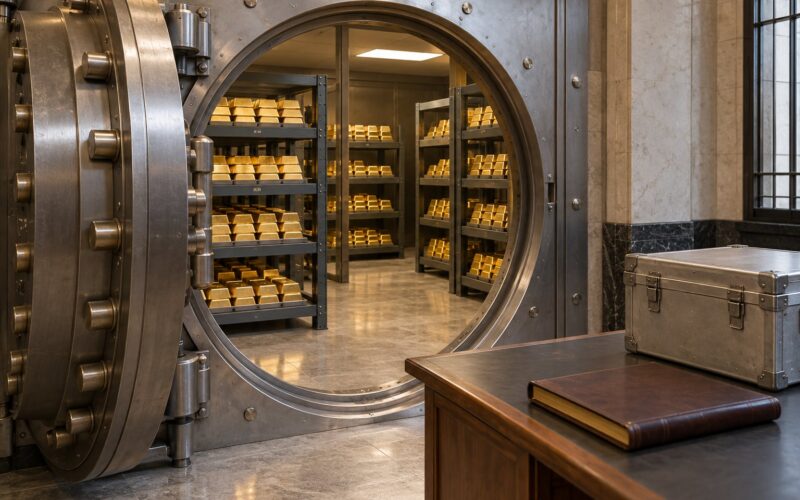
The gold is held as bullion in the vaults of designated member-country depositaries. Each gold depository named in IMF arrangements stores the Fund’s metal alongside other official holdings in its vault, with the account kept separate. The depository keeps possession. The Fund keeps title.
What you do not have with IMF gold is ownership by anyone else. Individual countries hold no claim on those ounces, the way a nation’s share of its own reserves is attributed to that nation. Nor is the metal typically earmarked bar by bar for a specific depositor. The Fund’s holding is an undivided position: a quantity of fine troy ounces, not a list of serialized bars with individual owners.
Retail buyers run into the same distinction when brokers advertise allocated metal, meaning specific bars assigned to your name. IMF gold is closer to the unallocated end of that spectrum, with the difference that the counterparty here is a treaty organisation with member governments behind it rather than a private vault operator.
What SDR means and why gold is priced in it
An SDR, or Special Drawing Right, is the IMF’s unit of account, created in 1969. Its value is set from a basket of five currencies: the US dollar, the euro, the Chinese renminbi, the Japanese yen and the pound sterling. The Fund reports most of its finances in SDRs rather than in any single national currency, which is why gold appears on its balance sheet in SDR and not in dollars.
The gold valuation rule follows from that. The Articles of Agreement set the price of gold for accounting purposes at SDR 35 per fine troy ounce, a figure inherited from the era when gold had an official dollar price of 35 US dollars an ounce and the SDR was roughly at parity with the dollar. The Fund has never marked the position to market. It sits in the financial statements at historical acquisition cost, with the gap to market disclosed as a memorandum item.
IMF gold by the numbers
| Measure | Figure | What it means |
|---|---|---|
| Fine troy ounces | 90.5 million | About 2,814 metric tonnes of fine gold |
| Balance-sheet book value | SDR 3.2 billion | 90.5 million ounces multiplied by SDR 35 |
| Valuation rule | SDR 35 per fine troy ounce | Fixed in the Articles of Agreement, never marked to market |
| Approximate market value | Over 350 billion US dollars | At a gold price near 4,000 US dollars an ounce |
| Sold in the 2009-10 program | 403.3 tonnes | Includes 200 tonnes sold to the Reserve Bank of India |
| Position in IMF liquidity tables | Non-usable resource | Excluded from usable resources and forward commitment capacity |
The 90.5 million ounce figure comes from the Fund’s own published liquidity position material and has circulated for well over a decade. Treat it as the last firmly documented level rather than a live tape reading, and check the current IMF data pages before quoting it as today’s number.
What Is the Difference Between IMF Gold and Country Reserves?
IMF gold belongs to the institution. Central bank gold belongs to a state. Everything that follows from that difference is about ownership, not about the metal itself.
| IMF gold | Central bank gold | |
|---|---|---|
| Who owns it | The Fund, on its own balance sheet | The issuing country’s state |
| Who can sell it | The Executive Board, by decision of members | The issuing authority, at its discretion |
| Typical buyer when sold | Another central bank, off-market first | Any buyer in the open market |
| Pledged or lent out | Held unpledged, no routine lending | Often swapped or leased against other currencies |
| Counts in IMF lending capacity | No, classified as a non-usable resource | Not counted, but sits in the holder’s own usable reserves |
| Reported in the holder’s reserve totals | No member includes it | Yes, in official reserve statistics |
So the United States, Germany, Italy, France and Russia appear near the top of every ranking of official gold holdings, and none of those bars are IMF property. When you read that the IMF has 90.5 million ounces, that metal is not counted inside any country’s reserve figures.
Access works differently too. A member country can borrow against or draw its own reserves, and it can choose to hold its gold at home or abroad. It has no mechanism to obtain IMF gold, even though it pays quota subscriptions into the institution that owns it.
Why Does the IMF Hold Gold?
The short answer is that the IMF inherited gold from the gold-standard system and then kept it because it is a hard asset with no counterparty.
How the holdings were built
Gold entered the Fund’s accounts through quota subscriptions paid during the 1930s and 1940s, when members contributed part of their quotas in metal. Under the Bretton Woods system, gold had an official price of 35 US dollars an ounce and was freely convertible, which makes that the natural origin of the SDR 35 accounting figure.
That era ended. Convertibility of dollar holdings into gold was suspended in 1971, and a second amendment to the Articles of Agreement in 1978 took gold out of the Fund’s day-to-day transactions. The metal stayed on the books with almost no function to perform, which is why it sat nearly idle for decades while arguments about selling it accumulated.
An endowment rather than a trading position
The case for keeping it rests on income. Selling gold and investing the proceeds in interest-bearing assets would let the Fund subsidise the cost of its concessional lending. The 2009-10 sale was structured around exactly that idea, with proceeds going into an endowment account that helps fund the Poverty Reduction and Growth Trust and the Catastrophe Containment and Relief Trust. The relief trust in particular ran close to empty in recent commentary, which is one reason the argument for selling the remaining gold keeps resurfacing.
There is also the credibility point. The institution that polices reserve management cannot be seen to depend on credit-sensitive assets for its own strength. Gold carries no counterparty risk, which is a genuine argument in a world where holding reserves in somebody’s debt has lost some appeal.
How Are the IMF’s Gold Holdings Reported?
The Fund publishes its gold position in its annual financial statements, on its Financial Resources and Liquidity Position pages, and in the International Financial Statistics database. The reports also state where the metal is held, by naming the gold depositories that provide safekeeping services.
Every figure needs a date attached to it. Official holdings numbers appear annually and lag the market by months or years, so an ounce count from a report published years ago and a gold price quoted today describe different moments. Comparing them without as-of dates is how readers end up with a market value that looks wrong.
What the published figures can and cannot tell you
The published data tells you the quantity of fine troy ounces, the historical-cost valuation, the named custodians and the accounting treatment. It does not give you a live market value on the balance sheet, a bar-by-bar inventory, or a sense of how quickly the Fund could convert any of it into usable funding.
Tidiness has also slipped. Since 2022, some official-sector participants have reported gold holding data less promptly and in less consistent form than they once did, which makes independent trackers such as the World Gold Council’s Gold Demand Trends a useful cross-check when the official series goes quiet or lags.
Can the IMF Sell or Lend Its Gold?
Selling is possible and has happened three times. Lending is not something the Fund does with this metal.
Gold transactions require a decision by the IMF Executive Board, which means a majority of member votes rather than a staff decision. That is why sales are slow and political, and why open headlines about an IMF gold auction tend to follow months of negotiation rather than lead them.
The three disposal episodes
- 1975 and 1976. The Fund held gold inherited from the gold-standard era and was permitted to return or sell it. Auctions over roughly four years disposed of about 25 million fine ounces, close to one-sixth of the holding at the time, and effectively cleared out most of the idle stock.
- 2000. A further authorised sale returned or sold part of the remaining holdings, again approved by members through the Board.
- 2009 and 2010. The largest recent programme, involving 403.3 tonnes. The Reserve Bank of India bought 200 tonnes for 6.7 billion US dollars, taking roughly half the programme in a single transaction, and the proceeds funded the endowment account.
How an IMF gold sale actually works
The sequence matters for anyone reading headlines. The Fund first approaches central banks and official buyers off-market, offering the metal privately at terms negotiated bilaterally. Only if that route fails does it consider an open market sale, and even then it phases the disposal to limit the impact on the gold price. The 2009-10 programme worked this way: a direct sovereign sale to one central bank absorbed half the volume before anything reached the open market.
The Fund does not routinely lend or swap its gold. Central banks routinely do both with their own holdings, which is the practical difference to keep in mind when headlines conflate the two.
What Does IMF Gold Holding Mean for Investors?
For most retail buyers of precious metals, the Fund’s gold matters in two ways: as a potential source of official-sector demand, and as a theoretical ceiling on the price if a sale ever happened.
The demand side is concrete. India bought 200 tonnes in a single 2009 transaction, and central banks with reasons to diversify away from dollar assets have been active buyers for most of the past decade. The Fund is one route into that trade, and a sale at its historic cost leaves the buyer acquiring an asset the IMF itself values on paper at a fraction of the price.
Bull case and bear case on an IMF sale
The bear reading treats the holdings as an overhang. A sale of the full remaining 2,814 tonnes would be a very large addition to annual supply, and bullion holders argue that publication alone caps how far the price can run ahead of the market’s ability to absorb metal.
The counter-argument is that a sale to central banks is a demand event, not a dumping event, because the metal leaves the financial system rather than the vault. The 2009-10 programme is the working example: 403.3 tonnes moved, and the dominant buyer was a central bank treating the purchase as a reserve decision.
The practical takeaway is that an IMF announcement is not a price signal on its own. Watch who is named as the buyer, over what period, and whether the sale is off-market or open. A phased programme to official buyers tells you very little about how much pressure physical bullion investors will feel.
How to check the numbers yourself
Go to the IMF’s Financial Resources and Liquidity Position material for the authoritative ounce count and book value, the International Financial Statistics database for the series behind it, and the World Gold Council for official-sector demand data that updates faster. Compare each against the date the source publishes, and do not mix a five-year-old holdings figure with this morning’s spot price without saying so.
IMF Gold Holdings: Key Facts and Caveats
What is documented:
- About 90.5 million fine troy ounces, roughly 2,814 metric tonnes, as an asset on the Fund’s balance sheet.
- A book value of SDR 3.2 billion, fixed at SDR 35 per fine troy ounce under the Articles of Agreement.
- Custody with designated member-country depositories, with the Fund holding title and individual countries holding no claim.
- A classification as a non-usable resource, excluded from usable liquidity, the precautionary balance and forward commitment capacity.
- Three authorised disposal episodes: the 1975-76 auctions, a 2000 sale, and the 403.3 tonne programme of 2009-10.
- A market value far above book value whenever the gold price sits above the historical cost.
What commonly gets said and is wrong:
- That the IMF owns 350 billion US dollars of usable reserves. The metal is real, but it is not usable liquidity and cannot back lending.
- That member countries co-own it. They do not, and their quota purchases created no claim on the ounces.
- That an IMF sale would flood the market with bullion. The documented mechanism puts central banks first, off-market.
- That the 2009 sale to India still threatens bullion buyers today. It completed more than a decade ago and is now history rather than an overhang.
Frequently Asked Questions
How much gold does the IMF hold?
The IMF holds about 90.5 million fine troy ounces of gold, which converts to roughly 2,814 metric tonnes. It carries that holding at a book value of SDR 3.2 billion, calculated at a fixed rate of SDR 35 per ounce set by the Articles of Agreement. At gold prices near 4,000 US dollars an ounce, the market value of the same metal runs well past 350 billion US dollars.
Where does the IMF store its gold?
The metal sits in vaults operated by gold depositories in member countries that have entered into safekeeping arrangements with the Fund. The depository keeps physical possession, and the IMF holds title to the whole undivided holding. The Fund publishes the identities of its gold depositories in its financial statements, so the locations are documented rather than secret.
Who physically holds IMF gold?
Designated member-country depositories hold the bars physically, with the IMF accounting for the ounces on its own balance sheet. Unlike a central bank’s holdings, these ounces are not attributed to any individual country, and no member has a right to withdraw them. The arrangement is closer to unallocated vault metal than to the specific bars a retail buyer can own outright.
How does the IMF value its gold?
The Articles of Agreement set gold at SDR 35 per fine troy ounce for accounting purposes, and the Fund has never marked the position to market. That rule is a legacy of the era when gold had an official price of 35 US dollars per ounce. The difference between book value and market value appears only as a memorandum item, which is why the balance sheet looks absurdly small next to the bullion price.
Can the IMF sell or lend its gold again?
Selling is possible and has happened three times, most recently in the 403.3 tonne programme of 2009 and 2010, which included 200 tonnes sold to the Reserve Bank of India. Any new transaction needs approval from the Executive Board, so it reflects a decision by member governments rather than a staff call. The Fund does not routinely lend or swap this metal.
Is IMF gold counted as usable liquidity?
No. In the IMF’s own liquidity tables, gold sits under non-usable resources. It is excluded from usable resources, from the precautionary balance the Fund holds back against loan losses, and from forward commitment capacity. That classification exists because converting the metal into emergency funding would require a sale approved by the Board first.
Conclusion
Start by separating custody from ownership. The bars sit in member-country vaults, the Fund owns them outright, and no member country can pull them out. Next, keep book value and market value apart: SDR 3.2 billion is an accounting artefact of a 1970s price rule, not a measure of what the metal is worth today.
From there, read any IMF gold headline for two things. Who is buying, and off-market or public. A phased sale to central banks is a demand event with a long approval process, not a dump onto the bullion market. Updated for 2026, the holdings data remains the most useful single number in this story, as long as you carry the date attached to it.