Options on gold futures are derivative contracts that give you the right, but not the obligation, to buy or sell a standard gold futures contract at a set strike price before a set expiration date. You pay a premium up front, and that premium is the most you can lose.
That is the whole idea in one paragraph. Everything below unpacks the pieces: what the contract actually is, how the premium is built, how profit and loss work out in dollars, and what happens at expiration.
- Underlying asset: a COMEX gold futures contract, quoted in dollars and fractions per troy ounce.
- Standard contract size: 100 troy ounces, so one point of gold price movement equals 100 dollars per contract.
- Tick size and value: 0.10 dollars per ounce, worth 10 dollars per tick on a standard contract.
- Maximum risk on a bought option: the premium you paid.
- Settlement: cash-settled in most cases, so exercising produces a futures position rather than a bar of metal in your hand.
Everything in this guide is educational. Futures and options trading can lose you money quickly, and the worked numbers below are illustrative examples, not forecasts or advice.
Table of Contents
- What Are Options on Gold Futures?
- Gold options vs gold futures vs gold ETFs vs bullion
- How Options on Gold Futures Work
- How options on gold futures work, step by step
- Calls and Puts: What Each One Does
- Which one fits which view
- In the money, at the money, out of the money
- Strikes, Expiration Dates, and Contract Multipliers
- Intrinsic Value, Time Value, and the Option Premium
- What actually sets the premium
- How Profit and Loss Are Calculated
- Bought call example
- Bought put example
- Exercise, Assignment, and Expiration
- American and European exercise
- What happens at expiration
- Margin, Risk, and Position Sizing
- Sizing with real numbers
- The tax side, briefly
- A Beginner’s Example: Buying a Gold Futures Call
- Frequently Asked Questions
- Are options on gold futures the same as buying gold?
- Should a beginner buy a call or a put on gold futures?
- Can I exercise a gold futures option before its expiration date?
- How much can a gold futures option lose?
- What happens if a gold futures option expires out of the money?
- Conclusion
What Are Options on Gold Futures?
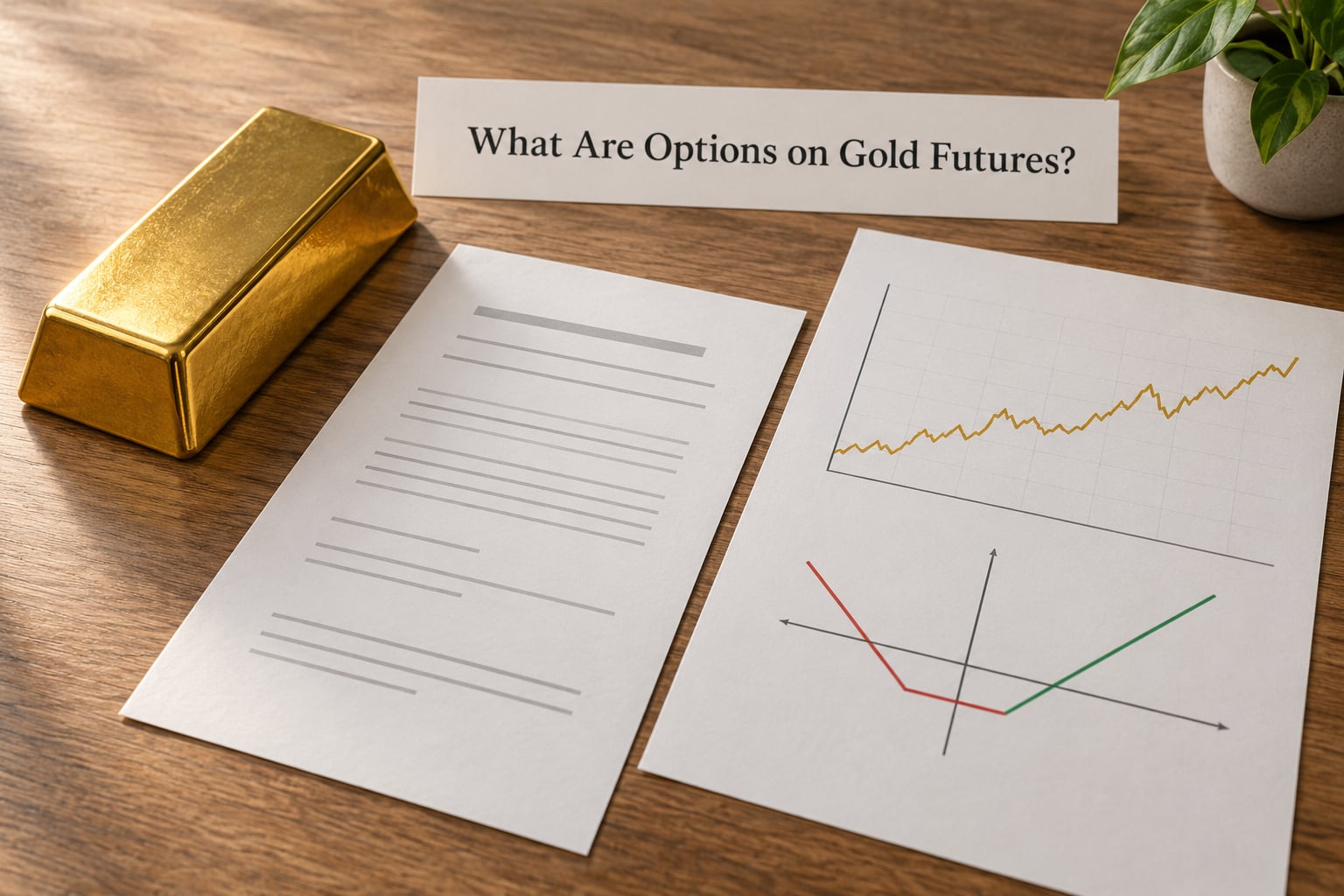
An option on gold futures is a contract whose value is tied to a gold futures price rather than to spot gold. The most widely traded version is the option on the COMEX gold futures contract, often written as GC. Gold futures options started trading on COMEX in the early 1980s and are now among the most liquid options markets in the world, which is why their bid-ask spreads are usually tight.
The important distinction is between what you hold and what the contract references. Owning a physical bar means you own metal. Buying a gold futures contract means you have agreed to take delivery at a future date. Buying an option on that futures contract means you hold a right that could turn into a futures position if it is worth exercising.
Gold options vs gold futures vs gold ETFs vs bullion
| Feature | Gold futures option | Gold futures | GLD ETF option | Physical gold |
|---|---|---|---|---|
| Obligation | None after paying the premium | Binding on both sides | None after paying the premium | You own it outright |
| Maximum loss | Premium paid | Larger than margin posted; margin calls possible | Premium paid | The amount you spent |
| Contract size | 100 troy ounces of GC futures | 100 troy ounces | 100 shares of the fund | Varies by product |
| Expiry | Yes, a fixed set of cycles | Yes, delivery month | Monthly, Friday expiry | None |
| Settlement | Cash, into a futures position | Physical delivery or cash equivalent | Cash | Hold the metal |
| Best used for | Defined-risk speculation and hedging | Leveraged directional exposure | Retail-friendly exposure with shares-based sizing | Long-term store of value |
GLD options deserve a note because they come up constantly. They track a gold-backed exchange-traded fund rather than the futures contract, so they size to 100 fund shares instead of 100 ounces, they never involve margin on the underlying, and they settle differently. They are easier for small accounts. Futures options are more capital-efficient per contract and carry a US tax advantage described later in this guide.
How Options on Gold Futures Work
The mechanics are the same as any other option. What changes is the underlying: the reference price is a gold futures contract, and one point of that price is worth 100 dollars on a standard contract.
How options on gold futures work, step by step
1. Open an account with a futures commission merchant. You need an account approved for options on futures, and the broker will ask you to acknowledge the risk disclosures. Not every retail broker that offers gold futures offers the options on them, which is the single most common frustration people report in trading forums.
2. Pick the underlying contract and its expiry. The front-month GC futures contract is the busiest, and its options are the most liquid. Options expire on specific calendar cycles rather than every day, so you choose a date and work back from it.
3. Choose a strike price. This is the futures price at which you would trade if you exercised. Strikes are spaced in fixed increments, typically 1.00 dollar per ounce for near-dated gold options, so you will not find every possible price listed.
4. Choose call or put, then buy or sell. Buying a call is a bullish bet. Buying a put is a bearish bet or a hedge. Selling either one is a different job entirely: you collect premium and take on an obligation.
5. Pay the premium. The quoted premium is priced per ounce, so you multiply by 100 for a standard contract. A premium quoted at 4.20 dollars costs you 420 dollars. On a micro contract with 10 ounces it costs 42 dollars.
6. Manage the position. Watch the option against the futures price. Most traders close or roll before expiration rather than hold through it.
7. Close, exercise, or let it lapse. Selling the option back to the market is the cleanest exit. Exercising converts it into a futures position. Letting it expire worthless costs you the premium and nothing more.
Calls and Puts: What Each One Does
A call gives its holder the right to buy the underlying at the strike. A put gives its holder the right to sell the underlying at the strike. Both are rights, never obligations, for the buyer.
Suppose GC futures trade at 2,350 dollars. A call with a 2,400 strike lets you enter at 2,400, which is only useful if futures go above that. A put with a 2,400 strike lets you enter at 2,400, which protects you if futures fall below it.
Which one fits which view
| Your view | Contract | What you are really saying | Max loss |
|---|---|---|---|
| Gold rising | Buy a call | Give me upside if futures climb, drop it if not | Premium paid |
| Gold falling | Buy a put | I want gains or insurance if futures drop | Premium paid |
| Holding gold, fear a drop | Buy a put | Floor my downside while keeping upside | Premium paid |
| Own gold, want income | Sell a call | Collect premium, accept a ceiling on gains | Unlimited, if price spikes |
| Flat, expect big move | Buy a straddle or strangle | Pay for a large move in either direction | Premium paid |
In the money, at the money, out of the money
These three labels describe where the futures price sits relative to the strike, and they decide whether an option has any value at expiration.
With GC at 2,350, a 2,300 call is in the money, a 2,350 call is at the money, and a 2,400 call is out of the money. A 2,400 put is in the money, a 2,350 put is at the money, and a 2,300 put is out of the money.
In-the-money options are mostly intrinsic value, which means they move nearly one-for-one with the futures price. Out-of-the-money options are mostly time value, which means they decay if nothing happens. Beginners buying cheap far out-of-the-money options are really buying time value and a lottery ticket.
Strikes, Expiration Dates, and Contract Multipliers
Every gold futures option is described by four numbers: the strike, the expiry, the multiplier, and the quoted premium. Once you can convert those into dollars, the contract stops being mysterious.
| Term | What it means | Example |
|---|---|---|
| Underlying | The contract the option is written on | COMEX gold futures (GC) |
| Strike price | The futures price at which you would trade | 2,400.00 dollars per ounce |
| Expiration | The last day the option can be traded or exercised | A date in the current or next calendar cycle |
| Multiplier | Ounces covered by one contract | 100 troy ounces standard, 10 on micro |
| Tick | Smallest price increment | 0.10 dollars per ounce |
| Tick value | Dollars per tick per contract | 10 dollars standard, 1 dollar on micro |
| Premium | Cost of the right, quoted per ounce | 4.20 dollars per ounce, so 420 dollars per standard contract |
| Exercise style | When you may exercise | American for COMEX gold futures options |
The multiplier is the part people trip over. A standard GC contract is 100 troy ounces, so a 3.00 dollar move in the futures price is a 300 dollar move on one option contract, whether you are long or short. Micro gold futures options use 10 ounces, which cuts every figure by a tenth and is the usual starting point for smaller accounts.
Expiries for gold futures options run on a monthly cycle with several listed expiry months at any time, including weeklies on the front contract. Closer expiries move fast and give narrow bid-ask spreads; further expiries cost more in time value and are easier to trade in size.
Intrinsic Value, Time Value, and the Option Premium
Every option premium is made of two parts, and separating them explains most of what happens to a position between now and expiration.
Intrinsic value is the money you would get by exercising right now. For a call it is the futures price minus the strike, floored at zero. For a put it is the strike minus the futures price, floored at zero.
Time value is everything else: the chance of a favorable move before expiry, plus the interest-rate and carry effects. It is always positive and it shrinks every day as expiry approaches. That shrinkage is called time decay, and it is measured by theta.
Take a call with a 2,400 strike when GC futures trade at 2,350. Intrinsic value is zero. If the premium is quoted at 14.50 dollars per ounce, the full 1,450 dollar premium is time value, and it is all at risk if gold drifts sideways.
Now take the same option when GC trades at 2,420. Intrinsic value is 20 dollars per ounce, or 2,000 dollars. If the premium is 26 dollars, then 600 dollars of what you paid is time value and 2,000 dollars is intrinsic. That remaining 600 dollars still bleeds away with every passing day unless the price keeps moving in your favour.
What actually sets the premium
Four inputs dominate: the futures price versus the strike, the time remaining, the implied volatility, and the cost of carry. Volatility matters most in gold. When the market expects a big move in gold, calls and puts get expensive, and when things calm down, every option loses value even if the price barely moved.
Cost of carry is the piece specific to futures-based options. Because the option settles into a futures contract, pricing follows a futures-style model, commonly described as Black-76, which uses the forward price rather than the spot price. The gap between them reflects interest rates and the gold lease rate, plus storage and insurance for the metal. This is why a futures option is not simply an option on the spot gold price with a different name.
Gold also has a persistent skew: downside puts usually trade above what pure volatility would suggest, because investors pay extra to be protected when gold falls. If you compare a call and a put at the same distance from the money, the put is often the more expensive one to buy. Selling those rich puts for income is a common strategy, and it carries real risk when gold drops hard.
How Profit and Loss Are Calculated
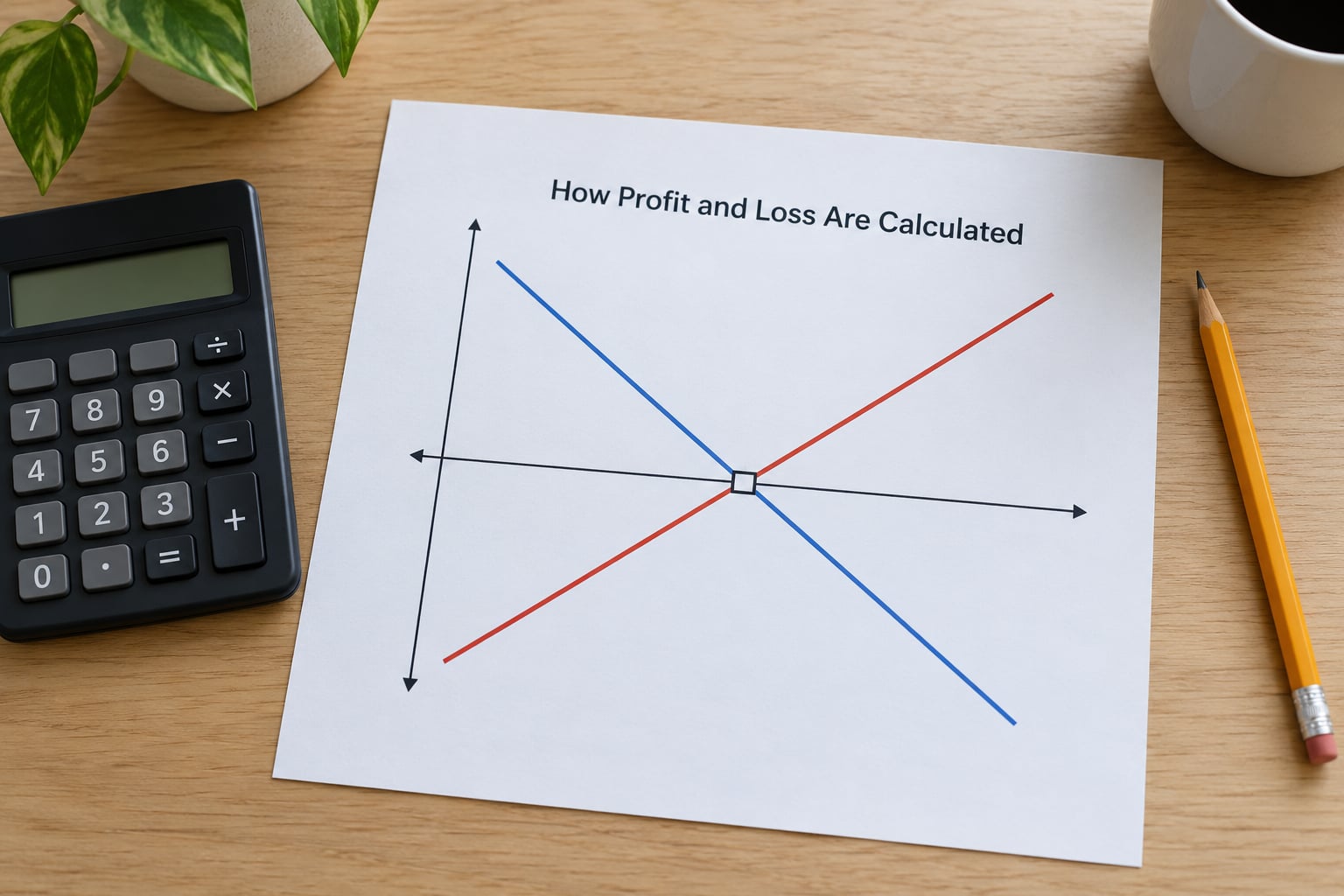
For a bought option the formula is short enough to do in your head. Profit is the difference between the option’s value at exit and the premium you paid, multiplied by the contract multiplier.
Bought call example
You buy a GC call with a 2,400 strike expiring this month, when futures are at 2,350. The premium is 14.50 dollars per ounce, which is 1,450 dollars for one standard contract.
- Breakeven: 2,400 plus 14.50, or 2,414.50 dollars per ounce.
- Maximum loss: 1,450 dollars, if the option expires worthless.
- Profit at 2,450 futures: 50 minus 14.50, so 35.50 per ounce, or 3,550 dollars.
- Profit at 2,500 futures: 100 minus 14.50, so 85.50 per ounce, or 8,550 dollars.
- Profit at 2,380 futures: 20 intrinsic minus 14.50 premium, so 5.50 per ounce, or 550 dollars.
Upside is not capped. That is the appeal and the trap: most of the gain arrives quickly if gold moves, and the entire premium is at risk if it does not.
Bought put example
You buy a GC put with a 2,400 strike while futures trade at 2,350, at a premium of 26 dollars per ounce, or 2,600 dollars per contract. The put is already 50 dollars in the money on intrinsic value alone.
- Breakeven: 2,400 minus 26, or 2,374.00 dollars per ounce.
- Maximum loss: 2,600 dollars.
- Profit at 2,300 futures: 100 intrinsic minus 26 premium, so 74 per ounce, or 7,400 dollars.
- Profit at 2,250 futures: 150 minus 26, so 124 per ounce, or 12,400 dollars.
- Profit at 2,380 futures: 20 intrinsic minus 26 premium, so a loss of 6 per ounce, or 600 dollars, even though the put finished in the money.
That last line is the lesson people miss most often. Being in the money at expiration does not mean making money. You have to clear the premium you paid, and if the move happens slowly enough, time decay eats the difference before you get there.
On a bought option your downside is fixed at the premium, which is exactly why many traders prefer options to futures. On a sold option the reverse applies, and losses can exceed anything you collected.
Exercise, Assignment, and Expiration
Exercise is what you do as the option holder: you use the right you paid for and take a position in the underlying gold futures contract at the strike. Assignment is what happens to the seller: an exercise against your short option is assigned to you, and you must take the opposite side at the strike.
American and European exercise
American-style options can be exercised at any time before expiry. European-style options can only be exercised on the expiry date itself. COMEX gold futures options are American-style, so in principle you can exercise early, and the right to do so is occasionally worth real money when interest rates are high.
In practice most retail traders never exercise. They sell the option or let it expire, because exercising a futures option means taking on a futures position with all the margin and roll management that comes with it. Early exercise is mainly a decision that arises when you are short a deep in-the-money call, or when a dividend-like consideration makes it worthwhile. For gold futures there is no dividend on the futures contract itself, so the main early-exercise pressure shows up near expiry on short calls.
What happens at expiration
Gold futures options are cash-settled against the settlement price of the underlying futures contract. If the option finishes in the money, the difference between the settlement price and the strike is paid out in cash. If it finishes out of the money, it simply expires worthless and the buyer loses the premium.
You do not receive a bar of gold. Anyone holding to expiration is running a small futures position they did not intend to open, and the position needs to be closed or rolled the next morning. That overnight handoff is where a lot of beginner confusion happens: the option closed, and now there is a futures position on the screen that was not part of the original plan.
The exchange clearing firm stands between buyers and sellers and processes exercise and assignment. Your broker handles the mechanics and the cash, and the broker’s platform will tell you whether an option is approaching expiration and whether it is in the money.
Margin, Risk, and Position Sizing
Here is the part that catches people out. The premium you pay for a bought option is not margin in the futures sense. It is the full purchase price of the position, and there is no margin call on it. If the option goes to zero, you lose what you paid and that is the end of it.
Written options work the other way around. You collect premium up front, and your broker will require a performance bond that can grow or shrink as the market moves. That bond is not the maximum of what you could lose; the real risk on a short call is unlimited if gold keeps rallying. Margin requirements are set by the broker within the exchange minimums, not by the exchange alone, so two brokers can carry different numbers for the same trade.
Sizing with real numbers
Start from the loss you are willing to accept, not from the contract you want to trade. Those are the same size when you buy options, which makes sizing unusually simple.
- Risking 500 dollars at 14.50 premium: one standard contract (1,450 dollars at risk). Four contracts would risk 5,800 dollars.
- Risking 500 dollars at 14.50 premium on micro contracts: the premium per contract is 145 dollars, so about three contracts, or 435 dollars at risk.
- Risking 500 dollars on a 10-lot futures position where one point equals 1,000 dollars: half a point of adverse movement takes the whole 500. That is how a day goes wrong.
Gold futures moves are sharp, especially around scheduled data, and people trading them report being stopped out by spikes that lasted minutes. Options buyers get a defined cap on that pain, but they still lose the premium if the spike goes the other way. Sizing to the premium means a total loss is a planned outcome rather than a surprise.
Two further risks deserve a mention. Bid-ask spreads widen in far out-of-the-money strikes and in thinly traded expiries, so you can lose a meaningful slice of the premium simply on the way in or out. And holding a position through expiration adds roll risk that disappears the moment you close early.
The tax side, briefly
In the United States, gold futures options fall under Section 1256 treatment. Gains and losses are treated as a mix of short-term and long-term capital gains each year, generally 60 percent short-term and 40 percent long-term, and losses can offset trading profits in the same year. That is a genuine structural advantage over most other option products. Rules differ by country and change, so check with a tax professional before relying on any of it.
A Beginner’s Example: Buying a Gold Futures Call
All prices, premiums and results in this section are hypothetical and illustrative. They are not live market data and not a recommendation.
Step one. You decide to take a defined-risk, bullish view on gold and choose a standard GC call rather than a futures contract, because the premium is the maximum you can lose.
Step two. GC futures are trading at 2,350 dollars. You pick a 2,400 strike call expiring in about three weeks, quoted at 14.50 dollars per ounce.
Step three. One contract is 100 ounces, so the premium is 1,450 dollars. You decide that amount is the whole risk on this idea, which means one contract and no more.
Step four. Over the next two sessions gold drifts to 2,372. Your option gains intrinsic value but you are still 28 dollars below the strike, so the position is up a little on delta and still mostly time value. You do nothing.
Step five. A data release hits, gold jumps to 2,395, and the option is now 5 dollars in the money. Its premium rises from 14.50 to roughly 24.00, giving a gain of about 9.50 per ounce, or 950 dollars on one contract. You are below your 2,414.50 breakeven, so this is not yet the profit you planned.
Step six. Two days from expiry, gold pushes to 2,412. The option is worth about 23.00 per ounce. You close the position at that price for a gain of roughly 8.50 per ounce, or 850 dollars, less commissions. Closing before expiry means no futures position appears on your account afterward.
The alternative ending. If gold had stalled and drifted down to 2,355 with a week left, the same option would be worth close to zero, and closing it would have turned 1,450 dollars into a loss of roughly 1,400. Identical decision, opposite outcome, and the only number that changed was the gold price.
Frequently Asked Questions
Are options on gold futures the same as buying gold?
No. A gold futures option is a contract on a paper promise about gold at a future date, not metal you own. If you buy a call and gold rises, you gain as the futures price moves above your strike plus premium. If gold falls, you lose the premium and that is the limit. Physical gold has no expiration and no premium, but you carry storage, spread and insurance costs instead.
Should a beginner buy a call or a put on gold futures?
Buy the one that matches the view you actually hold. A call is a bullish position with a fixed loss equal to the premium. A put is either a bearish position or insurance on gold you already hold. Many beginners pick based on which looks cheaper rather than which matches their outlook, and then wonder why the trade does not work. Decide the view first, then look at strikes and expiries.
Can I exercise a gold futures option before its expiration date?
Yes. COMEX gold futures options are American-style, so the holder may exercise at any time before expiry and take a futures position at the strike price. Most retail traders never do, because it creates a leveraged futures position requiring margin and a roll decision. Selling the option back is usually simpler. Early exercise mainly matters for short in-the-money calls and when interest rates make the time value small.
How much can a gold futures option lose?
If you bought it, the maximum loss is exactly the premium you paid. A 14.50 dollar premium on a standard 100-ounce contract costs 1,450 dollars, so that is the worst case at expiry. On a micro contract covering 10 ounces it is 145 dollars. If you sold the option instead, the loss is not capped: a short call can lose far more than the premium collected if gold rallies sharply.
What happens if a gold futures option expires out of the money?
It expires worthless and the buyer simply loses the premium paid. Nothing is assigned, no futures position is created and there is no margin call. The same applies to a short option that finishes out of the money: the premium collected is kept in full, which is the basis of premium-selling strategies. If you intend to hold through expiry, check the position during the final session, because in-the-money options do settle into a futures position.
Conclusion
Options on gold futures are simpler than their reputation suggests, and the first thing to get right is the contract underneath them. A standard COMEX gold futures contract covers 100 troy ounces, so one point of price movement is 100 dollars, and the premium quoted per ounce becomes a round dollar figure once multiplied out.
From there the decision is mostly about arithmetic and honesty. Work out your breakeven as the strike plus or minus the premium, decide in advance how much of that premium you are willing to lose, and pick an expiry that matches how long you actually expect the move to take. Then remember that a bought option loses its value every day the market sits still, and that a position held into expiry becomes a futures position whether you intended that or not.
Before trading anything, confirm with your own broker how exercise, assignment and margin work on their platform, and practice on the smallest contract your account supports until the mechanics feel ordinary rather than new.
This is general educational information about how a contract type works. It is not financial advice, and futures and options trading carries a substantial risk of loss.