Solar panels use silver as the metal that carries electricity off the surface of every photovoltaic cell. A screen-printed silver paste forms thousands of hair-thin conductive fingers and wider busbars on the front and rear of the cell, collecting the electrons the silicon generates and passing them out to the panel’s wiring. A typical residential module holds roughly 15 to 20 grams of it, an approximate industry figure that shifts with cell design.
That is the short answer. The rest of this guide covers where exactly the metal sits, why manufacturers picked silver over cheaper conductors, how much of it each type of panel takes, and why the falling amount of silver in each cell has not slowed the growth in total solar silver demand. It is a subject where the numbers in circulation contradict each other more often than they agree, so every figure below carries its source and year.
Table of Contents
- How Solar Panels Use Silver in Photovoltaic Cells
- How solar panels use silver: printing, drying and firing
- Why Solar Panels Need a Highly Conductive Metal
- Where Silver Is Used in a Solar Panel
- Front contact: fingers and busbars
- Rear contact: where designs differ most
- The parts of a panel that hold no silver
- What Happens If Silver Usage Is Reduced
- Silver thrifting in practice
- Why copper has not simply taken over
- The trade-offs manufacturers accept
- Why Silver Demand Matters for Solar Energy
- The conflicting numbers you keep seeing
- How Much Silver Is Used in Solar Panels?
- How to Follow Silver Demand from the Solar Sector
- Frequently Asked Questions
- Do all solar panels use silver?
- How much silver is used in one solar panel?
- What part of a solar panel contains silver?
- Is silver an important material for solar power?
- Can solar panels be made without silver?
- Does solar-panel growth increase silver demand?
- Conclusion
How Solar Panels Use Silver in Photovoltaic Cells
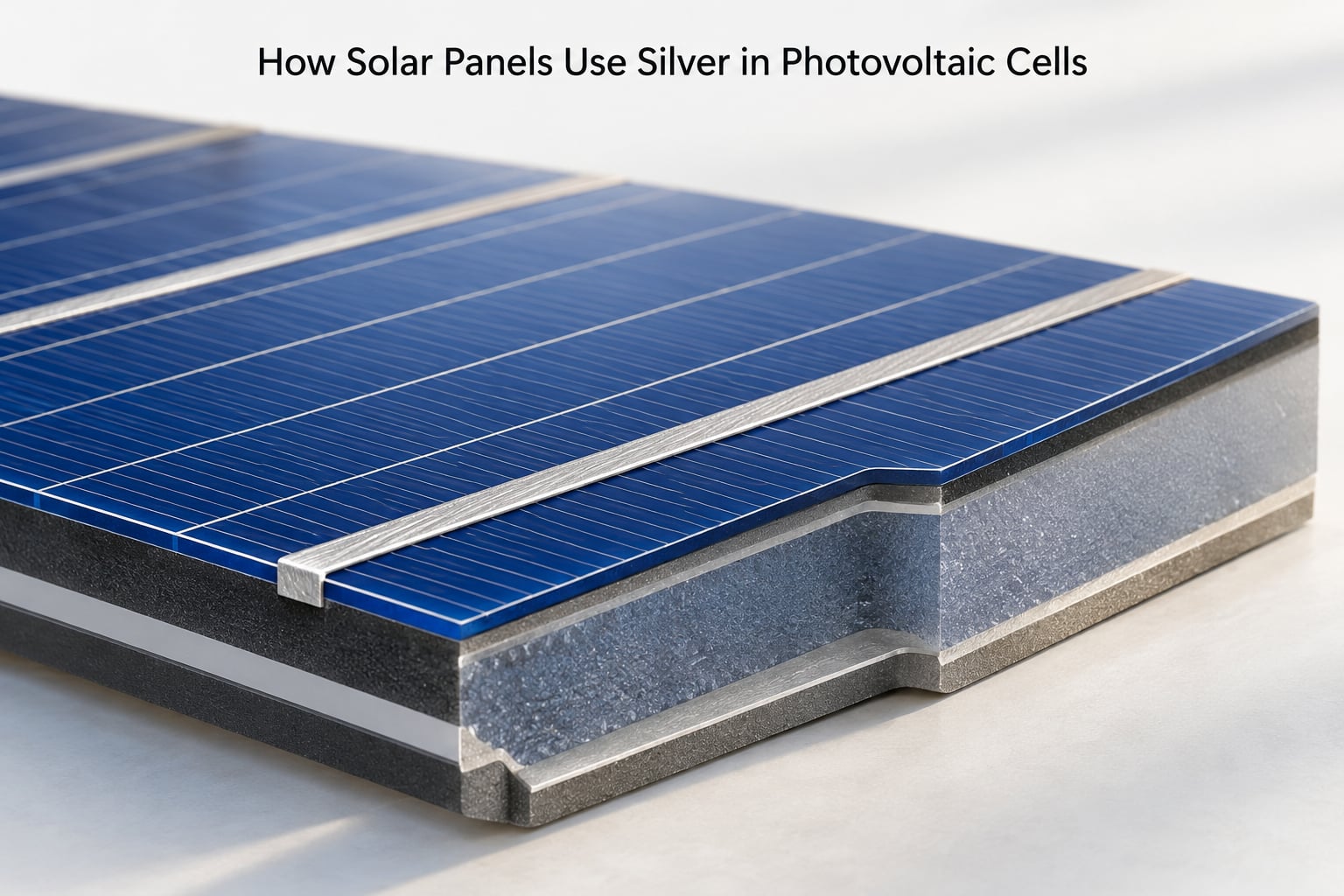
The silver in a solar panel is a paste that gets printed onto the cell, not a wire or a foil. It forms a metal skin of conductive lines that sits on top of the silicon, touching it at thousands of points to draw current out of the semiconductor.
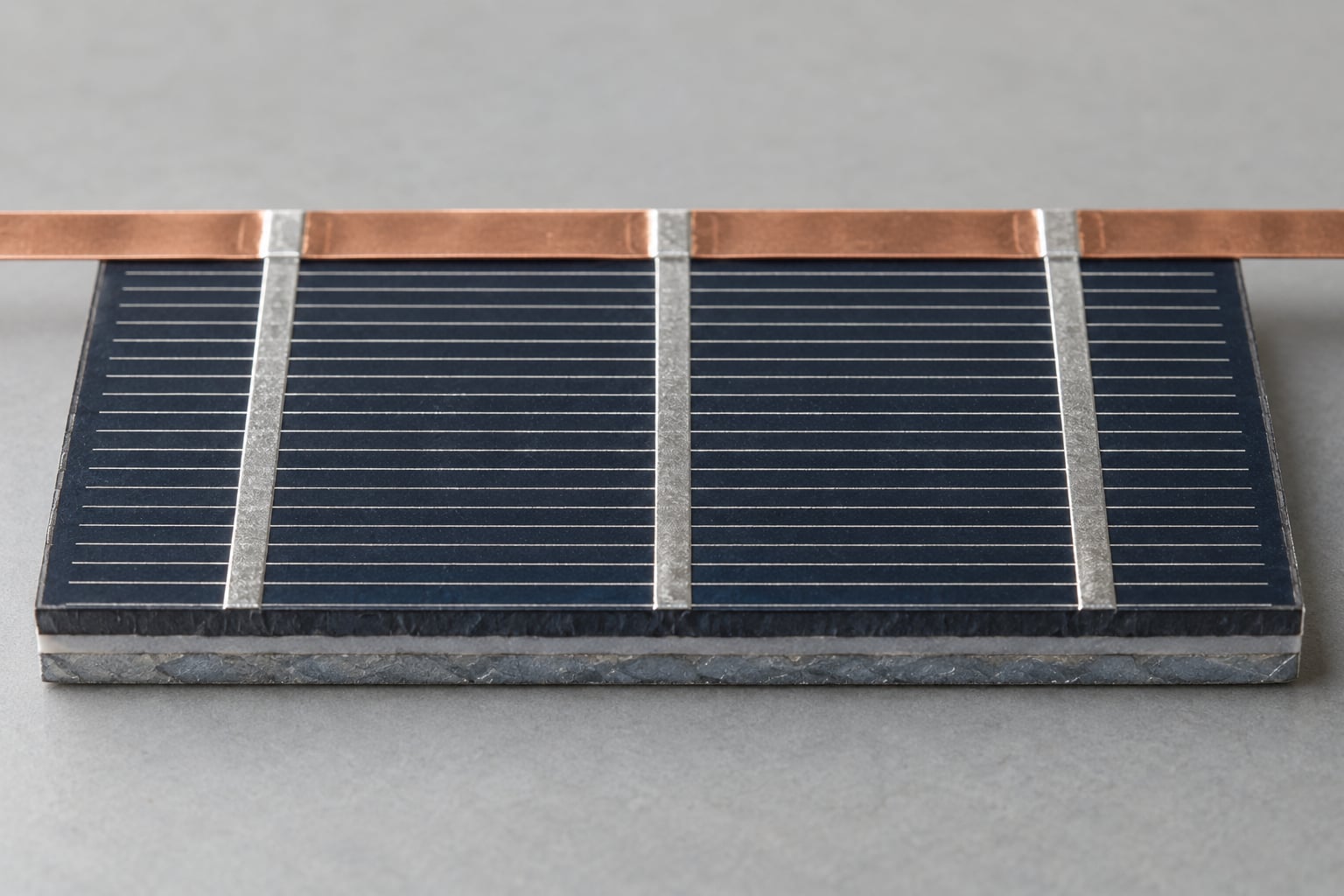
Silicon on its own does the light-absorbing work. When photons hit a properly built cell, they free electrons, and those electrons need somewhere to go. The printed silver is the path: fingers collect the electrons across the whole surface of the wafer, busbars gather them into a few wide lanes, and flat interconnect ribbons carry the current off the cell into the junction box and eventually to an inverter.
How solar panels use silver: printing, drying and firing
The manufacturing sequence matters, because each step shapes how much silver ends up in the finished cell.
- Print. A screen printer pushes silver paste through a fine mesh stencil, laying down the finger pattern, then the busbars on top.
- Dry. The wafer passes through a drying oven that evaporates the organic solvents in the paste and leaves a solid silver film bonded to the silicon.
- Fire. A furnace at several hundred degrees Celsius burns off the glass frit that bound the paste, and the silver particles sinter into a solid, low-resistance metal layer that makes real electrical contact with the wafer.
- Test and connect. Cells are measured, sorted, then strung with copper ribbon and potted into a module between glass and encapsulant.
Silver suits that fourth step because it survives it. Silver has the highest electrical conductivity of any metal, and unlike some other conductors it resists diffusing into the silicon during the high-temperature firing step, so the contact it forms holds its low resistance for the life of the panel.
Why Solar Panels Need a Highly Conductive Metal
Manufacturers need a metal that carries current well, forms a reliable low-resistance contact with silicon, and survives a firing process that would damage most materials. Silver is the only metal that clears all three tests at once, which is why it has stayed in the cell for decades.
Conductivity is only the start of the argument. A metallization layer has to do two jobs at the same time: move electricity, and stay out of the way of the light. Every extra shadow cast by a metal line is a photon the cell never converts.
Aluminium is cheaper and conducts reasonably well, so it has found a permanent home on the rear contact of most crystalline silicon cells, where light enters through the front. Copper is also abundant and cheap, and it is used extensively in the ribbons, cables and junction boxes outside the cell. On the front surface, though, where the paste must both touch silicon and stay thin, neither has fully displaced silver.
Aluminium paste oxidises at firing temperature, and an oxide layer at the silicon interface is an insulating barrier. Copper paste oxidises too, and copper also migrates faster under heat, which can degrade cell performance over time. Silver-aluminium formulations exist to manage this, but the silver still carries the contact.
A paste rather than a solid wire also solves the manufacturing problem. A stencil can print patterns far narrower than any practical mechanical wiring process, which is what lets fingers get down to a few tens of microns wide and keep shading losses low.
Where Silver Is Used in a Solar Panel
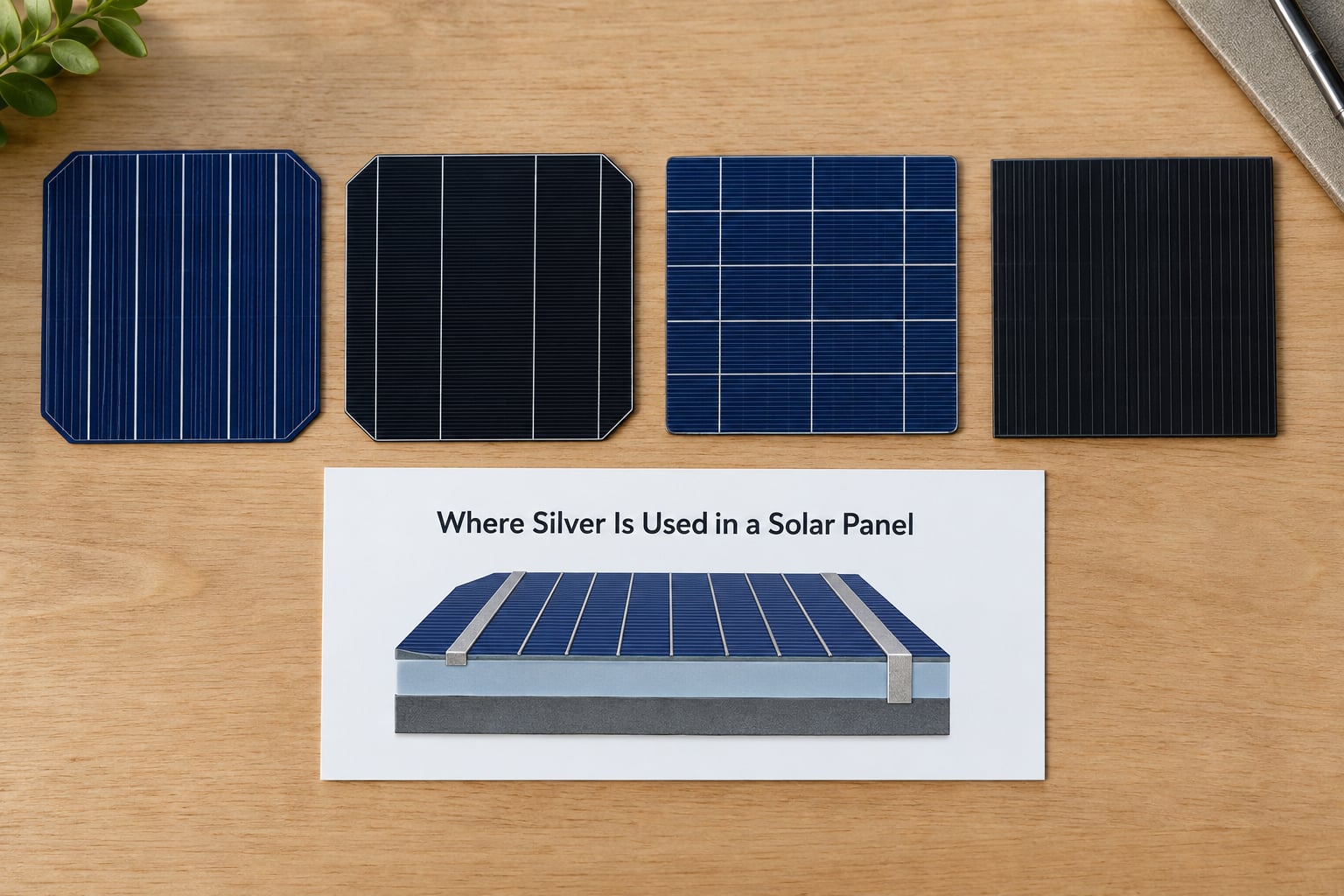
Silver in a photovoltaic panel shows up in three distinct places, all of them on the cells themselves rather than in the frame, glass or junction box.
Front contact: fingers and busbars
The front contact is the largest silver user on a conventional crystalline silicon cell. Dozens of hair-thin fingers run edge to edge across the wafer in parallel, each collecting electrons from the silicon along its length. Three wider busbars, usually vertical, cross those fingers and collect their combined current into a single lane. The front paste is often a silver-aluminium formulation, so the printed layer contains some aluminium by weight.
Rear contact: where designs differ most
The rear of the cell can be fully covered in silver paste, as older back-contact designs did, or it can use an aluminium layer interrupted by small openings that let light through to the silicon. Those rear openings are one reason absolute silver loading has fallen over time without a matching collapse in rear-side capability.
The parts of a panel that hold no silver
Everything outside the cell stack is silver-free in metallization terms: the tempered glass front and back, the encapsulant layers, the aluminium frame, the encapsulant edge seal, the junction box, the copper interconnect ribbons, the cabling and the backsheet. If a homeowner asks what percentage of a panel by mass is silver, the honest answer is a very small one, because the panel is dominated by glass, aluminium and silicon.
One further point worth separating out for anyone weighing recycled panels as a metal source: the copper ribbon, not the silver, is typically the most valuable metal in a scrapped module. The silver is interesting industrially because of the volume, not because a single discarded panel is worth much on its own.
What Happens If Silver Usage Is Reduced
Reducing silver per cell is possible, and cell makers have been doing it for years, but every method has a cost that shows up somewhere other than the silver bill.
Silver thrifting in practice
Thrifting means making the same electrical connection with less metal. The main levers are narrower fingers, thinner printed layers, lighter busbars, and moving from silver paste to lower-silver or aluminium-containing formulations on the rear. Industry trackers report average front-side silver loading per cell falling from roughly 120 milligrams in 2018 to around 70 milligrams by the mid-2020s.
That is a large fall in the amount of silver in each cell. It is also the point that confuses most readers who see solar framed as an ever-growing sink for the metal.
Why copper has not simply taken over
Copper paste is cheaper per kilo and coproduct copper already exists in quantity, so the argument for switching is obvious. The technical problem shows up during firing. Copper oxidises in air at the temperatures needed to sinter the paste, and copper oxides cannot make a low-resistance contact with silicon. Copper also has a higher diffusion rate, so it creeps under heat stress and degrades long-term cell performance.
Coated-copper approaches attack the oxidation problem at the surface. A thread on r/Wallstreetsilver linked to SunDrive Solar’s coated-copper claim and asked the community to weigh in, and the post drew almost no engagement, which tells you how thin the retail discussion of the technology is. The honest summary is that copper substitution is an active research and development area rather than a settled change of supplier.
The trade-offs manufacturers accept
- Narrower fingers reduce shading but raise line resistance, so a wafer can lose more to series losses than it gains in light.
- Lighter busbars cut silver use and add manufacturing steps to hold the ribbon bond.
- Aluminium rear contacts cut silver a lot and demand finer laser patterning.
- Multi-wire ribbon keeps current flowing as busbars get thinner, which adds copper per cell to save silver.
Nobody in the supply chain wants to be the first to trade a fraction of a percentage point of module efficiency for a cheaper input. That reluctance is the main reason the metallization recipe has changed gradually rather than abruptly.
Why Silver Demand Matters for Solar Energy
Solar became one of the largest industrial users of silver in the space of a decade, and that is what turns a metallization question into a commodity story. Photovoltaics consumed roughly 142 million ounces of silver in 2023, about 13.8% of total global silver demand, up from under 5% in 2014, according to Silver Institute data cited in industry explainers.
The International Energy Agency’s Global Critical Minerals Outlook reports the same shape in its own language: silver intensity declined significantly over its measurement period while total silver demand from the solar sector continued to rise, because installation growth outpaced the reduction in metal per cell. The IEA Global Critical Minerals Outlook 2026 remains the reference read for tracking both lines.
The conflicting numbers you keep seeing
Search results for this topic routinely carry two incompatible claims. One cites the 142 million ounce figure for 2023 from Silver Institute data. The other asserts solar consumes more than 200 million ounces a year, and that figure tends to travel through social media without attribution.
Treat the 200-plus-million-ounce number with suspicion. It does not trace cleanly to a named survey year, and The Silver Institute’s World Silver Survey remains the authoritative annual accounting of where silver goes. If you want to check any figure yourself, go to the World Silver Survey for the demand breakdown and the IEA outlook for intensity and installation trends, rather than taking a screenshot of a post.
A second correction is worth making explicitly, because the community gets it backwards more often than not. Newer panels do not use more silver than older ones. Per-cell loading has fallen steadily since around 2018, and the panels now being installed are the least silver-intensive of their generation.
How Much Silver Is Used in Solar Panels?
The table below is a conceptual guide at industry-approximate level, useful for sanity-checking claims rather than as a specification. Cell architecture, wafer size, metallization recipe and loading practices all move these numbers, and you should treat them as ranges.
| Module type | Approximate silver per module | In troy ounces | Approximate intensity |
|---|---|---|---|
| Residential rooftop module, around 400W | Roughly 15 to 20 g | About 0.5 to 0.6 oz | In the range of 40 mg per watt |
| Higher-power residential or commercial module, around 550W | Roughly 20 to 30 g | About 0.6 to 1 oz | Slightly lower per watt as cells get more efficient |
| Utility-scale module, around 600W and above | Roughly 25 to 35 g | About 0.8 to 1.1 oz | Continues to fall as fine-line printing spreads |
| Per cell, modern front-side loading | Around 70 mg | About 0.002 oz | Down from roughly 120 mg per cell in 2018 |
| Per cell, front and rear combined | Typically 90 to 130 mg | About 0.003 to 0.004 oz | Varies widely by PERC, TOPCon or HJT architecture |
Scaling that up gives a sense of the pull. A one-megawatt solar farm built from 400W modules needs roughly 2,500 modules, which works out to something in the order of 40 to 50 kilograms of silver in the array itself. The larger picture is the 142 million ounce annual figure quoted above, which covers every cell the industry prints rather than a single project.
How to Follow Silver Demand from the Solar Sector
Six things move the number, and they move it in different directions. Treating solar demand as a guaranteed investment outcome is the mistake; watching the drivers is the useful part.
- Installation volumes. The IEA outlook tracks deployed capacity by year, and that is the base everything else multiplies out from.
- Cell production, which is not the same as installation. China manufactures a large share of the world’s cells, much of them exported, so cell output can outrun installations in any given year.
- Silver loading per cell. This is the thrifting variable, and it moves in the opposite direction to volume.
- Cell architecture. PERC, TOPCon and HJT use different amounts of silver, so the architecture mix in a factory matters as much as the total wafer count.
- Recycling and scrap recovery. End-of-life modules and manufacturing scrap return silver to the market, though the volumes are small today.
- Substitution announcements. Any credible move to copper paste on the front contact would change the outlook more than a year of efficiency gains.
On recycling specifically, keep two things apart. Bench-scale results are promising: RZOLV Technologies reported 89.8% silver recovery in preliminary bench-scale tests on solar panel concentrate in March 2026, and Australian research reported in community forums has claimed near-total silver recovery from solar cell waste. Both are research-stage claims. Installed commercial recycling capacity still processes relatively little material, and trade coverage of end-of-life economics points out that recovered material value often does not cover the processing cost on its own. Headline recovery percentages are not the same as commercial economics.
None of this is a view on where silver should trade. It is a map of the inputs that move industrial demand, and the Silver Institute and IEA publications named above are where to read them.
Frequently Asked Questions
Do all solar panels use silver?
Almost all crystalline silicon panels do, because silver paste is still the standard way to make the front electrical contact. The exception is thin-film technology such as cadmium telluride, which uses no silver metallization at all. Among silicon panels the amount varies widely by architecture, with rear-contact designs using less than conventional front-contact ones.
How much silver is used in one solar panel?
A residential rooftop module of roughly 400W contains about 15 to 20 grams of silver, or around half a troy ounce. That figure is approximate and moves with cell design, wafer size and metallization recipe. A modern 600W utility-scale module holds roughly 25 to 35 grams.
What part of a solar panel contains silver?
The silver sits on the solar cells themselves, not in the panel hardware. On the front of each cell it forms the conductive fingers and the wider busbars printed over the silicon. The rear contact may contain silver or, in many designs, aluminium. Glass, frames, junction boxes and copper cabling contain no silver.
Is silver an important material for solar power?
It is one of the largest industrial users of the metal. Photovoltaics consumed roughly 142 million ounces of silver in 2023, about 13.8% of global silver demand, up from under 5% in 2014, according to Silver Institute data. Silver has no realistic full substitute in the front contact today, which is why it matters to the supply chain.
Can solar panels be made without silver?
Not at scale, with current technology. Thin-film panels already do it, but silicon dominates the market and silicon cells rely on silver paste for their electrical contact. Copper and aluminium are the main substitution candidates, and both oxidise at firing temperatures in ways that raise contact resistance. Coated-copper approaches are in development rather than in mass production.
Does solar-panel growth increase silver demand?
It has so far, and the IEA reports that falling silver intensity per watt has been outweighed by rising installations. Industry trackers put average front-side loading down from about 120 milligrams per cell in 2018 to around 70 milligrams by the mid-2020s, yet total solar silver demand kept rising. Copper substitution or a sustained slowdown in installations would be the two things that change that.
Conclusion
Solar panels use silver as printed metal contacts on every silicon cell, and that contact does something no cheaper conductor does reliably: it survives the firing process and keeps its low resistance for decades.
If you want to dig further, three things matter most. The first is the cell’s conductive layer, since that is where every milligram of the metal lives. The second is the falling amount of silver used per watt, which is the number most often reported backwards. The third is the pace of photovoltaic manufacturing, because that volume is what keeps total silver demand climbing even as each cell uses less.