Short answer: most of the metal in an electric vehicle sits in three places. A typical 60 kWh battery pack carries about 185 kg of battery minerals and metals, led by graphite, aluminum and nickel, and the rest of the car adds copper in every cable, aluminum and steel in the body, and rare-earth magnets in the motor. That is what metals go into an electric vehicle at a system level.
The catch is that no two EVs are built from the same recipe. A chemistry change from LFP to NMC 811 swaps cobalt and nickel for iron and phosphorus, and a motor change from permanent magnet to induction removes the rare-earth magnets entirely. Every number below is tied to a stated pack size or chemistry so it can be checked rather than repeated.
Table of Contents
- What Metals Go Into an Electric Vehicle by System?
- Which Metals Are Used in EV Batteries?
- What metals go into an electric vehicle battery pack
- How battery chemistry changes the metal mix
- Copper: The Main Conductor in an Electric Vehicle
- Aluminum and Steel: Metals That Build the EV
- Rare-Earth Metals in Electric Motors and Electronics
- What Other Metals Appear in EV Electronics?
- How the Metal Mix Changes Between EVs and Gas Cars
- Which Metals Matter Most for EV Manufacturing and Investors?
- Frequently Asked Questions
- What metals go into an electric vehicle the most?
- Are lithium and graphite both metals?
- Do all electric vehicles use rare-earth metals?
- Why does an electric vehicle need so much copper?
- What is the difference between LFP, NMC and NCA batteries?
- Can electric vehicles be recycled when their batteries reach the end of their lives?
- Conclusion: Start With the Battery and Wiring
What Metals Go Into an Electric Vehicle by System?
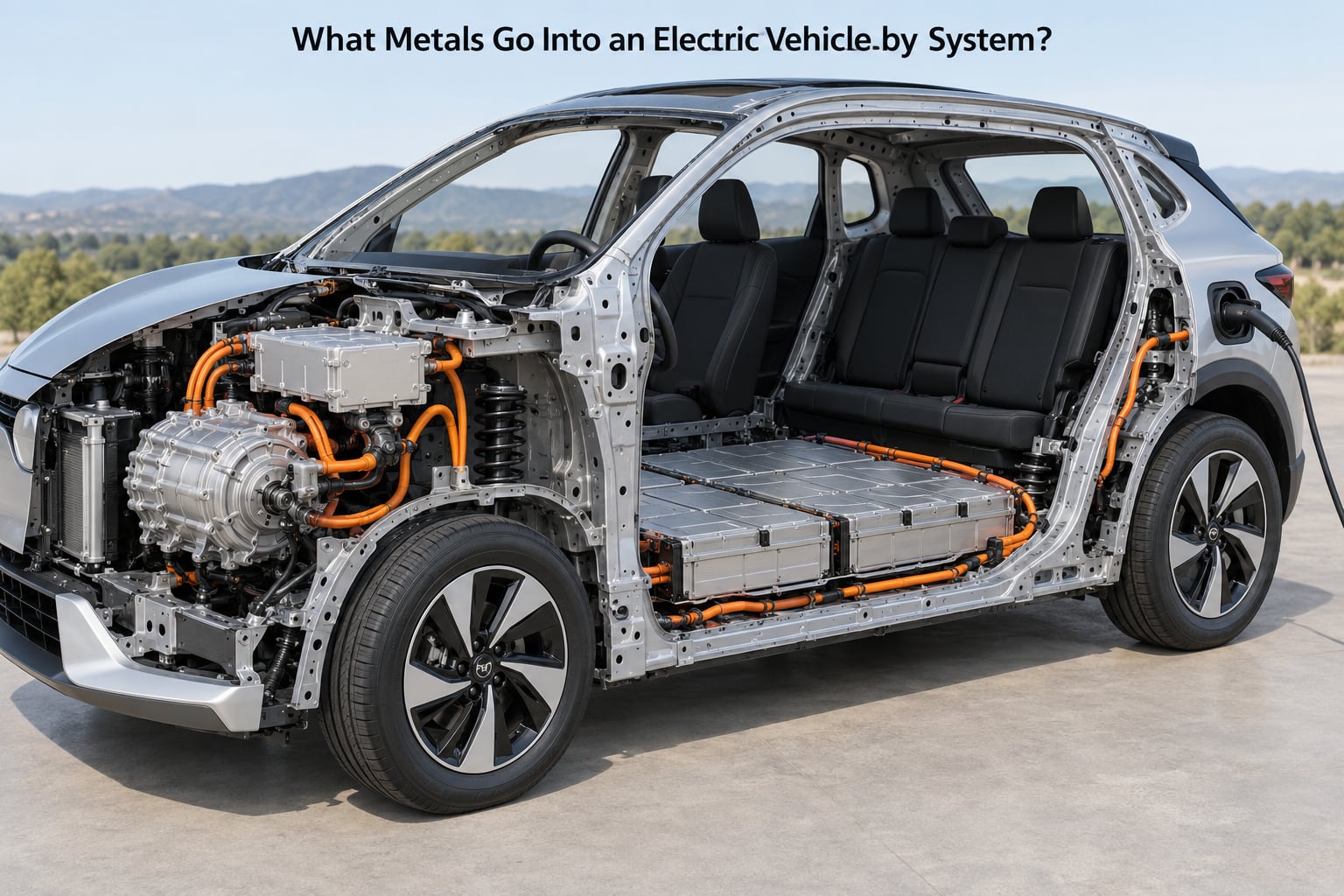
Here is the short version of the metals inventory, organized by the job each metal does rather than by mining origin.
| Metal | Vehicle system | Representative use | Category |
|---|---|---|---|
| Lithium | Battery pack | Charge-carrying ion in the cathode | Battery material |
| Nickel | Battery pack | Cathode active material, energy density | Battery material |
| Cobalt | Battery pack | Cathode stability and cycle life | Battery material |
| Manganese | Battery pack | Cathode and thermal-runaway stability | Battery material |
| Iron | Battery pack | LFP cathode base metal | Battery material |
| Copper | Motors, wiring, inverter | Windings, bus bars, HV cable, connectors | Electrical material |
| Aluminum | Body, pack casing | Castings, enclosures, panels, bus bars | Structural and electrical |
| Steel | Body, chassis | Space frame, crash structure, axles | Structural material |
| Neodymium, praseodymium, dysprosium, terbium | Traction motor | NdFeB permanent magnets in the rotor | Magnet material |
| Silver, gold, tin, palladium, zinc | Electronics | Contacts, solder, relays, sensors | Minor metals |
Two variables explain most of the variation between vehicles. The first is pack size, since every battery metal scales roughly with kWh. The second is chemistry, which decides whether nickel and cobalt appear at all. Vehicle size and manufacturer design choices then decide the aluminum-to-steel ratio in the body.
Which Metals Are Used in EV Batteries?
What metals go into an electric vehicle battery pack
Graphite is the largest mineral by mass in an EV battery at roughly 52 kg, about 28% of a 185 kg mineral load. It forms the anode, the layer that accepts lithium ions during charging, and it is not a metal at all despite appearing on every critical-minerals list.
Aluminum comes next at about 35 kg, spread across the cathode, the current collectors that carry current out of each cell, the cooling plates and the pack enclosure. Nickel at roughly 29 kg sits in the cathode, where it delivers most of the energy density that determines range. Copper at about 20 kg appears in the same current collectors, the internal bus bars and the interconnect tabs between cells.
The rest of the pack mineral load is manganese at about 10 kg, cobalt at roughly 8 kg, lithium at about 6 kg and iron at around 5 kg. Lithium is the lightest of these in mass terms but it does the actual charge-carrying work, moving back and forth between anode and cathode on every cycle.
| Mineral or metal | Role in the pack | Approx. kg per 60 kWh pack | Share of mineral mass |
|---|---|---|---|
| Graphite | Anode active material | 52 | 28.1% |
| Aluminum | Current collectors, casing, cooling | 35 | 18.9% |
| Nickel | Cathode active material | 29 | 15.7% |
| Copper | Current collectors, bus bars, tabs | 20 | 10.8% |
| Steel | Pack case and fasteners | 20 | 10.8% |
| Manganese | Cathode stability | 10 | 5.4% |
| Cobalt | Cathode stability and life | 8 | 4.3% |
| Lithium | Charge-carrying ion | 6 | 3.2% |
| Iron | LFP cathode base | 5 | 2.7% |
Treat that table as an order-of-magnitude guide for an average 60 kWh pack, not a teardown spec sheet. Figures you see quoted as 8 kg or 12 kg of lithium usually assume a larger pack, a different cathode formulation, or a lithium-equivalent conversion rather than the contained metal.
How battery chemistry changes the metal mix
LFP, NMC and NCA are not interchangeable labels. They describe what is in the cathode, and the cathode is where most of the pack value and most of the metal demand sits.
| Chemistry | Lithium and nickel | Cobalt | Manganese | Iron and phosphorus | Character |
|---|---|---|---|---|---|
| LFP | Lithium only, no nickel | None | None | Dominant | Cheaper metals, long cycle life, lower energy density |
| NMC 111 | Equal parts nickel, manganese, cobalt | High | High | Minor | Balanced energy density and cost |
| NMC 811 | Nickel-dominant at 80% | Low | Low | Minor | Higher energy density, less cobalt |
| NCA | Nickel-dominant with aluminum | Low | None | Minor | High energy density, common in cylindrical cells |
The shift toward LFP and high-nickel NMC changes the demand picture for nickel and cobalt even when EV build volumes keep climbing. Owners on owner forums like r/RealTesla regularly make the same point about LFP cost arithmetic: the cathode is roughly 4.5% lithium by weight, and there is no cobalt line at all.
Copper: The Main Conductor in an Electric Vehicle
Copper is the metal that most clearly separates an EV from a combustion car, because a battery EV needs to move large currents over long distances with thin wiring, while a combustion car moves far less electricity from alternator to starter to lights.
Component breakdowns commonly put total copper in an EV at 80 to 100 kg, against roughly 18 to 25 kg in a comparable combustion car. Within the vehicle, the motor windings account for about 20 to 25 kg, the battery pack for 25 to 30 kg, the high-voltage wiring harness for 15 to 20 kg, and charging-related hardware for another 5 to 10 kg. Charging infrastructure adds more: a single DC fast charger has been estimated at around 25 kg of copper on its own, which is why grid copper demand grows even when only a fraction of chargers are built.
Aluminum is the usual substitute where weight and cost matter more than conductivity, and it appears in bus bars and cable in short runs. Steel, silicon and aluminum alloys show up in sensors, braided shields and motor laminations. Copper stays the default for the runs that matter most.
Aluminum and Steel: Metals That Build the EV
Aluminum is the most widely used metal in an electric vehicle by weight, and it is the reason several published mass breakdowns put aluminum ahead of any battery metal once you include the body. It shows up in battery enclosures, die-cast front and rear subframes, hoods, doors, battery cooling plates and the space frame itself.
Steel still does the safety-critical work. Space frames, crash zones, axles, suspension components and many battery enclosures rely on steel because its strength-to-cost ratio is hard to beat in a structure that has to crumple predictably.
The lightweighting trade is straightforward. Every kilogram removed from a vehicle that has no engine to shift its weight around translates more of the pack’s energy into range, which is why aluminum and advanced high-strength steel keep appearing on new platforms. The trade-off is that aluminum costs more per ton than mild steel and repairs cost more, which pushes automakers toward aluminum where it shapes the package and steel where it protects the people in it.
Rare-Earth Metals in Electric Motors and Electronics
Rare-earth elements are used in small quantities but with almost no substitutes, which is what makes them a separate conversation from battery metals.
Neodymium is the workhorse. Combined with iron and boron in NdFeB magnets, it gives permanent-magnet synchronous motors their power density. Praseodymium is often part of the same alloy, dysprosium is added to preserve magnetization at high motor temperatures, and terbium appears in high-temperature grades and in some sensor applications.
Not every motor uses rare-earth magnets. Induction motors rely on electromagnets and use no rare earths at all. Switched reluctance motors use no permanent magnets either. Some manufacturers ship both motor types across their range, so the rare-earth content of a given EV depends on which drive unit is fitted rather than on the brand alone.
One correction worth making explicit: lithium, nickel and cobalt are critical minerals, not rare earth elements. They belong to a different part of the periodic table and a different mining and refining chain, and treating them as a single category is a category error that shows up constantly in online arguments. For supply context, the IEA and USGS routinely note that China accounts for roughly 80 to 85% of rare-earth refining capacity, while the Democratic Republic of the Congo supplies most cobalt and Indonesia most nickel.
What Other Metals Appear in EV Electronics?
Silver is the standout. It is used in contacts, bus bars and in the conductive paste on solar and electrode surfaces, and a mid-size pack contains enough of it that it shows up on commodity screens as a byproduct of copper and lead-zinc mining rather than as an EV product. The honest answer to how much silver sits in an EV is that it varies by pack design and cell format, and most published figures describe silver in the vehicle electronics rather than in the cells themselves.
Gold appears in connector plating and control-unit contacts. Tin is in solder alloys, palladium sits in certain contacts and capacitors, and zinc shows up in plating and fasteners. Silicon is increasingly added to graphite anodes to raise their charge capacity, and boron is a dopant in high-capacity cathode materials. None of these move a vehicle’s mass much. Several of them are hard to remove when the part fails, and each sits somewhere in the chain where a shortage would stall a build.
How the Metal Mix Changes Between EVs and Gas Cars
The clearest way to see the difference is to line the two vehicle types up side by side.
| Metal or material | Battery EV | Combustion car | What drives the gap |
|---|---|---|---|
| Copper | 80 to 100 kg | 18 to 25 kg | HV wiring, motors, inverter, on-board charging |
| Aluminum | Largest structural metal by mass | Growing, but less of it | Lightweighting to protect range, battery enclosures |
| Lithium, nickel, cobalt | Core pack materials | Absent, apart from a 12V lead-acid battery | Lithium-ion traction battery |
| Graphite | Largest pack mineral by mass | Absent | Anode material |
| Iron and rare earths | LFP cathodes; magnet motors | Engine block, exhaust and catalytic converter | Different powertrain entirely |
| Platinum group metals | Minimal, mostly in electronics | Substantial in the catalytic converter | Combustion exhaust treatment |
Combustion cars carry their own metal intensity, just in different places: iron and aluminum in the engine block, steel in the exhaust, and platinum group metals in the catalytic converter. Catalytic converters are one reason the claim that EVs are uniquely heavy in precious metals does not survive contact with a parts list.
Hybrids sit between the two. A plug-in hybrid contains a full battery pack, a motor and an engine, which makes it the most metal-dense powertrain sold in volume today.
Which Metals Matter Most for EV Manufacturing and Investors?
Reading this topic as a commodity investor means separating three things that often get blended: metal contained in a vehicle, metal refined into specification, and metal actually sold into the market that year.
Demand scales with build volume and with pack size. Chemistry choice is the second lever, and it has moved sharply toward LFP in the mass market and high-nickel formulations at the performance end. That combination matters: rising EV volumes do not translate one-for-one into rising nickel and cobalt volumes, because each battery carries less of them than the 2015-era average did.
Refining is where the concentration risk sits. Mine supply is spread across several countries, but conversion to battery-grade material is highly concentrated, which is why a disruption at one refinery can move a price without a single new mine being opened. Substitution moves faster on paper than in a factory. LFP, cobalt-free cathodes and reduced-dysprosium magnet grades all take pressure off specific metals, though each carries its own performance cost.
Recycling is the part that improves with time rather than with price. Battery-grade recycling discussions report recovered black mass running many multiples richer in nickel and cobalt than the ore it replaces, which is a structural argument for supply rather than a short-term one. End-of-life pack volumes stay small until the first large EV cohorts age out, so secondary supply is a 2030s question more than a 2020s one.
None of this is investment advice. The safe takeaway is that mine supply does not equal mine-equity performance, and commodity producers respond to margin, capital discipline and jurisdiction risk far more than to a single demand forecast.
Frequently Asked Questions
What metals go into an electric vehicle the most?
Aluminum is the most widely used metal by weight once the body is counted, and graphite is the largest single mineral inside the pack at roughly 52 kg in a 60 kWh battery. Aluminum follows at about 35 kg, then nickel at 29 kg, copper at 20 kg, steel at 20 kg, manganese, cobalt, lithium and iron. Motors and electronics add smaller amounts of rare-earth metals and minor metals.
Are lithium and graphite both metals?
Lithium is a metal, specifically an alkali metal. Graphite is not a metal at all; it is a form of carbon, and it appears on critical mineral lists because it is an essential battery input. This distinction matters because lithium, nickel and cobalt are classified as critical minerals, while rare earth elements such as neodymium and dysprosium come from a completely different supply chain.
Do all electric vehicles use rare-earth metals?
No. Only traction motors built around NdFeB permanent magnets need neodymium, and often praseodymium, dysprosium or terbium. Induction motors and switched reluctance motors use electromagnets and contain no rare earths, and many manufacturers offer more than one motor type across a single lineup. Check which drive unit a specific model uses before assuming its magnet content.
Why does an electric vehicle need so much copper?
A battery EV typically carries 80 to 100 kg of copper against 18 to 25 kg in a comparable combustion car. Motors need copper windings, the battery needs current collectors and bus bars, and the high-voltage harness carries large currents between pack, inverter, charger and motor. Copper is also used in charging equipment, where a single DC fast charger has been estimated at around 25 kg.
What is the difference between LFP, NMC and NCA batteries?
All three are lithium-ion chemistries that differ mainly in the cathode. LFP uses lithium, iron and phosphate with no nickel or cobalt, giving long cycle life and lower energy density. NMC blends nickel, manganese and cobalt in ratios such as 111 or 811. NCA is nickel-dominant with a little aluminum and cobalt, offering high energy density in cylindrical cells. The choice decides which metals a vehicle actually consumes.
Can electric vehicles be recycled when their batteries reach the end of their lives?
Yes. Modern packs are designed for recovery, and processes exist to separate black mass, recover lithium, nickel, cobalt and manganese, and recycle aluminum and steel casings. Recovered material is reported to be many times richer in nickel and cobalt than virgin ore. Volumes remain modest for now because most EVs on the road have not reached end of life, so recycling becomes a meaningful supply source over the coming decades.
Conclusion: Start With the Battery and Wiring
The core answer is short: lithium, nickel, cobalt, manganese, graphite, aluminum, copper, steel and iron sit in the pack and body, and rare-earth magnets show up in the motor on many but not all vehicles.
When you compare two EVs, check three things before comparing any metal figure: the pack capacity in kWh, the cathode chemistry, and the motor type. Those three answers account for most of the difference between any two breakdowns you will find online.