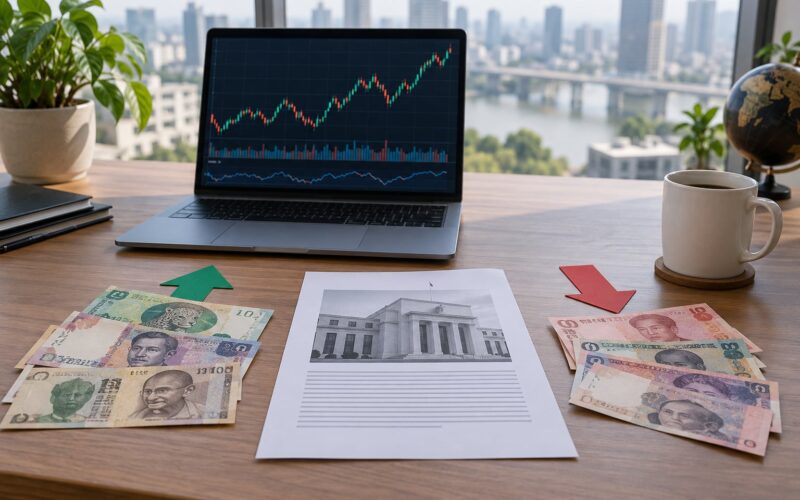
Purchasing power parity (PPP) is an economic tool that compares the real buying power of different currencies by looking at how much the same basket of goods and services costs in each country. In plain terms, it asks a simple question: how far does a standard basket of everyday purchases go in one country compared with another?
Investors care about it because GDP converted at market exchange rates routinely understates how much a country’s own production actually buys on its home soil. A worker in a low-price economy can be paid a small number of dollars and still live comfortably, which is exactly why headline league tables and lived experience so often disagree.
Before the detail, the short version:
- PPP is a comparison method, not a currency you can hold or trade.
- Absolute PPP compares price levels between two places. Relative PPP compares how prices have moved over time.
- The implied PPP exchange rate is simply the price of one country’s basket divided by the price of the same basket elsewhere.
- GDP at PPP and nominal GDP answer different questions, and picking the wrong one is the most common mistake in the topic.
- PPP is a long-run context check, not a signal you can time an entry with.
Here is how the mechanism works, how to calculate it yourself, and where it stops being useful.
Table of Contents
- What Is Purchasing Power Parity?
- Why market exchange rates and purchasing power parity disagree
- How Does Purchasing Power Parity Work?
- Absolute purchasing power parity
- Relative purchasing power parity
- Do not confuse purchasing power parity with real interest parity
- How Is Purchasing Power Parity Calculated?
- What Is the Difference Between Purchasing Power Parity and Market Exchange Rates?
- What Does Purchasing Power Parity Mean for Investors?
- What Are the Limitations of Purchasing Power Parity?
- Frequently Asked Questions
- Is purchasing power parity the same as the market exchange rate?
- How accurate is purchasing power parity?
- What does a high purchasing power parity country mean?
- How is purchasing power parity used in investment analysis?
- Why can market exchange rates differ from PPP exchange rates?
- Does purchasing power parity work for currencies such as the US dollar?
- Conclusion
What Is Purchasing Power Parity?
Purchasing power parity is a theory and a measurement method. The theory says that, in the absence of transport costs, tariffs and other barriers, an identical tradable good should cost the same in every country once you convert the price at the market exchange rate. Economists call that the law of one price, and it is the engine behind everything else in this article.
The method part is simpler. Statisticians build a standard basket of goods and services, price every item in each country, and divide. If the same basket costs proportionally more in one country, its currency is described as overvalued on a PPP basis. If it costs less, the currency is undervalued.
Why market exchange rates and purchasing power parity disagree
Because the law of one price only bites on things that can move. A shipment of coffee beans can be arbitraged across a border until the prices converge. A haircut cannot. Rent, childcare, a hospital visit, a plumbing repair and a university place have to be produced by someone standing in that country, at that country’s wages, in that country’s property market.
That is the engine behind most PPP gaps between rich and poor economies, and economists have a name for the pattern: the Balassa-Samuelson effect. Productivity gains in traded sectors push wages up, and those wages then price everything local, including services. The richer the country, the more its non-traded services cost.
This is also the answer to the puzzle that trips people up most: why a country can show a larger economy on a PPP basis while its citizens are not, on the whole, richer. The PPP number is saying that the same domestic output buys a lot more at home. It is not saying anyone gets paid more.
How Does Purchasing Power Parity Work?
Two price levels, one for each country, and a division between them. That ratio is the PPP conversion factor. Apply it to a country’s GDP and you get GDP at PPP, sometimes called PPP-adjusted GDP, which is the figure used in most cross-country comparisons of output and living standards.
Apply the same idea to a currency rather than an economy and you get the implied PPP exchange rate: the rate at which the two currencies would be trading if the law of one price held perfectly for the whole basket. Compare that implied rate with the rate actually quoted in the market and the gap tells you whether a currency looks expensive or cheap against its price level.
Absolute purchasing power parity
Absolute PPP is a snapshot. It answers: at this moment, how much does a standard basket cost in country A compared with country B? It holds nothing constant, it uses current price levels, and the level it produces is an equilibrium rate that theory says exchange rates should eventually drift toward. It is the version behind PPP-adjusted GDP and behind most “is this currency overvalued” commentary.
Relative purchasing power parity
Relative PPP is a movie rather than a snapshot. It assumes the exchange rate between two currencies will move at roughly the difference between their inflation rates, holding the absolute level of prices unconstrained. If country A runs 4% inflation and country B runs 2%, relative PPP expects A’s currency to lose about 2% of its value against B’s each year.
Here are the two side by side.
| Feature | Absolute PPP | Relative PPP |
|---|---|---|
| What it compares | The level of prices in two countries | The rate of change of prices in two countries |
| Time horizon | A point in time, with an implied long-run anchor | A period, usually years |
| What it holds fixed | Nothing; it takes the current level at face value | The absolute price level, which is allowed to drift |
| Main output | A PPP conversion factor and GDP at PPP | A predicted rate of change in the exchange rate |
| Typical use | Ranking economies, comparing living standards, global poverty lines | Long-run currency forecasts, inflation differentials over time |
| Main weakness | Sensitive to basket design and quality assumptions | Very loose in the short run, and it ignores rates and capital flows |
Do not confuse purchasing power parity with real interest parity
Real interest parity is a different idea that shares the letters PPP. It holds that the real interest rate in one country should roughly equal the real interest rate in another, once you adjust for expected inflation, and that the difference is made up by expected currency depreciation. It is about capital flows and yields. Purchasing power parity is about goods and services. Neither one reliably predicts the other over short periods, and conflating them is a common source of confusion in macro commentary.
How Is Purchasing Power Parity Calculated?
You can do the whole thing with a phone calculator. The steps below use an illustrative basket rather than live data, so you can see the arithmetic without hunting for price feeds.
- Build a basket. Pick a handful of items that people actually buy. A useful test basket mixes traded goods, which can cross a border, with local services, which cannot.
- Price it in both countries. Record the cost of the identical basket in each country’s own currency.
- Convert one price at the market rate. Divide the foreign basket price by the market exchange rate to express it in your home currency.
- Compute the implied PPP rate. Home basket price divided by foreign basket price, expressed in units of the foreign currency per unit of the home currency. That is the rate at which the two price levels would be equal.
- Compare it with the market. The bigger the gap, the more the market rate diverges from the price levels.
Worked example. Country A prices the tradables part of the basket at 40 dollars. Country B prices the same tradables at 3,000 units of its own currency, and the market rate is 100 units for one dollar. Converted at the market rate, B’s tradables basket costs 30 dollars, not 40.
The implied PPP rate is therefore 3,000 divided by 40, which is 75 units per dollar. The market says 100. That means the market rate is about 33% above the rate implied by tradable prices alone: country A’s currency is expensive against country B’s on this measure, or equivalently, B’s currency is undervalued.
Now add a local service, say a haircut. It costs 30 dollars in A and 800 units in B, which is 8 dollars at the market rate. The full basket is 70 dollars in A and 3,800 units, or 38 dollars, in B. The implied rate on the full basket is 3,800 divided by 70, about 54 units per dollar, and the apparent overvaluation jumps from roughly a third to roughly 84%.
That jump is the whole point of the non-tradable services problem, and it is why raw headline PPP indices are routinely trimmed into a tradables-only or “pure” PPP rate when economists want a cleaner read on currency misalignment.
One more piece of housekeeping, because you will meet two different formulas across these search results. Written as S equals P1 over P2, the result is an exchange rate. Written as the price ratio multiplied by the exchange rate, the result is a price level index, usually expressed as a percentage of the base country’s level, such as 62. They are the same division used for two different jobs. To get the over or undervaluation percentage, divide the market rate by the implied PPP rate and subtract one.
What Is the Difference Between Purchasing Power Parity and Market Exchange Rates?
The market exchange rate is what your bank, your broker and the screens on trading desks show you. PPP is what a standard basket implies the rate ought to be. They measure different things from different evidence, and only one of them is a price you can actually transact at today.
| Feature | Market exchange rate | PPP exchange rate |
|---|---|---|
| What it is | The traded price of one currency in another | The rate implied by the relative price levels of a standard basket |
| Who sets it | Currency markets, through supply, demand and central bank policy | Statisticians, from survey price data |
| Main inputs | Capital flows, trade flows, interest rate differentials, risk appetite, speculation | Surveyed prices for a defined basket of goods and services |
| How often it moves | Continuously, sometimes violently | Slowly, and only when a new survey round is published |
| Best used for | Valuing a portfolio today, remittances, trade settlement | Comparing real output and living standards across countries |
| Common mistake | Treating it as a measure of local buying power | Treating it as a forecast or a trading level |
Because the market rate is set by capital moving around the world and PPP is set by goods being consumed locally, the two can sit far apart for a very long time. The market rate absorbs whatever it needs to absorb: risk, liquidity, policy credibility, an export boom, a terms-of-trade shock.
What Does Purchasing Power Parity Mean for Investors?
Used carefully, PPP is a sanity check on a currency story rather than a price target. The usual reading runs like this. If a currency’s market rate sits well above its PPP-implied rate, the currency is described as overvalued on a PPP basis, and the argument is that domestic prices are too high relative to trading partners, so real spending power is weaker than the headline suggests. If the market rate sits below the implied rate, the currency is described as undervalued, and the argument is the reverse.
It also changes how you read growth data. Nominal GDP converted at market rates is the right number when you care about the dollars or euros an economy generates, because that is what settles foreign debt and what international investors can actually repatriate. GDP at PPP is the right number when you care about how much production the domestic economy can buy, or how large the economy is in real terms, or how a country’s output compares with a peer of similar size. Neither is wrong; they are answers to different questions.
One thing PPP does not do, despite how often it is implied, is mean that people earn PPP wages. A PPP-adjusted GDP figure tells you about the purchasing power of the average unit of output. It says nothing about any individual’s salary, and converting your own income with a PPP factor will usually produce a number that feels wrong, because PPP is built from a national consumption basket rather than from your spending.
The gap between market and PPP rates shows up as a trend in the real exchange rate, and that trend is the piece investors watch. A sustained, wide gap paired with a widening current-account deficit is one thing. The same gap paired with strong productivity growth and foreign investment is a different story entirely.
For anyone following dollar-denominated commodities, there is a useful angle here. Gold, oil and base metals are priced in dollars, and producers sell into that price while their costs are overwhelmingly local. When a producer’s currency is far from its PPP-implied rate, the gap changes how much of that dollar price actually reaches the domestic economy, which is one reason real prices in producer countries often look nothing like the headline dollar figure. It is a reminder that a commodity price is a dollar price, and a dollar price is not a local price.
None of this is a signal on its own. Think of PPP as the slow background rate against which faster-moving fundamentals, such as growth, inflation, policy rates, trade balances and what an asset is actually being priced at, are measured.
What Are the Limitations of Purchasing Power Parity?
Every one of these is a reason the method is described as an estimate rather than a measurement. None of them makes PPP useless, but they should temper how precisely you read any single number.
- People buy different things in different places. Consumption baskets are weighted by local spending patterns, so a basket that suits a household in one country may weight items the other country barely consumes. Reweighting the basket changes the answer.
- Non-tradable goods and services dominate the gap. Haircuts, housing, healthcare and education cannot be arbitraged, and they are precisely the items that make a low-income country’s domestic output cheap in PPP terms.
- Quality is hard to compare. A cheaper item may be less good, not just less expensive. Statisticians apply quality adjustments, but a fast-improving phone or a better-regulated clinic is not straightforwardly comparable across a survey round.
- Collection is expensive and infrequent. The World Bank’s International Comparisons Program surveys roughly a thousand products across well over a hundred countries, which is why benchmark PPP figures are benchmarked to a base year and then extrapolated rather than measured continuously.
- Capital flows and interest rates are invisible to it. PPP watches goods. Currencies are moved every day by portfolio flows, rate differentials and risk appetite, and none of that shows up in a price survey.
- It is a long-run tendency, not a forecast. Tariffs, capital controls, subsidies, taxes, transport costs and market structure all break the arbitrage that the law of one price depends on, sometimes for decades.
So keep it in proportion. PPP tells you about relative price levels and relative real size. It does not tell you when a currency will move, whether an asset is cheap, or what any individual earns.
Frequently Asked Questions
Is purchasing power parity the same as the market exchange rate?
No. The market exchange rate is the traded price of one currency in another, set continuously by capital flows, interest rate differentials and policy. The PPP exchange rate is what a standard basket of goods and services implies the rate should be, based on surveyed prices. Use the market rate to value a portfolio today, and PPP to compare buying power and real economic size across countries.
How accurate is purchasing power parity?
It is a well-established statistical estimate, not a precise measurement. Results depend on how the comparison basket is designed, how quality differences are adjusted for, and how far the survey round is from today. The World Bank benchmarks figures to a base year and extrapolates afterwards, so treat any single PPP number as a useful order of magnitude rather than an exact figure.
What does a high purchasing power parity country mean?
It means a standard basket of goods and services costs a lot there relative to a base country, so converting that country’s output at PPP produces a larger GDP figure than market exchange rates would. It says nothing about individual salaries. Wages are set by labour markets and productivity in that country, not by the PPP conversion factor, which is a national average of prices.
How is purchasing power parity used in investment analysis?
Investors use PPP as a long-run context check on a currency view. If the market exchange rate sits far above the PPP-implied rate, the currency is described as overvalued on a PPP basis and domestic prices are judged high relative to trading partners. PPP is combined with growth, inflation, rate differentials and current-account data rather than acted on alone, because market rates can sit away from it for years.
Why can market exchange rates differ from PPP exchange rates?
Because the two are driven by different things. Goods arbitrage towards price equality, but the market rate is set by money moving in and out of a country, by interest rate differences and by risk appetite, none of which a price survey can see. Tariffs, taxes, capital controls, transport costs and market structure also block arbitrage, so the gap can persist for long periods.
Does purchasing power parity work for currencies such as the US dollar?
It can be used, with care. The US has a very high domestic price level, so PPP-adjusted GDP for the US is close to its nominal GDP in dollar terms, while PPP figures for lower-price economies come out higher than their market-rate GDP. Because the dollar is the base currency for much global pricing, PPP rarely offers a trading signal against it, but it remains useful for comparing real output and living standards.
Conclusion
Purchasing power parity is a way of asking what money actually buys in a given country, and it is worth understanding because headline GDP converted at market rates and GDP at PPP can tell you two very different stories about the same economy.
Use it the way a careful investor would. Take the PPP number first as a long-run context check on a currency or an economy, then layer growth, inflation, interest rates, trade balances and what the asset itself is priced at on top before you do anything. And if someone tells you a country’s GDP is large “in PPP terms”, read it as a statement about domestic purchasing power, not about what anyone earns there. This is general educational information rather than individual investment advice, and figures and conventions change, so check the current releases from the IMF and the World Bank for anything you plan to act on.