Updated: October 2026
De-dollarization is the process by which countries, central banks and corporations reduce their reliance on the US dollar in global trade and invoicing, cross-border financial transactions, and central bank reserve holdings, shifting toward alternatives such as gold, the euro or the Chinese yuan. It is a gradual, partial rebalancing, not the sudden collapse of the dollar.
That distinction matters more than anything else in this topic. The word gets used as a scare headline far more often than it gets used precisely, and the gap between the alarmist version and the real one is where most bad investment decisions come from.
So let us get concrete about what has actually happened, what has not, and what an individual investor should reasonably watch. I’ve kept the data section in the open because the honest answer currently runs in both directions at once.
Table of Contents
- What Is De-Dollarization?
- What is de-dollarization versus dollarization and reserve diversification?
- Why Are Countries Considering De-Dollarization?
- Why the conversation picked up recently
- How Does De-Dollarization Work in Practice?
- The three forms of de-dollarization, side by side
- What Does De-Dollarization Mean for the US Dollar?
- Which Assets Are Likely to Benefit?
- What Are the Main Risks and Limitations?
- How Can Investors Monitor De-Dollarization?
- Frequently Asked Questions
- What does de-dollarization mean for the US?
- Is de-dollarization good or bad?
- Which countries have de-dollarized?
- What are the effects of de-dollarization?
- Why does the Trump administration want a weaker dollar?
- Who benefits from a weaker US dollar?
- Conclusion: Start With the Distinction Between Shift and Collapse
What Is De-Dollarization?
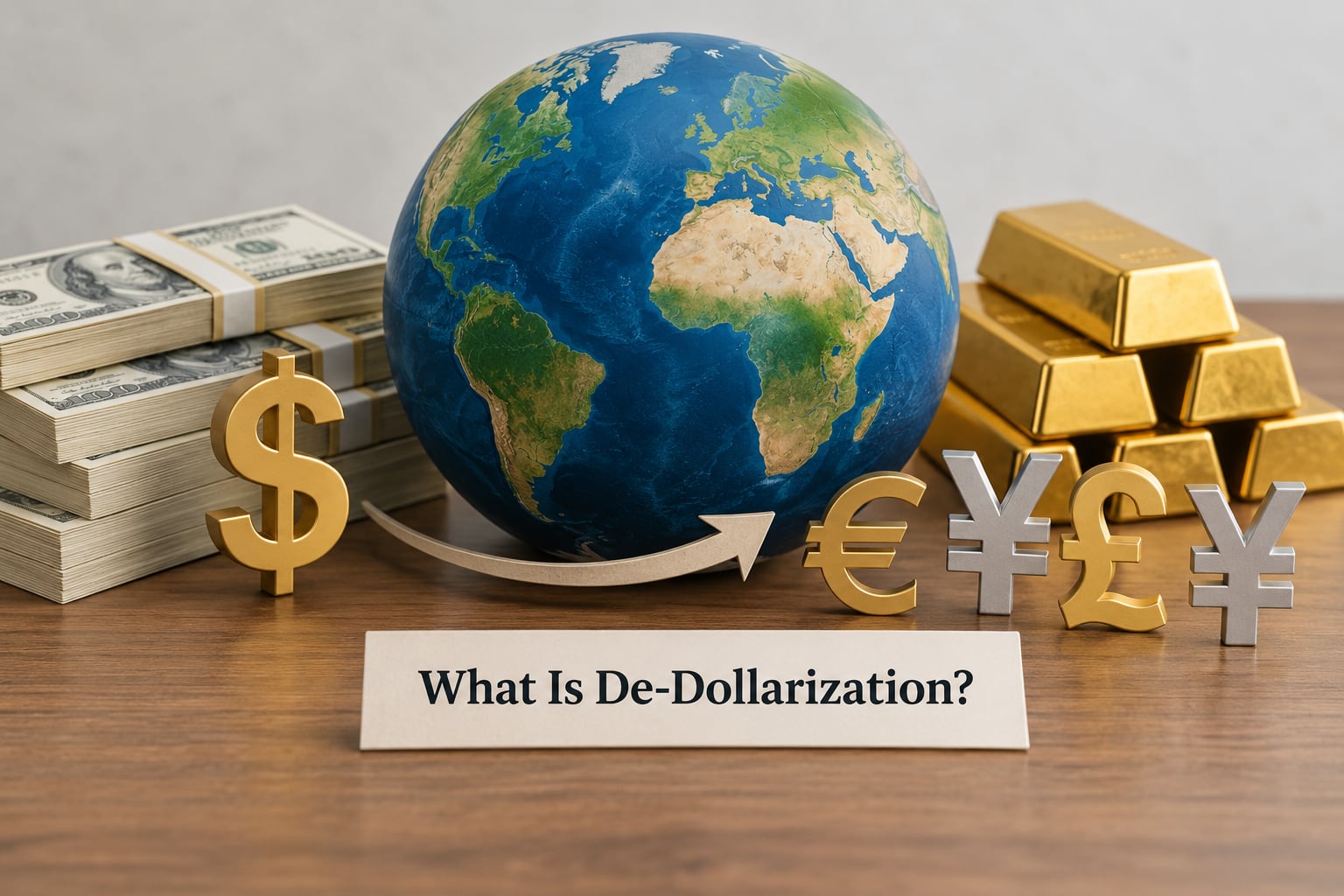
Strip away the noise and de-dollarization comes down to three separate things, and most arguments about it go wrong because they mix the three together.
- Reserve de-dollarization — central banks selling or maturing holdings of US Treasuries and dollar deposits, and buying gold or a wider mix of currencies instead.
- Invoicing de-dollarization — companies pricing goods and services in a currency other than the dollar, most often the yuan or the euro, especially for commodities.
- Settlement de-dollarization — payments moving across borders on rails that do not route through dollar-denominated infrastructure, such as regional central bank digital currency platforms.
These advance independently. A country can settle most of its trade in yuan while holding a reserve book that is still mostly dollars and Treasuries, and it can quietly add gold to reserves without changing a single invoice. Any article that reports progress without naming which of the three it means is not telling you much.
What is de-dollarization versus dollarization and reserve diversification?
It does not mean a country has stopped using the dollar. It does not mean dollars are disappearing from circulation. And it is not the same as dollarization, which is the reverse process where a country adopts someone else’s currency, most often the dollar, to tame inflation or borrow cheaply.
It is also worth separating de-dollarization from reserve diversification, which is the most common mix-up in forum debates. Diversification means spreading holdings more evenly across several currencies. De-dollarization means actively reducing the dollar weight. A central bank that holds 55 percent dollars and 45 percent a mix of euro, yen, sterling and gold has diversified without de-dollarizing much.
One more term you will meet: financial weaponization, meaning the use of dollar-based payment infrastructure and the US Treasury market to enforce sanctions. That is a driver of de-dollarization rather than a form of it, and it is the one that actually moved policy in 2026-era negotiations.
Why Are Countries Considering De-Dollarization?
Motives fall into two groups: real economic incentives and strategic ones. Most countries mix both, which is why the trend looks uneven rather than coordinated.
Insurance against sanctions. This is the driver with actual evidence behind it. When a government’s central bank reserves are frozen in a matter of days, the lesson is not abstract for anyone watching. Russia discovered what it means to have dollar and euro assets impounded; Iran has lived with it for years. A country weighing that risk is buying insurance, and insurance is not irrational.
Trade friction and tariffs. When the largest trading partner starts using tariffs as leverage, settling trade in that partner’s currency hands them a piece of the pricing power. Local-currency settlement arrangements, where a Chinese buyer pays in yuan and the seller receives their own currency through a clearing mechanism, cut both the policy exposure and the conversion cost.
Monetary autonomy. Dollar-denominated debt lets foreign buyers influence domestic conditions through US interest rates. Countries with floating exchange rates would rather not have their domestic cost of capital set in Washington, so holding fewer dollar assets means fewer channels through which Federal Reserve policy transmits upward.
Transaction costs. A dollar payment between two non-US banks often takes a hop through New York and pays a correspondent-banking fee. Direct or near-direct rails are cheaper. This is a boring reason, and it is often the one that decides whether a settlement shift actually happens.
Negotiating position. Simply holding optionality gives a government something to say. Having reserves it can spend without asking Washington for permission is a bargaining chip even when nothing is spent.
None of these motives requires hatred of the dollar. They require a preference for not being entirely dependent on it, which is a much more common position among allies than headlines suggest.
Why the conversation picked up recently
Debate about dollar dependence jumped in popularity through 2026 and the year before it. Tariff disputes put trade policy directly in conflict with the currency that settles most trade, fiscal projections raised questions about who absorbs American borrowing, and policy rhetoric encouraged foreign buyers to ask loud questions. Add central bank gold buying that has run at historically high tonnages in recent years per World Gold Council data, and you get a story that travels well. Speculation about a common BRICS currency has amplified it further, even though no such currency exists.
How Does De-Dollarization Work in Practice?
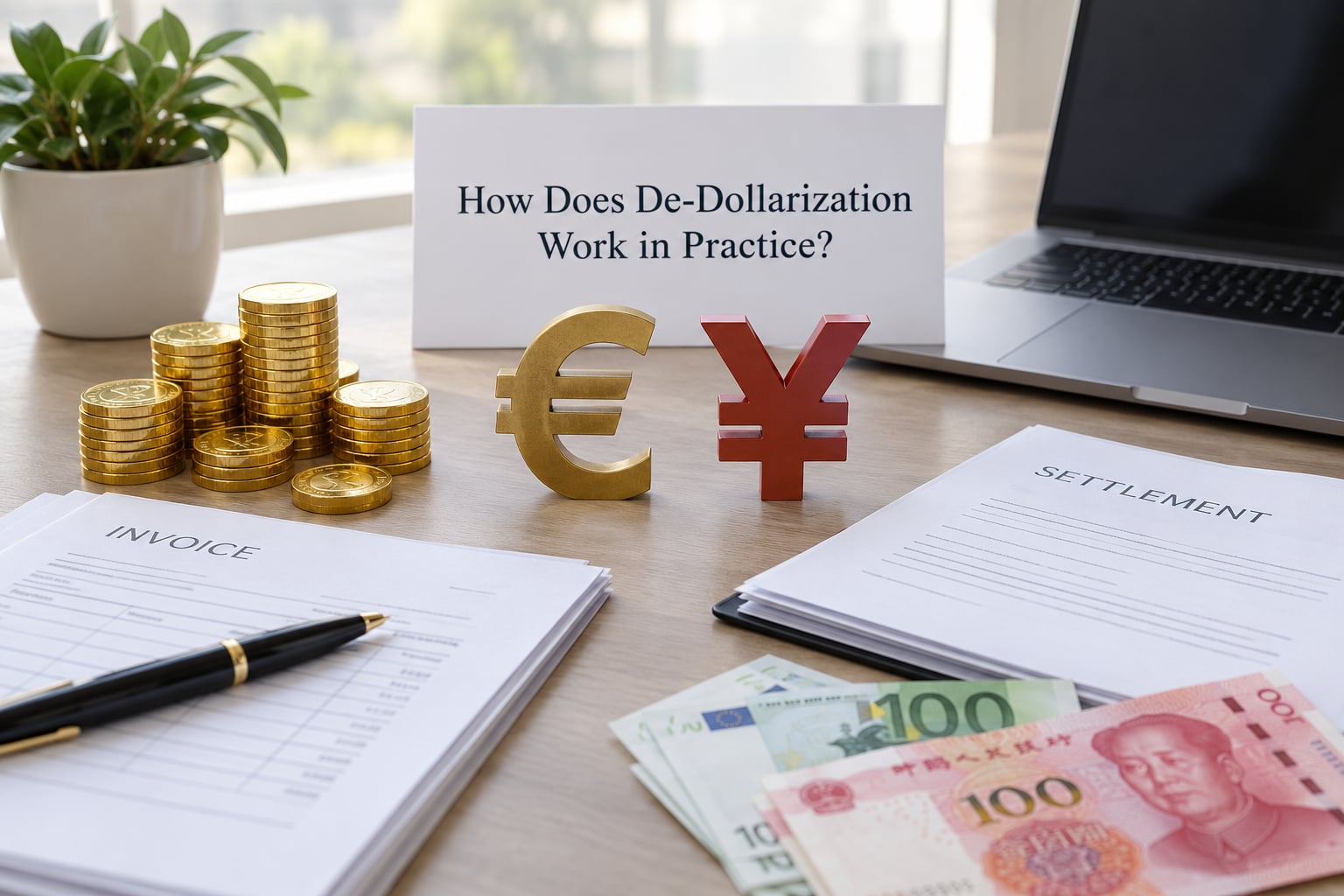
Mechanically, it happens through a handful of concrete channels rather than any grand replacement.
Reserve rotation. A central bank lets a Treasury position run off rather than rolling it, buys physical gold, or holds a larger share of euro, yen or sterling. The mechanics are dull because the amounts are large and the transactions are quiet.
Local-currency trade settlement. Bilateral agreements allow trade to be invoiced and settled in the two parties’ own currencies, removing the dollar from the middle. India and Russia have worked through the practical problems of oil and defence trade on this basis. Russia has pushed settlement with China almost entirely into yuan.
Alternative payment rails. Projects like mBridge, involving several Asian central banks, and the UAE and Saudi-backed Aber initiative aim to move cross-border payments and FX conversion without dollar clearing. Academic work on wholesale CBDCs points to a hub-and-spoke structure with a conversion layer, which is the same problem SWIFT solved for the dollar decades ago with US dollar policy built into it.
Commodity repricing. Selling oil, gas or metals in yuan or euros changes who carries the currency risk, even when the buyer eventually converts.
Corporate treasury shifts. A large exporter may hold working capital in yuan or euros and settle supplier invoices in the same currency. This is the least visible channel and probably the most common one at company level.
The three forms of de-dollarization, side by side
| Form | Mechanism | What it looks like | Where it stands |
|---|---|---|---|
| Reserves | Central banks rotate holdings between Treasuries, deposits, gold and other currencies | Rising gold purchases, slower growth in foreign Treasury holdings | Real and measurable, but slow |
| Invoicing | Goods priced and paid in a currency other than the dollar | Oil and commodities contracted in yuan or euros | Growing in specific corridors, not globally |
| Settlement | Payments routed on non-dollar infrastructure | CBDC platforms, direct clearing arrangements | Mostly pilot stage |
One point deserves emphasis because almost nobody makes it: stablecoins work against de-dollarization. Dollar-denominated stablecoins are a private, always-open extension of dollar settlement into places where banks and capital controls used to be the gate. For a business in a currency-short economy, holding a tokenized dollar balance is easier than holding dollars onshore, and the peg means the user never actually leaves the currency system.
So the fastest-growing new dollar infrastructure is, functionally, a way to use more dollars, not fewer.
What Does De-Dollarization Mean for the US Dollar?
If foreign reserve holders slowly trim dollar assets and shift trade invoicing away, the dollar loses some of the pricing power that comes with being the default settlement unit. Slower foreign demand for Treasuries would argue for higher yields on new issuance, all else equal.
The uncomfortable data point is that the trend is currently running the other way in the payment data. SWIFT tracking has shown the dollar’s share of international payments rising over the past several years, with the euro’s share falling noticeably. Read that alongside the headline about reserve diversification and the picture looks contradictory, so here is the reconciliation: de-dollarization is a margin story, not a turnover story. The dollar’s share of reserves and invoicing is a large but slowly shrinking slice of a very large pie, while payment volumes concentrate in whichever channels are cheapest and most liquid right now.
| Metric | What it measures | Direction of travel | Source |
|---|---|---|---|
| Dollar share of international payments | Volume moved over the main payment network | Higher over recent years | SWIFT RMB Tracker and monthly payment reports |
| Euro share of international payments | Same, for the main alternative | Falling | SWIFT payment reports |
| Share of allocated global reserves | Official holdings of currency and bonds | Gradual drift down for the dollar, from a high base | IMF COFER database |
| Central bank gold purchases | Tonnes bought by official sector | Sustained at historically high levels | World Gold Council |
| Foreign holdings of Treasuries | Treasuries held by non-US official accounts | Drifting down from peaks reached earlier in the decade | US Treasury TIC data |
| DXY dollar index | Trade-weighted value of the dollar | Cycle-dependent; no clean de-dollarization trend | ICE |
Figures move and the reporting lags, so treat the arrows as direction rather than as precise levels.
The scale question resolves the debate more usefully than the headlines do. There is no realistic pool of assets that can replace Treasuries as a reserve asset for most of the world. China is the only country with both a large enough economy and a deep enough capital market to run a competing system, and its capital account remains managed rather than open. Anyone forecasting dollar replacement has to explain that gap.
Which Assets Are Likely to Benefit?
Gold is the clearest candidate, and the mechanism is worth stating plainly rather than skipping to a price forecast. Gold has no issuer, no counterparty and no dependence on any government’s policy, which makes it the natural destination when the reason for moving is distrust of a specific issuer. Central bank buying is price-insensitive in a way that investor buying is not: a reserve manager buying to change the composition of a portfolio does not care what bullion did last month.
That is the mechanism. It is a slow, policy-driven bid rather than an emotional one, which is why it can persist through long periods of flat or falling prices.
Silver and other precious metals follow gold’s direction with more volatility, driven by industrial demand as much as reserve demand, so they are a leveraged expression rather than a cleaner one. Commodities broadly can benefit if invoicing shifts away from the dollar, because sellers gain pricing flexibility. Regional currencies gain where settlement shifts genuinely occur, though in most cases the exposure an ordinary investor can buy is thin and often hedged away by the local institution.
For US Treasuries, the effect is a slow reduction in one source of marginal demand. That is a real headwind worth watching, and it is not the same thing as a funding crisis.
What I would not do is treat any of this as a reason to expect a specific price level. Reserve demand is real and it is explainable; the numerical targets attached to it in commentary are guesswork dressed up as analysis.
What Are the Main Risks and Limitations?
Network effects. The dollar is used because others use it. Every invoice priced in dollars makes the next one cheaper to price in dollars, and that loop is the single most durable advantage in the whole system.
There is no substitute for Treasuries. A country needs a reserve asset it can hold in size, that is liquid, that it can sell quickly in a stress, and that carries no meaningful counterparty risk. Very few things pass that test at the required scale.
Convertibility. Reserves are useful only if they can be deployed anywhere. A currency with capital controls or a closed capital account is not a substitute for the dollar in a crisis, which is precisely why China’s reserve accumulation has not translated into a challenge to dollar dominance.
Contract inertia. Bonds, loans and commodity contracts are written in dollars for decades at a time. Changing the settlement currency of a position that runs twenty years means neither side gets a clean break.
The domestic constraint. The US runs deficits that need foreign buyers, so it has an interest in keeping the dollar attractive. That cuts both ways in a slower-burn way than headline writers imply.
And the biggest practical risk is interpretive. Treating policy language as completed action, or a single data release as a trend, has been the source of more bad outcomes in this topic than the macroeconomics has.
How Can Investors Monitor De-Dollarization?
You can follow this with a short list of checkable indicators rather than opinion pieces.
- IMF COFER reserve data, published quarterly, for the currency composition of allocated reserves. Trend lines matter more than single releases.
- SWIFT payment share reports, monthly, for how payments actually route. This one often contradicts the reserve story, which is exactly why it is useful.
- US Treasury TIC data, monthly, for foreign holdings of Treasuries.
- World Gold Council central bank statistics, for official-sector bullion demand and its direction.
- Settlement agreement announcements — the actual text tells you whether a currency swap line involves real conversion or is largely a gesture.
- New sanctions and asset freezes, since the freeze is the event that reliably moves policy in a direction it did not hold before.
- Currency composition in trade data, particularly whether commodity contracts continue to price in dollars.
- DXY and offshore dollar funding rates, which show pressure in the money markets rather than in rhetoric.
The one rule I would set: read all of them together. Any single metric on its own can be made to tell a dramatic story.
Frequently Asked Questions
What does de-dollarization mean for the US?
It means foreign governments slowly reduce dollar exposure, which would trim one source of demand for US Treasuries and weaken the dollar’s pricing power over time. It also removes an American lever: dollar-based clearing infrastructure makes sanctions possible. Neither effect happens quickly, since reserves turn over slowly and Treasury contracts run for decades.
Is de-dollarization good or bad?
It depends on your position. For a heavily indebted country with thin reserves, less dollar dependence is insurance against a hostile policy shift. For the US, a slower foreign bid for Treasuries is a modest headwind. Neither side is harmed in any sudden way, because the trend is incremental rather than disruptive. The honest answer is that the effect is small, real, and slow.
Which countries have de-dollarized?
No major country has fully de-dollarized. Sanctioned economies have shifted hardest, with Russia settling most trade with China in yuan. India has used local-currency arrangements with Russia for oil and defence. Gulf states have built alternative payment projects and are diversifying reserves. Central banks across many emerging economies are buying gold. Everywhere else, the shift is partial and concentrated in specific trade corridors.
What are the effects of de-dollarization?
Slower foreign demand for Treasuries, potentially higher yields on new US borrowing, and weaker exchange-rate pricing power for the dollar. Reserve buyers lose some liquidity if they hold less convertible currency. Gold tends to benefit because it carries no issuer risk. Payment and FX costs fall for banks that gain direct settlement rails. The effects are gradual, and most of them are visible over years rather than quarters.
Why does the Trump administration want a weaker dollar?
A weaker dollar makes American exports cheaper for foreign buyers, which fits an administration focused on tariffs and trade deficits. It can also offset some tariff effects by making imports more expensive. The policy goal and the effect differ from de-dollarization itself: this concerns the value of the dollar, not how much of it others hold in reserve.
Who benefits from a weaker US dollar?
Exporters whose goods are priced in dollars, especially manufacturers and commodity sellers, see demand rise as their products become cheaper abroad. Foreign holders of dollar assets lose purchasing power. Borrowers with dollar debt benefit because servicing is cheaper in local terms. Domestic US consumers generally pay more for imports. The effect on inflation depends on how much of the weakness import prices pick up.
Conclusion: Start With the Distinction Between Shift and Collapse
De-dollarization is real but modest: central banks are adding gold, a few trade corridors are invoicing outside the dollar, and payment alternatives are in pilot stages. None of that amounts to replacement, and the payment data currently points the other way. If you take one thing from this, watch reserve composition, payment share and Treasury holdings together rather than reacting to the next headline. General information only, not financial advice, and rules and data change over time.