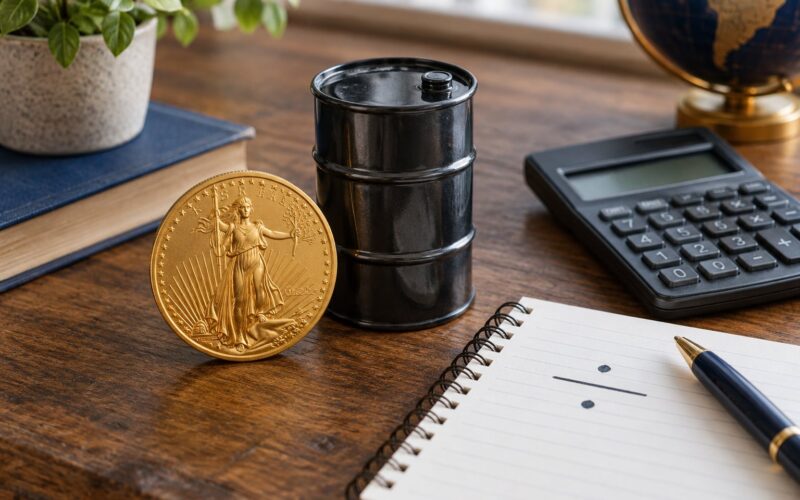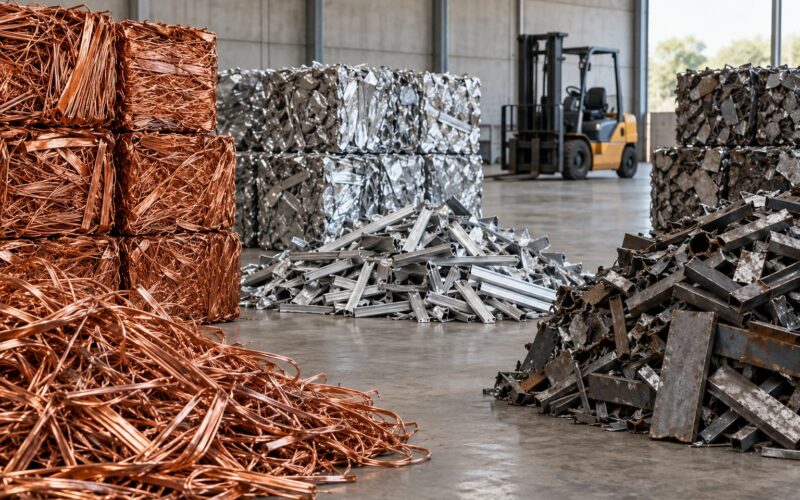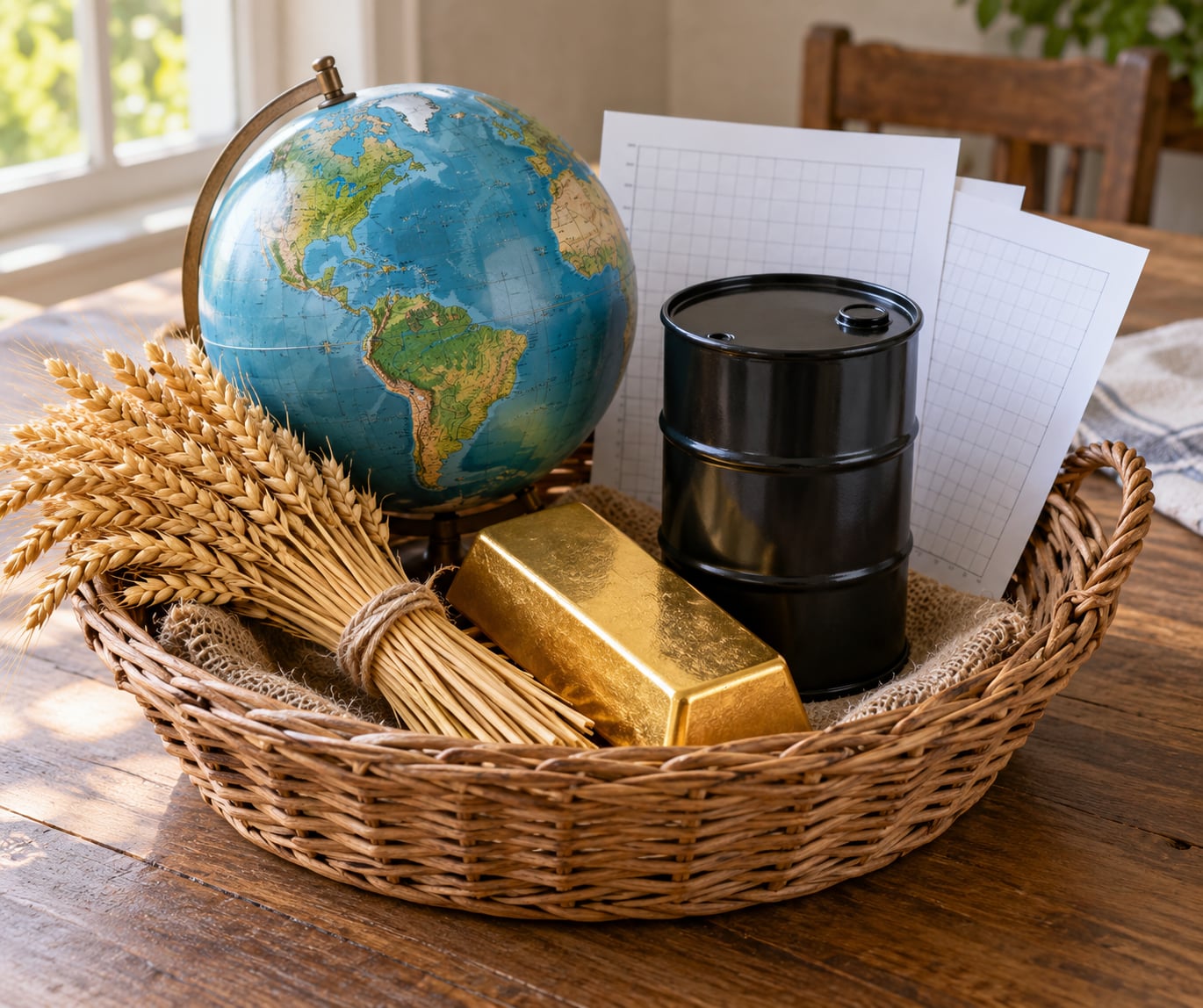
A commodity index is a rule-based number that tracks the price of a basket of raw materials, from crude oil and natural gas to gold, copper and wheat. It rises when most of the goods in the basket get more expensive and falls when most get cheaper, which gives investors one clean way to follow an entire sector.
So what is a commodity index and how does it work in practice? Almost every mainstream commodity index is built on futures contracts rather than physical goods, so the number you see quoted is a futures price, not a retail price at the pump or on the shelf. That distinction explains most of the odd behaviour people notice in commodity funds.
Table of Contents
- What Is a Commodity Index?
- How Does a Commodity Index Work?
- Why contracts expire and have to be replaced
- What Is a Commodity Index and How Does It Work in a Simple Example?
- What Are the Main Types of Commodity Indexes?
- How Are Commodity Indexes Weighted?
- How Do Investors Use Commodity Indices?
- What Costs and Risks Should Investors Know?
- Frequently Asked Questions
- What is roll yield in commodity futures markets?
- What are the four types of commodities?
- What are the top 5 traded commodities?
- Is a commodity index a good investment?
- What is the difference between a commodity index and the CPI?
- How do investors actually get exposure to a commodity index?
- Key Takeaways for Investors
What Is a Commodity Index?
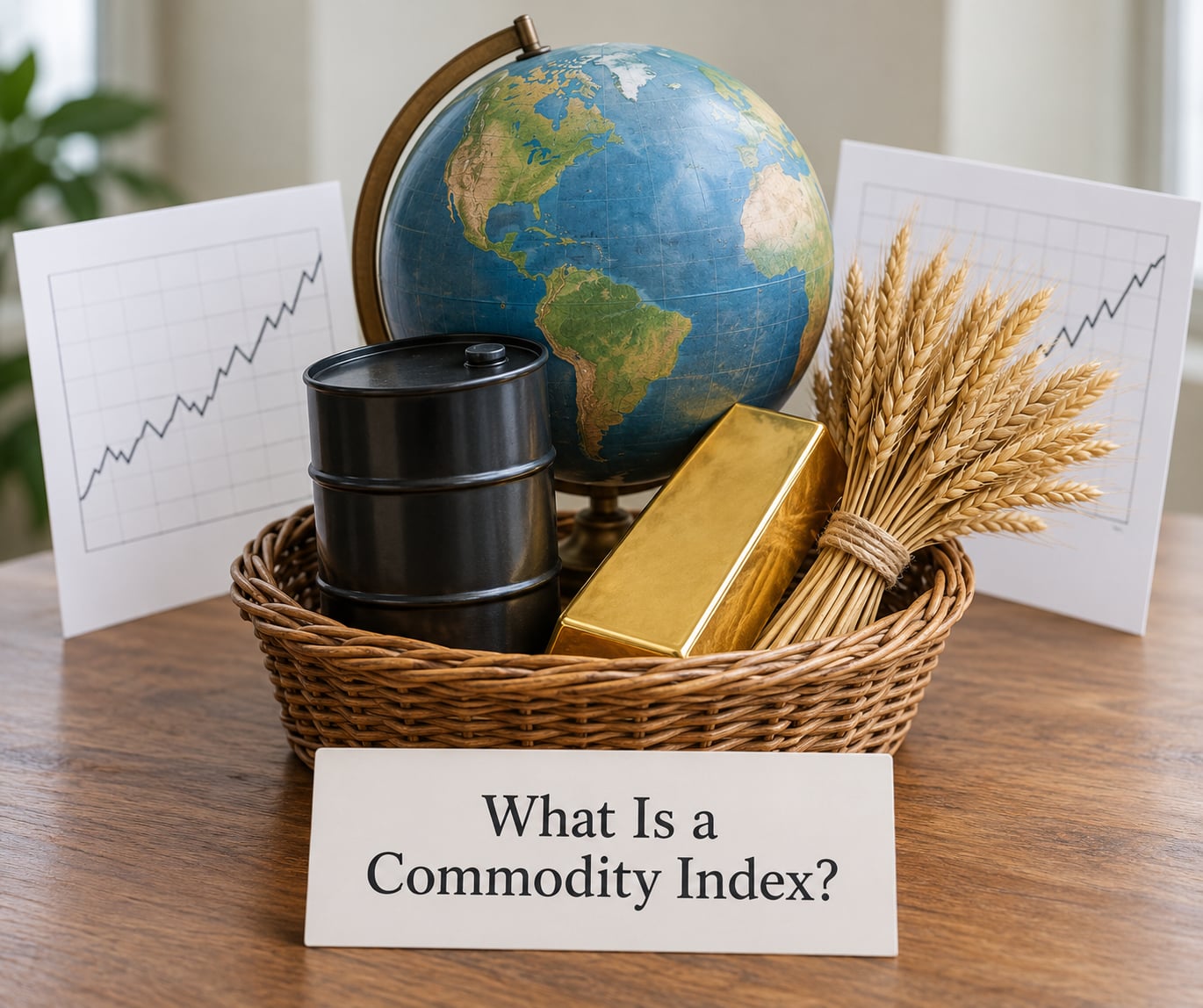
A commodity index measures the average price movement of a defined group of commodities. The provider publishes a methodology, a list of eligible contracts, and a weighting rule, then applies them mechanically every day so the index value can be reproduced by anyone.
Investors use the index for three reasons. It is a benchmark for judging whether a fund or a managed account added value. It is a measurement tool for tracking the direction of raw material prices over months or decades. And it is the underlying design that a futures-based exchange-traded fund copies when it holds contracts in the same proportions.
The reason to use an index rather than buying things directly comes down to practicality. Physical commodities are awkward to own: a barrel of crude sits in a tank, a hog is alive, and a bushel of soybeans needs storage. Storage, insurance, quality differences and transport costs all eat into what you actually get back. A single futures contract sidesteps storage but forces you to manage expiry dates and margin calls.
That leaves the index, which pools the exposure. One line item gives you positions across energy, metals and agriculture at once, sized by a published rule instead of by your judgement on any given Tuesday.
How Does a Commodity Index Work?
Four steps build and maintain a commodity index, and every provider does them in the same order with different ingredients.
- Select the constituents. The provider chooses individual commodities and specifies which futures contract month represents each one, usually the most liquid nearby month. Some indexes cover around twenty commodities; narrower ones cover four or five.
- Assign the weights. Each component gets a share of the index. The share comes from a published rule, most often the commodity’s share of world production value, though some indexes use equal weights or trade-volume weights instead.
- Calculate the index value. The provider multiplies each contract price by its quantity and sums them, then divides by a fixed number called the divisor so the index stays comparable over time. Broker and exchange-traded indices often launch at a base level of 1,000.
- Rebalance and roll on a schedule. Weights refresh annually or monthly, and the expiry rules change which contract month counts next. That rollover is where most of the hidden behaviour lives.
Why contracts expire and have to be replaced
A crude oil futures contract for delivery in a specific month has a finite life. Holding it to expiry means taking delivery or closing out the position. Index providers avoid that by rolling into the next contract before the old one expires, and the timing is fixed by published rules so the roll is not a discretionary trade.
The roll creates a cost or a gain depending on the shape of the futures curve. When later-dated contracts trade above nearby ones, the curve is in contango, and every roll sells a cheaper expiring contract to buy a dearer one. That difference is a headwind. When later-dated contracts trade below nearby ones, the curve is in backwardation, and the roll buys lower, which is a tailwind.
Because the curve usually leans toward contango when inventories are comfortable, the roll has subtracted from returns more often than it has added over long stretches. It is also the reason a broad commodity fund can trail the headline spot prices it appears to track.
What Is a Commodity Index and How Does It Work in a Simple Example?
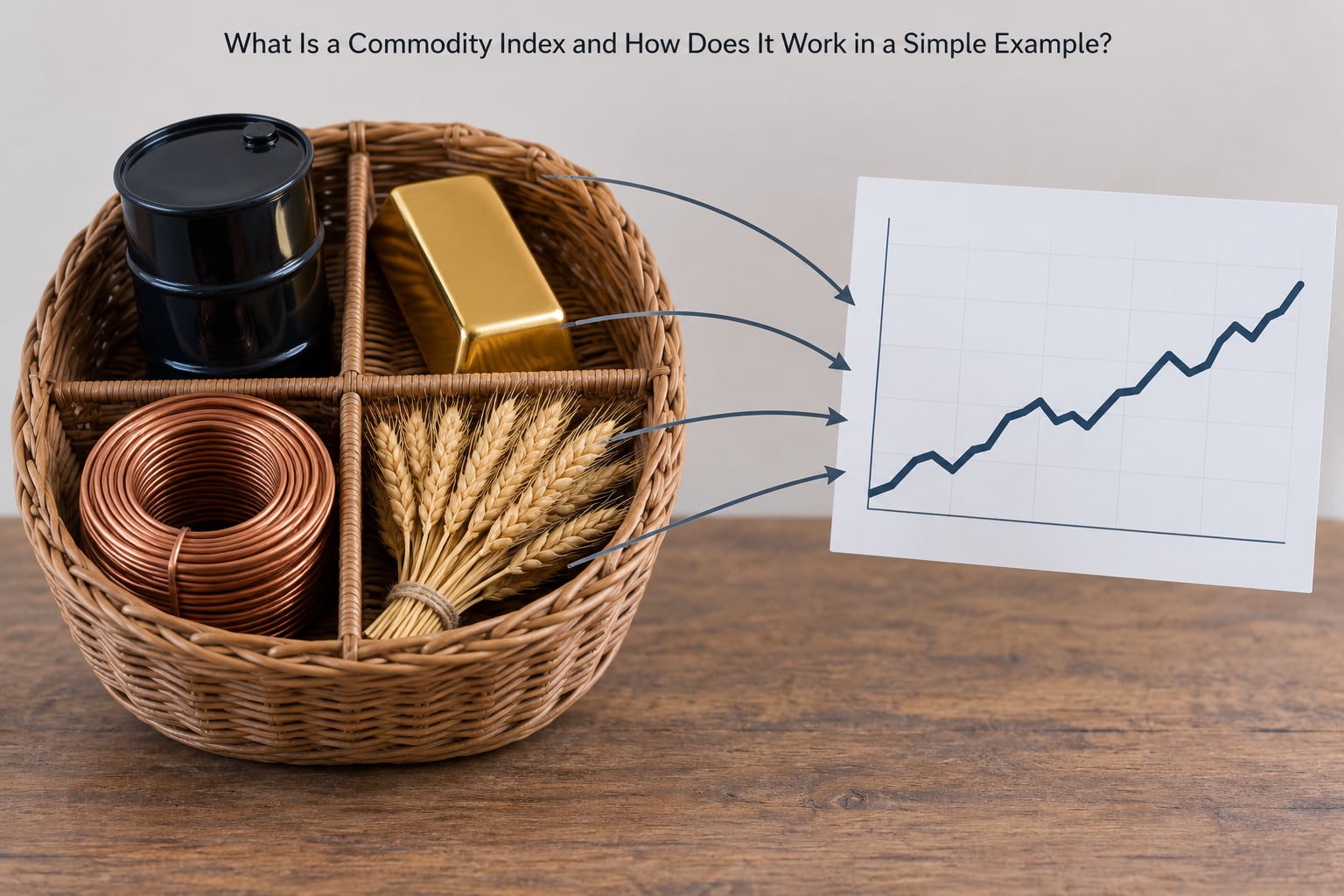
Here is a four-commodity basket with fixed weights, the kind used by many exchange-traded indices: crude oil at 40 percent, gold at 30 percent, copper at 20 percent and wheat at 10 percent. Assume the index starts at 1,000.
- Oil’s share of the basket is 400 points, gold 300, copper 200 and wheat 100.
- In a month when oil rises 10 percent, gold falls 2 percent, copper rises 4 percent and wheat rises 1 percent, the crude calculation is 400 × 1.10 = 440, gold 300 × 0.98 = 294, copper 200 × 1.04 = 208 and wheat 100 × 1.01 = 101.
- Adding those gives 1,043 points, so the index moves from 1,000 to 1,043, a gain of 4.3 percent.
Notice that the index gained 4.3 percent while oil alone gained 10 percent. That gap is the whole point of weighting. Because oil carries 40 percent of the basket, it dominates the outcome, and the other three contracts mainly serve to soften it.
Swap the weights for equal 25 percent allocations and the same four monthly moves produce 1,000 × (1.10 + 0.98 + 1.04 + 1.01) ÷ 4 = 1,032.5, or 3.25 percent. Same commodity moves, different index value, and the only thing that changed was the weighting rule.
What Are the Main Types of Commodity Indexes?
Commodity indexes split along two lines: how much of the market they cover, and whether they are backed by physical goods or built from futures.
- Broad-based indexes cover energy, metals and agriculture together. The S&P GSCI, launched in 1991 and formerly the Goldman Sachs Commodity Index, is the most widely quoted, weighted by world production value. The Bloomberg Commodity Index, or BCOM, was formerly the Dow Jones-UBS Commodity Index and is weighted more evenly across sectors.
- Energy indexes concentrate on crude oil, natural gas, refined products and heating oil. They behave more like an equity sector than like a diversifier, because energy prices swing on supply and demand shocks.
- Metals indexes split into precious metals, mainly gold, silver and platinum, and industrial metals such as copper, aluminium and zinc. The precious side tracks investor demand and the industrial side tracks manufacturing and construction.
- Agricultural indexes cover grains, oilseeds, softs such as sugar and coffee, and livestock. Weather, harvests and inventories drive these, and many contracts trade in thin markets.
- Single-commodity indexes track one contract. Useful as a clean benchmark for a specific market, less useful for diversification.
| Index | Provider | Weighting scheme | Coverage | Typical role |
|---|---|---|---|---|
| S&P GSCI | S&P Dow Jones Indices | World production value | Broad, energy-heavy | Most common performance benchmark |
| Bloomberg Commodity (BCOM) | Bloomberg Index Services | Modified equal weight across sectors | Broad, more balanced | Second reference benchmark |
| CRB | Commodity Research Bureau, now CME Group | Production-based with historical weighting | Roughly 21 commodities | Long-run price history |
| Rogers Commodity Index | Rogers Communications | Equal weight across a diversified list | Broad, many constituents | Return comparisons against equities |
| Deutsche Bank Commodity Index (DBIQ) | Deutsche Bank | Production value, liquid futures only | Broad | European and structured-product reference |
Some indexes are physically backed, meaning they hold metal or store grain against the shares. Most are futures-based, which is cheaper to run and rolls monthly. Physical backing removes roll costs but introduces storage and custody expenses that quietly eat the same money instead.
How Are Commodity Indexes Weighted?
Weighting decides how much each commodity moves the index, and no method is neutral.
Production weighting gives each commodity a share equal to its annual global production value. It is the most common scheme because it is objective and easy to reproduce. Its side effect is concentration: crude oil alone has carried a large minority of the S&P GSCI’s weight for years, so a broad index is not as diversified as the word “broad” suggests.
Equal weighting treats every component the same regardless of size. That reduces single-commodity dominance and tends to soften the energy-heavy lean of production-weighted indexes. The cost is that it puts meaningful money into markets that may be thinly traded and expensive to roll.
Square-root weighting and liquidity weighting sit between the two, damping the largest positions without ignoring their real economic size. Liquidity weighting uses open interest or trading volume, so contracts with active markets carry more of the index.
Whichever rule applies, weights reset on a published calendar, usually once a year. Prices then drift the weights away from those targets between resets, which is why a January factsheet tells you less about next December than it looks like it should.
How Do Investors Use Commodity Indices?
The honest framing is ballast, not engine. Commodity indexes have historically moved on a different rhythm from stocks and bonds, and that difference is what makes them useful.
- Diversification. Returns from raw materials respond to supply disruptions, weather and inventory news rather than to earnings or interest-rate policy. Low correlation over long periods can soften an equity-heavy portfolio.
- Inflation exposure. Commodity prices feed into consumer and producer prices, so a broad index is sometimes treated as an inflation hedge. It is a partial one: the link weakens when inflation comes from services, wages or shelter rather than from raw materials.
- Tactical allocation. Some investors raise commodity exposure during periods of falling growth, weak currencies or tight inventories. That is a market-timing decision, and it is a losing one more often than not.
- Hedging input costs. Airlines, chemical producers, utilities and food manufacturers buy index-linked contracts or futures to lock in fuel and feedstock prices.
- Benchmarking. Fund managers, consultants and index providers compare performance against the published index level rather than against raw commodity prices.
None of this guarantees anything. An index can fall for years, and it pays no income while it does it. If you read threads on r/ETFs, the most common description of a commodity allocation is closer to crash ballast than to a return driver, which is a fair way to think about the position.
What Costs and Risks Should Investors Know?
Roll yield. Contango means repeated buying of dearer contracts. That cost compounds quietly and is the single biggest reason a fund tracking a futures index can lag the spot prices it appears to track. It can reverse in backwardation, which is why it is not a permanent subtraction in every decade.
Where the return actually comes from. A futures-based index return has three parts: the spot price change of the commodities, the roll return, and the interest earned on the cash backing the positions. Research by Erb and Harvey found that roughly half of long-run GSCI index returns came from that last piece, the collateral yield, rather than from commodity prices rising.
Fees and tracking error. The expense ratio, trading costs and cash management all shave the return. Retail investors compare expense ratios directly before anything else, which tells you how thin the expected margin over the index is. The currency of the fund matters too: a dollar-based fund carries an exchange-rate component on top of commodity risk.
Volatility and no income. Commodity indices move in steps driven by headlines. They pay no dividend, so an investor who needs cash from the position has to sell into whatever the market is doing that month.
Tax friction. Futures-based funds in the United States typically generate a K-1 rather than a straightforward 1099, which turns a simple holding into a quarterly reporting chore and can create a tax bill on unrealised gains. Rules vary by country and change, so check the current treatment before buying.
The name confusion. A commodity index has nothing to do with the Consumer Price Index or the Producer Price Index. Those are government statistics built from surveys of retail and industrial prices. A commodity index is a market benchmark built from tradable futures. Similar names, different purpose.
Frequently Asked Questions
What is roll yield in commodity futures markets?
Roll yield is the gain or loss created when an index or fund replaces an expiring futures contract with a later-dated one. When the futures curve is in contango, meaning later-dated contracts cost more, the roll buys dearer contracts and subtracts from returns. In backwardation the roll buys cheaper contracts and adds to returns. Over long periods contango has been more common, so roll has often been a headwind for broad commodity funds.
What are the four types of commodities?
Commodities are usually grouped into energy, precious metals, industrial metals and agricultural products. Some breakdowns add a fifth group for livestock or softs such as sugar and coffee, which sit inside agriculture. The split that matters for index construction is hard versus soft: hard commodities are extracted or mined and include oil, metals and grain, while soft commodities are grown or raised and include coffee, sugar, cocoa and cattle.
What are the top 5 traded commodities?
By futures trading volume the largest contracts are typically crude oil, natural gas, gold, corn and soybeans. Which of those dominates a given index depends entirely on the weighting rule. In a production-weighted index such as the Su0026amp;P GSCI, crude oil and natural gas together carry a far larger share than equal weighting would give them, so the same five commodities produce very different index behaviour under different rules.
Is a commodity index a good investment?
It depends on the job. A commodity index is useful as a diversifier because its returns have often moved differently from stocks and bonds, and it is a reasonable inflation watch. It pays no income, it is volatile, and it can underperform for long stretches. It suits an investor who wants modest long-run exposure for diversification. It does not suit someone chasing income, unable to absorb equity-like volatility, or hoping for dependable short-term gains.
What is the difference between a commodity index and the CPI?
The Consumer Price Index is an official government statistic compiled from surveys of prices consumers actually pay, covering food, housing, transport and services. A commodity index is a market benchmark built from the futures prices of traded raw materials such as crude oil, metals and grain. The CPI is a policy input used to adjust benefits and wages. A commodity index is an investable benchmark used for performance measurement and portfolio construction.
How do investors actually get exposure to a commodity index?
Most retail exposure comes through futures-based exchange-traded funds and exchange-traded products that hold the same contracts in the same weights as the index they track, minus a fee. Other routes include commodity-linked notes, physical holdings in metal, managed futures accounts run by trend-following managers, and buying the producers themselves. Commodity-related shares are not index exposure: their returns come from company margins, capital spending and debt, not from commodity prices.
Key Takeaways for Investors
So what is a commodity index and how does it work? It is a rule-based benchmark that tracks the price of a basket of tradable raw materials, built on futures contracts and weighted by a published method. Its behaviour comes from three things: which commodities are included, how heavily each one is weighted, and what the futures curve does when contracts roll.
The roll is the part most glossed over. Contango usually subtracts, backwardation usually adds, and the collateral yield on the backing cash has historically supplied a surprising share of the total return. Fees and tracking error then take their cut, and tax treatment can turn a simple purchase into paperwork.
Start by reading one factsheet from an index provider end to end. Check the constituents, the weighting rule, the rebalancing date and whether the fund you are considering tracks that same index or a different one. Everything else in the decision follows from those four facts.
This is general education about index construction, not investment advice. Market rules, fund structures and tax treatment differ by country and change over time, so confirm the current details before committing money.