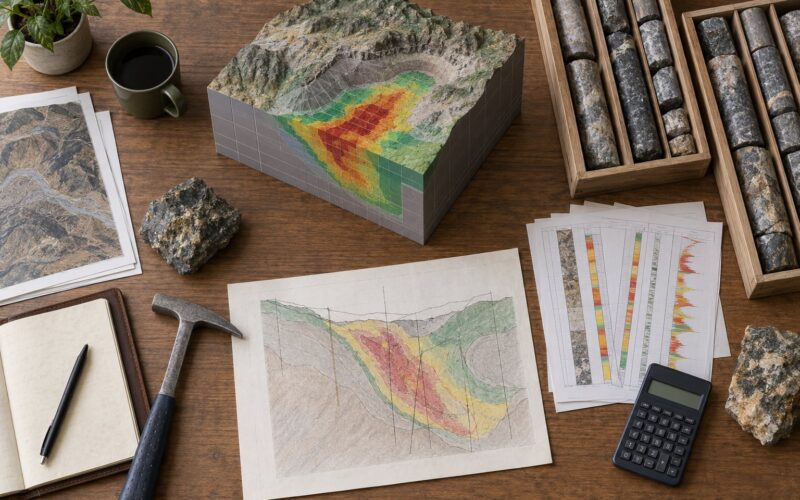
Mining stock red flags to watch for are the objective warning signs that a company is burning cash, issuing shares faster than it builds value, or selling a geological story that nobody independent has verified. Mining is pre-revenue, capital-hungry and mostly self-reported, so cheap shares usually price a real problem. This guide walks through ten of them and shows exactly where to check.
I have read a lot of junior mining disclosure over the years, and the pattern repeats. The bad names are rarely obvious on the day of the press release. They show up in the fourth quarter of a financing history, in a share count that doubled while the news flow sounded better than ever.
This is educational material, not investment advice. Rules, reporting standards and listing requirements vary by country and change over time, and total loss of capital is possible in any mining equity.
Table of Contents
- 10 Mining Stock Red Flags to Watch For at a Glance
- 1. Persistent Negative Free Cash Flow
- Why these mining stock red flags show up before anything else
- 2. Rapidly Rising Debt or Repeated Financing Needs
- 3. Share Dilution and Per-Share Growth That Disappoints
- 4. Reserves or Resources That Keep Changing
- 5. Permitting, Environmental, and Legal Problems
- 6. Production Results That Miss Promised Timelines
- 7. Unsustainable or Mistyped Operating Costs
- 8. Excessive Related-Party Transactions or Poor Governance
- 9. Geology and Engineering Claims Without Independent Support
- 10. Valuation Based on Speculation Rather Than Cash Flows
- Frequently Asked Questions
- What is the most important mining stock red flag?
- How can I tell whether a mining company is overleveraged?
- Are changing mineral reserve estimates always a warning sign?
- Why do mining companies issue so many shares?
- Should investors avoid projects with permitting delays?
- How can I assess a mining stock’s commodity-price assumptions?
- Conclusion: Start With the Financial Statements and Mine Plan
10 Mining Stock Red Flags to Watch For at a Glance
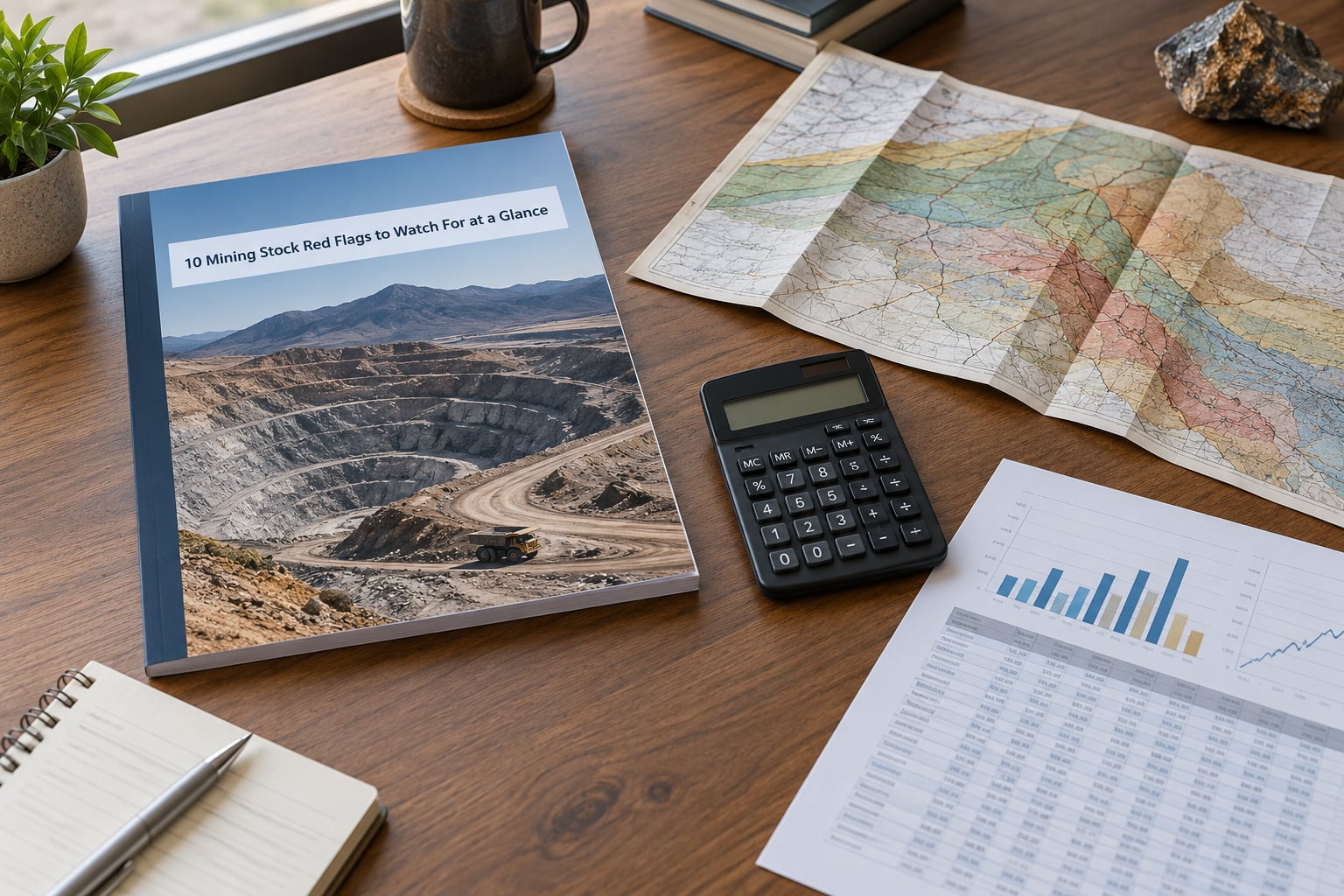
Each warning sign below has a home in a public document. That matters, because most mining stock red flags are invisible in press releases and obvious in filings. The table gives you the short version before the detail.
| Warning sign | Where to verify it | Severity |
|---|---|---|
| Persistent negative free cash flow | Annual cash flow statement, SEDAR+ or EDGAR | High |
| Rising debt and repeated raises | Balance sheet, MD&A liquidity section, financing news releases | High |
| Serial share issuance | Share count history, monthly returns, warrant and convert tables | High |
| Reserves that keep changing | Technical report sections 11 to 14, NI 43-101 or S-K 1300 | High |
| Permitting and legal problems | Permit register, environmental assessment filings, litigation notes | Medium to high |
| Missed production timelines | Quarterly production reports against guidance | Medium |
| Unsustainable operating costs | AISC reconciliation, cost guidance versus actuals | Medium |
| Related-party dealing and weak governance | Management information circular, related-party note | High |
| Unsupported geology claims | Qualified person sign-off, assay tables, core photographs | High |
| Speculative valuation | Valuation model assumptions against spot and consensus prices | Medium |
1. Persistent Negative Free Cash Flow
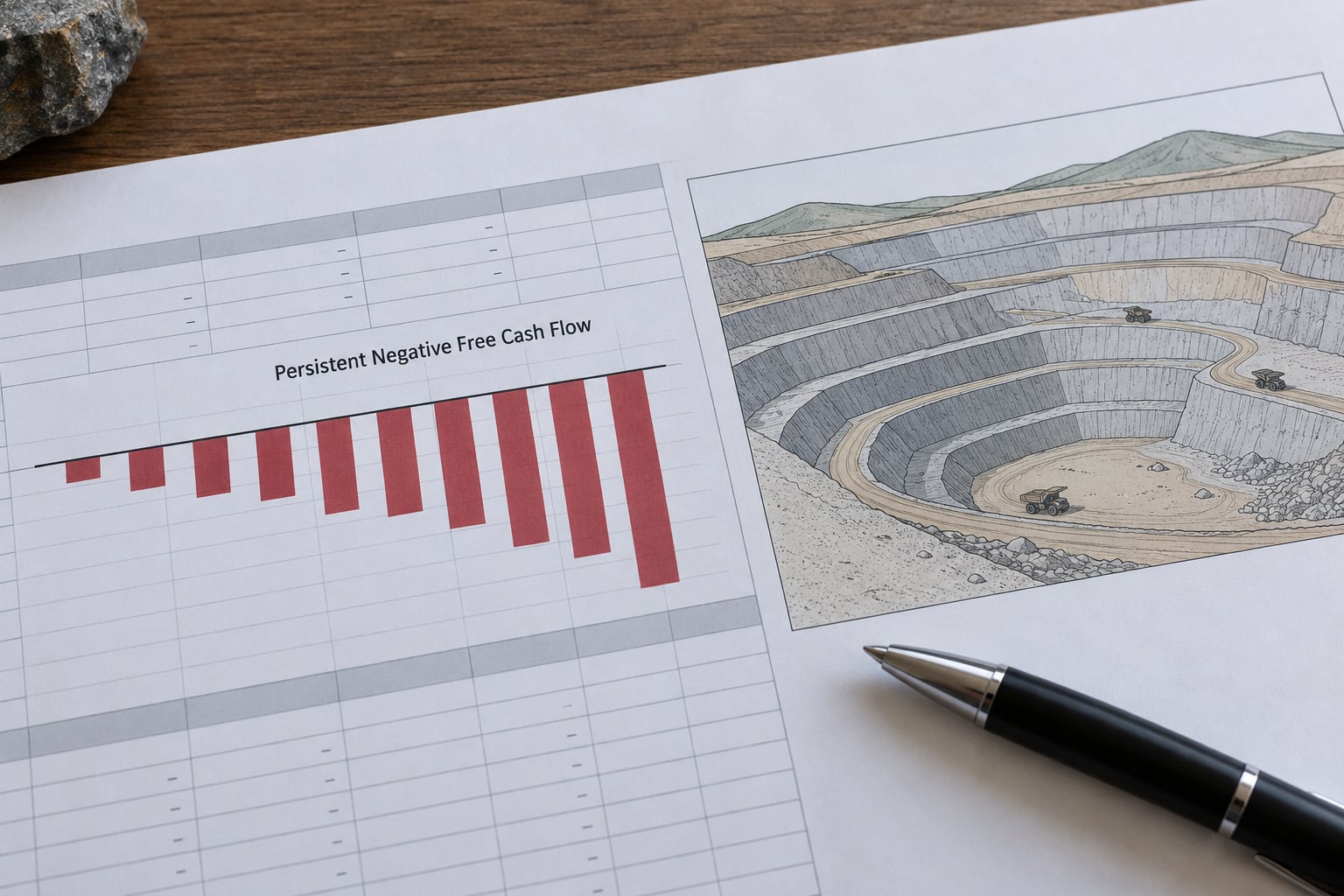
A mine that consumes more cash than it produces, year after year, is financing itself from other people. That is normal for a developer in construction, and it is a serious problem for a producer that has been operating for several quarters.
The test is arithmetic, not opinion. Take cash from operations and subtract capital expenditure for each of the last three to five reporting periods. A single negative year happens during a build phase. Three consecutive negative years at a producing asset means the operation cannot pay for itself, let alone return capital.
Look in the cash flow statement rather than the headline. Watch the gap between stated capital budgets and actual capital spend, because budgets are set before quotes are firm. Also check whether free cash flow weakness is being described as temporary in the management discussion and analysis while the number never improves.
Why these mining stock red flags show up before anything else
Cash is the first thing to run out and the hardest thing to replace quietly. A company with eighteen months of cash can absorb a bad drill result. A company with five months has to raise before it knows anything new, and raising after bad news is the worst possible price. That sequence, disappointing result followed by emergency financing, is the pattern most retail investors get caught by.
2. Rapidly Rising Debt or Repeated Financing Needs
Debt that grows faster than production is a warning that the mine plan costs more than the economics assumed. Read the total debt line across five years and compare it with tonnes milled and cash generated. Debt rising while output stays flat is not growth.
Covenant language deserves attention too. A facility with tight leverage or minimum production covenants can force a raise or an asset sale at the worst possible moment in the commodity cycle. Convertible debt is worse still: many mining converts carry reset and bonus conversion features that let the lender take shares at a discount when the stock falls, which turns a financing into forced dilution at the bottom.
Repeated small raises are the clearest version of this flag. A company that publishes a financing every few months, often just large enough to cover salaries, office costs and the next drilling program, has told you its projects do not pay for themselves. Check the news release archive and count how many financings landed in the last 18 months.
3. Share Dilution and Per-Share Growth That Disappoints
Share count is the number most retail investors ignore and the one that explains most junior mining disappointments. A company can report rising gold production, a bigger resource and a higher share price while every shareholder ends up with less of the company than they started with.
Pull the basic share count from each annual filing and line it up against the ounces or tonnes in the resource statement. If the share count grew 60 percent and the resource grew 10 percent, the per-share resource shrank by about a third, no matter what the headline says.
Structures that accelerate this are worth naming. Warrant overhang from repeated raises, stock option pools refreshed on every raise, and convertible debt all sit above the common shares and can turn into selling pressure. In many bullet financations the company also issues warrants to insiders and brokers at a discount, which concentrates selling in the hands of people whose incentive is the raise, not the mine.
Serial reverse splits belong here too. A reverse split does not create value. It is usually used to regain a minimum listing price or to reset a share count after a long decline, and the filings around one often carry other news worth reading.
4. Reserves or Resources That Keep Changing
A mineral reserve is an economic estimate, not a physical constant. It moves with price assumptions, recovery, costs, mine plans and metallurgy, so revisions happen legitimately. What should concern you is the direction and the timing of those revisions.
The red flag is a series of large downward restatements, especially ones that follow promotional announcements. If a headline result is followed a few months later by a quietly lower resource estimate, the headline was priced on a number that did not survive review. Upgrades that arrive only alongside a stock promotion deserve the same suspicion.
Check the technical report sections covering mineralogy, mining, processing and economic analysis, and compare the recovery and cost assumptions with what the operation has actually achieved. In the sections you will find the cutoff grade, the dilution assumption and the commodity price used. A reserve that only works at a long-run price well above consensus is a price bet wearing an engineering report as a disguise.
5. Permitting, Environmental, and Legal Problems
A permitted deposit is worth more than a spectacular unpermitted one. Permitting is where timelines slip quietly, because most permits are tied to conditions and to consultation rather than to a single date.
Look for unresolved environmental assessments, contested water allocations, tailings facility approvals, land access disputes and ongoing litigation. Each one adds months or years, and each one adds cost that rarely appears in the original project economics.
Community and Indigenous agreement processes deserve specific attention. Opposition from an affected community can stop a project outright, and companies under pressure to show progress sometimes announce an agreement before the consultation is complete. Read whether the agreement is final, conditional, or still framed as targeted.
Environmental liability is quieter than most investors expect. Legacy contamination, closure bonds and reclamation obligations from past owners can exceed the equity value in older districts. That obligation sits in the notes to the financial statements and in the technical report’s environmental section, not in the news feed.
6. Production Results That Miss Promised Timelines
Guidance is a forecast, and in mining it misses often. Missing once is weather. Missing repeatedly, or missing while the company raises money to fund the delay, is a planning problem worth pricing into your expectations.
Compare each quarter’s actual tonnes milled, grade and recovered ounces against the guidance given the quarter before. Track the trend line, not a single period. Ramp-up stories have a habit of resetting the target date rather than the plan, so a company can be “six months behind” for two years without ever admitting failure.
Cost overruns during construction follow the same shape. Compare the capital estimate in the feasibility study with the current estimate and the amount actually spent so far. A large gap on an approved project usually means either the estimate is stale or the scope changed, and both affect the return profile you are buying.
7. Unsustainable or Mistyped Operating Costs
Most mining projects look good at the assumed cost and bad at the actual cost. Operating cost assumptions are where optimistic models are most reliable, so this is a red flag with real money attached to it.
All-in sustaining cost bundles mining, milling, general administration, royalties and sustaining capital. Compare reported all-in sustaining cost with the figure the feasibility study promised, and with nearby peers in the same jurisdiction and the same orebody style. A company reporting comfortably below every peer in a high-cost jurisdiction is more likely to have a definition problem than a cost advantage.
Watch the inputs that move together. Stripping ratio drives open-pit mining cost and can rise steeply as the pit deepens. Energy costs hit both power bills and haulage. Royalties and transport charges can be contractual and permanent, which makes them a margin problem no amount of operational improvement fixes.
Pay attention to numbers that move between reports. A company that reclassifies sustaining capital as growth capital, or that changes how it treats royalties in its cost guidance, can report a lower cost without changing anything real. Consistency of definition matters as much as the level.
8. Excessive Related-Party Transactions or Poor Governance
Governance problems are the mining stock red flags that never show up in the news release. Start with the related-party transactions note. Management fees, office costs, consulting contracts and equipment rentals paid to entities owned by directors or officers are legal in many structures and still reduce the cash available to shareholders.
Next, look at insider holdings. Directors and officers who have bought meaningful amounts with their own money are taking real risk alongside you. Ownership that is almost entirely options, restricted units or a small holding acquired years ago at a much lower price is not the same signal.
Board composition matters too. A board with no one who has actually built or operated a mine, and no independent geological competence, will struggle to challenge management on the one question that matters. Watch also for concentration of roles: a chair who is also chief executive, or an oversized executive slate relative to a small company.
Cash sitting idle while management describes an aggressive programme deserves attention too. Explorers that consistently spend less than half of their budget on the ground are financing the next raise with the current cash balance rather than with progress.
9. Geology and Engineering Claims Without Independent Support
This is where fraud has historically entered the sector, and where a careful reader has the most advantage. Exploration results are largely self-reported, and the technical frameworks that govern them, including NI 43-101 in Canada, S-K 1300 in the United States and JORC in Australia, depend heavily on professional judgement rather than audit.
Start with the qualified person. Check who signed the technical report, what their relevant experience is, and whether they are independent of the company or connected to it through a long consulting relationship. A qualified person who signs a dozen reports a year for the same promoter deserves more scrutiny than one who is genuinely independent.
Then look at the assay practice. Legitimate drilling splits the core, sends intervals to a laboratory with an independent umpire program, and publishes the certified assay results along with the sampling protocol. Companies that report only composite or “mineralized zone” results without the individual intercepts, or that never publish core photographs or chain-of-custody detail, are hiding something. The Bre-X scandal, which ended with a settlement after the company’s purported 20 million ounce discovery collapsed, was ultimately an assay integrity failure.
Width reporting is another screen. Composite widths across several holes or several metres can be reported as though they were true thickness, and the difference can be a factor of three or more. Practitioners interviewed about this sector make the same point about exploration targets: a geophysical anomaly is a place to drill, not ore in the ground.
Finally, treat headline metallurgical recovery with suspicion when it comes from a primary deposit with no operating analogue. Very high recovery figures announced before bulk testing often collapse once the mineralogy is fully understood, and this is exactly the kind of claim a promotional release loves to lead with.
10. Valuation Based on Speculation Rather Than Cash Flows
The last red flag is the one that puts a price on all the others. A valuation that rests on a commodity price well above spot and consensus, on unquantified exploration upside, or on a mine plan that has not been permitted, is not a valuation. It is a hope with a spreadsheet attached.
Test it by pulling the key price, recovery, cost and capital assumptions out of any resource or mine valuation and comparing them with current market data and with the company’s own operating record. If the model needs both a higher commodity price and a lower cost per tonne than anything achieved nearby, the margin of safety is negative.
Exploration upside deserves a real but modest number. Undrilled ground is worth something, but it is worth less per ounce than drilled, measured, indicated or inferred material, and the discount widens sharply when the company has not funded a drill program this year.
One useful discipline is to value the producing or advanced asset on conservative cash flows first, then add exploration value at a large discount, then ask what price is left over. Many promotional valuations reverse that order and let exploration swallow everything.
Frequently Asked Questions
What is the most important mining stock red flag?
For most investors the first flag to check is the cash position against the share count history. A company that repeatedly raises money to stay alive dilutes existing holders no matter how good the geology is. Check the last four to six quarters of cash, the financing dates, and how the share count moved at each one. If the answer is a raise every few months, the other flags matter less because the structure decides the outcome.
How can I tell whether a mining company is overleveraged?
Compare total debt with cash, with production, and with cash generated over several periods. Watch covenant language in the credit agreement for leverage and minimum production tests, because a breach can force a raise at a bad price. For developers, debt service against the projected first year of free cash flow is the more useful measure than the debt ratio alone.
Are changing mineral reserve estimates always a warning sign?
No. Reserves are economic estimates and they move with price assumptions, costs, metallurgy and mine plans, so a legitimate revision is normal work rather than deception. The signal worth acting on is direction and timing: repeated downward restatements, or a reduction that lands shortly after a promotional announcement, suggests the headline number did not survive independent review.
Why do mining companies issue so many shares?
Exploration drilling, land payments, construction and debt service all cost cash before any revenue arrives, so equity is the default currency. A company with weak orebody economics keeps issuing because its projects do not pay for themselves. The question is not that shares are issued but whether each raise bought enough asset value per new share, and whether insiders funded it alongside outsiders.
Should investors avoid projects with permitting delays?
Delays are common and not automatically fatal, so read the reason rather than the calendar. A delay caused by additional consultation or a study requirement is normal sequencing. A delay caused by an unresolved water allocation, an unfunded environmental obligation, an unresolved court challenge or opposition from an affected community can stop the project and should change your conclusion about it.
How can I assess a mining stock’s commodity-price assumptions?
Open the technical report economic analysis and read the metal price used, then compare it with spot and with published consensus. Then check the recovery and cost assumptions the same way, because projects are often built to look good on three optimistic inputs at once. If the valuation only works at a price above the historical range, treat it as a price bet and size it that way.
Conclusion: Start With the Financial Statements and Mine Plan
Work through these flags in order. Start with the cash flow statement and the share count history, because they are objective, dated and impossible to spin. Then read the debt and covenant terms, the reserve and resource sections of the latest technical report, the permit status, and the operating cost reconciliation against peers.
Compare across several reporting periods rather than a single announcement. Any one of these ten flags on its own is survivable. Several of them at once, appearing across different documents and different years, is a different company from the one in the promotional coverage.
None of this is investment advice, and you can lose your entire capital in any single mining equity. Do your own work in the primary documents, and treat any company presented to you through paid coverage with more suspicion rather than less, because that arrangement pays someone whether the stock works or not.