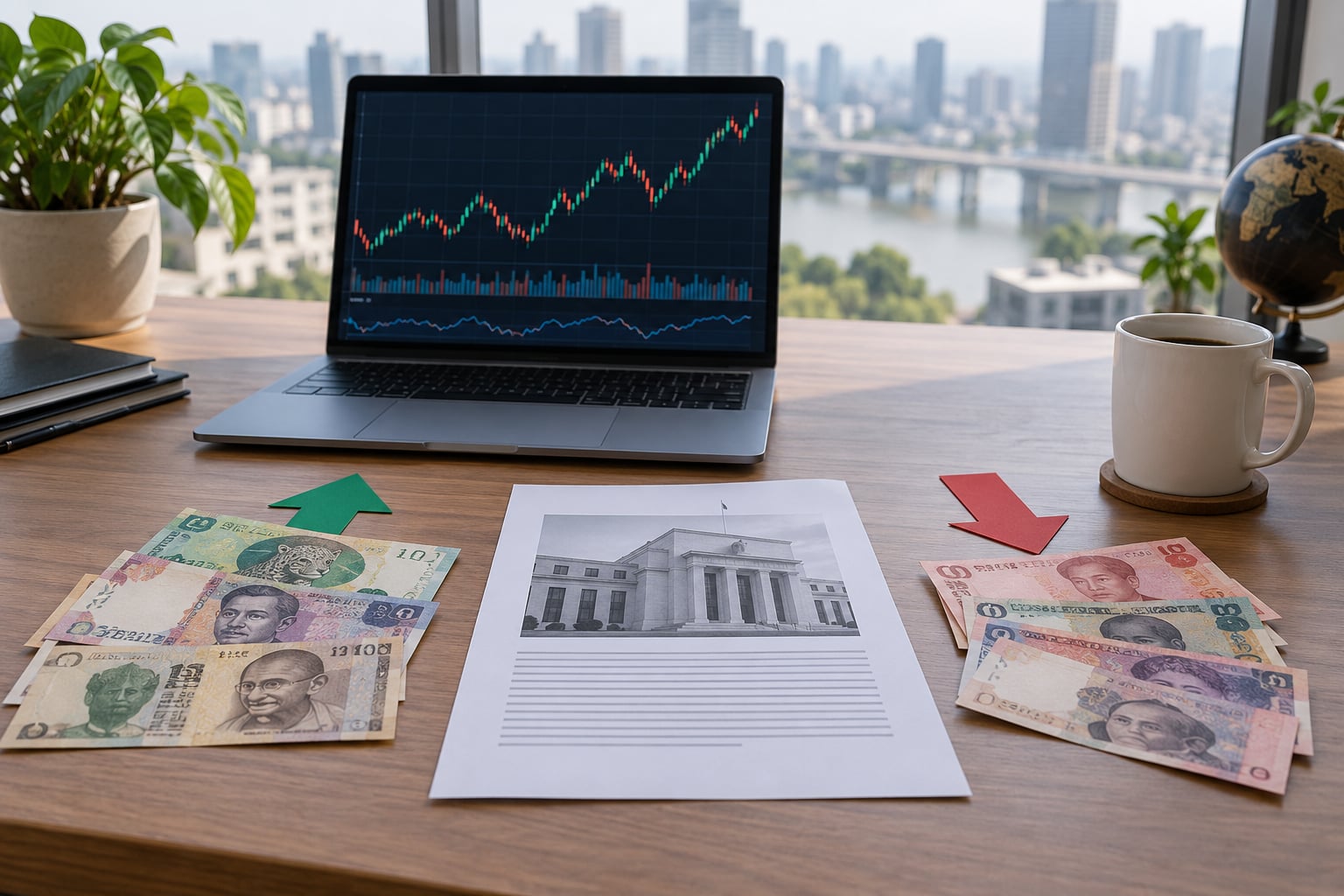
Hawkish Federal Reserve policy tends to strengthen the dollar and pressure emerging market currencies that depend on foreign capital and dollar borrowing, while dovish policy usually supports them. The reaction is never automatic, though. Domestic inflation, reserve levels and political risk decide how much of a Fed move a currency actually absorbs.
Understanding how emerging market currencies react to Fed policy has been the difference between a painful year and a tolerable one for a lot of self-directed investors. The mechanics are not secret, they are just rarely explained in plain words. Most page-one results on this topic are central bank papers and think-tank charts written for professionals.
Key takeaways:
- The Fed affects EM currencies through four channels: the interest rate differential, the dollar itself, global risk appetite, and domestic policy.
- Hikes usually weaken EM currencies, but a hike paired with dovish guidance often does the opposite.
- Currency depreciation does not automatically mean a country is in trouble. Weak reserve cover, a large dollar debt stock and shallow domestic markets raise the damage.
- The same Fed decision can send one currency down and another up, on the same afternoon.
As of October 2026, the federal funds target range has come well off its cycle peak after a stretch of cuts, and the exact level keeps changing. What matters for everything below is not one number but the direction of travel, because the dollar factor works the same way whether rates are rising or falling.
Table of Contents
- How Emerging Market Currencies React to Fed Policy
- What starts the currency reaction?
- Why a Fed rate hike can weaken an emerging-market currency
- How rate-cut expectations can support emerging-market currencies
- What happens when the Fed cuts because of a soft landing
- What happens when the Fed cuts because of recession
- How the dollar’s move changes the pressure
- Why commodity exporters can react differently
- Which domestic factors can override the Fed effect
- What time horizons should investors watch?
- How to read the reaction without chasing the first move
- Frequently Asked Questions
- Why does a stronger US dollar usually hurt emerging-market currencies?
- Do all emerging-market currencies react the same way to the Fed?
- Can Fed policy cuts make an emerging-market currency fall?
- How does dollar-denominated debt affect emerging-market currencies?
- What should investors watch after an unexpected Fed decision?
- Conclusion
How Emerging Market Currencies React to Fed Policy
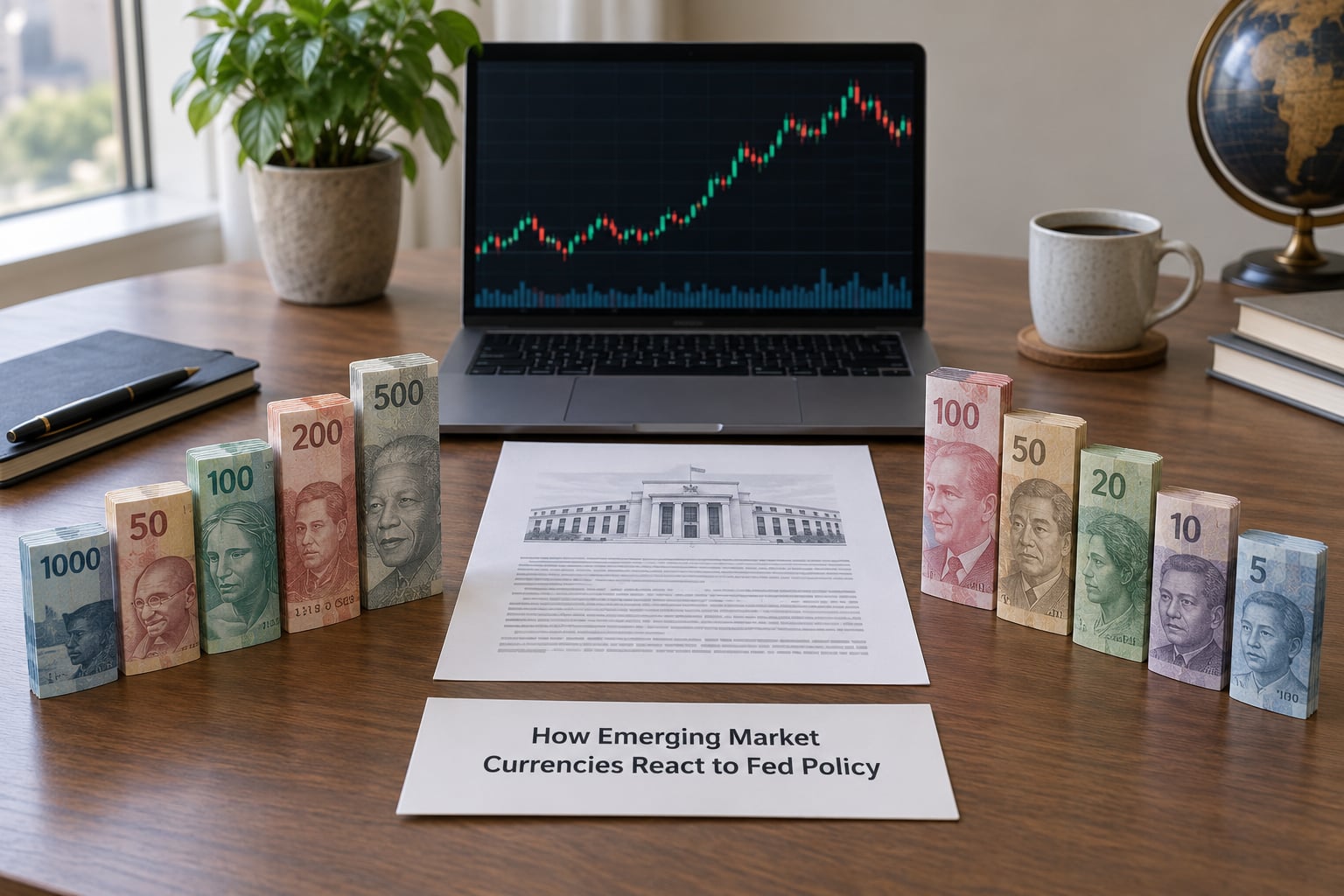
A Fed hike is a headwind for emerging-market currencies mainly through the interest rate differential: US assets pay more, money flows home, and the dollar firms. A Fed cut usually helps, unless markets read the cut as a warning that the US economy is weakening.
| Fed move | What markets read from it | Typical EM currency reaction | Most exposed economies |
|---|---|---|---|
| Hike | US yields rise, demand for dollar assets increases | Broadly weaker, sometimes sharply | Large dollar debts, thin reserves, current account deficits |
| Prolonged hold at a high level | The yield gap keeps paying for holding dollars | Weak to sideways; high-carry currencies can hold up | High inflation, weak policy credibility |
| Cut with a benign signal | US yields fall, the dollar softens, risk appetite improves | Firm to stronger, especially commodity exporters | Floating regimes with credible inflation targeting |
| Cut driven by a growth scare | Yields collapse, investors buy dollar safety | Often weaker in the first move | Import-dependent economies carrying dollar debt |
That last row is the one most commentary misses. The first move after a cut is frequently a dollar rally, because a global slowdown scares investors more than it reassures them.
What starts the currency reaction?
Understanding how emerging market currencies react to Fed policy starts at the announcement, but the useful part happens in the hours and days after it. Markets trade the expected path of policy, not the decision itself.
- The decision and the statement. The target range moves, and the language around future meetings shifts.
- Expectations reset. Traders reprice the number and timing of future moves, not just today’s.
- Treasury yields move. US short rates and the real yield on inflation-protected debt react first.
- The dollar responds. Rate differentials pull currency demand around the globe.
- Capital flows follow. Bond funds, equity funds, banks and hedge funds adjust positions.
- Emerging-market central banks respond. Through rate decisions, currency intervention or capital measures.
Step two is why a hawkish statement with no rate change can move currencies more than a hike nobody expected. If markets already priced a 25bp move, delivering it is a non-event. The surprise sits in the gap between what was expected and what happened.
The European Central Bank’s research on EM exchange rate swings puts it plainly: four drivers matter, US spillovers, global risk appetite, interest rate effects and domestic shocks, and the first two usually explain more than the interest rate differential on its own. Interest rate parity is a useful first approximation of where a currency should sit, not a description of where it will go.
Why a Fed rate hike can weaken an emerging-market currency
Take a hypothetical economy. It runs a current account deficit, borrows in dollars, and offers an 11% policy rate. Investors earn the gap between that rate and a US Treasury yield by funding in dollars and buying local assets. That trade is the carry trade, and a Fed hike narrows the gap the trade depends on.
Step by step, the tightening does four things. Dollar deposits and Treasuries pay more, so portfolio money slows its return to the local market. That capital outflow pressures the local currency. A weaker currency then raises the local cost of dollar debt, which tightens domestic financial conditions without the local central bank doing anything. And higher local funding costs eventually force that central bank to hike too.
Previous cycles show the pattern clearly. In 2013, when the Fed signalled reduced bond purchases, currencies across Asia and Latin America fell hard in a few months, a period markets still call the taper tantrum. Thailand and India entered that period with roughly 9 and 10 months of import cover respectively, buffers that helped their central banks hold policy steadier than many peers. In 2018, as US rates rose again, the Turkish lira and the Argentine peso depreciated sharply against the dollar, though both had domestic problems that would have caused damage regardless of Washington.
The mechanical part is the yield gap. The rest is confidence. The Federal Reserve’s own research on EM monetary policy found that emerging-market economies generally had to tighten policy to defend their currencies, contain capital flight and protect the credibility of their inflation frameworks. Rates were a defence, not a victory.
The opposite also happens. A hike delivered alongside explicitly dovish guidance can send an EM currency higher, because traders believe the tightening cycle has ended. The declaration, not the decision, was the signal. Global equities broadly rose on the day of the first hike in three years, including across Asia, which broke the naive expectation that a hike must mean an emerging-market sell-off.
How rate-cut expectations can support emerging-market currencies
The easing pathway runs in reverse but with the same four steps in the other order. Lower expected US yields reduce the appeal of dollar assets. The dollar usually softens, local currencies firm, and risk appetite improves across markets that had been priced for permanent tightening. If some of that country’s debt rolls at lower coupons, the refinancing relief is immediate.
What happens when the Fed cuts because of a soft landing
This is the good version. Inflation is coming down, growth holds up, and rates fall toward neutral. That combination tends to lift both bonds and equities, and local-currency EM bonds historically have had a strong stretch in these windows. The dollar softens, the carry trade stays open, and countries with credible inflation targeting get the room to cut at home too. Commodity exporters benefit twice, from a softer dollar and from steadier world demand.
What happens when the Fed cuts because of recession
This is the version that catches people. A growth scare triggers haven buying, and the dollar rises even as yields fall. Emerging-market currencies that fund themselves with foreign capital often weaken alongside equities and industrial commodities. Then comes the awkward part for local central banks. They cannot follow a cut if their own inflation is still sticky, so the rate gap stays wide and the currency keeps doing the work.
The visible outcome in 2026 has been a mixed record. Equities and bonds sometimes rallied in the same weeks, which is why a single headline about the Fed rarely tells you enough about an emerging-market portfolio.
How the dollar’s move changes the pressure
The dollar’s move matters separately from the rate move, and this is where the arithmetic becomes concrete. Take a currency quoted at 10.00 units per dollar, then assume the dollar appreciates by 5% against it.
| Bill | Cost at 10.00 | Cost at 10.50 | Change |
|---|---|---|---|
| Imported oil priced at 70 dollars per barrel (1000 barrels) | 70,000 in local currency | 73,500 in local currency | Up 3,500, or 5% |
| Server hardware priced at 800,000 dollars | 8,000,000 in local currency | 8,400,000 in local currency | Up 400,000, or 5% |
| Annual service on 1,000,000 dollars of debt at 6% | 60,000 a year on a principal of 10,000,000 | 63,000 a year on a principal of 10,500,000 | Up about 5,250 combined |
Nothing changed in dollar terms. Oil still costs 70 dollars a barrel. The local bill rose purely because the exchange rate moved, which is the definition of imported inflation. This is the “dollar factor” that the ECB isolates in its EM currency work, the common component that pushes many currencies in the same direction on the same day regardless of what their own central banks are doing.
The same arithmetic cuts the other way. A weaker dollar reduces the local cost of imported fuel, imported components and dollar debt service, which is one reason EM exporters and borrowers can outperform during dollar downswings. The direction is clear. The size is not, because it depends on how much of a country’s import bill is dollar-linked and how quickly local prices and wages adjust.
Why commodity exporters can react differently
Commodity exporters sit on both sides of the same shock. Most commodity prices are set in dollars, so a stronger dollar usually depresses the dollar price of oil, copper and iron ore, and with it the revenue an exporter receives. Brazil, Chile and South Africa are the standard illustrations of economies whose export receipts and government budgets move with the dollar price of a handful of commodities.
Importers get the mirror image. When the dollar strengthens and dollar commodity prices fall, the local cost of those imports can fall too, which is disinflationary rather than inflationary for countries like India, Indonesia or Turkey that buy most of their energy in dollars. That is why some dollar rallies help import-heavy economies while hurting exporters, and why a single “EM currency” index hides most of the useful information.
There is a second-order effect for exporters that runs the other way. When their currency falls, their non-commodity exports become cheaper for foreigners, which supports manufacturing and tourism revenue in local terms. Economies with a commodity export market that is a share of the whole generally absorb a dollar rally better than economies where one commodity dominates the export bill.
Which domestic factors can override the Fed effect
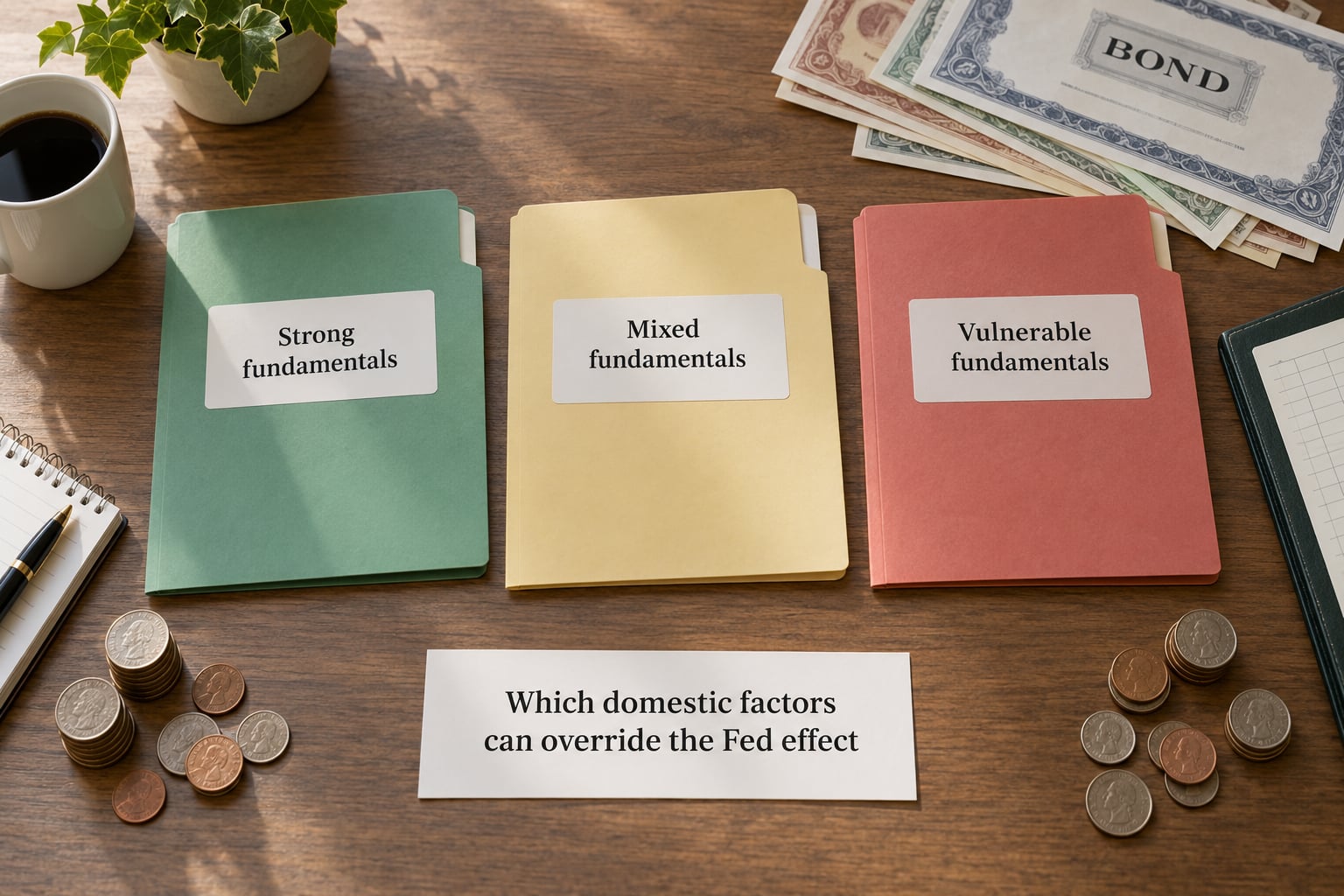
Ranked roughly by how much they can change the answer, the local variables are: inflation and the credibility of the inflation target, external debt denominated in dollars, foreign exchange reserves measured in months of imports, the current account balance, fiscal strength, political risk, the exchange rate regime, and how dependent the economy is on a few commodities.
The exchange rate regime deserves its own line. A freely floating currency can absorb shocks through price, since the rate does the adjusting. A pegged currency has no room, so the central bank spends reserves or raises rates instead, and the adjustment shows up as depleted reserves, domestic recession or, in the hardest cases, capital controls. China, where the yuan is managed against a basket with heavy intervention, sits at one extreme of this spectrum, and emerging-market currencies and Fed policy barely touch it directly.
| Profile | Typical features | Reaction to Fed tightening |
|---|---|---|
| Stronger fundamentals | Credible inflation target, reserves well above 12 months of imports, current account near balance, mostly local currency debt | Orderly or even absent. Policy rates can follow the Fed upward without a currency crisis. |
| Mixed fundamentals | Adequate reserves, persistent moderate inflation, some dollar debt, managed flexibility | Depreciation that is visible but survivable. Reserve sales smooth the path rather than reverse it. |
| Vulnerable fundamentals | Low reserve cover, large dollar-denominated obligations, political uncertainty, wide current account deficit | Sudden stops. Capital leaves fast, the currency gaps lower, and local rates jump hard to defend it. |
A sudden stop, meaning foreign capital inflows that halt almost overnight, is the failure mode worth watching for. Reserve adequacy is the buffer that decides whether a Fed surprise becomes a currency adjustment or a currency crisis, which is why months of import cover is the metric analysts reach for first.
What time horizons should investors watch?
The same Fed decision often produces opposite signals at different horizons, which is where most retail mistakes come from. On the day, currencies respond to the surprise and to positioning. Someone who read “hike equals emerging-market sell-off” and sold on the announcement missed the sessions when equities rose anyway.
Over one to three months, the driver is the expected path rather than the decision. Currency moves follow the gap between US and local policy expectations, and that gap can narrow or widen for months with no new Fed meetings in between.
Over six to twelve months, domestic outcomes dominate. Whether a currency holds its gains depends on inflation falling, reserves staying adequate and policy staying credible, none of which the Fed controls. This is the horizon at which the country, not the committee, decides the result.
That translation gap causes a lot of confusion too. A local-currency EM gain can disappear by the time you convert back to dollars, euros or pounds. Holding a broad emerging-market index inside a US retirement plan is the classic case, where the return you actually receive differs from the headline index return. That gap is the exchange rate talking.
How to read the reaction without chasing the first move
Watch a set of signals together rather than reacting to one price print. Changes in US real yields on inflation-protected debt tell you whether the move is a genuine tightening of financial conditions. The DXY dollar index shows whether this is a broad dollar story or an EM-specific one. Portfolio flow data in local currency bonds and equities shows whether the move has money behind it. Local central bank guidance shows whether policymakers are leaning against the currency. Inflation expectations and wage growth show whether that defence is sustainable. Reserve adequacy in months of imports shows how much buffer is left. Commodity prices show whether exporters are getting help or harm. Political risk events show whether the local story is deteriorating on its own terms.
Confirmation across several of those signals is what separates a rate-driven move from a country-specific problem, and it is the reason the same currency can shrug off a hike one quarter and collapse in the next.
Whether emerging markets are attractive at a given moment depends on how much of the Fed’s path is already priced in. Some of that judgment comes down to two choices: whether to hold the currency unhedged or hedge it back to your own, and whether to express a view through local currency or hard currency debt. Local currency bonds gain from a dovish Fed but can take real losses when the currency falls, while hard currency debt holds most of that currency risk but sits on the other side of the trade. Currency-hedged share classes solve the translation problem for equity positions and cost a spread. None of this is individual investment advice, and rules, rates and conditions differ by country and change over time, so treat it as general educational analysis.
Frequently Asked Questions
Why does a stronger US dollar usually hurt emerging-market currencies?
Most emerging-market currencies are priced against the dollar, so dollar strength mechanically lowers their value. Underneath that, a firm dollar raises the local cost of imported oil, imported components and dollar-denominated debt, and it signals that US assets pay more than local ones. Capital drifts toward dollar assets, the local currency weakens, and imported inflation follows.
Do all emerging-market currencies react the same way to the Fed?
No, and treating them as one bloc hides most of the useful information. How emerging market currencies react to Fed policy depends on reserve cover, the share of external debt in dollars, the current account, political risk and the exchange rate regime. The same morning can leave a well-managed Asian currency barely moved while a commodity importer with thin reserves falls several percent.
Can Fed policy cuts make an emerging-market currency fall?
Yes, when the cut signals trouble rather than relief. In a growth scare, investors buy dollars and US Treasuries for safety, and the dollar rises even as yields fall. That first move hurts currencies that depend on foreign funding. The same cut in a soft-landing context usually does the opposite, which is why the reason behind a cut matters more than the cut itself.
How does dollar-denominated debt affect emerging-market currencies?
It converts a Fed decision straight into a domestic problem. If a country’s currency falls 10% against the dollar, the local value of its dollar debts rises about 10% with it, on top of any rise in interest rates. That squeezes bank balance sheets, raises the sovereign’s own funding costs and can force emergency tightening or reserves sales, deepening the depreciation.
What should investors watch after an unexpected Fed decision?
Check the gap between what markets expected and what happened, then confirm with several signals rather than one. Watch US real yields, the DXY dollar index, portfolio flows into local bonds and equities, and local central bank guidance. For individual currencies, compare reserve adequacy in months of imports and the share of external debt denominated in dollars before drawing any conclusion.
Conclusion
Before drawing any conclusion from a Fed move, put three things side by side: the surprise in the decision itself, the direction of the dollar and US real yields that followed, and the domestic position of the country whose currency you care about. That three-way comparison is the whole method. A rate move that looks bearish on a headline can be neutral in a country with deep reserves and local currency debt, and it can be the trigger for something much worse in a country carrying dollar obligations it cannot refinance.
Stay current on the specifics of US policy before you draw conclusions, since the federal funds range and the guidance around it change the starting conditions for everything described here.