
What is the swiss franc safe haven status? It is the market’s long-standing belief that CHF holds its value and often appreciates when global risk spikes, drawn from permanent Swiss political neutrality, very low public debt, stable inflation, a strong external balance sheet and an independent Swiss National Bank. In practice the franc is a strong crisis hedge, not a guaranteed one.
That last distinction matters more than most write-ups admit. The franc has jumped on every major shock since 2011, and it has also sat still for long stretches while holders paid to keep it. Below is what the label actually covers, the evidence behind it, and the specific conditions under which it breaks down.
Key takeaways
- Safe-haven status means the franc absorbs flows during stress, not that it rises every time.
- Five structural pillars carry the reputation: neutrality, low sovereign risk, price stability, external strength and institutional credibility.
- The Swiss National Bank both defends the currency and caps it, so policy reaction is part of the price.
- Holding CHF costs money in carry terms, and that is the price of the insurance.
Table of Contents
- Swiss Franc Safe Haven Status at a Glance
- What Does Safe Haven Status Mean for a Currency?
- Crisis demand, flow and preference are not the same thing
- Why Investors Regard the Swiss Franc as a Safe Haven
- Political neutrality that predates modern finance
- Very low public debt and steady fiscal policy
- Low and unusually stable inflation
- A strong external balance sheet
- Institutional credibility and central bank independence
- What Is the Swiss Franc Safe Haven Status in Practice?
- Does the Swiss Franc Always Strengthen in a Crisis?
- A crisis that starts in Europe
- Interest rate expectations moving against it
- Crowded positioning
- Concerns about the Swiss economy itself
- What Limits the Franc’s Safe Haven Demand?
- The carry is thin and sometimes negative
- An export-dependent economy
- Deflationary pressure at home
- Intervention and policy surprise
- The banking and tax reputation is thinner than it was
- Some shocks favour other havens
- How Does CHF Compare With the Dollar, Euro, Yen, and Gold?
- What Factors Can Make the Swiss Franc Stronger or Weaker?
- How Investors Can Track the Franc’s Safe Haven Role
- Frequently Asked Questions
- Is the Swiss franc still considered a safe-haven currency?
- Why does the Swiss franc strengthen when global risk rises?
- Can the Swiss franc fall during a financial crisis?
- Is CHF a better safe haven than the US dollar or gold?
- How can investors tell whether safe-haven demand is increasing?
- Conclusion
Swiss Franc Safe Haven Status at a Glance
| Feature | Where the franc stands |
|---|---|
| Current classification | Established safe-haven currency with a contested edge in some shock types |
| Strongest traits | Political neutrality, low government debt, low inflation, current account surplus, independent central bank |
| Main drivers of demand | Flight to quality during risk-off moves, expectations of SNB intervention, corporate and central bank hedging |
| Key limitations | Negative carry, export-heavy economy exposed to a strong franc, deflationary pressure, intervention risk, crowded positioning |
| Versus other havens | More reliable than the yen in most stress episodes, thinner liquidity and lower yield than the dollar, weaker in inflation shocks than gold |
| Common pairs watched | EUR/CHF, USD/CHF, CHF/JPY |
The short version: the franc still carries the label, and for good structural reasons. The label has also weakened in specific circumstances, mostly because of what it costs to hold and how aggressively the central bank manages it.
What Does Safe Haven Status Mean for a Currency?
Safe-haven status is shorthand for a currency that attracts capital during stress rather than during calm. In practice three different things get called flight to quality, and they behave very differently.
Crisis demand, flow and preference are not the same thing
Crisis demand is the fast money: leveraged positions unwinding, margin calls forcing sales of whatever is liquid, and algorithms cutting exposure to risk in minutes. It produces a sharp, often short move, and it reverses as soon as volatility settles.
Short-term flow includes speculators and carry traders positioning for a repeat. This is the part that shows up in futures data and tends to amplify the first move rather than cause it.
Sustained preference is the slow part: a central bank, pension fund or corporate treasury that decides to keep part of its reserves or liabilities in CHF permanently. This is the only version that genuinely changes the currency’s structural value, and it is much harder to measure.
Academics usually test which of the three is at work by looking at how tightly a currency moves against equity markets and credit spreads in a given week. A high negative correlation with equities in a stressed month is evidence of crisis demand. A currency that only rallies for two days is telling you about flows, not about a lasting shift in where money lives.
Why Investors Regard the Swiss Franc as a Safe Haven
Five things do most of the work, and they compound each other. Take any one away and the franc still does fine; take three away and the reputation becomes hard to defend.
Political neutrality that predates modern finance
Switzerland has stayed formally neutral since 1815 and has not fought a war since the Sonderbund conflict in the 1840s. That record matters in a market where a single headline about troop movements or sanctions can reprice a currency overnight. Neighbouring risk is close by, but the shock stays outside Swiss borders.
Very low public debt and steady fiscal policy
Swiss federal debt sits near a quarter of gross domestic product, among the lowest ratios in Europe, and the country is bound by a debt brake that caps federal spending growth. Sovereign credit is not a live question, so CHF assets are not being repriced for default or downgrade risk the way debt-laden currencies are.
Low and unusually stable inflation
Swiss inflation has spent decades near or below the price stability objective, helped historically by a strong currency that imports disinflation. Buyers of CHF are paying for a currency that has rarely been a source of purchasing-power loss, which matters more than the absolute level of yields.
A strong external balance sheet
Switzerland runs persistent current account surpluses, supported by high-value exports in pharmaceuticals, machinery, watches and food. The country also takes in substantial foreign capital and has historically attracted more inward investment than it sends abroad, so the balance of payments provides a floor under the currency.
Institutional credibility and central bank independence
The Swiss National Bank is insulated from fiscal policy by design, which is unusual in Europe. It also holds one of the largest gold reserves in the world, a fact that does nothing for the exchange rate directly but reinforces the perception of an institution that can act under stress. Add a long record of publishing clear monetary assessments and you get the reputation investors actually price.
There is also an institutional memory at work. Foreigners who parked money in Switzerland through past crises recall that it worked, and behaviour shaped by one crisis tends to repeat in the next.
What Is the Swiss Franc Safe Haven Status in Practice?
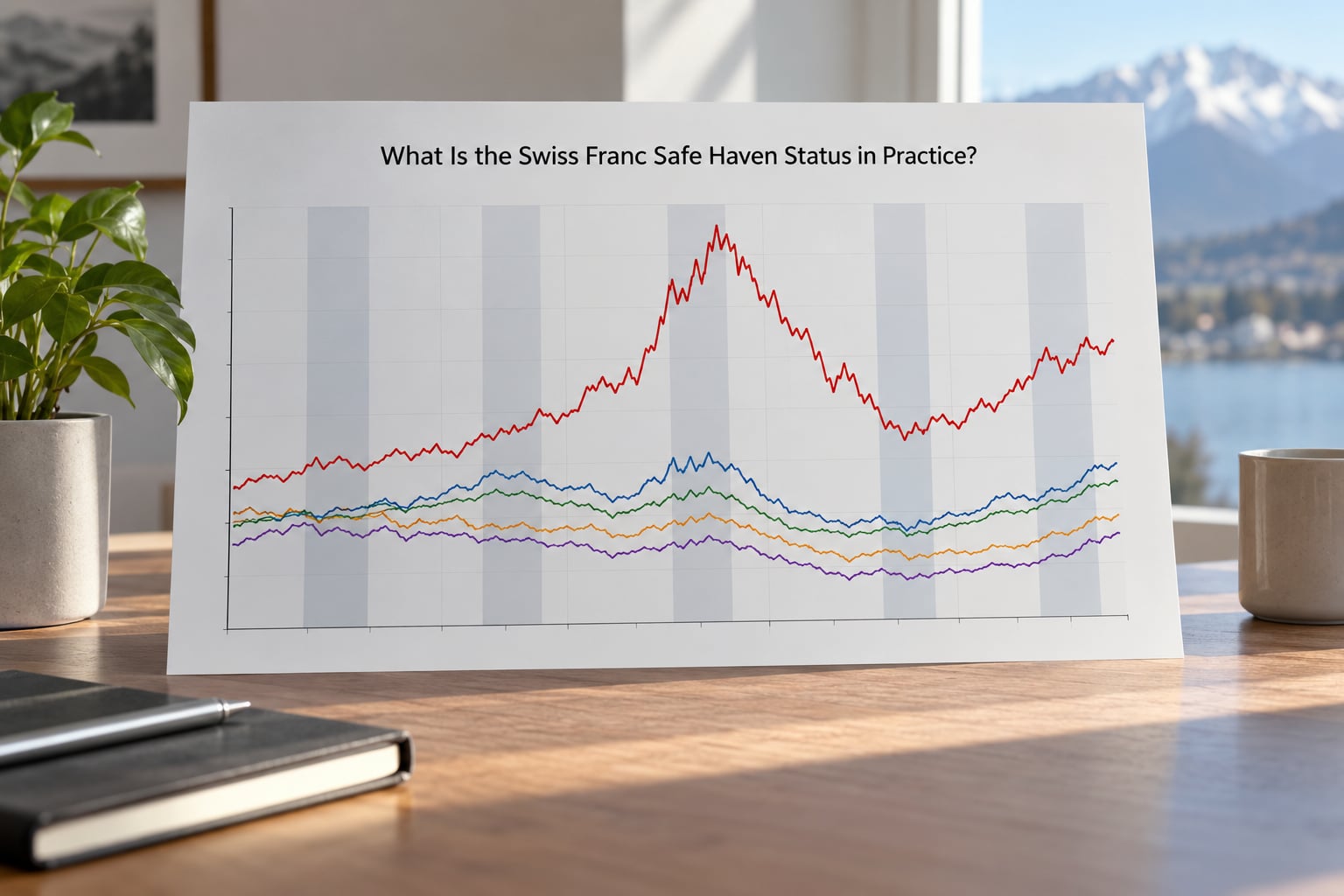
The reputation looks strongest in the table below. Read the last column as carefully as the first, because the exceptions are what separate a hedge from a myth.
| Episode | Initial reaction | What limits the move |
|---|---|---|
| Euro-area sovereign stress, 2011 to 2012 | Sharp CHF appreciation against the euro as investors left peripheral debt | The SNB introduced a minimum exchange rate of 1.2000 in 2011, capping the rise and capping the pain for exporters |
| Removal of the exchange rate floor, January 2015 | Violent, near-vertical appreciation and a market-wide scramble after the floor was abandoned overnight | The move was the central bank’s doing, not a vote of confidence in the currency; leverage was destroyed on the way |
| Global risk-off, 2020 | CHF gained sharply against the euro and many emerging-market currencies in the early pandemic selloff | Later in the year the SNB eased aggressively, capping appreciation and eventually pushing the franc lower |
| Inflation shock, 2022 onward | CHF was a laggard; the dollar and gold outperformed for much of the tightening cycle | A low-yield currency with a deflationary bias struggles when the shock is about inflation rather than growth |
| Middle East escalation, 2025 | The franc hit record strength against the dollar on a sharp risk move, briefly | Single-day moves on geopolitics fade quickly and say little about sustained reallocation |
Over multi-year horizons the pattern is steadier. The franc has generally appreciated against the dollar and the euro over the past two decades, and Switzerland has devalued the currency only once in modern history, in 1936. That record is the reason a lot of capital is still parked there.
It is worth remembering what the SNB has been doing underneath these moves. Negative interest rates, balance sheet expansion, and outright FX intervention have all been used at various points to hold the franc down when it got too strong for the domestic economy. Investors are not hedging against an unmanaged currency; they are hedging against a managed one, and the manager is an active participant.
Does the Swiss Franc Always Strengthen in a Crisis?
No, and the exceptions are more common than the marketing suggests. Four things can stop the franc from behaving like a haven.
A crisis that starts in Europe
When the shock originates in the euro area, the franc is often the escape route and sometimes the source. Investors unwinding euro exposure sometimes repatriate funds home, which is CHF demand. But euro-area political stress that pushes European savers into their own currency has produced episodes where the franc lagged, because the shock was read as a reason to hold euro assets rather than to flee them.
Interest rate expectations moving against it
CHF carry is thin or negative when Swiss policy rates are low, so a repricing of the SNB path can outweigh safe-haven flows. A hawkish shift in US or euro-area policy expectations tends to pull money toward higher-yielding currencies, and the franc follows if the rate gap widens enough.
Crowded positioning
Safe-haven positioning is popular precisely because it works most of the time, which makes it crowded. When everyone is long the franc, a shock that does not materialise, or a change in volatility regimes, unwinds that positioning quickly. The same liquidity that makes CHF attractive on the way in works against you on the way out.
Concerns about the Swiss economy itself
A large share of Swiss export revenue is priced in euros and US dollars, so a very strong franc squeezes margins at home. When that gets extreme, the political reaction pushes the SNB toward easing and currency intervention, and the franc’s appreciation gets capped by design.
Over the long run, most assessments treat the franc as having a mild negative or near-zero relationship with global equity returns, which is the textbook signature of a haven. Month by month, though, correlation is unstable and sometimes positive.
What Limits the Franc’s Safe Haven Demand?
Every structural strength comes with a cost, and the franc’s are real enough to matter for anyone actually holding it.
The carry is thin and sometimes negative
Swiss policy rates have spent long stretches at or below zero, and even at positive rates the yield on CHF is low compared with the dollar or euro. Holding the currency as insurance means paying up in yield terms in calm markets, when safe-haven demand is absent. This is the single biggest reason retail holders of CHF exposure complain about the result even when the thesis was right.
An export-dependent economy
Pharmaceuticals, machinery, precision engineering and food exporters earn in foreign currency and cost in francs. Persistent CHF strength is a drag on those margins, which is a direct reason the SNB has spent decades leaning against an appreciating franc.
Deflationary pressure at home
Low domestic inflation is part of the appeal to outsiders, but the same strength has contributed to very low or negative price growth in Switzerland, squeezing wages and domestic margins. Strong money and strong economy are not always partners.
Intervention and policy surprise
The January 2015 abandonment of the exchange rate floor remains the cautionary case everyone remembers. Leveraged positions were wiped out in hours, and Eastern European borrowers with franc-denominated mortgages saw monthly payments jump. The franc can move far faster than a hedge is designed to tolerate.
The banking and tax reputation is thinner than it was
Switzerland’s image as a discreet place for capital came largely from banking secrecy. FATCA, the OECD common reporting standard and the global minimum tax have removed much of that advantage, and foreign holders of Swiss accounts have faced new reporting and tax questions. Some of the capital that once stayed in CHF for tax reasons now has a weaker reason to stay at all.
Some shocks favour other havens
When the problem is inflation rather than deflation, gold has usually done the job. When the problem is a liquidity squeeze, the dollar’s depth and the yen as a funding currency behave differently. The franc’s best record is in growth and credit shocks, and it is weakest in inflation shocks.
How Does CHF Compare With the Dollar, Euro, Yen, and Gold?
No haven wins every episode. The table below is the version I would want before deciding where to put crisis protection, with the caveat that past behaviour is a guide rather than a promise.
| Haven | What drives demand | Main weakness | Best-case crisis scenario |
|---|---|---|---|
| Swiss franc | Political neutrality, low debt, stable inflation, independent central bank, strong external accounts | Low or negative carry, export drag, intervention risk, modest liquidity depth | European credit event or growth shock that pushes investors out of riskier currencies |
| US dollar | Depth of markets, global reserve demand, dollar funding needs, safe-asset Treasuries | Policy and fiscal uncertainty at home, and a rate that can be a headwind for holders | Global liquidity squeeze where cash and Treasuries are the only thing that clears |
| Euro | Size of the bloc, deep capital markets, improving or worsening political integration | Fragmented politics, sovereign debt dispersion, no single lender of last resort | Orderly euro-area recovery that pulls capital back into the currency |
| Japanese yen | Low yields, carry-trade funding role, repatriation after a period abroad | Very low yields and decades of lost purchasing power, plus monetary policy drift | Sharp carry-trade unwind, where the yen rallies hard and fast |
| Gold | No counterparty, inflation hedge, central bank buying, crisis tail-risk cover | No yield, wider spreads and more volatile short-term swings than FX | Inflation shock, currency debasement or banking stress at the sovereign level |
The practical reading: the franc is a strong complement to the dollar rather than a replacement for it, and gold covers the inflation case the franc handles worst. Investors who want one instrument to do both jobs tend to find the compromise disappointing, which is why allocation across two or three is more common.
That comparison is also where the honest answer to what is the swiss franc safe haven status comes from. The label is not a ranking, and it does not describe one asset. It describes a conditional behaviour: the franc absorbs growth and credit shocks well, handles inflation shocks poorly, and gets a vote on the final direction from Swiss policy.
What Factors Can Make the Swiss Franc Stronger or Weaker?
Here is the driver list I keep on a watchlist, in roughly the order it moves the exchange rate.
| Factor | Pushes CHF stronger | Pushes CHF weaker |
|---|---|---|
| Global risk sentiment | Equity selloff, widening credit spreads, volatility spikes, funding stress | Calm markets, recovering risk appetite, low volatility |
| Swiss policy rate expectations | Hawkish SNB repricing or inflation undershooting | Easing expectations, negative rate speculation, deflationary data |
| Balance of payments | Current account surplus widening, strong services and trade receipts | Export slowdown in Europe or North America, profit repatriation abroad |
| Capital flows | Foreign inflows into Swiss assets, corporate hedging demand, reserve diversification | Outflows as the tax and domicile advantages erode |
| Intervention signals | Warnings or heavy purchases defending the franc’s downside | Explicit willingness to cap appreciation, which caps the upside too |
| Euro-area conditions | Euro stress, weak euro-area growth, sharper ECB easing | Euro-area recovery, higher euro yields narrowing the rate gap |
| Dollar and real yields | Falling US real yields, dollar weakness from a US policy shock | Rising US real yields and a stronger global dollar |
| Positioning | New money entering as a defensive allocation | Crowded longs unwinding once volatility falls |
Note the last two rows. Dollar strength and franc positioning regularly override the risk signal, which is why CHF has rallied in a risk-off month before and after the biggest shocks of the past decade.
How Investors Can Track the Franc’s Safe Haven Role
You do not need to trade the franc to monitor whether the safe-haven bid is real. These six indicators tell you what the market is doing, and they update continuously.
- CHF exchange rates, especially EUR/CHF and USD/CHF. A move that happens alongside a fall in equities and a widening of credit spreads is a haven reaction. A move that happens in calm markets is more likely a rate or positioning story.
- Implied volatility on the franc. Safe-haven demand shows up as a jump in EUR/CHF and USD/CHF implied volatility together with a directional move. Rising volatility without direction usually means hedging, not conviction.
- Swiss sovereign yields. A haven bid pulls investors into Swiss government bonds. If yields fall while the franc rises, the two are working together. If yields rise with the franc, the move is probably interest-rate driven.
- Intervention and reserve signals. The SNB publishes monthly data on foreign currency purchases, and its monetary policy assessments warn when the exchange rate is judged to be moving too fast. A published warning has historically preceded capped moves.
- Cross-currency basis. The basis in currency swaps reflects how much extra investors pay to borrow CHF. A steepening basis is consistent with heavy demand for CHF cash, often from corporate hedging.
- Fund and account flows. Currency-hedging programmes by European and Japanese corporates and pensions move large sums for structural reasons, independent of short-term stress. Changes there tell you about sustained preference rather than crisis flows.
One more thing worth watching is the franc’s correlation with equities, updated monthly. A haven should show a negative relationship in stressed periods. When the relationship breaks down for several months, either the regime has changed or the position is too crowded to be useful.
This is general market information rather than investment advice. Rates, policy expectations and rules change over time, and any decision about currency exposure should reflect your own time horizon, liabilities and tax position.
Frequently Asked Questions
Is the Swiss franc still considered a safe-haven currency?
Yes, in the broad sense. Markets still treat CHF as a destination during global stress because Switzerland combines permanent political neutrality, very low public debt, low inflation and an independent central bank. The caveat is that the status now comes with costs: low or negative carry, an export-dependent economy that resists a too-strong currency, and a central bank willing to intervene in both directions. It is a dependable haven, not a risk-free one.
Why does the Swiss franc strengthen when global risk rises?
Investors sell assets they consider risky and buy what they consider stable, a flight to quality. CHF qualifies because Swiss sovereign credit is close to unquestioned, inflation has been mild, and the country has avoided war and political disruption for two centuries. The Swiss National Bank usually steps in during episodes, either with intervention or with policy signals, which changes how far the move goes but rarely the direction.
Can the Swiss franc fall during a financial crisis?
It can, and it has. When the shock is about inflation rather than deflation, the franc tends to lag gold and the dollar. It can also fall when global real yields rise, when euro-area conditions improve, or when crowded positioning unwinds after volatility drops. The January 2015 removal of the exchange rate floor showed how violently the currency can jump in the other direction, which is a risk in itself for anyone holding leveraged exposure.
Is CHF a better safe haven than the US dollar or gold?
It depends on the shock. The franc has a better record than the yen in most growth and credit scares, and a cleaner policy framework than the euro. The dollar has deeper liquidity and matches funding stress better. Gold wins when the problem is inflation or debasement, because a currency with zero yield is a poor hedge for rising prices. Most defensive allocations use two or three rather than picking one.
How can investors tell whether safe-haven demand is increasing?
Judging what is the swiss franc safe haven status comes down to watching the franc next to its neighbours. A haven bid shows up as CHF appreciation against EUR and USD while equities fall, credit spreads widen and implied volatility on CHF pairs jumps. Confirm it with Swiss sovereign yields falling and a steepening cross-currency basis. If the franc rises while risk assets rally, the driver is probably interest rates rather than safety.
Conclusion
So what is the swiss franc safe haven status? The honest verdict is that it remains real, structurally supported and one of the most consistent crisis performers among major currencies. What it is not is automatic, free or complete.
Start by identifying what kind of shock you are worried about, because growth scares, inflation shocks and liquidity squeezes produce different winners. Then watch Swiss policy expectations and the euro-dollar rate gap, since those two frequently override the safe-haven signal. Finally, judge the franc’s relative performance against the dollar and gold rather than against its own history, which is where the label either holds up or quietly does not.